
Manual HR vs HR Software: 15 Powerful Reasons HR Software Is Transforming Modern Businesses
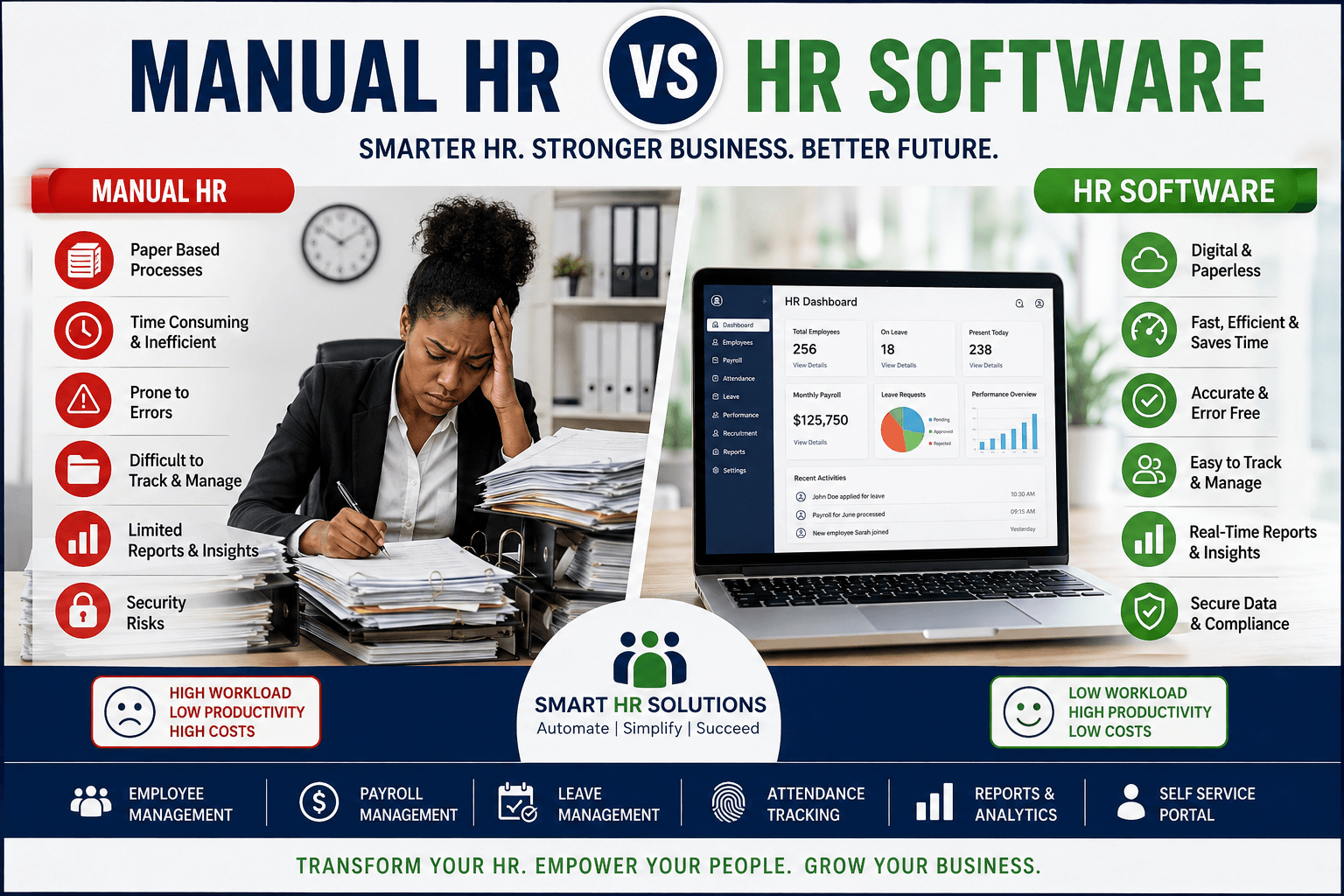
Human Resource management has evolved significantly over the last decade. Organizations of every size are moving away from paperwork, spreadsheets, and manual record-keeping toward digital solutions that automate HR processes. The debate around Manual HR vs HR Software has become more relevant than ever as businesses strive to improve efficiency, reduce operational costs, and deliver better employee experiences.
Whether you manage a small startup, a growing SME, or a large enterprise, your HR department plays a critical role in employee recruitment, payroll, attendance tracking, leave management, performance evaluation, and compliance. Managing these responsibilities manually may have worked in the past, but today’s business environment demands speed, accuracy, and real-time information.
This comprehensive guide explores Manual HR vs HR Software, highlighting their differences, advantages, disadvantages, and why more companies are embracing digital HR management systems.
What is Manual HR?
Manual HR refers to managing human resource functions using traditional methods such as:
- Paper employee files
- Excel spreadsheets
- Physical leave forms
- Printed payroll records
- Manual attendance registers
- Email approvals
- Filing cabinets
In a manual HR environment, nearly every process depends on human effort.
Examples include:
- Writing employee records by hand
- Calculating salaries manually
- Filing recruitment documents physically
- Recording attendance using paper registers
- Managing employee evaluations on printed forms
Although manual systems have served businesses for decades, they become increasingly difficult to manage as organizations grow.
What is HR Software?
HR Software is a digital platform that automates and centralizes HR operations.
Instead of relying on paperwork, HR professionals manage employee information through a secure online system.
Modern HR software typically includes:
- Employee database
- Payroll management
- Leave management
- Attendance tracking
- Recruitment management
- Performance management
- Employee self-service portal
- Document management
- Reporting dashboards
- Compliance management
When comparing Manual HR vs HR Software, automation is the defining difference.
Why Businesses Are Comparing Manual HR vs HR Software
Organizations are under pressure to:
- Reduce administrative work
- Improve employee satisfaction
- Save operational costs
- Eliminate errors
- Improve compliance
- Increase productivity
These challenges have made Manual HR vs HR Software one of the most important decisions for business leaders.
Manual HR vs HR Software: Complete Comparison
| Feature | Manual HR | HR Software |
|---|---|---|
| Employee Records | Paper Files | Digital Database |
| Leave Management | Manual Forms | Automated Workflow |
| Payroll | Spreadsheet Calculations | Automated Payroll |
| Recruitment | Physical Documents | Online Tracking |
| Attendance | Registers | Biometric & Digital |
| Reports | Manual Compilation | Instant Reports |
| Security | Physical Storage | Encrypted Cloud Storage |
| Accessibility | Office Only | Anywhere Anytime |
| Scalability | Difficult | Easy |
| Accuracy | Prone to Errors | Highly Accurate |
The comparison clearly demonstrates why businesses are increasingly choosing HR software.
Employee Record Management
One of the biggest differences in Manual HR vs HR Software lies in employee record management.
With Manual HR:
- Documents get misplaced.
- Filing takes time.
- Retrieval is slow.
- Storage space becomes expensive.
HR Software provides:
- Digital employee profiles
- Instant document retrieval
- Secure storage
- Automatic backups
- Easy updates
Instead of searching through filing cabinets, HR managers can locate employee information within seconds.
Recruitment Process
Recruitment is another area where Manual HR vs HR Software shows significant differences.
Manual recruitment often involves:
- Printing CVs
- Physical interviews
- Paper evaluation forms
- Email chains
- Manual scheduling
HR Software simplifies recruitment through:
- Online job postings
- Applicant tracking
- Interview scheduling
- Candidate scoring
- Digital onboarding
Recruiters save countless hours while improving hiring quality.
Payroll Management
Payroll remains one of the most sensitive HR functions.
With Manual HR:
- Salary calculations take hours.
- Human errors are common.
- Tax calculations become complicated.
- Payslip preparation is repetitive.
HR Software automates:
- Salary calculations
- Deductions
- Overtime
- Bonuses
- Taxes
- Payslip generation
This dramatically reduces payroll errors while ensuring employees receive accurate salaries on time.
Leave Management
Managing leave manually becomes increasingly difficult as employee numbers grow.
Manual leave management involves:
- Paper leave forms
- Email approvals
- Manual balance calculations
- Filing leave records
HR Software automates:
- Leave requests
- Approval workflows
- Leave balance calculations
- Notifications
- Leave calendars
Employees can submit leave requests online without visiting the HR office.
Attendance Tracking
Attendance management highlights another major distinction in Manual HR vs HR Software.
Manual attendance systems often include:
- Paper registers
- Excel sheets
- Supervisor signatures
Problems include:
- Buddy punching
- Missing records
- Calculation errors
- Time theft
HR Software integrates with:
- Biometric devices
- Mobile attendance
- GPS attendance
- Facial recognition
- Fingerprint scanners
Attendance reports become available instantly.
Performance Management
Manual HR performance reviews often happen annually.
Challenges include:
- Lost evaluation forms
- Delayed feedback
- Subjective assessments
- Poor record keeping
HR Software enables:
- Continuous performance reviews
- Goal tracking
- KPI monitoring
- Employee feedback
- Automated reminders
Managers make better performance decisions using real-time data.
Compliance Management
Regulatory compliance is essential for every business.
Manual HR compliance involves:
- Tracking regulations manually
- Filing statutory reports
- Managing employee contracts physically
Missing compliance deadlines may lead to:
- Penalties
- Legal disputes
- Financial losses
HR Software automatically tracks:
- Contract expiry
- Employee certifications
- Compliance deadlines
- Required documentation
This significantly reduces legal risks.
Data Security
Businesses store highly confidential employee information.
Manual HR faces risks including:
- Lost files
- Unauthorized access
- Fire damage
- Theft
HR Software protects information using:
- User permissions
- Encryption
- Cloud backups
- Audit trails
- Multi-factor authentication
Sensitive employee information remains secure.
Cost Comparison
Many businesses believe manual systems are cheaper.
However, hidden costs include:
- Paper
- Printing
- Storage
- Filing cabinets
- Lost productivity
- Human errors
- Overtime
- Administrative labor
Although HR software requires an initial investment, it usually reduces long-term operational costs through automation and improved efficiency.
Productivity Improvements
HR professionals spend significant time on repetitive administrative work.
Manual tasks include:
- Filing documents
- Answering leave balance questions
- Calculating payroll
- Preparing reports
- Searching employee files
HR Software automates repetitive work, allowing HR teams to focus on:
- Talent development
- Employee engagement
- Strategic planning
- Organizational culture
- Workforce planning
This shift from administration to strategy is one of the biggest advantages in the Manual HR vs HR Software comparison.
Continue to Part 2 for:
- 15 additional advantages of HR Software
- Common challenges of Manual HR
- Detailed case studies
- Customer testimonials
- HR software service description
- Comprehensive FAQ section
- 600-word conclusion
- Strong call to action
This section naturally incorporates the keyword Manual HR vs HR Software multiple times while maintaining readability and SEO best practices.
Part 2: Benefits, Challenges, Case Studies, Testimonials, Service Description, FAQ, Conclusion & Call to Action
15 Reasons HR Software Outperforms Manual HR
The debate around Manual HR vs HR Software becomes much clearer when businesses evaluate the long-term benefits of automation. Below are fifteen reasons why organizations are replacing manual HR systems with modern HR software.
1. Faster HR Processes
Manual HR requires repetitive paperwork and multiple approvals. HR software automates these workflows, reducing processing time from days to minutes.
For example, a leave request that previously required printed forms and physical signatures can now be approved online in just a few clicks.
2. Improved Accuracy
Manual calculations increase the likelihood of payroll errors, incorrect leave balances, and inaccurate employee records.
HR software automatically performs calculations, ensuring greater consistency and minimizing costly mistakes.
3. Centralized Employee Information
With manual HR, employee information is often stored in multiple folders, spreadsheets, or filing cabinets.
HR software stores all employee records in one centralized database, making it easy to search, update, and manage information.
4. Better Decision Making
HR managers need reliable data to make informed decisions.
HR software provides dashboards and reports that show:
- Staff turnover
- Leave trends
- Recruitment performance
- Attendance patterns
- Payroll summaries
- Employee growth
These insights are difficult to generate using manual systems.
5. Employee Self-Service
Employees no longer need to visit the HR office for every request.
Using HR software, employees can:
- Apply for leave
- Download payslips
- Update personal information
- View attendance
- Access company documents
This improves efficiency while reducing HR workload.
6. Easier Recruitment
Recruitment becomes faster through:
- Online applications
- Candidate tracking
- Automated interview scheduling
- Digital onboarding
Compared to Manual HR vs HR Software, automated recruitment significantly reduces hiring time.
7. Remote Access
Modern workplaces increasingly support hybrid and remote work.
HR software enables HR teams and employees to securely access information from anywhere, while manual HR depends heavily on physical files.
8. Better Compliance
Labour laws and statutory requirements continue to evolve.
HR software helps organizations maintain compliance by tracking important deadlines, contracts, and mandatory employee records.
9. Stronger Security
HR software includes:
- Role-based access
- Password protection
- Audit logs
- Data encryption
- Secure cloud backups
These features provide much stronger protection than physical filing systems.
10. Paperless Operations
Businesses can significantly reduce paper usage by digitizing:
- Employment contracts
- Leave applications
- Performance reviews
- Employee records
- Payroll documents
This lowers costs while supporting environmental sustainability.
11. Increased Employee Satisfaction
Employees appreciate quick responses and transparent HR processes.
HR software enables faster approvals, easier communication, and convenient access to HR services, resulting in a better employee experience.
12. Scalability
Manual systems often struggle as organizations grow.
HR software can easily accommodate hundreds or thousands of employees without requiring additional filing cabinets or extensive paperwork.
13. Time Savings
Administrative tasks that once consumed hours can now be completed in minutes.
Examples include:
- Payroll processing
- Attendance calculations
- Leave approvals
- Report generation
14. Improved Reporting
Generating HR reports manually often requires compiling information from multiple spreadsheets.
HR software can instantly generate reports on:
- Employee headcount
- Payroll costs
- Leave balances
- Attendance
- Recruitment
- Performance metrics
15. Lower Long-Term Costs
While HR software requires implementation and subscription costs, businesses often save money by reducing:
- Administrative labor
- Printing expenses
- Filing costs
- Payroll errors
- Compliance penalties
- Lost productivity
These long-term savings make HR software a worthwhile investment.
Challenges of Manual HR
Understanding the limitations of manual systems further highlights the value of Manual HR vs HR Software.
Common challenges include:
- Time-consuming paperwork
- Duplicate data entry
- Misplaced employee files
- Payroll errors
- Delayed approvals
- Difficult reporting
- Poor document security
- Compliance risks
- Limited scalability
- High administrative costs
As organizations grow, these challenges become increasingly difficult to manage.
Case Study 1: Growing Retail Company
Background
A retail business with 150 employees relied on spreadsheets and paper files for attendance, payroll, and leave management.
Challenges
- Payroll processing took three days each month.
- Leave balances were often inaccurate.
- Employee files were difficult to retrieve.
- HR staff spent excessive time on administrative tasks.
Solution
The company implemented an HR software solution featuring:
- Automated payroll
- Digital employee records
- Online leave management
- Attendance tracking
Results
- Payroll processing time reduced by 80%.
- Leave approvals became significantly faster.
- HR paperwork reduced dramatically.
- Employee satisfaction improved due to faster service.
Case Study 2: Manufacturing Company
Background
A manufacturing firm with over 500 employees managed attendance manually using paper registers.
Challenges
- Frequent attendance discrepancies
- Overtime calculation errors
- Payroll delays
- High administrative workload
Solution
The organization introduced HR software integrated with biometric attendance.
Results
- Attendance accuracy improved substantially.
- Overtime calculations became automated.
- Payroll processing became faster and more reliable.
- HR staff focused more on employee development instead of paperwork.
Customer Testimonials
“Before implementing HR software, payroll processing took nearly an entire week. Today, we complete it within a few hours while maintaining excellent accuracy.”
— Finance Manager, Nairobi
“Employee leave management has become effortless. Staff apply online, managers approve instantly, and HR no longer handles stacks of paperwork.”
— HR Officer, Mombasa
“Switching from manual HR to HR software transformed our operations. Reporting is faster, employee records are organized, and our HR team is far more productive.”
— Operations Director, Kisumu
Our HR Software Services
Our HR software solution is designed to help businesses automate every stage of human resource management.
Employee Management
- Digital employee records
- Employment history
- Document management
- Contract tracking
Payroll Management
- Salary processing
- Tax calculations
- Overtime management
- Payslip generation
Leave Management
- Online leave applications
- Automated approvals
- Leave balance tracking
- Leave reports
Attendance Management
- Biometric integration
- GPS attendance
- Mobile clock-in
- Attendance reports
Recruitment
- Job posting
- Applicant tracking
- Interview scheduling
- Candidate management
Performance Management
- Goal setting
- Performance reviews
- KPI tracking
- Employee appraisals
Employee Self-Service
Employees can:
- View payslips
- Request leave
- Update personal details
- Access HR documents
- Track attendance
Additional Content: Why the Shift from Manual HR vs HR Software Is Accelerating
Across Africa and globally, organizations are embracing digital transformation to improve efficiency and remain competitive. One of the most significant changes has been the move from paper-based HR administration to cloud-based HR management systems. The discussion around Manual HR vs HR Software is no longer simply about technology—it is about improving productivity, employee satisfaction, and long-term business growth.
Companies that continue relying on manual HR processes often find it difficult to keep pace with changing workforce expectations. Employees expect quick access to payslips, instant leave approvals, digital onboarding, and self-service portals. These expectations are difficult to meet using manual systems. This is why the comparison of Manual HR vs HR Software continues to favor automated HR solutions.
Manual HR vs HR Software for Small Businesses
Many small business owners believe HR software is only suitable for large corporations. In reality, SMEs often gain the greatest benefits because they typically have limited administrative resources.
When evaluating Manual HR vs HR Software, small businesses quickly realize that HR software eliminates repetitive administrative work while allowing owners and HR personnel to focus on business growth.
Instead of manually calculating payroll, tracking attendance in spreadsheets, and filing employee records in cabinets, HR software automates these tasks accurately and efficiently. The transition from Manual HR vs HR Software enables small businesses to scale without significantly increasing administrative costs.
Manual HR vs HR Software for Medium-Sized Companies
As organizations grow beyond 50 employees, manual HR processes become increasingly difficult to manage.
Medium-sized businesses frequently encounter:
- Duplicate employee records
- Payroll processing delays
- Leave approval bottlenecks
- Compliance challenges
- Increased paperwork
- Difficulty generating management reports
Comparing Manual HR vs HR Software, it becomes evident that automation helps businesses manage growth more effectively. HR software centralizes employee information, streamlines approvals, and generates reports in real time, giving managers greater visibility into workforce performance.
Manual HR vs HR Software for Large Enterprises
Large organizations manage hundreds or even thousands of employees across multiple departments and locations. Manual HR systems simply cannot provide the speed, accuracy, or scalability required.
In the Manual HR vs HR Software comparison, enterprise HR software offers advanced capabilities such as:
- Multi-branch employee management
- Workflow automation
- Performance analytics
- Digital document storage
- Recruitment tracking
- Employee self-service
- Role-based security
- Cloud accessibility
These features allow HR departments to manage large workforces with greater efficiency and consistency.
How HR Software Improves Employee Experience
One of the biggest differences in Manual HR vs HR Software is the employee experience.
Manual HR often involves lengthy approval processes, physical paperwork, and delayed responses to employee requests.
HR software empowers employees by allowing them to:
- Submit leave requests online
- Access payslips instantly
- Update personal information
- Track leave balances
- View attendance records
- Receive HR notifications
This level of convenience increases employee satisfaction while reducing the administrative burden on HR teams. Organizations comparing Manual HR vs HR Software consistently find that employee engagement improves after implementing HR software.
Environmental Benefits of HR Software
The discussion around Manual HR vs HR Software also includes environmental sustainability.
Manual HR relies heavily on:
- Paper files
- Printed contracts
- Physical forms
- Filing cabinets
- Printed reports
By switching to HR software, businesses significantly reduce paper consumption, printing costs, and physical storage requirements. Digital workflows not only save money but also support environmentally responsible business practices.
Future Trends in Manual HR vs HR Software
Technology continues to reshape human resource management. Businesses evaluating Manual HR vs HR Software should also consider emerging innovations that are transforming HR operations.
Modern HR software increasingly includes:
- Artificial Intelligence (AI) for recruitment
- Predictive workforce analytics
- Automated onboarding
- Mobile HR applications
- Digital signatures
- Chatbots for employee support
- Cloud-based document management
- Advanced reporting dashboards
These innovations enable organizations to make faster, data-driven decisions while improving overall HR efficiency.
As technology evolves, the gap between Manual HR vs HR Software will continue to widen, making digital HR systems an essential investment for forward-thinking organizations.
The comparison of Manual HR vs HR Software clearly shows that automation is no longer a luxury—it is a necessity for businesses that want to improve productivity, reduce operational costs, and deliver a better employee experience.
Whether you operate a small business, a growing SME, or a large enterprise, choosing HR software helps streamline HR operations, improve compliance, strengthen data security, and provide real-time insights for better decision-making.
Organizations that embrace HR software today are better prepared for future growth, changing workforce expectations, and increasing regulatory requirements. If your business is still relying on spreadsheets and paper records, now is the perfect time to transition from Manual HR vs HR Software and build a more efficient, scalable, and modern HR function.
Frequently Asked Questions
Is HR software suitable for small businesses?
Yes. Modern HR software is scalable and can be customized for startups, SMEs, and large enterprises.
Is HR software secure?
Yes. Most HR software includes encryption, user permissions, backups, and audit trails to protect sensitive employee data.
Can HR software reduce payroll errors?
Absolutely. Automated payroll calculations minimize human error and improve accuracy.
Is HR software better than manual HR?
For most growing businesses, HR software offers greater efficiency, accuracy, scalability, and compliance than manual HR.
How long does implementation take?
Implementation time depends on business size and requirements, but many organizations can begin using HR software within a few weeks.
Conclusion
The comparison between Manual HR vs HR Software clearly demonstrates that modern businesses benefit significantly from digital HR solutions. While manual HR may appear familiar and inexpensive at first, it often results in higher administrative costs, slower processes, increased errors, and greater compliance risks as an organization grows.
HR software transforms the way organizations manage their workforce by automating repetitive tasks, improving data accuracy, enhancing security, and providing real-time insights for better decision-making. Features such as automated payroll, leave management, attendance tracking, employee self-service, recruitment management, and performance monitoring help HR teams become more strategic and productive.
Businesses that embrace HR software are better positioned to support growth, improve employee satisfaction, and remain compliant with changing labor regulations. Instead of spending valuable time on paperwork and manual calculations, HR professionals can focus on talent development, employee engagement, and organizational success.
If your business is still relying on manual HR processes, now is the ideal time to evaluate a modern HR solution. Investing in HR software is not just about replacing paper files—it is about creating a more efficient, accurate, and scalable HR function that supports long-term business growth.
Throughout this comparison of Manual HR vs HR Software, one conclusion remains consistent: organizations that adopt HR software gain a competitive advantage through streamlined operations, improved employee experiences, and data-driven HR management.
Ready to Transform Your HR?
Stop spending valuable time on paperwork and manual processes. Upgrade to a modern HR software solution that automates payroll, leave management, attendance, recruitment, and employee records—all from one secure platform.
Whether you are a startup, SME, or large enterprise, our HR software is designed to help you save time, reduce costs, improve compliance, and increase productivity.
Contact us today to schedule a free demo and discover how HR software can streamline your HR operations and support your business growth. Let us help you move from manual HR to a smarter, faster, and more efficient digital HR system.