
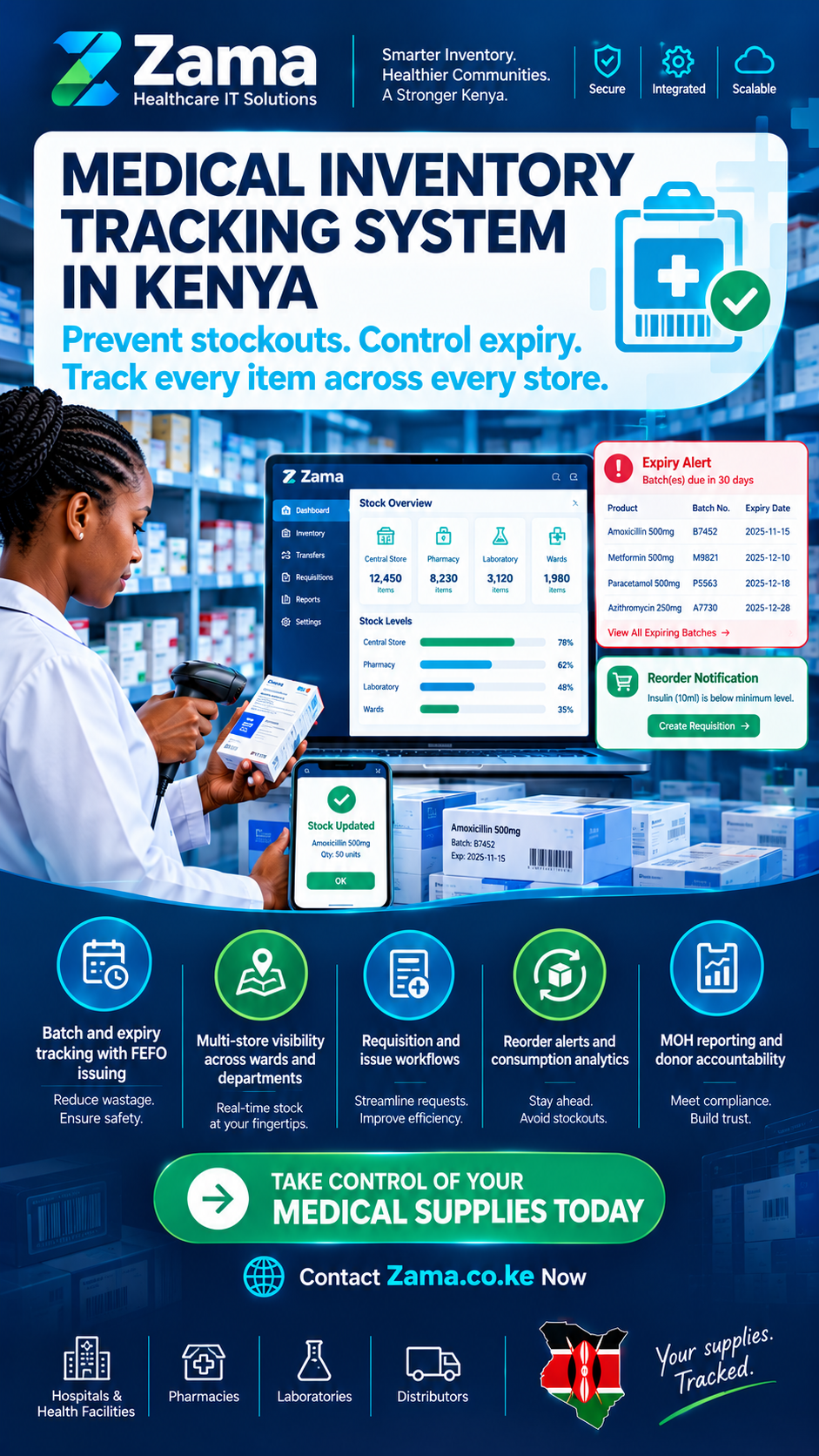
Medical inventory tracking system in Kenya is a question that every hospital administrator, pharmacy manager, and supply chain director must answer in 2026. With Kenyan healthcare facilities juggling thousands of consumables—surgical supplies, pharmaceuticals, laboratory reagents, PPE, and medical devices—across multiple stores, wards, and theatres, the risk of stockouts disrupting patient care and expiry losses eroding budgets has never been greater. At zama.co.ke, we’ve helped numerous healthcare facilities across Kenya implement custom medical inventory tracking systems that provide real-time visibility, prevent stockouts, and control expiry across every store and ward. This comprehensive guide explores the medical inventory tracking system in Kenya, from understanding what these systems deliver to selecting the right implementation approach for your facility.
What a Medical Inventory Tracking System Actually Delivers
Before diving into the medical inventory tracking system in Kenya, it’s essential to understand what this technology actually does. A medical inventory tracking system is a digital platform that records every movement of every medical item—receipts from suppliers, transfers between stores and wards, consumption during patient care, returns, and write-offs. It maintains a live, accurate position of what is held, where it is held, and when it expires.
A proper medical inventory tracking system in Kenya does far more than maintain a stock list. It tracks items at batch and lot level with expiry dates and manufacturer information. It monitors multiple store locations—central stores, pharmacy, laboratory, theatre, and ward cupboards. It records consumption against patients or departments. It enforces first-expiry-first-out issue. It triggers replenishment when stock reaches reorder levels. It produces the consumption reports that inform procurement and budget planning.
For a Kenyan healthcare facility, the practical definition of a medical inventory tracking system in Kenya is this: the platform that tells you exactly what medical supplies you hold, exactly where they are, exactly when they expire, exactly what has been consumed and by which department, and exactly what needs reordering—at every moment, across every store in your facility.
Why Kenyan Healthcare Facilities Need Medical Inventory Tracking Systems
When evaluating the medical inventory tracking system in Kenya, consider the compelling reasons for adoption:
The Stockout Risk to Patient Care
A stockout in a hospital is not an inconvenience—it is a clinical risk. A surgical procedure delayed because sutures are unavailable. A patient’s treatment postponed because a reagent has run out. A ward unable to administer a prescribed medication because the pharmacy cupboard is empty. These events happen regularly in Kenyan facilities that lack real-time inventory visibility.
A modern medical inventory tracking system in Kenya prevents avoidable stockouts. It monitors stock levels against consumption rates and supplier lead times. It alerts procurement before stock reaches critical levels. It shows which items are at risk across every store so that transfers can be made between locations before a shortage affects patient care.
The Expiry Loss Problem
Medical inventory includes perishable items—pharmaceuticals, reagents, blood products, and sterile supplies. Each has a defined shelf life. Items that expire on the shelf represent a total financial loss and, in the case of pharmaceuticals, a compliance concern if expired stock remains accessible.
A proper medical inventory tracking system in Kenya records the expiry date of every batch on receipt. It displays an expiry dashboard showing what will expire in 30, 60, and 90 days. It enforces first-expiry-first-out issue so older stock moves first. It alerts in time to redistribute stock to higher-consumption departments or arrange supplier returns. Facilities using expiry-aware systems cut write-offs significantly.
Multi-Store and Multi-Department Complexity
Hospitals hold stock in many locations—a central store, a pharmacy, a laboratory store, a theatre store, and cupboards on every ward. Without a system, each location maintains its own records, often in exercise books. Central stores do not know what wards hold. Wards request items that are sitting unused in another department.
A comprehensive medical inventory tracking system in Kenya provides a single view across all stores and departments. It shows what is held where, enables transfers between locations with proper documentation, and prevents duplicate requisitions for items already available elsewhere in the facility.
Consumption Visibility and Budget Control
Healthcare budgets are tight. Understanding where medical supplies are consumed—by department, by procedure, by ward—is essential for budget planning and cost control. Without consumption data, budgets are set by guesswork and adjusted by crisis.
A quality medical inventory tracking system in Kenya records consumption against departments, patients, or procedures. It produces reports showing consumption patterns, cost per department, and trends over time. Procurement and finance teams make decisions based on data rather than impressions.
Theft and Loss Prevention
Medical supplies are portable, valuable, and easily resold. Theft—by staff or by outsiders—is a persistent problem in Kenyan facilities. Without transaction-level tracking, losses are discovered only during stocktakes and cannot be attributed.
A proper medical inventory tracking system in Kenya records every movement with a user, timestamp, and reason. It flags unusual patterns—excessive issues to a single department, out-of-hours movements, repeated adjustments. It reconciles physical stock against system stock through cycle counting. Accountability improves and losses fall.
Regulatory and Audit Requirements
Healthcare facilities face audit requirements from the Ministry of Health, county health authorities, and donors funding specific programs. Demonstrating that medical supplies were received, stored correctly, issued appropriately, and accounted for requires complete records. Manual records rarely satisfy auditors.
A comprehensive medical inventory tracking system in Kenya maintains complete, auditable records for every item—receipt documentation, storage conditions, issue records, and consumption evidence. Audit preparation becomes straightforward rather than a scramble.
Data Protection Act and Confidentiality
Medical inventory systems may link consumption to patients—for example, which patient received which medication. This constitutes personal health data under Kenya’s Data Protection Act. A compliant medical inventory tracking system in Kenya implements role-based access, encryption, audit trails, and retention policies aligned with the Act, ensuring that patient-linked consumption data is protected.
Key Features of a Medical Inventory Tracking System in Kenya
When evaluating the medical inventory tracking system in Kenya, focus on these core features:
1. Item Master with Clinical Attributes
The foundation is a comprehensive item master. A proper system records item name, generic and brand names, unit of measure, pack size, manufacturer, supplier, and storage requirements—temperature range, light sensitivity, and handling instructions. It links items to therapeutic categories and, where relevant, to procedure codes.
2. Batch and Lot Tracking with Expiry Dates
Every receipt must capture batch or lot number, expiry date, and manufacturer. A comprehensive medical inventory tracking system in Kenya records these attributes at receipt, tracks them through every movement, and enforces first-expiry-first-out issue. It produces batch traceability reports for recalls and adverse event investigations.
3. Multi-Store and Multi-Location Support
A quality medical inventory tracking system in Kenya supports multiple store locations—central store, pharmacy, laboratory, theatre, and ward cupboards—with visibility across all of them, transfer documentation between locations, and location-specific reorder levels.
4. Requisition and Issue Workflows
Wards and departments must requisition supplies. A proper medical inventory tracking system in Kenya supports electronic requisitions, approval workflows, issue from store against requisition, and recording of receipt at the requesting department. Requisition history shows consumption patterns and supports budget allocation.
5. Real-Time Stock Visibility
Stock must be accurate at every moment. A comprehensive medical inventory tracking system in Kenya updates stock with every receipt, issue, transfer, return, and adjustment, shows stock by item, batch, and location, and flags items below reorder levels.
6. Reorder Point and Replenishment Alerts
Automatic alerts prevent stockouts. A quality medical inventory tracking system in Kenya calculates reorder points based on consumption rates and supplier lead times, alerts procurement when stock reaches critical levels, and suggests order quantities based on demand patterns.
7. Expiry Dashboard and FEFO Enforcement
Expiry management is critical. A proper medical inventory tracking system in Kenya displays upcoming expiries by item, batch, and location, enforces first-expiry-first-out issue at the point of dispensing or issuing, and alerts in time to redistribute or return near-expiry stock.
8. Supplier Management and Purchase Orders
Stock must be replenished efficiently. A comprehensive medical inventory tracking system in Kenya manages supplier records, generates purchase orders based on reorder levels, tracks deliveries against orders, and reconciles supplier invoices against receipts.
9. Cycle Counting and Stocktake
Periodic stocktake is essential, but full physical counts disrupt operations. A quality medical inventory tracking system in Kenya supports cycle counting—counting a subset of items on a rotating schedule—to maintain accuracy without shutting down the store. It records variances, supports investigation, and adjusts stock with a complete audit trail.
10. Reporting and Analytics
Facility leadership needs visibility. A proper medical inventory tracking system in Kenya provides dashboards showing stock value by store and category, consumption by department, expiry exposure, stockout frequency, and supplier performance.
What Makes a Medical Inventory Tracking System Different in Kenya
The medical inventory tracking system in Kenya has unique characteristics that global solutions often lack:
Ministry of Health Reporting
Kenyan facilities must submit specific MOH reports that depend on accurate consumption and stock data. A system built for Kenya generates these reports from routine inventory transactions.
SHA and Donor-Funded Programs
Many Kenyan facilities receive supplies through SHA programs and donor-funded vertical programs (HIV, TB, malaria). A system built for Kenya tracks stock by funding source alongside standard inventory, so that program-specific accountability requirements are met.
Cold Chain and Storage Conditions
Vaccines, reagents, and certain pharmaceuticals require cold chain. A system built for Kenya records storage conditions and alerts when temperature excursions occur or when items approach the end of their cold-chain life.
Low-Bandwidth and Offline Operation
Connectivity across Kenya varies. A system built for Kenya operates offline at remote stores and syncs when connectivity returns, so that ward and store operations do not halt during outages.
Barcode and Mobile Scanning
Kenyan facilities increasingly use Android devices for barcode scanning rather than dedicated handhelds. A system built for Kenya is optimized for mobile scanning on affordable devices.
Data Protection Act Alignment
Patient-linked consumption data is sensitive. A compliant system implements role-based access, encryption, and audit trails aligned with the Act.
Local Support
Kenyan facilities need support in their timezone and language. Local support is a practical requirement.
Key Factors That Determine Cost
When analysing cost, several factors directly influence pricing:
1. Number of Items and Suppliers
Larger catalogues with many suppliers increase configuration and tracking complexity.
2. Number of Stores and Locations
Multiple store locations add transfer documentation, visibility, and consolidated reporting complexity.
3. Batch and Expiry Tracking Requirements
Batch-level traceability with cold chain attributes adds complexity to receiving, issuing, and reporting.
4. Integration with Clinical and Pharmacy Systems
Integration with EMR, pharmacy, and billing systems adds significant complexity.
5. Barcode and Scanning Deployment
Device procurement, label printing, and scanning workflows add cost.
6. Reorder Point and Demand Planning Complexity
Consumption-based reorder calculations and demand forecasting add complexity.
7. Deployment Model
Cloud, on-premise, or hybrid deployment affects cost and ongoing support.
8. Customization
Custom reports, MOH formats, and donor reporting add to the build.
9. Training and Ongoing Support
Training storekeepers, pharmacists, and ward staff, plus ongoing support, contributes to total cost.
For a transparent quote based on your facility’s specific requirements, contact zama.co.ke today.
Use Cases
County and Referral Hospitals
Large public facilities use medical inventory tracking systems to manage thousands of items across central stores, pharmacy, laboratory, theatre, and wards, while generating MOH reports automatically.
Private Hospitals
Private hospitals use the software to control costs, prevent stockouts, and integrate consumption with billing.
Small and Medium Clinics
Clinics use lightweight systems to track essential medicines and consumables without complex infrastructure.
Mission and Faith-Based Hospitals
Mission hospitals use the software to manage donor-funded supply programs alongside standard inventory, with program-specific accountability.
Diagnostic Centres
Diagnostic centres use the software to track reagents, consumables, and calibration materials with expiry control.
Pharmacy Chains
Pharmacy chains use the software for multi-branch stock visibility, transfers, and consolidated procurement.
The Zama.co.ke Approach to Medical Inventory Tracking System Development
When considering the medical inventory tracking system in Kenya, zama.co.ke follows a structured approach:
Clinical and Operational Discovery
We map your item catalogue, store structure, requisition workflows, reporting obligations, and funding sources.
System Design
We design item master structures, batch tracking, reorder logic, and reporting formats.
Development and Integration
We build the system, integrate pharmacy and clinical systems where required, and configure MOH and donor reporting.
Testing and Data Migration
We test receipts, transfers, issuing, expiry alerts, and cycle counting, then migrate item masters and stock balances.
Training and Support
We train storekeepers, pharmacists, and ward staff, and provide go-live support.
Post-Launch Optimization
We monitor stockouts, expiry losses, and consumption patterns, then refine reorder rules.
The ROI
When evaluating the medical inventory tracking system in Kenya, the ROI is compelling:
Reduced Stockouts: Real-time visibility and reorder alerts prevent shortages that disrupt care.
Lower Expiry Losses: Expiry dashboards and FEFO issuing prevent avoidable write-offs.
Reduced Theft: Transaction-level tracking and reconciliation reduce shrinkage.
Better Budget Control: Consumption data enables accurate procurement planning.
Audit Readiness: Complete records satisfy MOH, county, and donor audits.
Faster Stocktakes: Cycle counting reduces disruption and improves accuracy.
Improved Patient Care: Supplies are available when needed.
Implementation Considerations
Assess Your Current Process
Document how items are received, stored, requisitioned, issued, and counted today, and where losses and stockouts occur.
Choose the Right Solution
Match complexity to your facility. A clinic needs less than a referral hospital.
Plan for Data Migration
Migrate item masters, supplier records, and stock balances carefully, validating accuracy.
Train Your Team
Storekeepers, pharmacists, and ward staff all interact with the system.
Ensure Compliance
Build MOH reporting, donor accountability, and Data Protection Act controls in from day one.
Test Thoroughly
Test receipts, transfers, issuing, expiry alerts, and stocktake workflows.
Consider a Phased Rollout
Start with the central store, then extend to pharmacy, laboratory, and wards.
The Cost of Delaying
While facilities evaluate the medical inventory tracking system in Kenya, the cost of inaction compounds daily. Every month of poor visibility is stockouts that disrupt care. Every month of untracked expiry is write-offs. Every month of manual records is audit risk.
Why Contact Zama.co.ke
When researching the medical inventory tracking system in Kenya, facilities should contact zama.co.ke because:
Healthcare Expertise: We understand clinical supply chains, requisition workflows, and MOH reporting.
Batch and Expiry Control: We build FEFO enforcement and expiry dashboards natively.
Donor Accountability: We track stock by funding source for program reporting.
Custom Development: We build systems matched to your stores, items, and workflows.
Transparent Pricing: No hidden fees and full source-code ownership.
Ongoing Support: We stay available as your facility grows.
For a custom quote based on your facility’s specific requirements, contact zama.co.ke today.
Medical inventory tracking system in Kenya is essential for any healthcare facility seeking to prevent stockouts, control expiry, reduce theft, and satisfy audit requirements. From item masters and batch tracking to reorder alerts, expiry dashboards, and MOH reporting, the right system changes how your facility manages supplies.
At zama.co.ke, we’ve helped healthcare facilities across Kenya implement medical inventory tracking systems that deliver measurable results. Our approach ensures you get exactly what your facility needs—nothing more, nothing less.
Don’t let the complexity of a medical inventory tracking system in Kenya hold you back. Whether you run a small clinic, a county hospital, or a national chain, we have the expertise to guide you through every step.
Contact zama.co.ke today for a custom quote based on your facility’s specific requirements.