
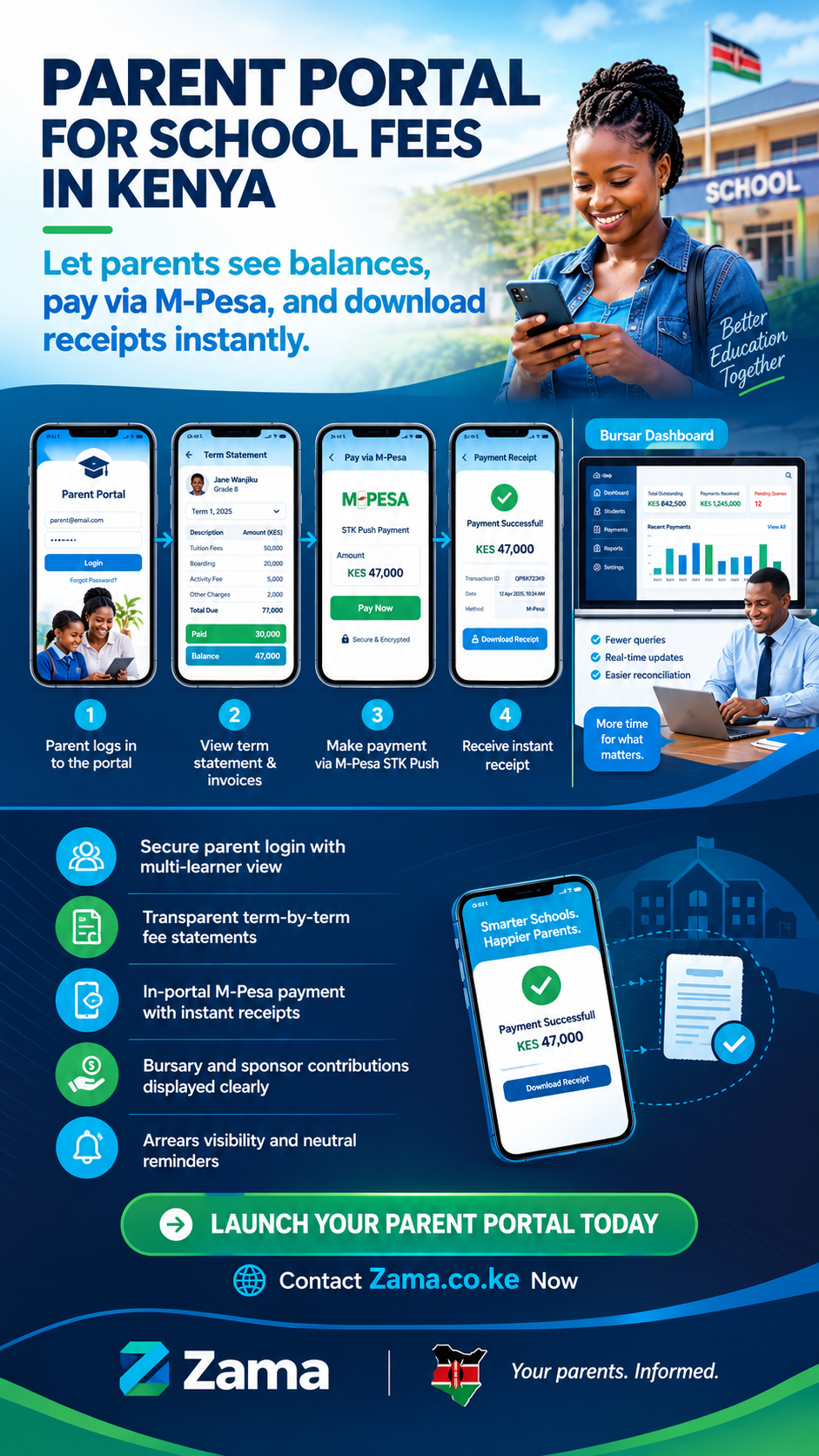
Parent portal for school fees in Kenya is a question that every school director, bursar, and board member must answer in 2026. With Kenyan parents paying fees through M-Pesa, receiving WhatsApp messages from class teachers, and managing their households from a phone, the expectation that they should also see their child’s fee balance, download a statement, and pay instantly has become entirely reasonable. Yet most schools still answer fee queries through a bursar’s desk that closes at 4 p.m., issue hand-written receipts, and cannot tell a parent their balance without searching through a ledger. At zama.co.ke, we’ve helped numerous schools across Kenya design and build parent-facing fee portals that answer these questions instantly, collect payments automatically, and reduce the burden on bursars. This comprehensive guide explores the parent portal for school fees in Kenya, from understanding what a parent portal delivers to selecting the right development approach for your school.
What a Parent Portal for School Fees Actually Delivers
Before diving into the parent portal for school fees in Kenya, it’s essential to understand what this technology actually does. A parent portal for school fees is a secure, login-protected platform where a parent or guardian can see their child’s fee account—current balance, invoices issued, payments made, discounts applied, arrears outstanding—and act on it by paying through M-Pesa, downloading a statement, or raising a query with the bursar.
A proper parent portal for school fees in Kenya does far more than display a number. It authenticates the parent against the correct learner or learners. It shows term-by-term history with full transparency. It presents the fee structure that produced each invoice. It confirms M-Pesa payments instantly and issues receipts. It displays discounts, bursaries, and waivers with their basis. It shows arrears ageing and any payment arrangements in place. It sends statements on request and reminders automatically.
For a Kenyan school, the practical definition of a parent portal for school fees in Kenya is this: the platform that lets every parent see exactly what their child owes, exactly what has been paid and when, exactly what remains outstanding, and exactly how to settle it—at any hour, from a phone, without calling the school.
Why Kenyan Schools Need a Parent Fee Portal
When evaluating the parent portal for school fees in Kenya, consider the compelling reasons for adoption:
The Bursar Query Burden
In most Kenyan schools, the bursar answers the same questions hundreds of times per term. How much does my child owe? Did my M-Pesa payment go through? Why is my balance higher than I expected? Can I get a statement? Each query interrupts the bursar’s work on reconciliation, reporting, and arrears follow-up—the tasks that actually require their expertise.
A modern parent portal for school fees in Kenya moves these queries to self-service. Parents log in and find their own answers. The bursar’s phone stops ringing with routine questions and starts being used for exceptions, arrangements, and genuine problems. Time is redirected to work that matters.
Parent Trust and Transparency
Fee disputes in Kenyan schools often stem from poor visibility rather than bad faith. A parent believes they paid in full; the school’s ledger shows a shortfall. A parent does not understand why a transport charge was added. A parent was never told that a sibling discount was applied to one term but not the next. Without shared visibility, these become arguments.
A proper parent portal for school fees in Kenya creates shared truth. Parents see the invoice that was raised, the charges that composed it, the payments that were applied, and the discounts that were granted. Disputes reduce dramatically because both sides are looking at the same record.
The M-Pesa Acknowledgement Gap
Kenyan parents pay fees through M-Pesa and expect immediate acknowledgement. In many schools, the payment is confirmed by M-Pesa to the parent’s phone but takes days to appear in the school ledger—and sometimes never appears at all if the reference was unclear. The parent is left uncertain, and the school is left with unapplied payments in an exception queue.
A comprehensive parent portal for school fees in Kenya closes this gap. Payments are reconciled against the learner account automatically, and the parent sees the payment reflected in the portal along with an official receipt. The M-Pesa confirmation on the phone and the portal balance agree.
Prepayment and Early Collection
Schools collect fees more efficiently when parents can pay early and easily. A portal that allows payment at any hour, from anywhere, with instant confirmation, encourages early settlement rather than last-minute queuing on opening day.
A quality parent portal for school fees in Kenya makes prepayment the path of least resistance. Parents pay during the holiday, receive a receipt, and arrive on opening day with the fee already settled. The school’s cash flow improves and the opening-day scramble disappears.
Arrears Visibility and Graceful Follow-Up
Arrears management is sensitive. Schools must pursue outstanding fees without damaging relationships with families experiencing genuine hardship. A portal supports this balance by giving parents visibility before the school has to chase.
A proper parent portal for school fees in Kenya shows parents their arrears ageing, any payment arrangements in place, and the next due date. Automated reminders are neutral and factual rather than personal. Parents who are struggling can see the situation clearly and approach the school early rather than avoiding it.
Multi-Learner Families
Many Kenyan families have more than one child at the same school, or children across primary and secondary sections. Managing fees for multiple learners through a single bursar visit is confusing and error-prone.
A comprehensive parent portal for school fees in Kenya supports multi-learner access. One parent login shows all their children, each with their own account, and allows consolidated or individual payment. Statements can be viewed per learner or combined for the family.
Bursaries, Sponsors, and Third-Party Payments
Kenyan learners are frequently supported by bursaries, county funds, sponsors, or religious organizations. Managing these alongside parent payments is complex—who paid what, against which learner, and what remains the family’s responsibility.
A quality parent portal for school fees in Kenya shows third-party payments separately from parent payments, displays the sponsor’s contribution against the invoice, and clarifies what the family still owes. This transparency prevents the misunderstandings that arise when a bursary is assumed to cover more than it does.
Data Protection Act Compliance
Fee accounts contain personal and financial data about parents and learners, and sometimes sensitive information about bursary eligibility or hardship. Kenya’s Data Protection Act, enforced by the Office of the Data Protection Commissioner, requires lawful processing, secure storage, controlled access, and respect for data subject rights. A portal exposed without proper controls would be a serious compliance failure.
A compliant parent portal for school fees in Kenya implements strong authentication, role-based access, encryption, audit trails, and retention policies aligned with the Act. Parents see only their own children’s accounts—never another family’s.
Reduced Paperwork and Receipt Costs
Paper statements, printed receipts, and manual registers cost money and time. A portal eliminates most of this. Statements are downloaded rather than printed. Receipts are delivered digitally. Registers are replaced by a searchable database.
A proper parent portal for school fees in Kenya reduces paper consumption, printing costs, and storage requirements while improving record quality.
Key Features of a Parent Portal for School Fees in Kenya
When evaluating the parent portal for school fees in Kenya, focus on these core features:
1. Secure Parent Authentication
The foundation is secure login. A proper system authenticates parents by phone number with OTP verification, or by email and password with two-factor authentication. It links the authenticated parent to the correct learner records and prevents unauthorised access.
2. Multi-Learner Account View
Parents with several children need one view. A comprehensive parent portal for school fees in Kenya shows all learners linked to the parent, each with their own balance, invoices, and payment history, along with a consolidated family summary.
3. Transparent Fee Statements
Statements must be clear. A quality parent portal for school fees in Kenya presents term-by-term statements showing opening balance, invoices raised with line-item detail, payments received with dates and channels, discounts applied, and closing balance.
4. In-Portal M-Pesa Payment
Payment must be simple. A proper parent portal for school fees in Kenya integrates M-Pesa Daraja API for STK Push and PayBill payments, lets the parent choose the amount and the learner, confirms payment in seconds, and issues an official receipt immediately.
5. Instant Receipts
Receipts must be immediate. A comprehensive parent portal for school fees in Kenya generates numbered, tamper-evident receipts upon payment confirmation, delivers them in-portal and by SMS or email, and stores them permanently for audit.
6. Arrears and Due Date Visibility
Parents should see what is due and when. A quality parent portal for school fees in Kenya displays outstanding balances, due dates by term, ageing of any arrears, and any agreed payment arrangement with its schedule.
7. Discounts, Bursaries, and Waivers Display
Support must be visible. A proper parent portal for school fees in Kenya shows sibling discounts, staff concessions, scholarships, bursaries, and hardship waivers as separate line items with their basis, so that parents understand exactly how their balance was calculated.
8. Statement Download and Printing
Parents need documents. A comprehensive parent portal for school fees in Kenya allows statements to be downloaded as PDF and printed, with the school’s branding and official numbering, suitable for employers, sponsors, or personal records.
9. Payment History and Audit Trail
Every payment must be traceable. A quality parent portal for school fees in Kenya maintains a complete history of every payment with date, amount, channel, M-Pesa reference, and the learner account it settled.
10. Query and Support Channel
Not everything is self-service. A proper parent portal for school fees in Kenya allows parents to raise a query against a specific invoice or payment, routes it to the bursar with full context attached, and tracks resolution—so that disputes are documented rather than conducted verbally.
What Makes a Parent Portal for School Fees Different in Kenya
The parent portal for school fees in Kenya has unique characteristics that global solutions often lack:
M-Pesa as the Primary Payment Rail
In many markets fee payment runs on cards and bank transfers. In Kenya it runs on M-Pesa. A portal built for Kenya integrates Daraja API natively for STK Push and PayBill payments, matching each payment to the correct learner automatically.
Messy Bill References
Kenyan parents type whatever they remember as the PayBill account reference—an admission number, a surname, a child’s first name, or nothing useful. A portal built for Kenya matches intelligently using reference, payer phone number, and amount, and routes genuinely ambiguous payments to an exception queue rather than misapplying them.
Term-Based Fee Structures
Kenyan schools bill per term, with three terms per year, optional boarding and transport, and mid-term adjustments. A portal built for Kenya presents this structure clearly across terms and years.
Bursaries and Sponsor Payments
Many Kenyan learners receive third-party support. A portal built for Kenya displays bursary and sponsor contributions distinctly from parent payments.
Phone-First Access
Kenyan parents predominantly use phones. A portal built for Kenya is mobile-first, loads fast on weak connections, and uses clear typography and large touch targets.
SMS as a Primary Channel
Kenyan parents rely on SMS more than email. A portal built for Kenya sends receipts, reminders, and statements by SMS as well as in-portal.
Data Protection Act Alignment
Fee data is personal and financial data. A compliant portal implements consent, role-based access, and audit trails aligned with the Act, and ensures parents see only their own children.
Local Support
Kenyan schools need support in their timezone and language, particularly at term start. Local support is a practical requirement.
Key Factors That Determine Cost
When analysing cost, several factors directly influence pricing:
1. Enrolment Size
More learners mean more accounts, more statements, and higher transaction volumes.
2. Fee Structure Complexity
Optional boarding and transport, multiple discounts, and bursaries add configuration effort.
3. Number of Campuses
Multi-campus schools add configuration and consolidated family views.
4. M-Pesa Integration Depth
STK Push, PayBill, and automatic matching each add development effort.
5. Portal Feature Scope
Statements, payment, arrears, queries, and downloads each add to the build.
6. Integration with School Systems
Integration with the school’s fee management, student records, and accounting systems determines complexity.
7. SMS and Notification Volume
Reminder and receipt frequency across enrolment size determines recurring messaging costs.
8. Deployment Model
Cloud, on-premise, or hybrid deployment affects cost and ongoing support.
9. Training and Ongoing Support
Training bursars and providing parent onboarding materials, plus support through term peaks, contributes to total cost.
For a transparent quote based on your school’s specific requirements, contact zama.co.ke today.
Use Cases
Private Primary and Secondary Schools
Private schools use parent portals to give fee visibility, collect M-Pesa payments early, and reduce bursar queries.
Public Schools with Day and Boarding Streams
Schools with mixed streams use portals to show boarding and day charges separately per learner.
Multi-Campus School Groups
Groups use portals for family views across campuses and consolidated statements.
Schools with High Bursary Populations
Schools administering bursaries and sponsor funds use portals to display third-party contributions clearly.
International Schools
International schools use portals for multi-currency fee display and international payment alongside M-Pesa.
TVET and Vocational Institutions
Institutions use portals to manage term fees alongside practical training charges.
The Zama.co.ke Approach to Parent Portal Development
When considering the parent portal for school fees in Kenya, zama.co.ke follows a structured approach:
School and Operational Discovery
We map your fee structures, payment channels, discount rules, arrears policy, and communication preferences.
Portal Design
We design authentication, statement presentation, payment flows, and query handling.
Development and Integration
We build the portal, integrate M-Pesa Daraja API and your school’s fee and student systems, and configure SMS and email notifications.
Testing and Data Migration
We test authentication, statement accuracy, payment matching, receipts, and multi-learner views, then reconcile opening balances carefully before launch.
Training and Support
We train bursars and administrators, and provide parent onboarding instructions.
Post-Launch Optimization
We monitor portal adoption, unmatched payments, and query volume, then refine the experience.
The ROI
When evaluating the parent portal for school fees in Kenya, the ROI is compelling:
Fewer Bursar Queries: Parents self-serve routine questions.
Faster Fee Collection: Early, easy M-Pesa payment improves cash flow.
Reduced Disputes: Shared statements replace conflicting memories.
Lower Printing Costs: Digital statements and receipts reduce paper.
Better Arrears Recovery: Visibility and neutral reminders prompt earlier payment.
Improved Parent Trust: Transparency strengthens the school-family relationship.
Compliance Protection: eTIMS receipts and Data Protection Act controls are built in.
Implementation Considerations
Assess Your Current Fee Process
Document how fees are structured, how payments arrive, how receipts are issued, and where parent queries concentrate today.
Choose the Right Solution
Match complexity to your school. A small day school needs less than a multi-campus group with bursaries.
Plan for Data Migration
Migrate learner accounts and opening balances carefully, reconciling totals with the audited position.
Train Your Team
Bursars and administrators must understand how the portal presents accounts and how queries route.
Ensure Compliance
Build eTIMS, Data Protection Act, and audit-trail controls in from day one.
Test Thoroughly
Test authentication, multi-learner views, M-Pesa matching, receipts, and statement downloads.
Consider a Phased Rollout
Start with statements and M-Pesa payment, then add arrears visibility and query handling.
The Cost of Delaying
While schools evaluate the parent portal for school fees in Kenya, the cost of inaction compounds every term. Every term of phone-based queries is bursar time lost. Every term of delayed reconciliation is parent frustration. Every term of unclear balances is disputes that damage relationships.
Why Contact Zama.co.ke
When researching the parent portal for school fees in Kenya, schools should contact zama.co.ke because:
Education Expertise: We understand term billing, boarding and transport structures, and bursary management.
M-Pesa Expertise: We integrate Daraja API for automatic learner-level reconciliation.
eTIMS Expertise: We issue compliant receipts and transmit them to KRA in real time.
Parent-Centric Design: We build for phones, SMS, and low-bandwidth connections.
Custom Development: We build portals matched to your fee structures and policies.
Transparent Pricing: No hidden fees and full source-code ownership.
Ongoing Support: We stay available through term-start peaks as enrolment grows.
For a custom quote based on your school’s specific requirements, contact zama.co.ke today.
Parent portal for school fees in Kenya is essential for any school seeking to reduce bursar queries, collect fees earlier, and build trust through transparency. From secure login and multi-learner views to M-Pesa payment, instant receipts, and arrears visibility, the right portal changes how families experience your school’s finances.
At zama.co.ke, we’ve helped schools across Kenya implement parent fee portals that deliver measurable results. Our approach ensures you get exactly what your school needs—nothing more, nothing less.
Don’t let the complexity of a parent portal for school fees in Kenya hold you back. Whether you run a small day school, a boarding academy, or a multi-campus group, we have the expertise to guide you through every step.
Contact zama.co.ke today for a custom quote based on your school’s specific requirements.