
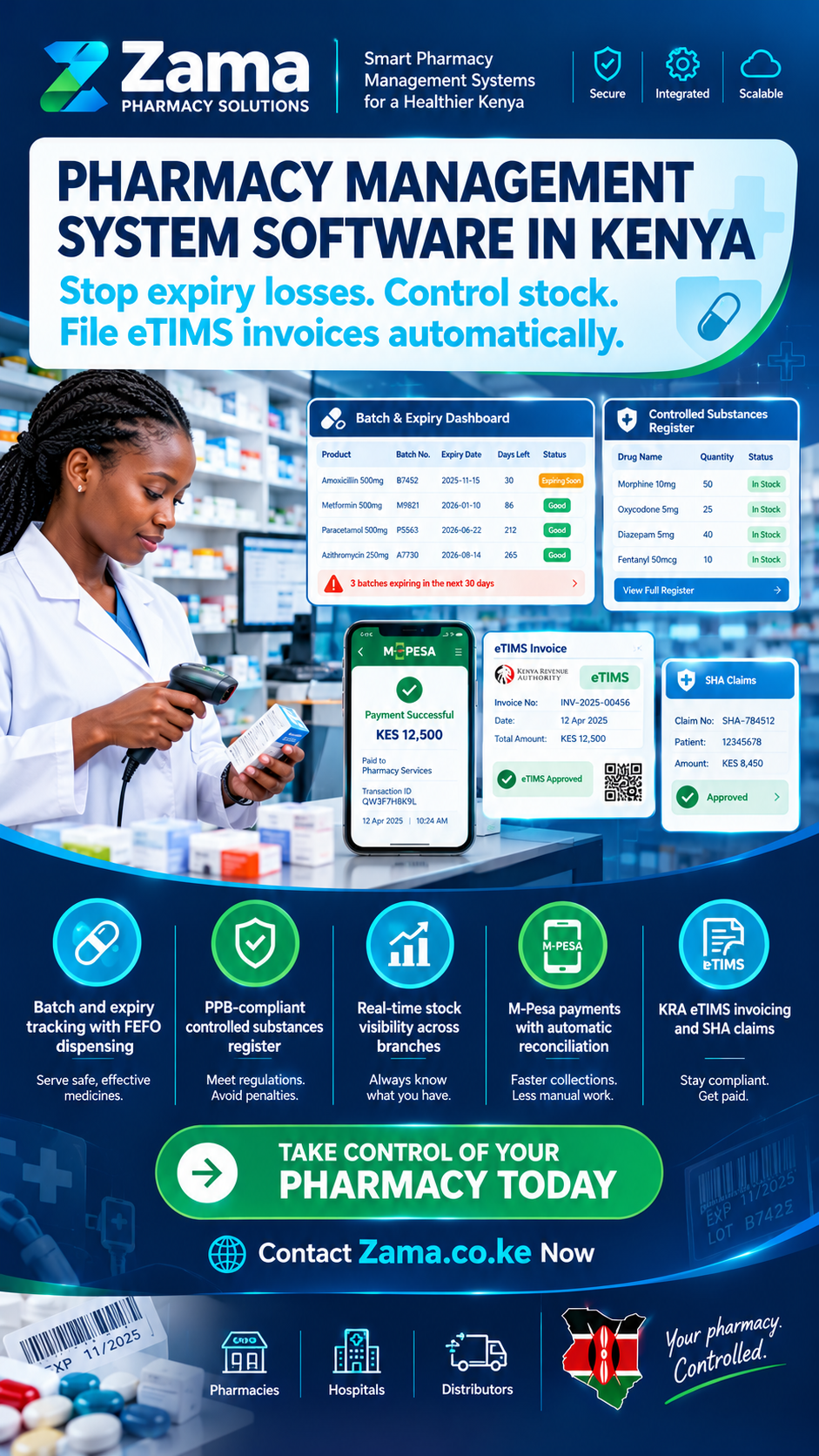
Pharmacy management system software in Kenya is a question that every retail pharmacy owner, hospital pharmacy manager, and pharmaceutical distributor must answer in 2026. With the Pharmacy and Poisons Board enforcing strict documentation requirements, KRA eTIMS compliance mandatory for every sale, controlled substances requiring meticulous registers, and stock losses from expiry and theft eroding already thin margins, the gap between pharmacies that run on manual registers and those that run on integrated software has become a survival issue. At zama.co.ke, we’ve helped numerous pharmacies and pharmaceutical businesses across Kenya implement custom management software that controls stock, enforces compliance, and protects margins. This comprehensive guide explores pharmacy management system software in Kenya, from understanding what the software delivers to selecting the right implementation approach for your pharmacy.
What Pharmacy Management System Software Actually Delivers
Before diving into pharmacy management system software in Kenya, it’s essential to understand what this technology actually does. Pharmacy management system software is a digital platform that manages the complete pharmacy operation—receiving stock from suppliers, storing it correctly, dispensing against prescriptions, tracking batches and expiry dates, recording controlled substances, processing sales, and generating the documentation that regulators require.
A proper pharmacy management system software in Kenya does far more than act as a cash register. It maintains a real-time stock position by product, batch, and expiry date. It enforces first-expiry-first-out dispensing so that older stock moves first. It flags products approaching expiry so they can be returned to suppliers or moved before they become worthless. It checks dispensing against prescriptions and against patient allergy or interaction information where available. It maintains PPB-compliant registers for controlled substances. It generates KRA eTIMS-compliant tax invoices automatically.
For a Kenyan pharmacy, the practical definition of pharmacy management system software in Kenya is this: the platform that tells you exactly what stock you hold, exactly which batches expire when, exactly what has been dispensed and to whom, exactly what controlled substances are on hand, and exactly what has been sold and invoiced—all in real time, with a complete audit trail.
Why Kenyan Pharmacies Need Management System Software
When evaluating pharmacy management system software in Kenya, consider the compelling reasons for adoption:
The Expiry Loss Problem
Expiry is the single largest controllable loss in Kenyan pharmacy. Medicines have defined shelf lives. A product that expires on the shelf is a total write-off—the pharmacy paid for it, stored it, and now must destroy it. Without batch-level tracking and expiry visibility, pharmacies discover expiring stock only when it has already expired.
A modern pharmacy management system software in Kenya prevents expiry losses. It records the expiry date of every batch on receipt. It displays an expiry dashboard showing what will expire in 30, 60, and 90 days. It enforces first-expiry-first-out dispensing so that older stock is sold first. It alerts in time to return stock to suppliers under return agreements. Pharmacies using expiry-aware systems cut write-offs dramatically.
The Controlled Substances Register
Kenya’s Pharmacy and Poisons Board requires meticulous record-keeping for controlled substances—morphine, pethidine, and other scheduled drugs. Every receipt, every dispensing, and every balance must be recorded, and the register must reconcile at all times. Manual registers are error-prone, and a discrepancy can trigger regulatory action.
A proper pharmacy management system software in Kenya maintains a dedicated controlled substances register that updates with every transaction, reconciles automatically, and produces the reports PPB inspectors require. Discrepancies are visible immediately rather than discovered during an inspection.
KRA eTIMS Compliance
Since January 2024, all VAT-registered businesses in Kenya must transmit invoices to KRA through eTIMS. Pharmacies issuing hundreds of receipts daily cannot comply manually. Penalties for non-compliance reach double the tax due, with a minimum in the region of KSh 100,000 per offence.
A comprehensive pharmacy management system software in Kenya generates KRA-compliant tax invoices for every sale and transmits them to eTIMS in real time. Compliance becomes automatic and invisible.
Stock Theft and Shrinkage
Pharmacy stock is high-value, portable, and easy to resell. Theft—by staff or by outsiders—is a persistent problem. Without transaction-level tracking, shrinkage is difficult to detect and impossible to attribute.
A quality pharmacy management system software in Kenya records every movement with a user, timestamp, and reason. It flags unusual patterns—excessive voided sales, out-of-hours dispensing, repeated adjustments. It reconciles physical stock against system stock through cycle counting. Accountability improves, and shrinkage falls.
Prescription and Dispensing Accuracy
Dispensing errors harm patients and expose the pharmacy to liability. A manual process where a pharmacist reads a handwritten prescription and selects stock from a shelf creates opportunities for error—wrong drug, wrong strength, wrong quantity.
A proper pharmacy management system software in Kenya supports accurate dispensing through barcode scanning of products, structured prescription entry, and, where integrated, allergy and interaction checks. The dispensed product matches the prescription, and the record is complete.
Supplier Returns and Credit Notes
Pharmacies routinely return near-expiry stock to suppliers under return agreements. Managing these returns manually is complex—each supplier has different terms, return windows, and credit note processes. Without systematic tracking, returns are missed and credits are lost.
A comprehensive pharmacy management system software in Kenya tracks return eligibility by batch, generates return documentation, and tracks credit notes against supplier accounts—ensuring that the pharmacy recovers value that would otherwise be lost.
Multi-Branch and Hospital Pharmacy Complexity
Retail chains and hospital pharmacies operate across multiple locations, with stock transfers between branches, different pricing for different customer types, and integration with hospital billing systems. Managing this without software is impossible.
A quality pharmacy management system software in Kenya supports multi-branch stock visibility, inter-branch transfers, location-specific pricing, and integration with hospital billing so that pharmacy charges flow directly into the patient’s account.
Data Protection Act Compliance
Pharmacy records include patient information linked to dispensed medicines—among the most sensitive personal data under Kenya’s Data Protection Act. The Office of the Data Protection Commissioner requires lawful processing, secure storage, controlled access, and respect for data subject rights.
A compliant pharmacy management system software in Kenya implements role-based access, encryption, audit trails, and retention policies aligned with the Act, ensuring that patient data is protected by design.
Key Features of Pharmacy Management System Software in Kenya
When evaluating pharmacy management system software in Kenya, focus on these core features:
1. Batch and Expiry Tracking
The foundation is batch-level tracking with expiry dates. A proper system records every batch on receipt, displays expiry information at dispensing, enforces first-expiry-first-out, and provides an expiry dashboard showing upcoming expiries so returns can be arranged in time.
2. Real-Time Stock Visibility
Stock must be accurate at every moment. A comprehensive pharmacy management system software in Kenya updates stock with every receipt, dispensing, return, and adjustment, shows stock by product and by batch, and flags products below reorder levels.
3. Prescription Management and Dispensing
Dispensing must be structured and accurate. A quality pharmacy management system software in Kenya supports structured prescription entry, barcode scanning of products at dispensing, quantity validation, and recording of the dispensing pharmacist. Where the pharmacy serves a hospital, prescriptions should flow directly from the clinical system.
4. Controlled Substances Register
PPB compliance requires a dedicated register. A proper pharmacy management system software in Kenya maintains a controlled substances register that updates automatically, reconciles balances, records the prescriber and patient, and generates the reports inspectors require.
5. KRA eTIMS Invoicing
Every sale must be eTIMS compliant. A comprehensive pharmacy management system software in Kenya generates KRA-compliant tax invoices automatically and transmits them to eTIMS in real time, storing the validation receipt for audit.
6. M-Pesa Payment Integration
Kenyan patients pay via M-Pesa. A quality pharmacy management system software in Kenya integrates M-Pesa Daraja API for STK Push and PayBill payments, confirms payment instantly, and reconciles it against the sale automatically.
7. Supplier Management and Purchase Orders
Stock must be replenished efficiently. A proper pharmacy management system software in Kenya manages supplier records, generates purchase orders based on reorder levels, tracks deliveries against orders, and reconciles supplier invoices.
8. Returns and Credit Notes
Returns must be tracked. A comprehensive pharmacy management system software in Kenya manages supplier returns with documentation, tracks credit notes against supplier accounts, and records customer returns appropriately.
9. Pricing and Customer Categories
Pharmacies price differently for different customers—walk-in retail, corporate accounts, insurance, and SHA. A quality pharmacy management system software in Kenya supports multiple price lists, applies the correct price by customer category, and manages insurance and SHA claims where applicable.
10. Reporting and Analytics
Pharmacy owners and managers need visibility. A proper pharmacy management system software in Kenya provides dashboards showing sales, stock value, expiry exposure, top-selling products, slow-moving products, shrinkage, and margin analysis.
What Makes Pharmacy Management System Software Different in Kenya
Pharmacy management system software in Kenya has unique characteristics that global solutions often lack:
PPB Compliance
The Pharmacy and Poisons Board governs pharmacy operations in Kenya, including documentation, controlled substances, and premises requirements. A system built for Kenya aligns with PPB requirements rather than imposing foreign conventions.
KRA eTIMS as a Native Function
In Kenya, every sale must be eTIMS compliant. A system built for Kenya transmits invoices to KRA in real time as a core function, not an add-on.
M-Pesa as the Primary Payment Rail
Kenyan patients pay via M-Pesa. A system built for Kenya integrates Daraja API natively for STK Push and PayBill payments with automatic reconciliation.
SHA and Insurance Claims
Patients increasingly access medicines through SHA and private insurance. A system built for Kenya supports eligibility verification and claims submission.
Product Catalogue Reality
The Kenyan pharmaceutical market includes branded and generic products with complex naming and equivalences. A system built for Kenya supports generic substitution rules and multi-name product catalogues.
Low-Bandwidth and Offline Operation
Connectivity across Kenya varies. A system built for Kenya operates offline for dispensing and syncs when connectivity returns, so that patient care does not stop during outages.
Data Protection Act Alignment
Pharmacy records are sensitive personal data. A compliant system implements consent, role-based access, encryption, and audit trails aligned with the Act.
Local Support
Kenyan pharmacies need support in their timezone and language. Local support is a practical requirement.
Key Factors That Determine Cost
When analysing cost, several factors directly influence pricing:
1. Number of Products and Batches
Larger catalogues with many batches increase configuration and tracking complexity.
2. Number of Branches
Multi-branch operations add stock transfer, consolidated reporting, and consolidated procurement complexity.
3. Hospital Integration Requirements
Integration with hospital billing and clinical systems adds significant complexity for hospital pharmacies.
4. SHA and Insurance Integration
Eligibility verification and claims submission add complexity.
5. M-Pesa and eTIMS Integration
Payment and tax compliance integrations must be built carefully and maintained.
6. Controlled Substances Requirements
Enhanced registers and reporting add configuration effort.
7. Deployment Model
Cloud, on-premise, or hybrid deployment affects cost and ongoing support.
8. Customization
Custom reports, workflows, and pricing rules add to the build.
9. Training and Ongoing Support
Training pharmacists, pharmacy technologists, and cashiers, plus ongoing support, contributes to total cost.
For a transparent quote based on your pharmacy’s specific requirements, contact zama.co.ke today.
Use Cases
Retail Pharmacies
Retail pharmacies use management software to control expiry, enforce PPB registers, and process M-Pesa sales with eTIMS invoicing.
Hospital Pharmacies
Hospital pharmacies use the software to integrate with clinical systems, dispense against electronic prescriptions, and bill charges to patient accounts.
Pharmacy Chains
Chains use the software for multi-branch stock visibility, inter-branch transfers, and consolidated procurement and reporting.
Wholesale Pharmacies
Wholesalers use batch-level inventory management to serve retail pharmacies and hospitals with accurate documentation and credit control.
Clinic-Attached Pharmacies
Clinics with in-house pharmacies use the software to link consultations to dispensing and settle charges through a single patient account.
Specialised Pharmacies
Specialised pharmacies—oncology, fertility, and chronic care—use custom-configured software for their specific product ranges and documentation requirements.
The Zama.co.ke Approach to Pharmacy Management System Software Development
When considering pharmacy management system software in Kenya, zama.co.ke follows a structured approach:
Pharmacy and Operational Discovery
We map your product catalogue, supplier relationships, dispensing workflows, PPB obligations, and payment methods.
System Design
We design batch tracking, expiry control, dispensing workflows, registers, and reporting.
Development and Integration
We build the software, integrate M-Pesa Daraja API, KRA eTIMS, SHA where applicable, and hospital systems where required.
Testing and Data Migration
We test dispensing, batch tracking, expiry alerts, and payment reconciliation, then migrate stock and supplier data.
Training and Support
We train pharmacists, technologists, and cashiers, and provide go-live support.
Post-Launch Optimization
We monitor expiry losses, stock accuracy, and sales performance, then refine the system.
The ROI
When evaluating pharmacy management system software in Kenya, the ROI is compelling:
Reduced Expiry Write-Offs: Expiry dashboards and FEFO dispensing prevent avoidable losses.
Eliminated Stock Theft: Transaction-level tracking and reconciliation reduce shrinkage.
Compliance Protection: PPB registers and eTIMS invoicing reduce regulatory and penalty risk.
Faster Payment Collection: In-portal M-Pesa payments accelerate settlement.
Accurate Dispensing: Barcode scanning and structured entry reduce errors.
Recovered Supplier Credits: Systematic returns tracking recovers value that would be lost.
Better Visibility: Dashboards inform purchasing, pricing, and branch decisions.
Implementation Considerations
Assess Your Current Process
Document how stock is received, stored, dispensed, and counted today, and where losses occur.
Choose the Right Solution
Match complexity to your operation. A single retail outlet needs less than a hospital pharmacy or a chain.
Plan for Data Migration
Migrate product catalogues, batch data, supplier records, and stock balances carefully.
Train Your Team
Pharmacists, technologists, and cashiers all interact with the system and need role-specific training.
Ensure Compliance
Build PPB registers, eTIMS, and Data Protection Act controls in from day one.
Test Thoroughly
Test batch tracking, expiry alerts, dispensing, controlled substances, and payment reconciliation.
Consider a Phased Rollout
Start with stock and dispensing, then add SHA claims, hospital integration, and analytics.
The Cost of Delaying
While pharmacies evaluate pharmacy management system software in Kenya, the cost of inaction compounds daily. Every month of manual tracking is undetected expiry. Every month of untracked dispensing is shrinkage and compliance exposure. Every invoice outside eTIMS is penalty risk.
Why Contact Zama.co.ke
When researching pharmacy management system software in Kenya, pharmacies should contact zama.co.ke because:
Pharmacy Expertise: We understand batch tracking, expiry control, PPB registers, and dispensing workflows.
M-Pesa Expertise: We integrate Daraja API for in-pharmacy payments with automatic reconciliation.
eTIMS Expertise: We transmit compliant invoices to KRA in real time.
SHA Integration: We connect eligibility verification and claims submission.
Custom Development: We build software matched to your catalogue, branches, and workflow.
Transparent Pricing: No hidden fees and full source-code ownership.
Ongoing Support: We stay available as your pharmacy grows.
For a custom quote based on your pharmacy’s specific requirements, contact zama.co.ke today.
Pharmacy management system software in Kenya is essential for any pharmacy seeking to control expiry, prevent shrinkage, satisfy PPB and KRA requirements, and protect margins. From batch tracking and FEFO dispensing to controlled substances registers, M-Pesa payments, and eTIMS invoices, the right system changes how your pharmacy operates.
At zama.co.ke, we’ve helped pharmacies across Kenya implement management software that delivers measurable results. Our approach ensures you get exactly what your pharmacy needs—nothing more, nothing less.
Don’t let the complexity of pharmacy management system software in Kenya hold you back. Whether you run a single retail outlet, a hospital pharmacy, or a chain of branches, we have the expertise to guide you through every step.
Contact zama.co.ke today for a custom quote based on your pharmacy’s specific requirements.