
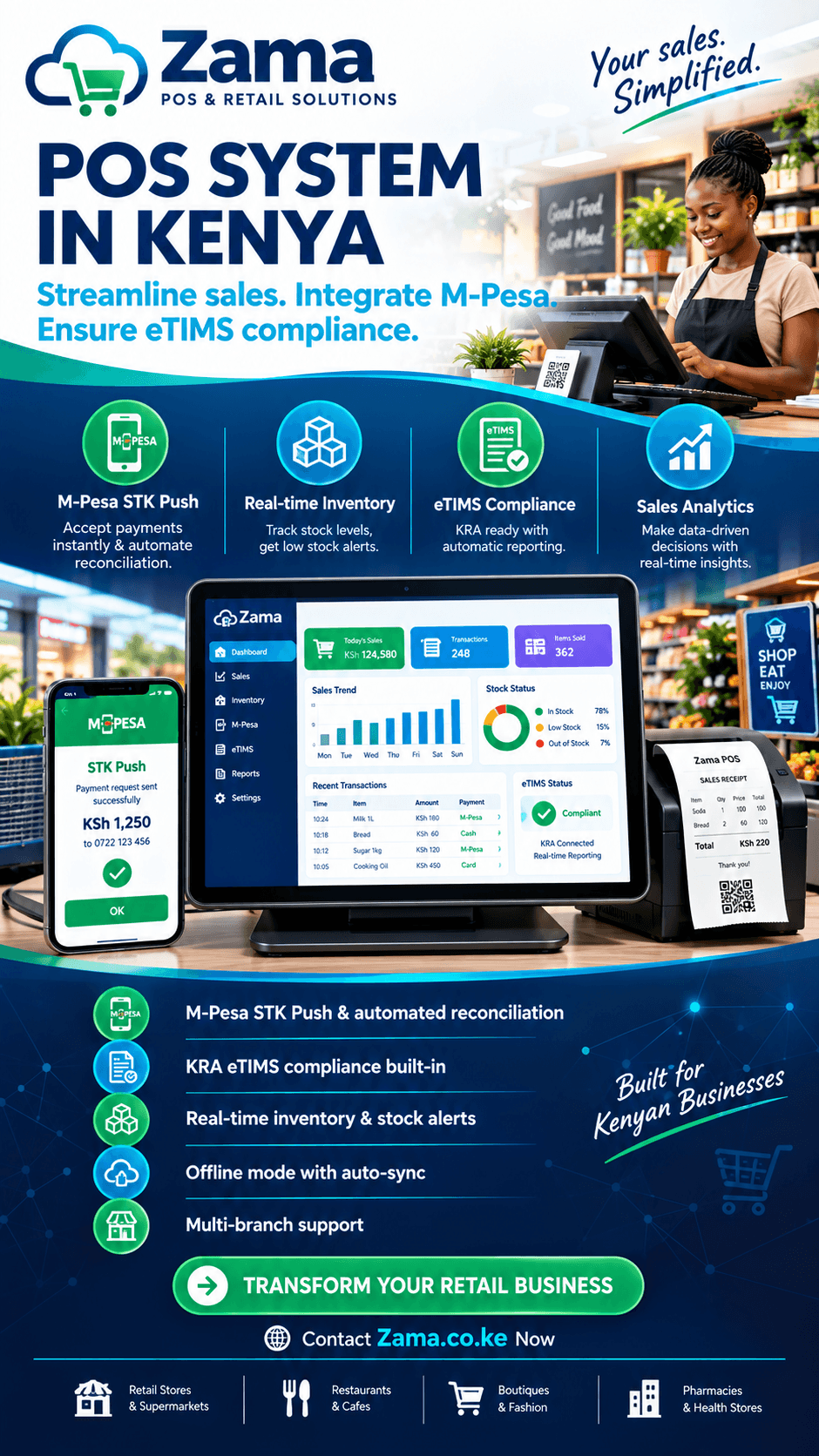
POS system in Kenya is a question that every retailer, restaurant owner, and business operator must answer in 2026. With KRA’s eTIMS mandate now fully in effect, mobile money transactions exceeding KES 7.3 trillion in 2025, and Kenyan consumers expecting seamless digital payments, the point-of-sale has evolved from a simple cash register into the operational backbone of modern commerce. At zama.co.ke, we’ve helped numerous businesses across Kenya implement POS solutions that streamline sales, automate compliance, and provide real-time visibility into operations. This comprehensive guide explores POS system in Kenya, from understanding core features to selecting the right solution for your retail business.
What a POS System Actually Does
Before diving into POS system in Kenya, it’s essential to understand what this technology actually does. A POS (point-of-sale) system is the combination of hardware and software that handles sales transactions, captures payment, prints receipts, and updates inventory in real time. It replaces the cash box, manual stock book, and handwritten receipt with a digital system that tracks every sale, every payment, and every item sold.
A proper POS system in Kenya does far more than ring up sales. It tracks every item on your shelves, flags stock running low, reconciles M-Pesa and cash at the end of the day, and produces clean, VAT-ready reports for KRA. The era of manual processes is closing fast, especially with KRA’s push for electronic tax invoicing through eTIMS. For Kenyan retailers, the benefits are practical and immediate: faster checkout, accurate stock control, reduced theft and shrinkage, seamless M-Pesa reconciliation, and eTIMS-ready reporting.
For a Kenyan business owner, the practical definition of POS system in Kenya is this: the system that tells you exactly what sold today, exactly what is left on the shelves, exactly how much money came in, and exactly how much tax you owe—all in real time, from a single dashboard accessible on any device.
Why Kenyan Retailers Need a Modern POS System
When evaluating POS system in Kenya, consider the compelling reasons for adoption:
KRA eTIMS Compliance Is Mandatory
The most urgent driver for POS system in Kenya is tax compliance. Since January 2024, all VAT-registered businesses in Kenya must transmit invoices to KRA through the eTIMS (Electronic Tax Invoice Management System). Non-compliance carries penalties of up to KES 1 million or imprisonment. Businesses that fail to issue an electronic tax invoice can face a penalty of double the tax due, or a minimum penalty in the region of Ksh 100,000, and non-compliant businesses are also more likely to be flagged for detailed KRA audits.
A POS system with eTIMS integration transmits every transaction at the till directly to KRA the moment it happens, instead of relying on paper receipts that could get lost, altered, or ignored at tax time. For MSEs and SMEs, a lightweight POS system with eTIMS support can be the difference between spending hours reconciling handwritten books and having accurate, KRA-ready records generated automatically.
M-Pesa Integration Is Non-Negotiable
In Kenya, over 80% of non-cash payments are made through M-Pesa. A POS system that does not integrate M-Pesa STK Push—where the customer receives a payment prompt on their phone automatically—forces staff to manually confirm Lipa na M-Pesa transactions, leading to errors and slower checkout. A proper POS system in Kenya should have native M-Pesa STK Push built directly into the checkout flow: the customer enters their phone number, receives the push, enters their PIN, and the transaction is confirmed in the POS within seconds.
The Cost of Stock Theft and Shrinkage
Stock theft is not just a headline story; it’s a daily nightmare for small-to-medium retailers across Nairobi, Mombasa, and Kisumu. The pain points are familiar: handwritten receipts that can be altered, cash-only transactions that leave no audit trail, limited internet connectivity forcing manual stock counts, and high staff turnover. A recent KRA survey showed that 42% of Kenyan SMEs lose money each month to internal theft. Average monthly loss per retailer ranges from KSh 80,000 to KSh 150,000, and 30% of owners admit they can’t trust their own cashiers.
A modern POS system in Kenya addresses these losses through real-time inventory tracking, role-based access controls, and integrated payment reconciliation. Every sale updates stock levels the moment the customer pays—whether via M-Pesa, cash, or card. Each transaction is timestamped, linked to a specific user, and stored securely. In a Mombasa boutique, implementing role-based access reduced refund abuse by 63% within the first month.
Essential Features of a POS System in Kenya
When evaluating POS system in Kenya, focus on these core features:
1. M-Pesa STK Push Integration
M-Pesa integration is the foundation of any modern POS system in Kenya. The system should support STK Push (Lipa Na M-Pesa Online), where cashiers initiate a payment request directly from the POS interface, sending a secure prompt to the customer’s phone. This eliminates manual entry errors, speeds up checkout, and improves customer experience. Every transaction processed through the integrated Paybill or Till number is instantly verified and automatically reconciled within the system, ensuring sales reports and General Ledger are always accurate.
The direct API integration ensures all M-Pesa payment records are secure, linked immediately to the corresponding eTIMS invoice, and available for comprehensive audit reporting.
2. KRA eTIMS Compliance
Since January 2024, all VAT-registered businesses in Kenya must transmit invoices to KRA through eTIMS. A compliant POS system in Kenya should integrate through VSCU (Virtual Sales Control Unit) or OSCU (Online Sales Control Unit) protocols, ensuring every transaction is instantly validated and transmitted as required by law. All issued invoices should be stored with corresponding eTIMS validation details, providing an indisputable audit trail for tax filings.
3. Real-Time Inventory Management
A comprehensive POS system in Kenya should provide real-time inventory tracking with barcode scanning. Every sale automatically reduces inventory, giving owners accurate stock visibility at all times. Advanced features include stock tracking with supplier management, purchase orders, batch and lot tracking, expiry date alerts, low-stock alerts via SMS, email, or dashboard, and stock take with variance reporting.
For pharmacies, supermarkets, and businesses with expiry dates, batch and lot tracking is essential. A pharmacy that flags expiring stock before it’s written off saves money the spreadsheet way never catches.
4. Offline Mode with Auto-Sync
Kenya’s connectivity isn’t always reliable. Fibre cuts happen. A town can lose internet for half a day during maintenance, and sales can’t stop. A proper POS system in Kenya should work offline, processing sales, updating inventory, running reports, looking up customers, and queuing eTIMS invoices. When the connection returns, everything syncs in order.
Offline mode that stores transactions locally and pushes them to the cloud when the network returns is essential for Kenyan businesses. Automatic alerts to the manager’s phone when stock drops below a set threshold ensure visibility even during connectivity challenges.
5. Multi-Branch Support
For businesses with multiple outlets, a proper POS system in Kenya should support unlimited locations and inter-branch stock transfers. Centralized management allows owners to monitor all branches from a single dashboard, compare performance, and manage inventory across locations. For retailers operating three or more outlets, the ability to manage inter-branch transfers without extra cost is a significant advantage.
6. Reporting and Analytics
Real-time dashboards and analytics are essential for data-driven decisions. A comprehensive POS system in Kenya should generate daily sales summaries, inventory movement reports, cashier performance reports, profit margin analysis, VAT reports, and product performance reports. Real-time sales notifications from the POS dashboard enable owners to monitor business performance from anywhere.
7. Role-Based Access Controls
Not every staff member needs full system control. A proper POS system in Kenya should allow role-based permissions: sales clerks can process sales but cannot edit past transactions; managers can approve refunds and generate reports; accountants can view financial summaries without seeing inventory details. This segregation stops rogue employees from voiding sales and pocketing cash.
8. Payment and Reconciliation
Beyond M-Pesa, a modern POS system in Kenya should support multiple payment methods including cash, card payments, and bank transfers. Automated reconciliation matches payments to transactions seamlessly, reducing manual cross-checking of M-Pesa SMS confirmations. End-of-day reports match POS sales with M-Pesa statements, and reduced cash handling means less money on the floor and fewer opportunities for theft.
POS Hardware: Core Components
A complete retail POS setup is built from several pieces of hardware. You can start lean and add components as your shop grows:
POS Terminal or Computer: The brain of the system—either an all-in-one touchscreen POS terminal or a desktop computer running POS software. All-in-one terminals are compact and purpose-built for retail counters.
Receipt / Thermal Printer: Produces fast, ink-free receipts. For supermarkets and restaurants where speed matters, an 80mm thermal printer is the standard. They are reliable, quiet, and cheap to run because they use heat-sensitive paper rather than ink or ribbons.
Barcode Scanner: A handheld or counter-mounted barcode scanner lets cashiers ring up items in a fraction of a second. For any shop with hundreds of products, the cost is recovered in time saved and pricing errors avoided.
Cash Drawer: A lockable cash drawer connects to your printer or terminal and pops open automatically when a cash sale is recorded—improving accountability and keeping notes and coins organised and secure.
Customer Display: Shows the running total so shoppers can see prices as they are scanned, building trust and reducing disputes.
Types of POS Systems Available in Kenya
When researching POS system in Kenya, several deployment options are available:
Cloud-Based POS: Accessed from multiple devices and locations simultaneously. Data is stored securely in the cloud, but the system can continue operating if connection is lost and sync when restored. Cloud-based systems are ideal for multi-branch businesses and those seeking remote management capabilities.
Local-First Desktop POS: Works reliably with unstable internet. Data is stored locally on each device with periodic sync. Designed for small retail businesses with 1-5 active cashiers where owners need clear stock visibility, daily money reconciliation, and fast checkout without downtime.
Hybrid POS (Online & Offline): Combines cloud benefits with offline capability. Continues selling even without internet, then syncs when connection returns.
Android POS Terminals: Compact, portable devices with built-in printers and card/M-Pesa acceptance. Suitable for dukas, small retail shops, and kiosks needing basic receipting.
POS System Providers in Kenya
Several providers offer POS system in Kenya solutions. When evaluating options, consider:
Local Support: Imported POS units that break down with no local technician become expensive paperweights. Choose providers with local support and spare parts availability.
eTIMS Readiness: Non-negotiable for KRA compliance. The device or software must either be eTIMS compliant out of the box or integrate with eTIMS without extra middleware costs.
M-Pesa Integration: Most Kenyan customers expect both M-Pesa and card options at checkout. Native integration is preferable to third-party connectors.
Offline Mode: Kenya’s connectivity isn’t always reliable. A good POS should still process sales and sync receipts once back online.
Scalability: Choose a system that can grow with your business—from a single kiosk to a chain of stores.
For businesses seeking a truly custom POS system built for their specific workflows, zama.co.ke provides tailored solutions that integrate M-Pesa STK Push, KRA eTIMS compliance, real-time inventory management, and role-based access controls—all designed for Kenyan retail realities.
Implementation Considerations for Kenyan Retailers
When implementing a POS system in Kenya, consider these factors:
Assess Your Business Needs
Evaluate your specific requirements: transaction volume, product categories, number of branches, payment methods accepted, and reporting needs. A duka has very different needs from a supermarket with multiple tills.
Choose the Right Solution
The best POS system for your business depends on your size, complexity, and budget. Consider whether you need a simple cash register replacement or a full retail management platform with inventory, supplier management, and analytics.
Plan for Data Migration
Migrating product catalogues, pricing data, and customer records requires careful validation. Ensure product names, SKUs, prices, and stock quantities are accurate before migration.
Train Your Staff
Cashiers, supervisors, and managers need training on the new system. Role-specific training using real scenarios produces higher adoption rates and fewer errors.
Ensure Compliance
Configure the system for KRA eTIMS compliance from day one. Ensure every sale generates a compliant tax invoice and transmits to KRA in real time. Non-compliance carries penalties that far exceed the cost of a proper system.
Test Offline Mode
Verify that the POS works offline and syncs correctly when connection returns. This is essential for Kenyan businesses operating in areas with unreliable internet.
The ROI of a POS System in Kenya
When evaluating a POS system in Kenya, the ROI is compelling:
Reduced Stock Theft: Real-time inventory tracking and audit trails reduce shrinkage significantly. Retailers report 70-87% reduction in unexplained stock losses after implementing proper POS systems.
Faster Checkout: Barcode scanning cuts queue times during peak hours, improving customer satisfaction and increasing throughput.
Accurate Stock Control: Every sale automatically reduces inventory, eliminating manual counts and reducing human error.
Seamless M-Pesa Reconciliation: Automated matching of M-Pesa payments to sales eliminates manual cross-checking and reduces errors.
eTIMS Compliance: Automated tax invoice generation eliminates penalties and audit risks.
Real-Time Visibility: Owners can monitor sales, stock, and cash flow from anywhere, enabling faster, better-informed decisions.
Staff Accountability: Role-based access and transaction logging create accountability without micromanagement.
The Zama.co.ke Approach
When considering a POS system in Kenya, zama.co.ke follows a structured approach:
Business Assessment
We evaluate your retail operation: transaction volume, product mix, branch structure, payment methods, and reporting requirements. This includes understanding your current challenges and defining success metrics.
System Design
We design a POS solution tailored to your specific business—whether it’s a single-counter duka, a multi-branch supermarket, or a restaurant with kitchen display integration.
Implementation and Configuration
We handle system configuration, product catalogue setup, M-Pesa integration, eTIMS compliance configuration, and hardware installation.
Training and Support
We provide role-specific training for cashiers, supervisors, and managers, including sales processing, inventory management, reporting, and troubleshooting.
Post-Implementation Support
We remain available for maintenance, troubleshooting, and system upgrades as your business evolves.
POS system in Kenya is essential for any retailer seeking to streamline sales, ensure KRA compliance, reduce stock theft, and provide seamless customer experiences. From M-Pesa STK Push and eTIMS integration to real-time inventory tracking and offline capability, the right system transforms how retail businesses operate.
At zama.co.ke, we’ve helped businesses across Kenya implement POS solutions that deliver measurable results. Our approach ensures you get exactly what your business needs—nothing more, nothing less.
Don’t let the complexity of POS system in Kenya hold you back. Whether you’re running a small duka, a growing supermarket, or a restaurant chain, we have the expertise to guide you through every step.
Contact zama.co.ke today and let us help you build a POS system that transforms your retail operations.