
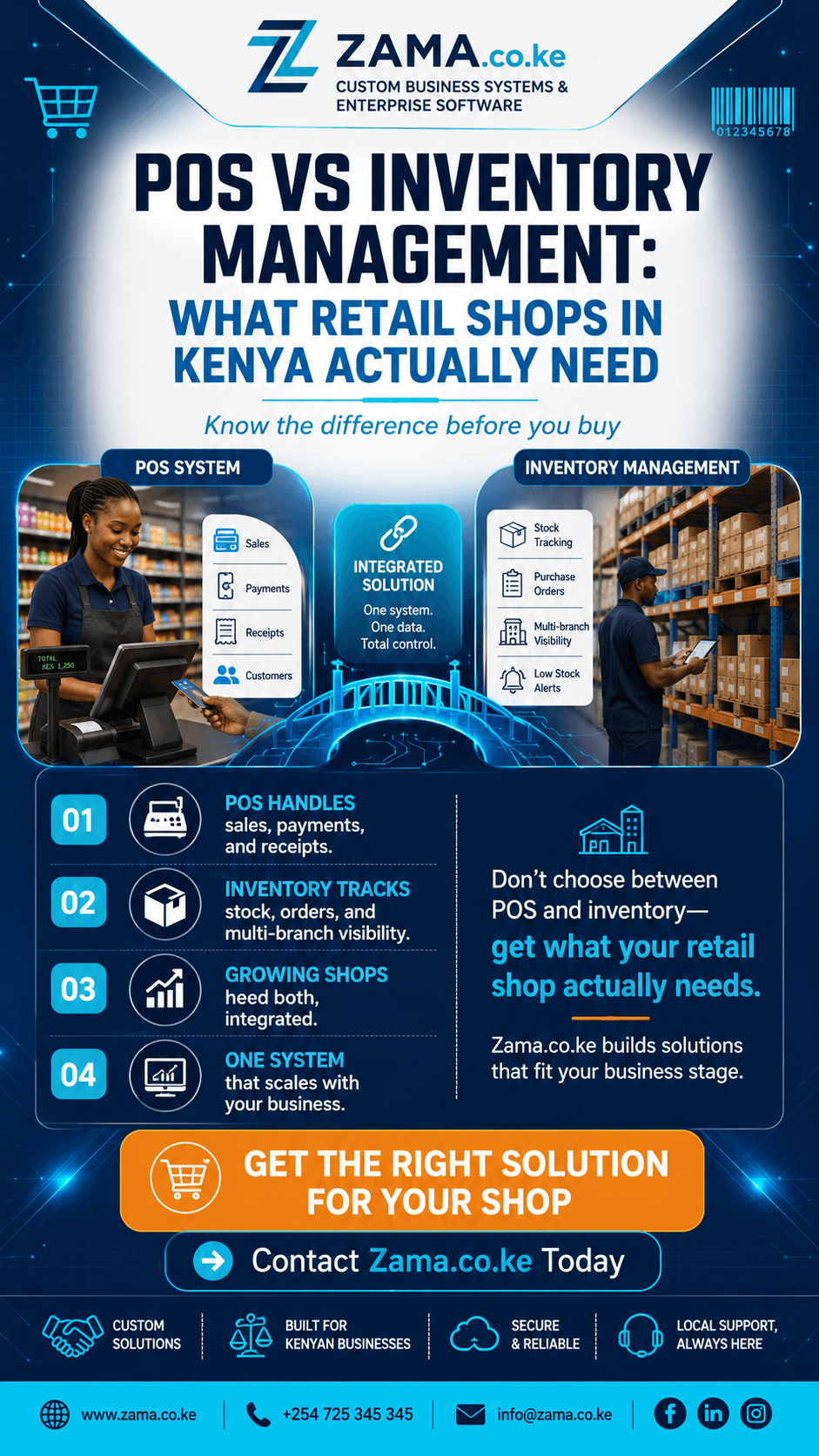
POS vs inventory management software: what retail shops in Kenya need is a question that every shop owner, retailer, and entrepreneur running a business in Nairobi, Mombasa, or Kisumu must answer in 2026. With thousands of retail shops operating across Kenya, the distinction between a point-of-sale system and a dedicated inventory management solution has become critical for sustainable growth. At zama.co.ke, we’ve helped numerous retail businesses across Kenya build custom solutions that address their unique operational challenges. This comprehensive guide explores POS vs inventory management software: what retail shops in Kenya need, helping you understand the difference and choose the right approach for your business.
Understanding the Core Difference
Before diving into POS vs inventory management software: what retail shops in Kenya need, it’s essential to understand what each system does. A Point-of-Sale (POS) system is designed to process sales transactions at the checkout counter. It calculates totals, processes payments, and provides receipts. It typically integrates with a barcode scanner and receipt printer . An inventory management system, on the other hand, focuses on tracking stock levels, managing purchase orders, and providing visibility into what products are available across your business .
The reality for most Kenyan retailers is that they need both capabilities, but understanding POS vs inventory management software: what retail shops in Kenya need means knowing the features that matter most for your specific business context.
What a POS System Does
A POS system is primarily transactional. It handles:
Sales Processing
The POS is where the sale happens. It tallies up orders, takes payments, creates invoices, and logs the transaction . This is the frontline of any retail operation.
Payment Management
Modern POS systems in Kenya must handle multiple payment types: cash, M-Pesa, card payments, and sometimes bank transfers . A good POS captures payment data so finance teams can reconcile sales against cash and M-Pesa payouts .
Receipt Generation
Customers expect a receipt. A POS produces sales receipts and stores them in a format that can be referenced later.
Basic Sales Reporting
Basic POS systems typically provide daily and weekly sales reports. This gives shop owners visibility into total revenue, payment method breakdowns, and basic sales trends .
When evaluating POS vs inventory management software: what retail shops in Kenya need, a POS alone cannot give you a complete picture. It tells you what sold, but it doesn’t tell you what you still have, what you need to order, or where your stock is located across multiple branches.
What Inventory Management Software Does
Inventory management software is about control and visibility. It handles:
Stock Tracking
Real-time stock visibility across all locations. When a sales transaction is recorded, inventory should update automatically, keeping stock records aligned across the business .
Purchase Orders and Replenishment
Inventory systems help you create purchase orders to suppliers. They track what has been ordered, what has been received, and what is pending. Some systems send low-stock alerts when items reach a reorder point .
Stock Valuation and Cost Tracking
Inventory management tracks the cost of goods sold, landed costs including import duty and freight, and real-time valuation of stock on hand .
Multi-Location Synchronization
For retailers with more than one branch, inventory management software ensures stock levels across all locations are synchronized. This prevents overstocking in one branch while another runs out .
Reporting and Analytics
Inventory systems provide reports on stock movement, slow-moving items, wastage, and seasonal trends. This helps shop owners make informed buying decisions .
When considering POS vs inventory management software: what retail shops in Kenya need, you realize that most businesses need both functions, but the balance depends on your stage of growth.
The Problems with POS-Only Solutions
Many Kenyan retailers start with basic POS software. When they only use a POS, they encounter problems including:
Inventory That Drifts from Reality
When stock is not updated automatically with sales, the POS inventory numbers drift. It eventually becomes a source of confusion rather than reliable data .
Poor Multi-Branch Visibility
POS systems that don’t sync across branches leave managers flying blind when stock moves between locations.
Manual Reconciliation Overhead
Without proper inventory tracking, owners need to manually adjust stock after physical counts, often leading to discrepancies .
Loss of Replenishment Control
Without reorder alerts and purchase order tracking, you face out-of-stock situations or unnecessary over-purchasing .
The Problems with Inventory-Only Solutions
If a retailer uses inventory management software without a POS, they encounter:
Manual Sales Entry
Every sale must be entered manually to update stock records. This is time-consuming and prone to errors.
No Checkout Efficiency
There is no fast checkout experience for the customer. Staff spend time navigating menus while customers wait .
Weak Payment Reconciliation
Without POS, there is no structured payment capture. Sales data still needs to be reconciled with cash and M-Pesa records separately.
Limited Day-to-Day Operations Control
A back-office inventory system helps with planning but does not help with daily sales execution. When looking at POS vs inventory management software: what retail shops in Kenya need, you need to consider both operational and control requirements.
What Retail Shops in Kenya Actually Need
After working with retailers of all sizes across Kenya, we’ve seen that POS vs inventory management software: what retail shops in Kenya need depends on your business stage:
Early-Stage Retail (Single Shop)
You need a POS with stock tracking. Features to prioritize include:
Basic POS for fast checkout
Stock tracking at the item level
Sales reporting for daily and weekly visibility
M-Pesa reconciliation to ensure payments match sales
At this stage, “how much does a proper inventory system cost” becomes less of an issue than “how do I avoid inventory losses.” A POS with good inventory control can solve most problems .
Growing Retail (2-3 Branches)
You need an integrated solution that connects sales and inventory. Features to prioritize include:
Multi-location stock synchronization
Inter-branch stock transfers
Centralized purchasing
Supplier and purchase order management
KRA compliance for invoices and tax reporting
Multi-location inventory sync is non-negotiable for businesses opening more than one branch . Trying to add it later to a POS built for one branch is much harder than building it correctly from the start .
Mature Retail Chain (5+ Branches)
You need full retail management software. Features to prioritize include:
Real-time cross-branch visibility
HR and payroll capabilities
Advanced analytics on branch performance
Audit controls to protect against shrinkage
Supplier and procurement automation
Integrated accounting for finance teams
At this scale, having a unified retail management platform is essential. The same platform that runs a single branch should be able to handle a multi-location chain without being replaced .
Key Considerations for Kenyan Retailers
1. M-Pesa Integration
Every Kenyan retail solution must integrate with M-Pesa. Whether it is through the Safaricom Daraja API or another method, the system should automatically reconcile M-Pesa payments with sales records . Manual reconciliation of M-Pesa statements is a major time-waster for Kenyan SMEs .
2. KRA Compliance
Your system must be able to generate eTIMS-compliant invoices. This is not optional in 2026. KRA penalties for non-compliant invoicing can be significant, and automated compliance saves time and money .
3. Offline Capability
Internet in Kenya is not always consistent, especially in towns outside Nairobi. A retail system should have offline capabilities to continue operating during outages and sync when connectivity returns .
4. Multi-Location Support
If you plan to open more branches, your system must handle multi-location inventory from the start. Trying to bolt it on later is expensive and difficult .
5. User-Friendly Interface
The system should be simple enough for cashiers to learn quickly. Staff resistance to complex systems is a common implementation challenge .
The Real Cost of Not Choosing Wisely
When evaluating POS vs inventory management software: what retail shops in Kenya need, consider the cost of not choosing correctly:
Manual Reconciliation Costs: Finance teams can lose hours every week matching M-Pesa payouts to sales records. A 2023 survey of 1,200 Kenyan SMEs by the Kenya ICT Board found that 68% of businesses using entry-level software lose an average of KSh 1.2 million every year to manual workarounds and duplicate data entry .
Inventory Gaps: If a shop loses more than KSh 50,000 a month to dead stock or out-of-stock popular items, the current system cannot handle multi-location inventory .
KRA Penalties: If filing VAT returns takes more than 4 hours, the system is outdated. KRA penalties for non-compliant invoicing can reach KSh 100,000 per offence .
Lost Growth Opportunities: Turning down large orders because you cannot track fulfillment causes you to lose revenue you will never recover .
The Zama.co.ke Approach
When retailers ask POS vs inventory management software: what retail shops in Kenya need, zama.co.ke helps them find the right answer through a structured process:
Operational Discovery
We define the retail workflow: items, pricing, cashier activity, stock movement, branch structure, payment methods, and the reports leadership needs .
System Design
Modules, data structure, permissions, user journeys, and reporting layers are planned so the platform supports the business model coherently .
Build and Integrate
Core modules, dashboards, automation logic, and external connections are developed in stages with review checkpoints against agreed requirements .
Validation and Rollout Readiness
We test critical workflows, user roles, integrations, calculations, and reporting behavior so the system can be adopted with confidence .
Post-Launch Support
After go-live, we support stabilization, user feedback, ongoing maintenance, and the next round of improvements informed by real usage .
Why Retailers Choose Custom Solutions
When retailers consider POS vs inventory management software: what retail shops in Kenya need, they often choose custom solutions because:
Business-Process Understanding
We design systems around how the organization actually works instead of treating the project as a feature list with no operational structure .
Architecture That Supports Change
A good software foundation makes it easier to add modules, integrations, reports, and new user groups without rebuilding everything later .
Reporting and Control Mindset
The software is planned to support both execution by teams and oversight by management, not only one side of the equation .
Reliable Support
Software projects create value over time, so we stay available to maintain, refine, and extend the platform after launch .
Integration-Ready
We can connect payments, messaging, CRMs, legacy tools, and data services so the software becomes part of the wider operating environment .
POS vs inventory management software: what retail shops in Kenya need is not an either/or question. Most retailers need both capabilities, but the right balance depends on your stage of growth.
For a single shop, a POS with strong stock tracking is usually sufficient. For growing retailers with multiple branches, you need a system that integrates POS sales with multi-location inventory management, purchase orders, and KRA compliance. For mature retail chains, you need a full retail management platform that connects sales, inventory, finance, HR, and analytics in one unified system .
At zama.co.ke, we’ve helped retail businesses across Kenya build custom solutions that address their unique needs. Whether you are starting with a single shop or managing a growing chain, we have the expertise to guide you through every step of the journey.
Don’t let the complexity of POS vs inventory management software: what retail shops in Kenya need hold you back. The real cost is not choosing the right system—it is staying with tools that were never designed to handle growth.
Contact zama.co.ke today and let us help you build a retail management system that transforms your operations.