
Real Estate ERP Kenya: The Ultimate Guide to Streamlining Property Management and Real Estate Operations
Introduction
The real estate industry in Kenya is evolving rapidly. Property developers, real estate agencies, landlords, property managers, and construction companies are handling more projects, tenants, properties, finances, and compliance requirements than ever before. As businesses grow, managing these operations using spreadsheets or disconnected software becomes inefficient and prone to costly mistakes.
This is where a Real Estate ERP Kenya solution becomes essential.
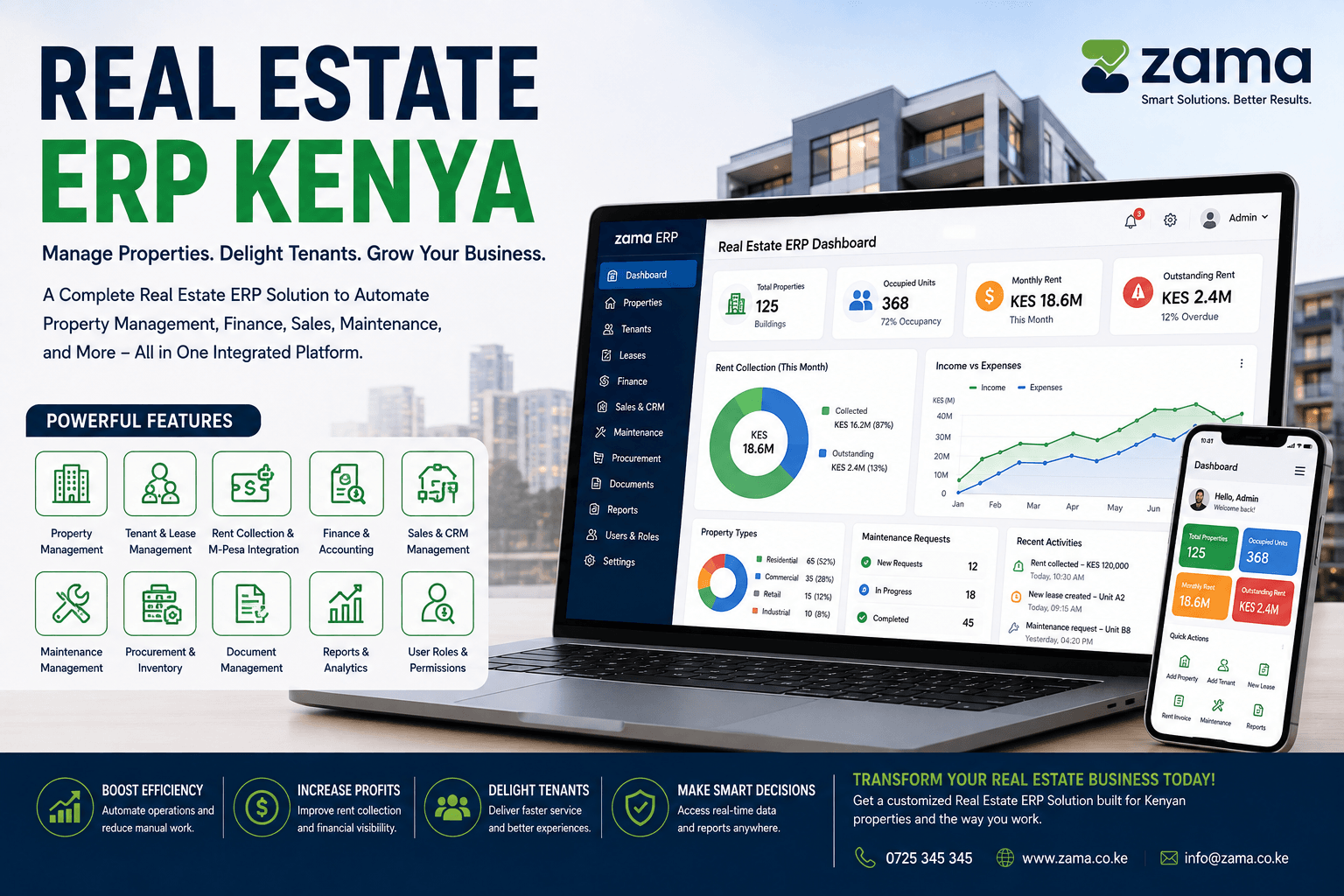
A Real Estate ERP Kenya is an integrated software platform that connects all aspects of a real estate business into one centralized system. Instead of using separate applications for accounting, property management, sales, customer relationship management (CRM), maintenance, procurement, and reporting, everything is managed through a single platform.
Whether you manage residential apartments, commercial buildings, shopping malls, gated communities, mixed-use developments, or large real estate portfolios, implementing a Real Estate ERP Kenya helps improve efficiency, reduce operational costs, enhance customer satisfaction, and support business growth.
What is a Real Estate ERP?
Enterprise Resource Planning (ERP) software integrates multiple business functions into one system. In the property industry, a Real Estate ERP Kenya combines operational, financial, and customer management tools into a unified platform.
Instead of employees working in isolated systems, all departments share real-time information. Finance teams, sales agents, property managers, maintenance staff, and executives can collaborate more effectively, improving productivity and decision-making.
Why Kenyan Real Estate Businesses Need a Real Estate ERP
Kenya’s property market continues to expand with increasing demand for residential, commercial, and mixed-use developments. Managing this growth manually presents several challenges:
- Delayed rent collection
- Poor communication between departments
- Duplicate data entry
- Manual financial reporting
- Maintenance delays
- Inaccurate occupancy records
- Lost customer information
- Difficult compliance management
A Real Estate ERP Kenya addresses these challenges by centralizing data, automating repetitive tasks, and providing real-time insights into business performance.
Common Challenges Without a Real Estate ERP
1. Fragmented Information
Many organizations use different software for accounting, CRM, maintenance, and tenant management. This creates data inconsistencies and delays.
A Real Estate ERP Kenya ensures that all departments access the same accurate information from one centralized database.
2. Slow Financial Processes
Manual invoicing, rent tracking, and reconciliation increase the risk of errors.
Automation simplifies financial operations and improves cash flow management.
3. Poor Customer Service
When customer information is scattered across multiple systems, responding to inquiries becomes slow and inconsistent.
With a Real Estate ERP Kenya, staff can instantly access tenant, buyer, or client information, leading to faster and more professional service.
4. Maintenance Delays
Maintenance requests often get lost when managed manually.
An integrated ERP system tracks requests, assigns technicians, monitors progress, and records completion history.
5. Limited Reporting
Business owners need real-time visibility into occupancy rates, rental income, expenses, maintenance costs, and project performance.
A Real Estate ERP Kenya provides customizable dashboards and reports that support informed decision-making.
Key Features of a Real Estate ERP Kenya
Property Management
Manage all properties from a single dashboard, including:
- Residential apartments
- Commercial buildings
- Office spaces
- Shopping malls
- Warehouses
- Mixed-use developments
- Land portfolios
The system stores detailed information about each property, including occupancy status, lease agreements, maintenance history, and financial performance.
Tenant Management
Maintain complete tenant records such as:
- Contact information
- Lease agreements
- Payment history
- Communication logs
- Maintenance requests
- Notices
- Renewals
A Real Estate ERP Kenya helps strengthen tenant relationships through organized and accessible information.
Sales and CRM
For property developers and agencies, the CRM module manages:
- Leads
- Prospects
- Site visits
- Property inquiries
- Sales pipeline
- Customer follow-ups
- Reservation management
- Sales performance
Automated follow-ups help convert more leads into customers.
Financial Management
Track all financial activities, including:
- Rent collection
- Sales revenue
- Expenses
- Bank reconciliation
- Accounts payable
- Accounts receivable
- Budgeting
- Financial statements
This integration ensures accurate and timely financial reporting.
Lease Management
The ERP system manages:
- Lease creation
- Renewals
- Expiry alerts
- Rent escalations
- Security deposits
- Contract documentation
Automated reminders reduce the risk of missed renewals.
Maintenance Management
Track property maintenance from request to completion.
Features include:
- Work order creation
- Technician assignment
- Progress tracking
- Maintenance schedules
- Vendor management
- Cost monitoring
A Real Estate ERP Kenya helps maintain properties efficiently while improving tenant satisfaction.
Procurement Management
Manage procurement processes such as:
- Purchase requests
- Supplier records
- Quotations
- Purchase orders
- Goods received
- Vendor payments
This improves transparency and reduces procurement delays.
Inventory Management
Track inventory including:
Inventory alerts help prevent shortages and unnecessary purchases.
Human Resource Management
Many ERP solutions include HR features such as:
- Employee records
- Payroll
- Attendance
- Leave management
- Performance reviews
- Recruitment
This creates a unified platform for both operational and workforce management.
Reporting and Business Intelligence
A robust Real Estate ERP Kenya offers dashboards and analytics covering:
- Rental income
- Occupancy rates
- Vacancies
- Property profitability
- Maintenance expenses
- Sales performance
- Cash flow
- Customer satisfaction
Executives can monitor business performance in real time and make data-driven decisions.
Benefits of Implementing a Real Estate ERP Kenya
Improved Efficiency
Automation reduces repetitive tasks, enabling employees to focus on strategic activities and customer service.
Better Decision-Making
Access to real-time reports and analytics allows management to identify trends, monitor performance, and respond quickly to business opportunities.
Increased Revenue
Better lead management, faster invoicing, improved rent collection, and enhanced customer service contribute to higher revenue generation.
Reduced Operational Costs
Automation minimizes paperwork, reduces manual errors, and improves resource utilization, lowering operational expenses.
Enhanced Customer Experience
Quick responses, accurate information, timely maintenance, and transparent communication build stronger relationships with tenants and buyers.
Improved Compliance
A Real Estate ERP Kenya helps businesses maintain organized records, manage contracts, and generate reports that support regulatory and internal compliance requirements.
Scalable Growth
As your portfolio expands, the ERP system grows with your business without requiring multiple disconnected software solutions.
Cloud-Based Accessibility
Modern ERP systems are cloud-based, allowing authorized users to access information securely from anywhere using a laptop, tablet, or smartphone.
This flexibility supports remote work and improves collaboration across branches and departments.
Real Estate ERP Kenya (Part 2): Modules, Implementation, Case Studies, FAQs & Why Choose Zama
Core Modules of a Real Estate ERP Kenya
An effective Real Estate ERP Kenya should provide a complete suite of modules that work together seamlessly.
Property Portfolio Management
This module enables organizations to manage multiple properties from a single dashboard.
It tracks:
- Residential apartments
- Commercial buildings
- Office complexes
- Shopping malls
- Mixed-use developments
- Warehouses
- Land parcels
- Gated communities
Managers can easily monitor occupancy, rental income, maintenance status, and profitability for every property.
Tenant and Lease Management
Managing tenants manually becomes increasingly difficult as portfolios grow.
A Real Estate ERP Kenya simplifies tenant administration by storing:
- Tenant profiles
- Lease agreements
- Security deposits
- Lease renewals
- Rent escalation schedules
- Move-in and move-out records
- Communication history
Automatic reminders notify both managers and tenants before leases expire, reducing vacancies and missed renewals.
Accounting and Financial Management
Finance is at the heart of every successful real estate business.
An ERP system automates:
- Rent invoicing
- Receipt generation
- Expense tracking
- Accounts receivable
- Accounts payable
- Bank reconciliation
- Cash flow management
- Profit and loss statements
- Balance sheets
- Tax reporting
With a Real Estate ERP Kenya, finance teams spend less time on manual reconciliation and more time analyzing business performance.
Sales and Customer Relationship Management (CRM)
Property developers and agencies rely on strong customer relationships.
The CRM module helps manage:
- Leads
- Property inquiries
- Site visits
- Follow-ups
- Sales opportunities
- Bookings
- Reservations
- Buyer communication
- Sales reporting
This ensures no potential customer is overlooked and helps increase conversion rates.
Maintenance Management
Maintenance directly impacts tenant satisfaction and property value.
A Real Estate ERP Kenya allows users to:
- Log maintenance requests
- Assign technicians
- Track work orders
- Schedule preventive maintenance
- Monitor maintenance costs
- Evaluate contractor performance
Timely maintenance improves tenant retention and protects long-term property investments.
Procurement and Vendor Management
Real estate businesses regularly purchase maintenance supplies, construction materials, office equipment, and outsourced services.
An ERP solution helps manage:
- Approved suppliers
- Purchase requisitions
- Quotations
- Purchase orders
- Delivery tracking
- Supplier invoices
- Vendor performance
This creates greater transparency and cost control.
Document Management
Property businesses generate thousands of important documents.
Examples include:
- Lease agreements
- Sale agreements
- Property titles
- Inspection reports
- Maintenance reports
- Receipts
- Invoices
- Contracts
A Real Estate ERP Kenya securely stores these documents in one centralized location with role-based access.
Integration Capabilities
A modern Real Estate ERP Kenya should integrate with other essential business systems, including:
- M-Pesa payment integration
- Bank payment systems
- Accounting software
- HR and payroll systems
- Biometric attendance systems
- Email platforms
- SMS gateways
- WhatsApp communication platforms
- Business intelligence tools
These integrations eliminate duplicate data entry and improve operational efficiency.
How to Successfully Implement a Real Estate ERP Kenya
Step 1: Assess Business Requirements
Identify current challenges and define clear objectives. This ensures the ERP solution aligns with your operational needs.
Step 2: Map Existing Processes
Document workflows for:
- Property management
- Leasing
- Sales
- Finance
- Maintenance
- Procurement
Understanding current processes makes system configuration more effective.
Step 3: Customize the ERP
Every organization has unique requirements. Configure the software to reflect your approval workflows, property structures, reporting needs, and financial processes.
Step 4: Migrate Existing Data
Import critical information, including:
- Property records
- Tenant information
- Customer databases
- Financial records
- Supplier details
- Historical transactions
Accurate data migration is essential for a successful implementation.
Step 5: User Training
Provide comprehensive training for:
- Property managers
- Finance teams
- Sales staff
- Maintenance personnel
- Executives
Well-trained users achieve faster adoption and maximize the value of the system.
Step 6: Go Live and Monitor Performance
Launch the system, monitor user adoption, gather feedback, and make improvements where necessary.
Case Study 1: Property Management Company in Nairobi
A property management company overseeing more than 150 residential and commercial units struggled with disconnected systems.
Challenges
- Manual rent collection
- Delayed financial reporting
- Maintenance backlogs
- Poor communication between departments
Solution
The company implemented a Real Estate ERP Kenya with integrated finance, maintenance, CRM, and reporting modules.
Results
- Rent collection efficiency improved significantly.
- Financial reports were generated in minutes instead of days.
- Maintenance response times decreased substantially.
- Management gained real-time visibility across all properties.
Case Study 2: Real Estate Developer
A property developer managing multiple housing projects required a centralized platform to oversee sales, construction costs, procurement, and customer communication.
Challenges
- Fragmented project information
- Delayed sales follow-ups
- Procurement inefficiencies
- Manual reporting
Solution
A customized Real Estate ERP Kenya integrated CRM, procurement, finance, and project management into one solution.
Results
- Faster lead conversion
- Improved procurement control
- Better project visibility
- Enhanced executive reporting
- Reduced administrative workload
Customer Testimonials
Property Manager
“The ERP transformed how we manage tenants, maintenance, and financial reporting. Everything is now available from one dashboard.”
Finance Manager
“Monthly financial reporting used to take several days. Now we generate accurate reports within minutes.”
Real Estate Developer
“Our sales team follows up with prospects more effectively, while management has complete visibility into project performance.”
Why Choose Zama?
Zama develops intelligent software solutions tailored to the Kenyan real estate industry.
Our Real Estate ERP Kenya solution includes:
- Property management
- Tenant management
- Lease management
- CRM and sales automation
- Financial management
- Maintenance tracking
- Procurement management
- Document management
- M-Pesa integration
- WhatsApp integration
- Custom dashboards
- Business intelligence reports
- Role-based security
- Cloud hosting
- Mobile accessibility
- User training
- Ongoing technical support
- System customization
- Future upgrades
Whether you manage 20 units or 20,000, our ERP solution is designed to grow with your business.
Frequently Asked Questions
Can the ERP manage multiple properties?
Yes. It supports multiple residential, commercial, and mixed-use properties from a centralized dashboard.
Does it support M-Pesa payments?
Yes. The system can integrate with M-Pesa to simplify rent collection and payment reconciliation.
Is it cloud-based?
Yes. Authorized users can securely access the system from anywhere using an internet connection.
Can it integrate with existing accounting software?
Yes. Integration with accounting and payroll systems is available to reduce manual work and improve data accuracy.
Is the system suitable for small businesses?
Absolutely. The ERP is scalable and can serve small agencies, medium-sized property managers, and large real estate enterprises.
Why Investing in a Real Estate ERP Kenya Is the Smart Choice for Long-Term Growth
The real estate industry is becoming increasingly competitive, and businesses must embrace digital transformation to remain efficient, profitable, and customer-focused. Whether you are a property developer, property management company, real estate agency, landlord, or investment firm, implementing a Real Estate ERP Kenya is no longer a luxury—it is a strategic necessity. By integrating property management, tenant management, finance, sales, maintenance, procurement, and reporting into one centralized platform, a Real Estate ERP Kenya enables businesses to streamline operations, reduce manual work, and make smarter decisions based on real-time data.
One of the greatest advantages of adopting a Real Estate ERP Kenya is the ability to eliminate disconnected systems and manual processes. Instead of relying on spreadsheets, paperwork, or multiple software applications, every department works from a single source of accurate information. This improves collaboration, minimizes costly errors, and ensures that managers always have a clear view of business performance. With automated workflows and instant access to critical information, organizations can respond faster to customer needs and market opportunities.
Customer expectations have also evolved significantly. Tenants and property buyers expect quick responses, transparent communication, efficient maintenance services, and convenient payment options. A modern Real Estate ERP Kenya empowers businesses to meet these expectations through integrated CRM tools, automated notifications, maintenance tracking, lease management, and secure online payment integrations. Delivering a superior customer experience not only improves satisfaction but also increases tenant retention, strengthens your brand reputation, and encourages referrals.
Financial management is another area where a Real Estate ERP Kenya delivers exceptional value. Accurate rent collection, automated invoicing, expense tracking, bank reconciliation, and real-time financial reporting provide business owners with complete visibility into cash flow and profitability. Executives can confidently make informed investment decisions using reliable data instead of estimates or outdated reports. Better financial control ultimately supports sustainable business growth and improved operational efficiency.
As your property portfolio expands, managing additional buildings, tenants, employees, suppliers, and maintenance requests becomes increasingly complex. A scalable Real Estate ERP Kenya grows alongside your business, ensuring that your technology continues to support your operations without requiring costly replacements or multiple disconnected systems. Cloud-based accessibility also allows authorized users to securely manage operations from anywhere, making it easier to oversee multiple branches or properties across Kenya.
Beyond operational efficiency, investing in a Real Estate ERP Kenya positions your business for future innovation. Emerging technologies such as artificial intelligence, predictive analytics, mobile applications, and business intelligence are transforming how successful real estate companies operate. An ERP platform provides the digital foundation needed to adopt these innovations, helping organizations remain competitive in a rapidly changing market.
At Zama, we understand that every real estate business has unique operational needs. That is why we develop customized ERP solutions designed specifically for the Kenyan market. Our team works closely with clients to configure the system according to their workflows, integrate essential services such as M-Pesa and accounting software, provide comprehensive user training, and deliver reliable technical support. Whether you manage a few rental properties or a large real estate portfolio, our solution is built to simplify operations, improve productivity, and maximize profitability.
Now is the ideal time to modernize your business with a Real Estate ERP Kenya. Investing in the right technology today will help you automate routine tasks, improve financial performance, strengthen customer relationships, and gain the insights needed to make smarter business decisions. If you are ready to transform the way you manage properties, tenants, finances, and operations, contact Zama today for a free consultation and discover how our Real Estate ERP Kenya can help your business achieve sustainable growth, greater efficiency, and long-term success.
Contact Zama Today
Ready to modernize your real estate operations?
Zama provides a powerful Real Estate ERP Kenya solution tailored to the needs of Kenyan property businesses. Our experts will help you implement a secure, scalable, and fully customized ERP platform that simplifies operations and drives business success.
Contact us today to schedule a free consultation and discover how Zama’s Real Estate ERP Kenya can help you automate processes, improve profitability, and deliver exceptional service to your clients.