
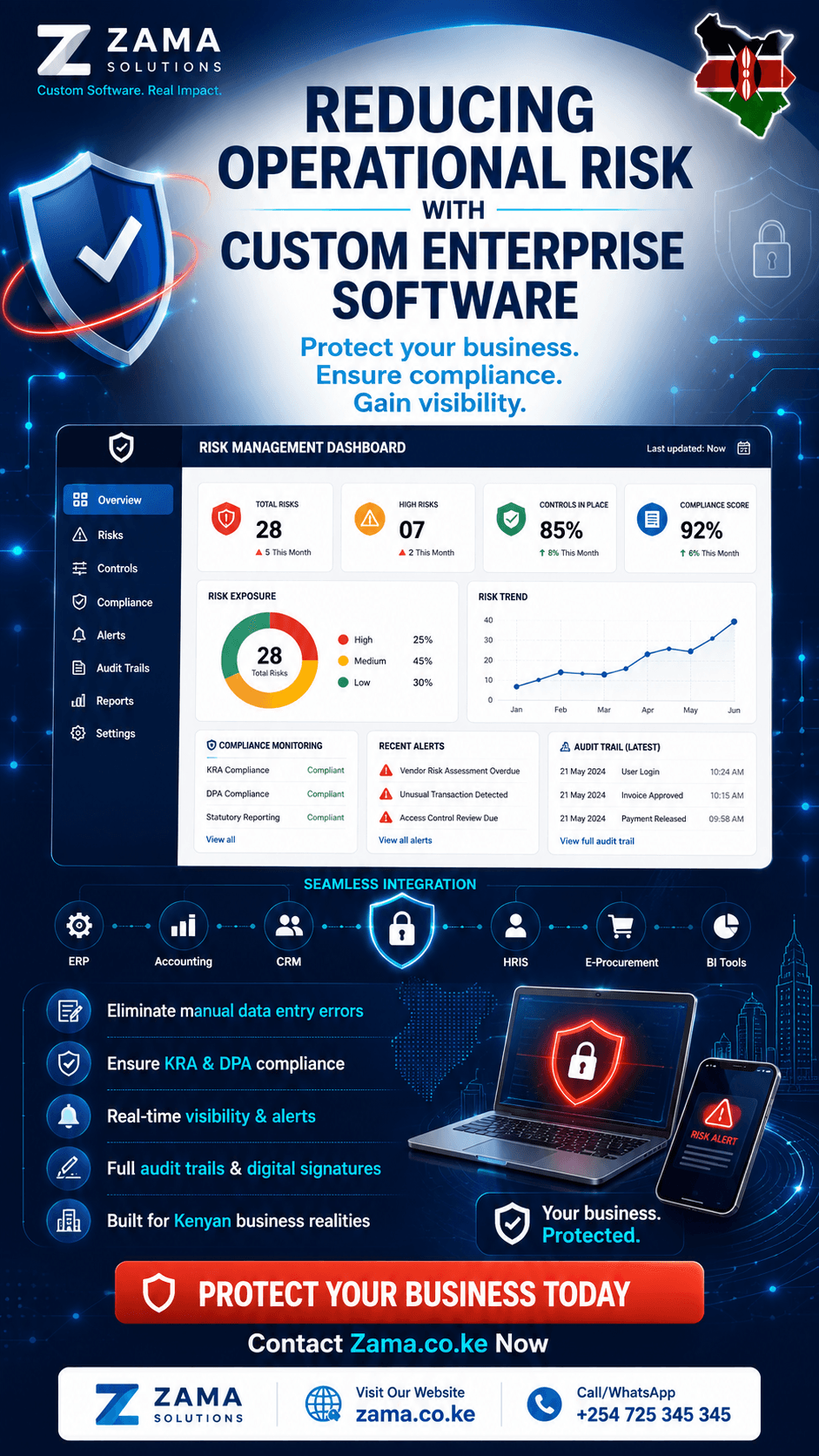
Reducing operational risk with custom enterprise software is a question that every business owner, operations director, and compliance officer in Kenya must answer in 2026. With regulatory scrutiny intensifying across banking, manufacturing, logistics, and other sectors—and the cost of manual errors, data breaches, and compliance failures rising—the ability to proactively manage operational risk has become a strategic imperative. At zama.co.ke, we’ve helped numerous organizations across Kenya build custom enterprise software solutions that reduce operational risk, ensure compliance, and protect business continuity. This comprehensive guide explores reducing operational risk with custom enterprise software, from understanding the sources of operational risk to implementing solutions that deliver measurable protection.
The Cost of Operational Risk in Kenyan Organizations
Before diving into reducing operational risk with custom enterprise software, it’s essential to understand the scale of the problem. A Nairobi wholesale distributor recently lost KSh 14 million in a single month because their software couldn’t handle a surge in M-Pesa payments during a promotional period. The system crashed. Orders were lost. Customers walked away .
This isn’t rare. It’s epidemic. Over 60% of Kenyan SMEs report that their software systems don’t meet their actual business needs . And that “cheap” manual approach is costing most Nairobi SMEs between KSh 3 million and KSh 8 million per year . The spreadsheet isn’t saving you money—it’s just hiding the loss.
The numbers tell a stark story about reducing operational risk with custom enterprise software. The average SME in Nairobi spends significant amounts monthly on manual processes that software could automate . Consider the hidden costs: 15–20 hours per week in duplicated admin work across teams, 8–12% of stock value lost to poor inventory tracking, unnecessary KRA penalties from inaccurate records, and a full-time employee’s salary wasted on tasks a system could automate .
Understanding Operational Risk and How Software Addresses It
Operational risk refers to the potential for loss resulting from inadequate or failed internal processes, people, systems, or external events. In the Kenyan context, operational risks are amplified by unique challenges: fragmented systems, reliance on manual processes, inconsistent internet connectivity, and evolving regulatory requirements.
The key to reducing operational risk with custom enterprise software lies in building systems that address these specific challenges. Generic software—often designed for different markets—creates operational risks because it doesn’t account for local realities. As one analysis notes, most international SaaS platforms are not built for Kenya. They assume US credit cards, US tax structures, and a US business culture. They were never designed for the realities of doing business on Biashara Street or in Eastleigh .
How Custom Enterprise Software Reduces Operational Risk
1. Eliminating Manual Data Entry Errors
Manual processes are the greatest source of operational risk. When staff manually re-enter data between disconnected systems, errors compound. A Nairobi pharmacy chain was losing KSh 200,000 monthly to stockouts and expired inventory because their system couldn’t handle multiple branches, different suppliers, or real-time tracking .
Custom software eliminates manual data entry by integrating systems. A custom solution can connect M-Pesa Daraja API directly to bank statements in real time—payments matched to invoices within seconds, not days . This integration is fundamental to reducing operational risk with custom enterprise software because it eliminates the reconciliation errors that plague manual processes.
2. Ensuring Regulatory Compliance
Regulatory compliance is a major operational risk for Kenyan businesses. KRA updates eTIMS requirements frequently; the Data Protection Act imposes strict penalties for data breaches; and sector-specific regulations are constantly evolving. Generic software built for other markets rarely supports local compliance requirements out of the box.
Custom software can be built with KRA eTIMS compliance integrated from day one—every sale auto-generates a fiscal invoice, eliminating midnight scrambles before deadlines . This proactive approach to compliance is a cornerstone of reducing operational risk with custom enterprise software.
Co-operative Bank of Kenya recently implemented a new treasury management system as part of a broader strategy to modernise its treasury infrastructure. The platform embeds risk management capabilities covering credit, market, and operational risk—addressing key challenges in operational efficiency, risk management, and scalability .
3. Providing Real-Time Visibility and Control
Operational risk thrives in environments where management lacks visibility. Without real-time dashboards, emerging risks go unnoticed until they become crises. One logistics company struggled with manual tracking across 200+ deliveries daily using WhatsApp and paper. Orders were lost. Drivers were confused. Customers were angry .
Custom enterprise software provides real-time dashboards that show pending approvals, stock levels, and exceptions. RiskTech, a purpose-built risk management platform, enables organisations to identify, measure, control, monitor, and report risks seamlessly and efficiently all within a single integrated environment. It provides automated risk dashboards that update as risk data changes, dynamic risk heatmaps for visual identification of risk concentrations, and board-ready risk reports generated in minutes, not days .
4. Automating Approval Workflows and Audit Trails
Manual approval processes create significant operational risk. Kenya’s premier public-health research organization, KEMRI, had automated many workflows but lacked a native, legally binding digital-signature capability. Manual sign-off processes delayed approvals by 3–5 days, and scanned PDF signatures carried non-compliance risk under Kenyan e-signature laws .
Custom software automates approval workflows with legally compliant digital signatures, full audit trails, and timestamped non-repudiable logs for each signature event . This reduces operational risk by ensuring every decision is documented, approved by the right authority, and traceable.
5. Protecting Against System Failures and Downtime
Operational risk includes the risk of system failures. Generic software often crashes under peak loads. A Nairobi wholesale distributor lost KSh 14 million in a single month because their “custom software” couldn’t handle a surge in M-Pesa payments during a promotional period .
Custom enterprise software can be architected for Kenyan conditions—offline-capable, optimized for low-bandwidth networks, and scalable to handle volume spikes. Built-to-scale solutions avoid costly rebuilds and grow with your business without the KSh 1 million+ price tag of replacing entire systems .
The Zama.co.ke Approach
When considering reducing operational risk with custom enterprise software, zama.co.ke follows a structured approach:
Operational Risk Assessment
We identify the sources of operational risk in your organization: manual processes, fragmented systems, compliance gaps, and visibility limitations.
Process Mapping and Redesign
Before building any system, we understand how work actually happens—where errors occur, where delays happen, and where information gets lost.
Custom Solution Design
We design software that addresses your specific risk points, built on a modern, secure architecture with full audit capabilities.
Integration and Deployment
We connect your systems—ERP, CRM, M-Pesa, bank accounts, and KRA platforms—to create a single source of truth.
Post-Launch Support
We remain available to maintain, refine, and extend your solution as your business evolves and new risks emerge.
Reducing operational risk with custom enterprise software is essential for any Kenyan organization operating in 2026. From eliminating manual errors and ensuring regulatory compliance to providing real-time visibility and protecting against system failures, the right software transforms how businesses manage risk.
At zama.co.ke, we’ve helped organizations across Kenya build custom enterprise software that reduces operational risk and protects business continuity. Our approach ensures you get exactly what your organization needs—nothing more, nothing less.
Don’t let the complexity of reducing operational risk with custom enterprise software hold you back. Whether you’re a small SME or a large enterprise, we have the expertise to guide you through every step.
Contact zama.co.ke today and let us help you build a custom enterprise software solution that protects your business from operational risk.