
Replace Manual Systems Kenya for Modern Business Growth
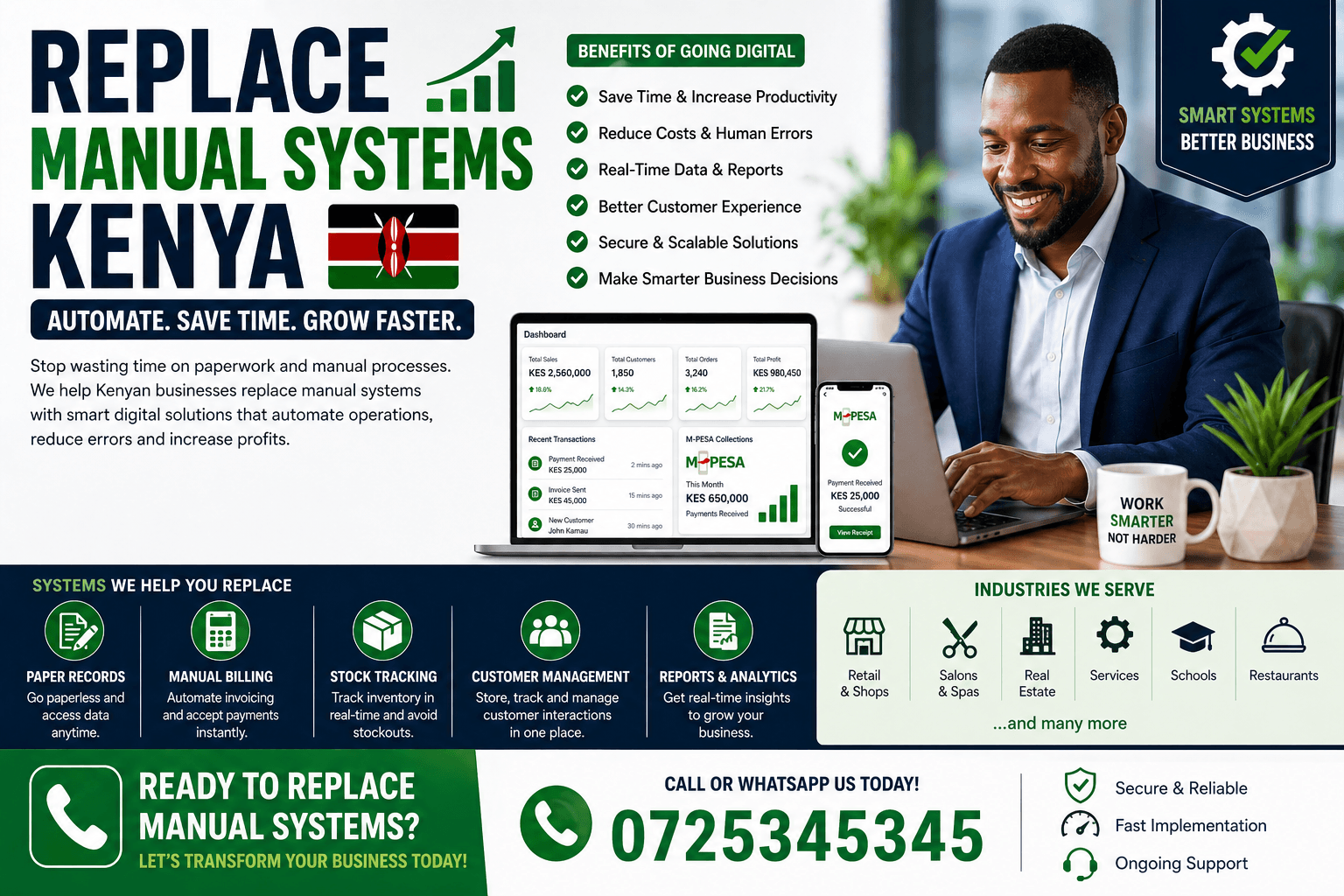
If you’re looking to Replace Manual Systems Kenya, you’re taking a decisive step toward improving efficiency, cutting costs, and scaling your operations. Manual processes—paper records, spreadsheets, and repetitive data entry—slow businesses down and increase errors. Companies that replace manual systems in Kenya gain speed, accuracy, and real-time control.
Making the move to digital systems allows your business to operate 24/7, serve customers faster, and make data-driven decisions.
🚀 Why You Should Replace Manual Systems Kenya Today
Businesses that replace manual systems Kenya experience:
- Faster operations and reduced delays
- Fewer errors in billing, reporting, and inventory
- Lower operational costs
- Better customer experience
- Real-time visibility across the business
With mobile payments like M-Pesa, it’s easier than ever to modernize how you collect and manage money.
🔧 What It Means to Replace Manual Systems
To replace manual systems Kenya means transitioning from paper-based or disconnected processes to integrated digital platforms that handle:
- Customer management (CRM)
- Sales and POS tracking
- Inventory control
- Payments and invoicing
- HR and payroll
- Reporting and analytics
Instead of chasing records, your system updates everything automatically.
🧩 Key Areas to Replace Manual Systems Kenya
1. Payments & Billing
Move from cash tracking to automated payments:
- Instant confirmations
- Automatic receipts
- Real-time reconciliation with M-Pesa
2. Customer Records
Replace notebooks and scattered files with a centralized CRM:
- Store customer data
- Track interactions
- Automate follow-ups
3. Sales & Inventory
Manual stock tracking leads to losses. Digital systems:
- Update stock in real time
- Track sales automatically
- Alert on low inventory
4. Reporting & Accounting
Instead of end-month manual reports:
- Get dashboards instantly
- Track profit and expenses
- Make faster decisions
5. Workflow & Operations
Replace manual coordination with:
- Task automation
- Approval workflows
- Notifications and reminders
📊 Before vs After You Replace Manual Systems Kenya
| Process | Manual System | Digital System |
|---|---|---|
| Payments | Cash tracking | Automated with M-Pesa |
| Sales | Written records | Real-time POS |
| Customers | Paper files | CRM database |
| Reports | Manual calculations | Instant dashboards |
This is the transformation when you replace manual systems Kenya.
🏢 Industries That Benefit Most
🏬 Retail & Shops
- POS systems
- Inventory automation
- Supplier tracking
🏠 Property Management
- Rent automation
- Tenant portals
- Financial reporting
💇 Salons & Services
- Booking systems
- Client management
- Payment automation
🌐 Online Businesses
- E-commerce systems
- Automated orders
- Payment integrations
Step-by-Step Plan to Replace Manual Systems Kenya
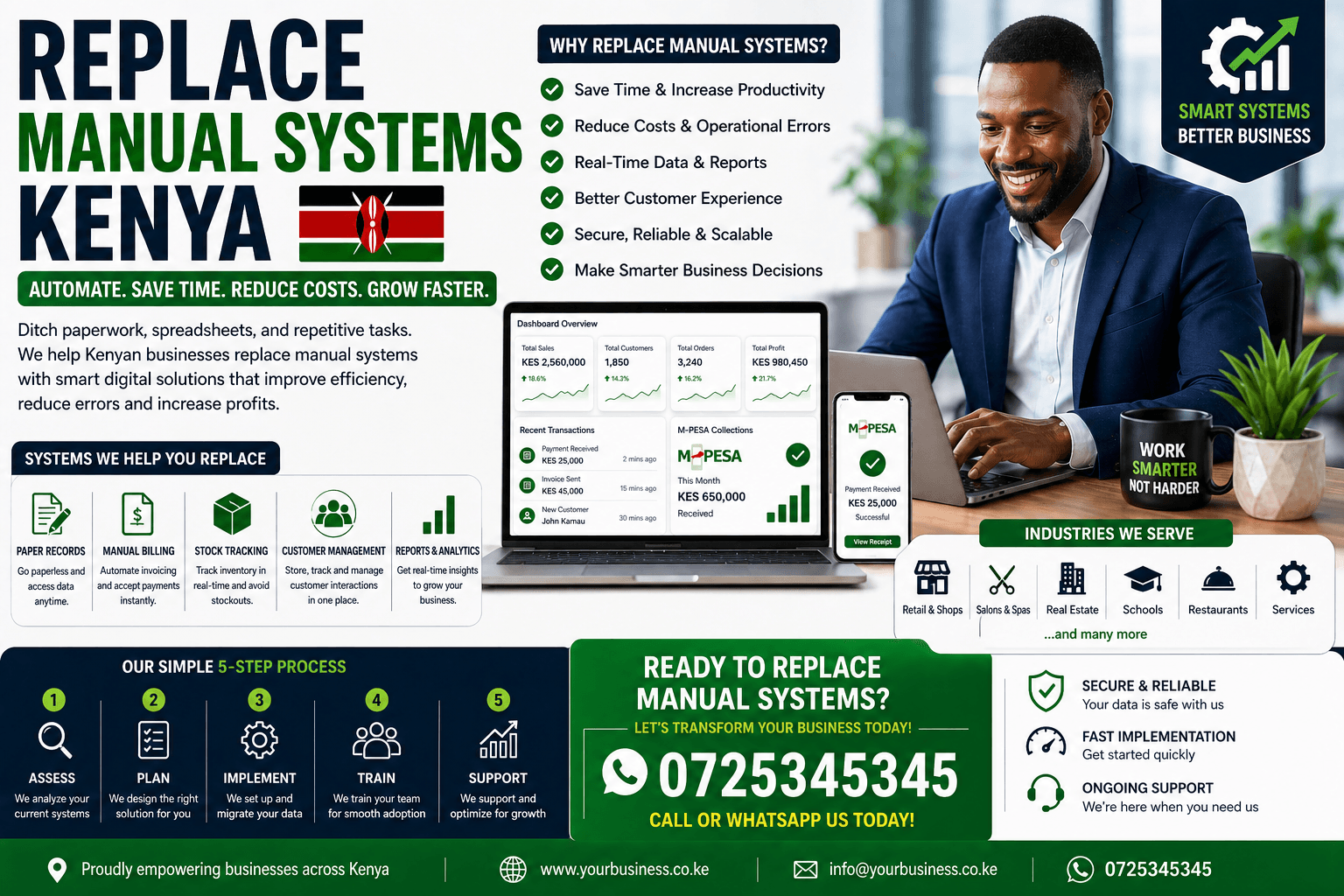
Step 1: Audit Your Current Processes
Identify where manual work causes delays or errors.
Step 2: Choose the Right Systems
Select tools for CRM, POS, billing, and operations.
Step 3: Integrate Payments
Connect to M-Pesa for seamless transactions.
Step 4: Train Your Team
Ensure your staff can use the system effectively.
Step 5: Monitor and Optimize
Track performance and improve continuously.
⚠️ Common Mistakes to Avoid
When you replace manual systems Kenya, avoid:
- Switching too many systems at once
- Choosing complex tools your team can’t use
- Ignoring integration between systems
- Skipping training and onboarding
💰 Cost of Replacing Manual Systems in Kenya
Costs vary depending on business size:
- Small businesses: KES 20,000 – 100,000
- Medium businesses: KES 100,000 – 500,000
- Enterprise systems: KES 500,000+
Start small, then expand as your business grows.
📈 Long-Term Benefits
Businesses that replace manual systems Kenya gain:
- Scalability across multiple branches
- Better decision-making through data
- Higher profitability
- Strong competitive advantage
🔐 Security & Reliability
As you digitize:
- Use secure systems and backups
- Control user access
- Protect customer data
- Ensure system uptime
Reliability is key when you replace manual systems Kenya.
🏁 Final Thoughts
To grow in today’s market, you must replace manual systems Kenya. Businesses that move early gain speed, control, and scalability.
✔ Eliminate paperwork
✔ Reduce errors
✔ Improve efficiency
✔ Scale faster
🚀 Call to Action
Now is the time to replace manual systems Kenya and transform your business into a fully digital, automated operation.
Integrations That Make Replacement Successful
To fully Replace Manual Systems Kenya, your tools must be connected. Integration ensures that one action updates every part of your business.
Essential Integrations:
- Payments + Accounting: automatic reconciliation via M-Pesa
- POS + Inventory: stock updates instantly after every sale
- CRM + Communication: auto follow-ups via SMS/WhatsApp
- Website + Leads: capture and assign prospects automatically
Disconnected tools recreate manual work—connected systems eliminate it.
⚙️ Recommended System Stack (Kenya)
🟢 Starter (Small Businesses)
- Basic CRM
- Simple invoicing + mobile payments
- Lightweight reporting
🟡 Growth (Scaling Businesses)
- Advanced CRM with workflows
- POS + inventory
- Automated billing and reminders
🔴 Advanced (Multi-Branch / Enterprise)
- Full ERP (finance, HR, operations)
- Multi-branch dashboards
- Role-based access control (RBAC)
- Real-time analytics and forecasting
Choose a stack that fits your current size but can grow with you.
🧠 Practical Workflow After You Replace Manual Systems
A modern, efficient flow should look like:
- Lead captured (website/WhatsApp)
- Customer saved in CRM
- Quote or invoice generated
- Payment received via M-Pesa
- System updates records automatically
- Fulfillment or service triggered
- Customer notified instantly
- Reports updated in real time
This is how businesses operate once they Replace Manual Systems Kenya.
📊 KPIs to Track After Replacement
Measure impact to ensure success:
- Processing time per task (reduced)
- Error rate (near zero)
- Revenue growth
- Customer response time
- Stock accuracy (%)
- Operational cost savings
Data proves the ROI of replacing manual systems.
🛡️ Security, Backup & Compliance
When you Replace Manual Systems Kenya, protect your data:
- Role-based user permissions
- Secure hosting (SSL, firewalls)
- Automated daily backups
- Audit logs for accountability
- Compliance with Kenya data protection laws
Security is part of a professional system—not optional.
📱 Mobile-First Operations
Kenya is mobile-driven. After you Replace Manual Systems Kenya, ensure:
- Mobile dashboards for owners
- Field staff apps
- SMS confirmations for customers
- On-the-go access to reports
If it works on mobile, your business runs anywhere.
🧪 Testing Before Going Live
Before full rollout:
- ✔ Test payments (success/failure cases)
- ✔ Validate reports accuracy
- ✔ Check user permissions
- ✔ Test notifications (SMS/email)
- ✔ Simulate real transactions
A smooth launch prevents downtime and errors.
📈 Scaling Across Kenya
After you Replace Manual Systems Kenya, scaling becomes simple:
- Open branches without operational chaos
- Monitor all locations from one dashboard
- Standardize processes across counties
- Train new staff quickly
Digital systems remove growth limitations.
💼 New Revenue Opportunities
Replacing manual systems unlocks:
- Online sales channels
- Subscription services
- Automated upselling
- Data-driven marketing campaigns
You don’t just save money—you make more.
🔄 Continuous Improvement Strategy
Keep improving after you Replace Manual Systems Kenya:
- Review KPIs weekly
- Identify bottlenecks
- Automate additional processes
- Train your team
- Optimize continuously
The best businesses evolve constantly.
🏁 Strong Closing
Manual systems slow you down. Digital systems move you forward.
If you want speed, accuracy, and growth, the next step is clear—Replace Manual Systems Kenya and build a business that runs efficiently, scales easily, and competes at the highest level.
Migration Plan to Replace Manual Systems Kenya (Zero Downtime)
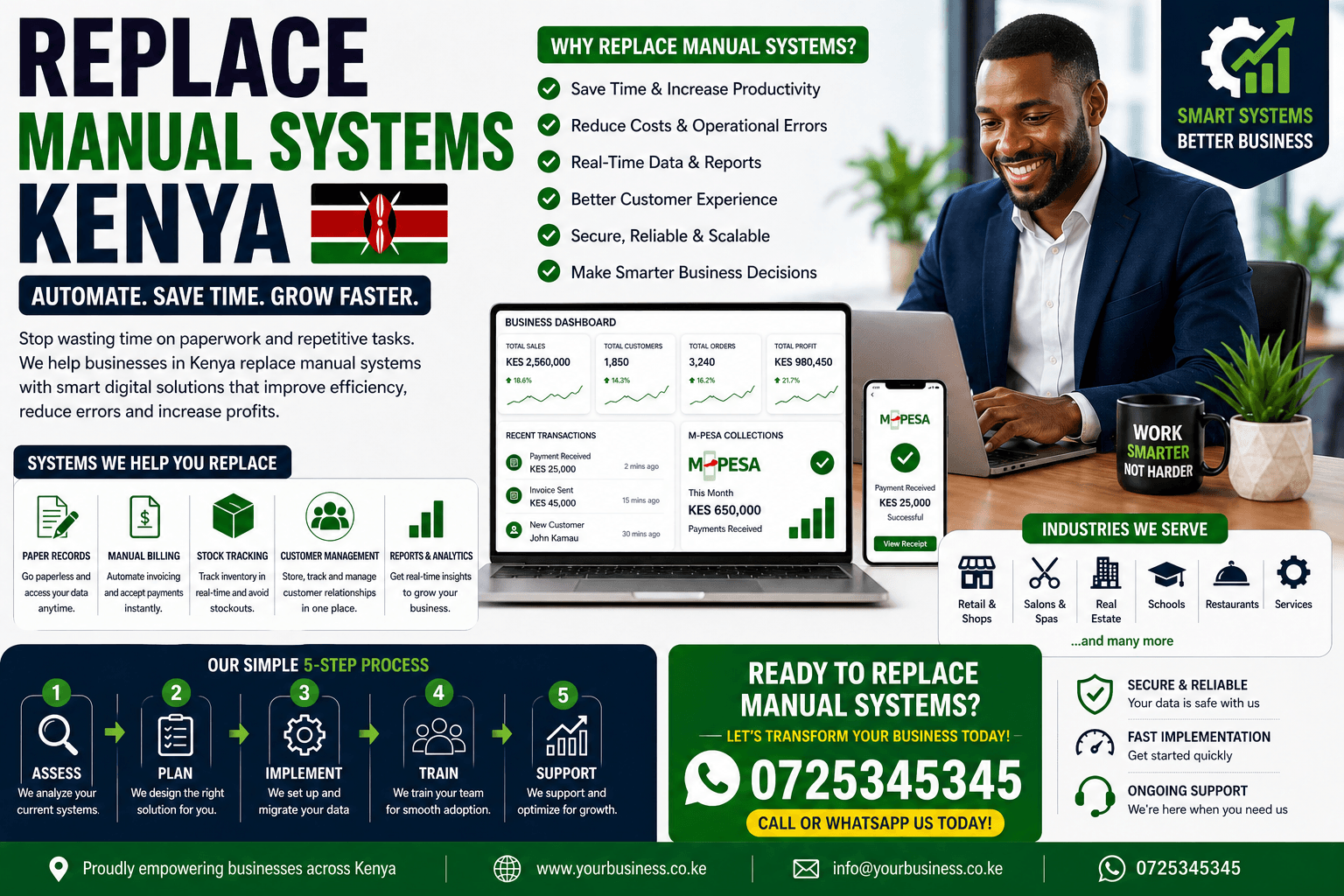
A smooth transition is critical when you Replace Manual Systems Kenya. Use a phased approach to avoid disruptions:
Phase 1: Discovery & Mapping
- Document all current manual workflows
- Identify bottlenecks and error-prone steps
- Define clear success metrics (speed, accuracy, cost)
Phase 2: System Design
- Choose tools (CRM, POS, ERP, billing)
- Design data structure (customers, products, transactions)
- Plan integrations, especially payments via M-Pesa
Phase 3: Data Migration
- Clean existing data (remove duplicates, fix errors)
- Import customers, inventory, and historical records
- Validate totals and balances after import
Phase 4: Pilot Rollout
- Start with one branch or department
- Run parallel (manual + digital) for a short period
- Fix gaps before full deployment
Phase 5: Full Go-Live
- Switch off manual processes
- Enforce system usage across teams
- Monitor closely during the first 2–4 weeks
🧠 Change Management (Make Your Team Adopt Fast)
Even the best systems fail without adoption. When you Replace Manual Systems Kenya, manage people, not just tools:
- Training sessions: role-based (sales, finance, ops)
- Simple SOPs: step-by-step guides for daily tasks
- Champions: assign power users in each department
- Incentives: reward teams that fully adopt the system
- Support: quick help desk for issues during rollout
Adoption = results.
⚙️ Data Structure You Should Get Right
Before you Replace Manual Systems Kenya, standardize your core data:
- Customers: name, phone, email, location, history
- Products/Services: SKU, price, cost, category
- Transactions: invoices, payments, refunds
- Inventory: opening stock, movements, suppliers
- Users/Roles: permissions for access control
Clean data ensures accurate reports and smooth operations.
🔄 Automation Rules That Save the Most Time
Set up these rules immediately after you Replace Manual Systems Kenya:
- Auto-generate invoices on order creation
- Send payment reminders before due dates
- Trigger receipts instantly after payment
- Alert low stock levels automatically
- Assign leads based on location or workload
Small automations compound into huge time savings.
📊 Reporting You Must Enable from Day One
After you Replace Manual Systems Kenya, track:
- Daily sales & collections
- Outstanding invoices (aging report)
- Top-selling products/services
- Stock valuation & movement
- Profit & loss (weekly/monthly)
Real-time visibility is the biggest upgrade from manual systems.
🛡️ Reliability & Uptime
To keep your digital operations stable:
- Use cloud hosting with high uptime (99.9%+)
- Schedule automated backups (daily + offsite)
- Enable fail-safes for payments and receipts
- Monitor system logs and errors
A reliable system builds trust internally and with customers.
📱 Field Operations (Run Your Business Anywhere)
When you Replace Manual Systems Kenya, empower teams outside the office:
- Sales reps capture orders on mobile
- Technicians update job status on-site
- Managers view dashboards from anywhere
- Customers receive SMS confirmations instantly
Mobility keeps operations moving in real time.
📈 Post-Implementation Optimization
After go-live, keep improving:
- Analyze slow steps and automate them
- Reduce clicks in common workflows
- Add integrations (e.g., SMS, email, APIs)
- Refine dashboards for decision-makers
Continuous optimization turns a good system into a great one.
💰 ROI Calculator (Simple Way to Justify the Switch)
Estimate your gains after you Replace Manual Systems Kenya:
- Hours saved per employee per week × hourly cost
- Reduction in errors/refunds
- Faster collections (improved cash flow)
- Increased sales from better follow-ups
Most businesses recover costs within months.
🏆 Final Takeaway
When you Replace Manual Systems Kenya, you’re not just upgrading tools—you’re upgrading how your business thinks and operates.
- Faster processes
- Accurate data
- Better decisions
- Easier scaling
Move from paperwork to performance. Replace manual systems and run your business like a modern, high-growth company.