
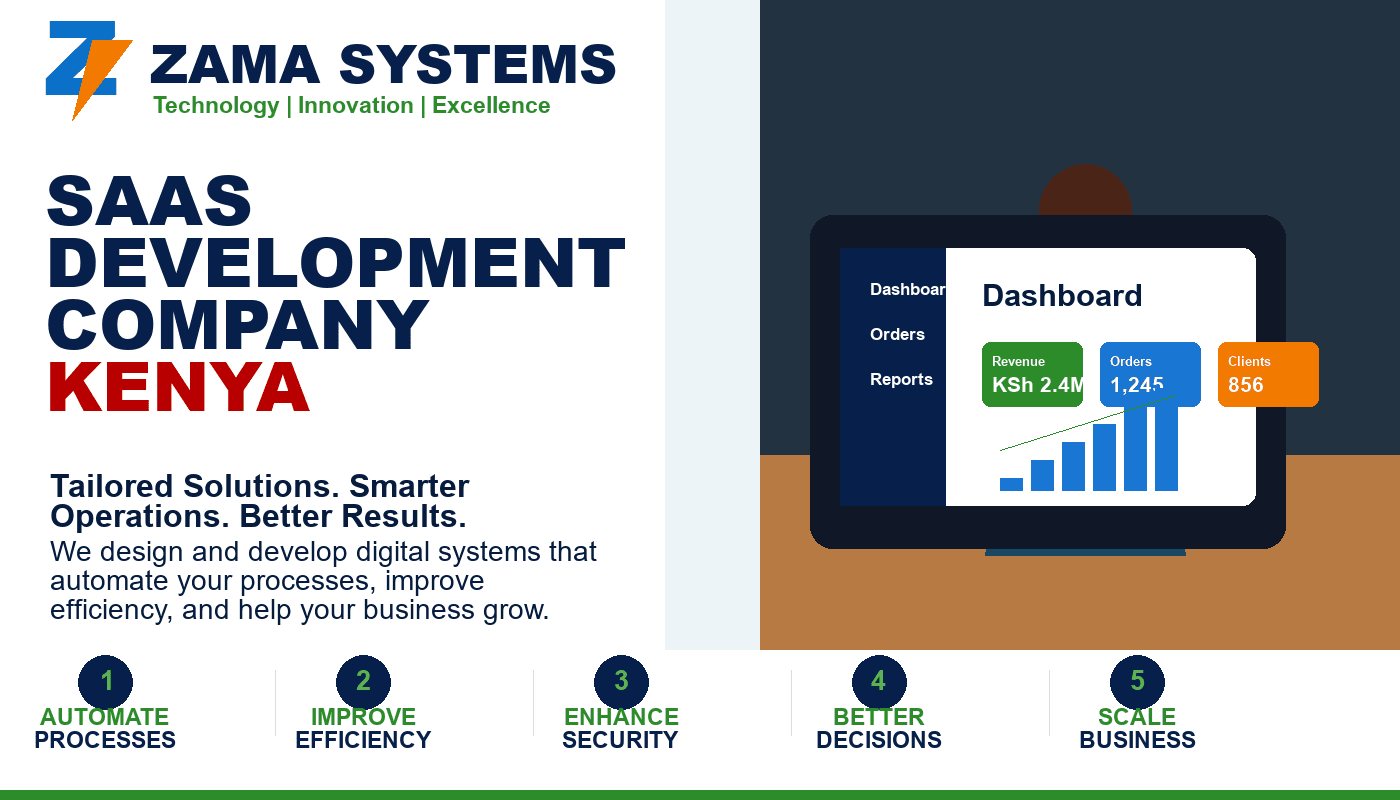
SaaS Development Company Kenya: Why Businesses Are Moving to Software-as-a-Service
The software industry is changing rapidly. Businesses no longer want complicated software installations, expensive hardware, or systems that are difficult to maintain. Instead, organizations are embracing cloud-based solutions that are accessible from anywhere, scalable, and easier to manage.
This shift has led to the rapid growth of Software as a Service (SaaS) platforms.
Across Kenya, startups, SMEs, real estate firms, healthcare providers, educational institutions, financial companies, and large enterprises are investing in SaaS solutions to improve efficiency, reduce costs, and create new revenue streams.
As a leading SaaS Development Company in Kenya, Zama Web Experts
helps organizations design, build, and scale cloud-based software platforms that solve real business challenges.
Whether you’re creating a property management platform, customer portal, finance system, healthcare application, school management platform, or business automation solution, SaaS technology provides the foundation for growth.
For professional consultation, call +254725345345.
What Is SaaS?
Software as a Service (SaaS) is a software delivery model where applications are hosted online and accessed through a web browser.
Instead of purchasing software and installing it on individual computers, users subscribe to the platform and access it via the internet.
Examples of SaaS products include:
- Customer Relationship Management systems
- Property Management Platforms
- School Management Systems
- Accounting Software
- Human Resource Systems
- Customer Service Portals
- Inventory Management Platforms
- Business Automation Systems
SaaS platforms allow businesses to access software from anywhere while eliminating the need for expensive infrastructure.
Why SaaS Is Growing Rapidly in Kenya
Kenya is one of Africa’s leading technology markets.
Several factors are accelerating SaaS adoption.
Increased Internet Connectivity
Businesses now have reliable internet access, making cloud software practical for daily operations.
Mobile-First Economy
Kenya’s strong mobile adoption supports online business systems and SaaS platforms.
M-Pesa Integration
The ability to integrate mobile payments into software systems has created significant opportunities for SaaS businesses.
Digital Transformation
Organizations are replacing manual processes with modern software solutions.
Cost Efficiency
SaaS eliminates large upfront software investments.
Businesses only pay for what they use.
Benefits of SaaS Platforms
Accessibility from Anywhere
Users can access SaaS applications from:
- Offices
- Homes
- Field locations
- Mobile devices
This flexibility improves productivity.
Lower Costs
Traditional software often requires:
- Servers
- Installation costs
- Maintenance expenses
- IT infrastructure
SaaS reduces these costs significantly.
Automatic Updates
Software updates are deployed centrally.
Users always access the latest version without manual installations.
Scalability
As organizations grow, SaaS platforms can support:
- More users
- Additional modules
- Increased data volume
- Expanded operations
Businesses can scale without replacing systems.
Improved Security
Modern SaaS platforms implement:
- Encryption
- Role-based access
- Activity monitoring
- Secure authentication
Security remains a top priority.
Types of SaaS Platforms Businesses Need
Property Management SaaS
Property managers need systems that automate:
- Rent collection
- Tenant management
- Maintenance requests
- Financial reporting
SaaS property platforms improve operational efficiency.
Customer Service Platforms
Businesses need centralized customer support systems.
Features include:
- Ticket management
- Request tracking
- Customer communication
- Reporting dashboards
School Management Systems
Educational institutions require software for:
- Student records
- Admissions
- Fee tracking
- Academic reporting
A SaaS platform simplifies administration.
Healthcare Management Platforms
Healthcare organizations use SaaS solutions for:
- Patient records
- Billing
- Appointment scheduling
- Reporting
This improves service delivery.
Financial Management Systems
Finance-focused SaaS platforms support:
- Billing
- Invoicing
- Collections
- Reconciliation
- Reporting
Automation improves financial visibility.
Characteristics of Successful SaaS Platforms
Not all SaaS products succeed.
The most successful platforms share several characteristics.
User-Friendly Design
Users should easily understand the platform.
Complex systems discourage adoption.
Scalability
A SaaS platform should support future growth.
Architecture must accommodate increasing demand.
Strong Security
Users trust SaaS providers with sensitive information.
Security must be built into every layer of the platform.
Reliable Performance
Slow systems frustrate users.
Performance optimization is critical.
Valuable Reporting
Business leaders require insights.
Dashboards and reports increase software value.
SaaS Development Process
Discovery Phase
The project begins by understanding:
- Business objectives
- User roles
- Workflows
- Technical requirements
This ensures software aligns with organizational goals.
System Architecture
The platform structure is planned.
This includes:
- Database design
- Security architecture
- User permissions
- Integration requirements
Strong architecture supports long-term scalability.
User Experience Design
User interfaces are designed to maximize usability.
The goal is to make software intuitive and efficient.
Development
The application is built using modern technologies.
Features are developed in structured milestones.
Testing
Comprehensive testing verifies:
- Functionality
- Security
- Performance
- Responsiveness
Quality assurance reduces risk.
Deployment
The SaaS platform is launched into production.
Users gain access to the system.
Ongoing Support
Continuous improvements ensure long-term success.
Maintenance includes:
- Updates
- Security patches
- Feature enhancements
- Technical support
Essential SaaS Features
User Authentication
Secure login systems protect user accounts.
Features include:
- Password security
- Multi-factor authentication
- Session management
Role-Based Permissions
Different users require different access levels.
Role-based access improves security and usability.
Subscription Management
SaaS businesses often operate on recurring revenue models.
Subscription features include:
- Billing
- Plan management
- Payment processing
- Account upgrades
Reporting Dashboards
Users need visibility into their activities and performance.
Dashboards provide valuable insights.
Notifications
Systems communicate with users through:
- SMS
- In-app alerts
Automation improves engagement.
M-Pesa Integration in SaaS Platforms
For Kenyan businesses, M-Pesa integration is often essential.
Benefits include:
Automated Payments
Users pay directly through the platform.
Subscription Billing
Recurring payments become easier to manage.
Payment Reconciliation
Transactions are automatically matched with accounts.
Financial Reporting
Revenue visibility improves significantly.
M-Pesa integration creates a better customer experience.
Technologies Used for SaaS Development
At Zama Web Experts, we utilize proven technologies such as:
- Laravel
- React
- Vue.js
- Node.js
- PostgreSQL
- MySQL
- Cloud Infrastructure
- REST APIs
Technology selection depends on platform requirements and growth expectations.
Industries Benefiting from SaaS Development
Real Estate
Property operations, tenant management, and financial reporting.
Education
Student administration and fee management.
Healthcare
Patient management and billing systems.
Retail
Inventory, sales tracking, and reporting.
Finance
Collections, approvals, and financial visibility.
Logistics
Dispatch tracking and operational management.
Why Businesses Choose Custom SaaS Development
Off-the-shelf software often forces businesses to adapt their processes.
Custom SaaS development allows organizations to:
- Build around existing workflows
- Create unique competitive advantages
- Integrate specialized requirements
- Maintain ownership of their platform
Custom solutions provide greater flexibility.
Future of SaaS in Kenya
The future of SaaS is closely tied to:
Artificial Intelligence
AI-powered automation and analytics.
Business Intelligence
Advanced reporting and forecasting.
Mobile Applications
Companion mobile experiences for users.
Cloud Infrastructure
Highly scalable environments.
Hyperautomation
Combining workflows, AI, and integrations.
Organizations investing in SaaS today position themselves for long-term success.
Why Choose Zama Web Experts as Your SaaS Development Company in Kenya?
, we specialize in building SaaS products that solve operational challenges and create business opportunities.
Our expertise includes:
- SaaS Development
- Enterprise Software Development
- Web Portal Development
- Business Automation Systems
- Mobile Applications
- M-Pesa Integrations
- API Integrations
- Long-Term Platform Support
We focus on creating software that users adopt, businesses depend on, and organizations can scale.
Conclusion
SaaS has transformed the way businesses operate. Instead of relying on outdated systems and manual processes, organizations now have access to scalable, cloud-based software that improves efficiency, visibility, and growth.
Whether you’re launching a new software product, modernizing operations, or creating a platform for customers and staff, SaaS provides a powerful foundation for success.
If you’re looking for a trusted SaaS Development Company in Kenya, partner with Zama Web Experts
.
Contact Zama Web Experts
📞 Phone: +254725345345
🌐 Website: www.zama.co.ke