
School ERP Development Kenya: The Ultimate Guide to Digitizing School Management in 2026
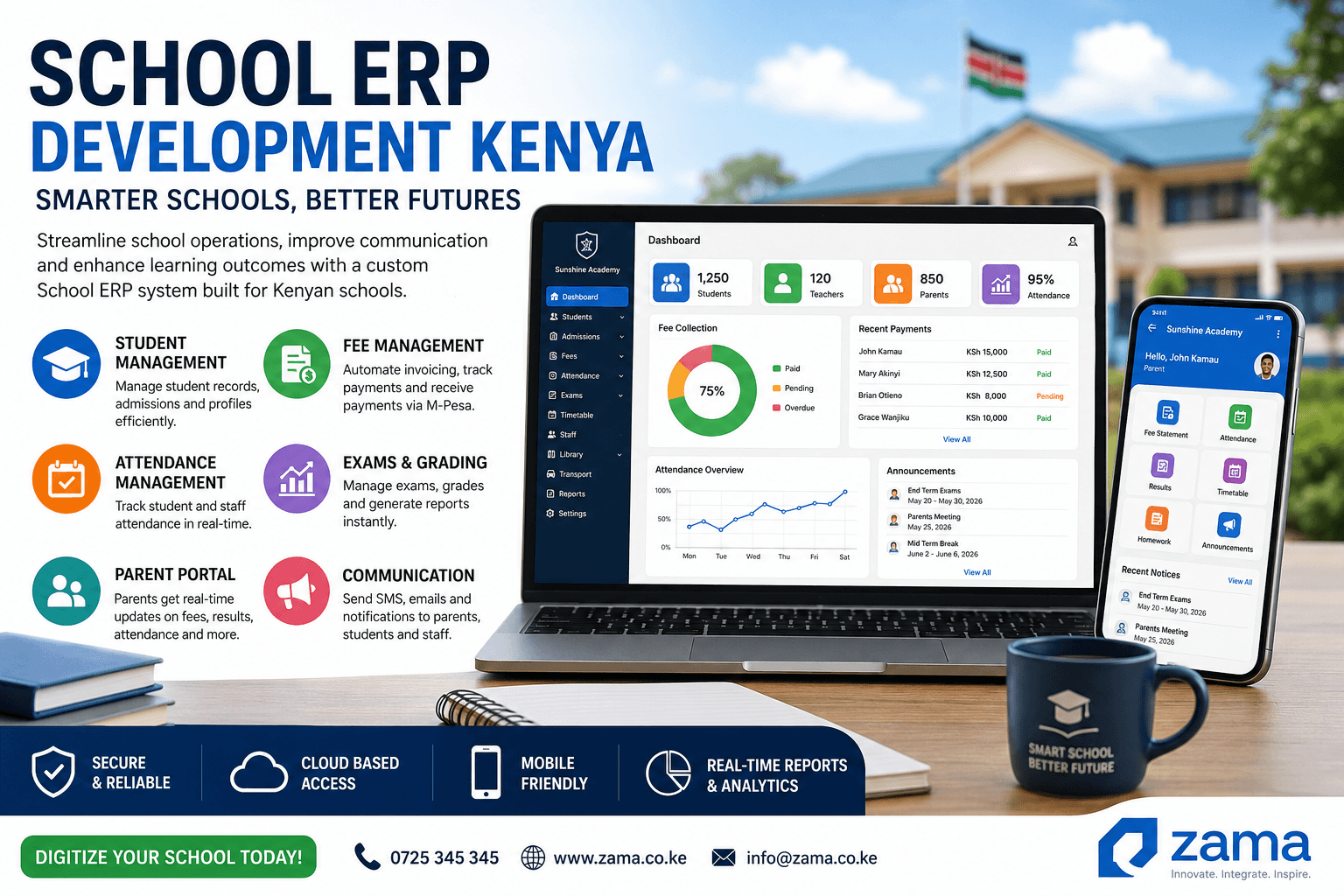
Managing a modern educational institution involves much more than teaching students. Schools must handle admissions, fee collection, examinations, attendance, transport, communication, payroll, library management, and compliance with government regulations. Manual processes are becoming inefficient, costly, and prone to errors. This is why School ERP Development Kenya has become a priority for schools seeking to improve efficiency and provide better services to parents, teachers, and students.
Whether you operate a kindergarten, primary school, secondary school, college, university, or technical institution, investing in School ERP Development Kenya enables you to centralize operations, automate repetitive tasks, and make data-driven decisions.
At Zama, we specialize in developing customized School ERP solutions that match the specific needs of Kenyan educational institutions. Our systems are secure, scalable, mobile-friendly, and integrated with local payment platforms such as M-Pesa.
What is School ERP Development Kenya?
School ERP Development Kenya refers to the process of designing and building software that manages every administrative and academic function of a school from a single centralized platform.
ERP stands for Enterprise Resource Planning. In education, it connects different departments into one integrated system.
Instead of maintaining separate spreadsheets for admissions, finance, examinations, and attendance, everything is managed within one application.
A modern School ERP includes modules for:
- Student Information
- Admissions
- Fee Management
- Timetable
- Attendance
- Examination Management
- Results Processing
- Payroll
- Human Resources
- Transport
- Hostel Management
- Inventory
- Procurement
- Communication
- Parent Portal
- Teacher Portal
- Student Portal
- Library Management
With School ERP Development Kenya, administrators save time while improving accuracy and accountability.
Why Kenyan Schools Need ERP Systems
Education is becoming increasingly digital. Parents expect real-time updates about their children’s performance, attendance, fee balances, and school activities.
Schools relying on manual systems often struggle with:
- Lost records
- Duplicate data
- Fee reconciliation errors
- Delayed report cards
- Poor communication
- Long admission processes
- Time-consuming report generation
School ERP Development Kenya eliminates these challenges by automating workflows and providing instant access to information.
Schools using ERP systems experience:
- Faster operations
- Better parent satisfaction
- Improved financial management
- Accurate reporting
- Increased transparency
- Enhanced security
- Better decision-making
Challenges Facing Schools Without ERP Systems
Many Kenyan schools still rely on manual files or disconnected software.
Common challenges include:
Poor Fee Tracking
Finance offices spend hours reconciling payments from banks, M-Pesa, and cash transactions.
A customized ERP automatically updates fee balances after payment.
Manual Attendance Registers
Teachers spend valuable teaching time marking attendance manually.
Digital attendance allows instant reporting and parent notifications.
Delayed Communication
Parents may receive important announcements too late.
An ERP sends:
- SMS alerts
- Email notifications
- Mobile app notifications
Difficult Report Generation
Preparing academic reports manually takes days.
With School ERP Development Kenya, report cards are generated instantly.
Data Duplication
The same student information is entered multiple times.
ERP systems store information once and make it available across departments.
Key Modules of School ERP Development Kenya
Student Information Management
This module stores:
- Student profiles
- Admission numbers
- Parent contacts
- Medical records
- Academic history
- Fee balances
- Discipline records
Everything is accessible from one dashboard.
Admissions Management
Admission processes become faster by allowing:
- Online applications
- Document uploads
- Applicant evaluation
- Admission letters
- Student registration
This module significantly improves the enrollment experience.
Fee Management
Finance departments benefit from automated:
- Fee invoices
- Payment reminders
- Receipts
- Fee statements
- Outstanding balances
- Financial reports
The system supports M-Pesa integration for seamless payment collection.
Attendance Management
Teachers can record attendance using:
- Web portal
- Mobile phones
- Tablets
- Biometric devices
- RFID cards
Parents receive attendance notifications immediately.
Timetable Management
Administrators can create:
- Class schedules
- Teacher schedules
- Room allocations
- Subject timetables
Automatic conflict detection prevents scheduling errors.
Examination Management
The examinations module supports:
- Continuous Assessment Tests
- Mid-term exams
- End-term exams
- Competency-Based Curriculum assessments
- Grade calculations
- GPA computation
- Ranking
- Performance analysis
Teachers enter marks online, reducing paperwork.
Report Card Generation
Schools can generate professional report cards automatically.
Features include:
- Teacher comments
- Performance graphs
- Subject rankings
- Overall grades
- Attendance summaries
Parents can download reports online.
Library Management
The library module manages:
- Books
- Borrowing
- Returns
- Fines
- Digital resources
- Book reservations
Barcode support improves efficiency.
Payroll Management
Schools with many employees simplify payroll through:
- Salary processing
- Deductions
- Tax calculations
- Payslip generation
- Leave balances
- Pension management
Human Resource Module
The HR module handles:
- Employee records
- Recruitment
- Contracts
- Promotions
- Leave
- Performance reviews
- Staff training
Everything is stored securely.
Transport Management
Schools operating buses can manage:
- Routes
- Drivers
- Vehicle maintenance
- Fuel usage
- Student assignments
- Pickup points
Parents receive transport updates.
Hostel Management
Boarding schools benefit from:
- Room allocation
- Hostel occupancy
- Bed assignments
- Visitor management
- Student movement tracking
Inventory Management
Schools track:
- Furniture
- Computers
- Laboratory equipment
- Textbooks
- Stationery
- Sports equipment
Stock alerts prevent shortages.
Procurement Management
Automate purchasing through:
- Purchase requests
- Supplier management
- Quotations
- Purchase orders
- Delivery tracking
- Invoice approvals
This improves accountability.
Parent Portal
Parents can log in to:
- View fee balances
- Download receipts
- Check attendance
- View report cards
- Read announcements
- Message teachers
This strengthens school-parent communication.
Teacher Portal
Teachers can:
- Record attendance
- Enter exam marks
- Access timetables
- Manage assignments
- Communicate with parents
Everything is accessible online.
Student Portal
Students can:
- Access assignments
- Download notes
- View timetables
- Check results
- Receive announcements
- Track academic progress
The portal supports remote learning and self-service.
Communication Module
An ERP centralizes communication by enabling schools to send:
- Fee reminders
- Exam schedules
- Event notifications
- Emergency alerts
- Holiday notices
- Academic updates
Communication can be delivered via SMS, email, or mobile app notifications.
Benefits of School ERP Development Kenya
Investing in School ERP Development Kenya provides measurable advantages for institutions of all sizes.
Improved Administrative Efficiency
Automated workflows reduce repetitive manual tasks, allowing staff to focus on student success rather than paperwork.
Better Financial Management
Finance teams gain accurate fee tracking, automated invoicing, and real-time financial reports, helping reduce revenue leakage.
Enhanced Transparency
Parents, teachers, administrators, and school boards all have access to the information they need, improving trust and accountability.
Faster Decision-Making
With dashboards and analytics, school leaders can monitor enrollment, fee collection, academic performance, and attendance in real time.
Stronger Parent Engagement
Parents stay informed through instant notifications, online portals, and easy access to student information, fostering stronger collaboration between home and school.
Improved Data Security
Unlike paper records, ERP systems include user permissions, encrypted databases, automated backups, and audit trails to protect sensitive school information.
Scalability
As a school grows, additional modules and users can be added without disrupting operations, making School ERP Development Kenya a long-term investmen
Advanced Features of School ERP Development Kenya
As technology evolves, schools require more than basic administration tools. Modern School ERP Development Kenya solutions incorporate advanced technologies that improve learning outcomes, strengthen communication, and simplify management.
Cloud-Based Accessibility
Cloud technology allows users to access the ERP system from anywhere with an internet connection. School administrators, teachers, parents, and students can log in securely using computers, tablets, or smartphones.
Benefits include:
- No expensive on-site servers
- Automatic software updates
- Secure cloud backups
- Lower maintenance costs
- Easy scalability
Cloud-based School ERP Development Kenya ensures uninterrupted access to school information, whether users are on campus or working remotely.
Mobile Application Integration
A mobile app makes school management even more convenient. Parents can receive notifications instantly, while teachers can update attendance and grades on the go.
Mobile app features include:
- Fee balance inquiries
- Push notifications
- Homework updates
- Exam results
- Timetables
- Attendance reports
- School announcements
- Event reminders
This level of accessibility makes School ERP Development Kenya more valuable for today’s digitally connected families.
M-Pesa and Bank Payment Integration
One of the biggest advantages of customized School ERP Development Kenya is integration with local payment methods.
Parents can pay school fees using:
- M-Pesa
- Bank transfers
- Debit cards
- Credit cards
- Mobile banking
Once payment is completed, the ERP automatically:
- Updates the student’s account
- Generates a receipt
- Sends confirmation via SMS or email
- Updates financial reports
This eliminates manual reconciliation and reduces accounting errors.
Business Intelligence and Analytics
School leaders require accurate data to make informed decisions. ERP dashboards provide insights into:
- Student enrollment trends
- Fee collection performance
- Attendance statistics
- Academic performance
- Staff productivity
- Financial reports
- Budget utilization
These analytics help administrators improve planning and resource allocation.
Learning Management System (LMS) Integration
Schools offering digital learning can integrate an LMS into their ERP system.
Features include:
- Online classes
- Assignment submission
- Digital examinations
- Video lessons
- Course materials
- Student discussions
- Performance tracking
This creates a complete digital learning environment.
How School ERP Development Kenya Improves Different Departments
Administration
Administrators benefit from centralized information that improves coordination across all departments.
Tasks become easier, including:
- Student registration
- Staff management
- Timetable planning
- Resource allocation
- School communication
- Reporting
Finance Department
Finance teams can automate:
- Billing
- Receipts
- Fee reminders
- Expense tracking
- Budget preparation
- Financial statements
- Audit reports
This minimizes revenue leakage and improves accountability.
Teachers
Teachers spend less time on paperwork and more time teaching.
They can:
- Mark attendance
- Record marks
- Generate report cards
- Share assignments
- Communicate with parents
- Monitor student performance
Parents
Parents appreciate having immediate access to important information such as:
- Fee balances
- Attendance
- Exam results
- Homework
- School notices
- Event calendars
This strengthens parent-school collaboration.
Students
Students benefit from:
- Online learning resources
- Assignment tracking
- Academic progress monitoring
- Timetables
- Examination schedules
- Digital report cards
The School ERP Development Process
At Zama, we follow a structured software development process to deliver reliable and scalable ERP solutions.
1. Requirement Gathering
We begin by understanding the school’s operations, objectives, and unique challenges.
This includes consultations with:
- School directors
- Principals
- Finance officers
- Teachers
- ICT staff
- Parents where applicable
2. System Design
Our team designs:
- Database architecture
- User interfaces
- Security framework
- Workflow diagrams
- Mobile responsiveness
The design ensures a user-friendly experience for all stakeholders.
3. Software Development
Our developers build each module according to the approved requirements, ensuring seamless integration between departments.
4. Testing
Before deployment, the ERP undergoes extensive testing to verify:
- Functionality
- Performance
- Security
- Compatibility
- Data accuracy
Any issues identified are resolved before launch.
5. Deployment
The completed system is deployed either on cloud infrastructure or the school’s preferred hosting environment. Existing data can be migrated from spreadsheets or legacy systems.
6. User Training
Successful implementation depends on user adoption. We provide comprehensive training for administrators, finance staff, teachers, and other users to ensure they can confidently use the system.
7. Ongoing Support and Maintenance
After deployment, we continue to support schools through:
- Technical assistance
- Security updates
- Feature enhancements
- Performance monitoring
- System maintenance
Why Choose Zama for School ERP Development Kenya?
Zama is a trusted Kenyan software development company delivering innovative solutions for educational institutions.
When you choose Zama for School ERP Development Kenya, you benefit from:
- Customized ERP solutions tailored to your school’s needs
- Secure and scalable cloud-based systems
- M-Pesa and banking integrations
- Mobile-friendly interfaces
- Comprehensive user training
- Reliable technical support
- Affordable implementation costs
- Continuous system improvements
We work closely with schools to develop software that simplifies administration while enhancing the learning experience.
Case Study: Digital Transformation of a Kenyan School
A private secondary school with over 1,000 students struggled with manual fee reconciliation, paper attendance registers, and delayed report card preparation.
After implementing a customized School ERP Development Kenya solution from Zama:
- Fee reconciliation time reduced by 80%
- Report card preparation reduced from five days to a few hours
- Parent communication improved through automated SMS and email notifications
- Attendance tracking became real-time
- Administrative workload reduced significantly
- Financial reporting became faster and more accurate
The school also experienced improved parent satisfaction due to increased transparency and faster access to information.
Customer Testimonials
“Our operations are now seamless.”
“The ERP system developed by Zama transformed the way we manage admissions, examinations, and fee collection. Everything is now centralized and easy to access.”
— School Director, Nairobi
“Parents appreciate the transparency.”
“Parents can check fee balances, attendance, and report cards online. Communication has greatly improved since implementing the system.”
— Principal, Nakuru
“Excellent support.”
“The Zama team understood our requirements and delivered a customized ERP solution that perfectly fits our school’s operations. Their support has been exceptional.”
— Finance Manager, Kisumu
Frequently Asked Questions (FAQs)
How long does it take to develop a School ERP?
Development timelines depend on the number of modules required, but most customized ERP systems are completed within a few weeks to a few months.
Can the ERP integrate with M-Pesa?
Yes. Our School ERP solutions support M-Pesa integration for fee payments, automatic reconciliation, and receipt generation.
Is the system suitable for CBC schools?
Absolutely. The ERP can be customized to support the Competency-Based Curriculum (CBC), including assessments, learner progress tracking, and reporting.
Can parents access the system using their phones?
Yes. Parents can use a secure web portal or mobile application to access student information, fee statements, and school communications.
Is the system secure?
Yes. We implement user authentication, role-based access control, encrypted data storage, and regular backups to ensure the security of school data.
Get Started with School ERP Development Kenya
Investing in School ERP Development Kenya is one of the most effective ways to improve efficiency, reduce operational costs, and enhance the educational experience for students, parents, teachers, and administrators.
Whether you are running a kindergarten, primary school, secondary school, college, university, or technical institution, Zama can design a customized ERP solution that fits your unique requirements.
Our team is committed to delivering reliable, secure, and scalable software that grows with your institution. From admissions and fee management to examinations, communication, payroll, and analytics, we provide end-to-end digital solutions that help schools thrive in today’s technology-driven environment.
Contact Zama today to discuss your School ERP project and discover how a customized solution can transform your institution into a smarter, more efficient, and future-ready school.