
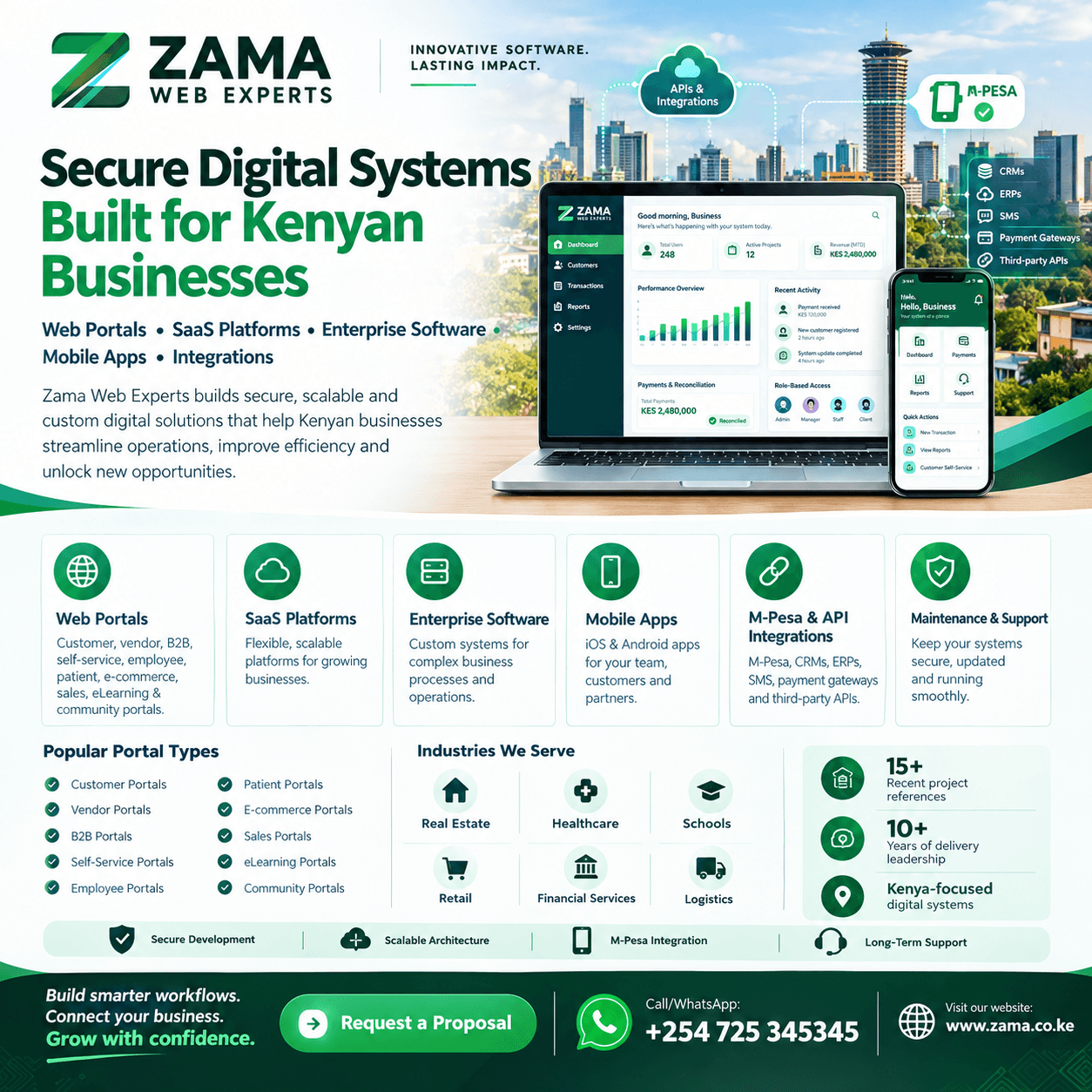
Secure web portal development for Kenyan enterprises is a question that every IT director, operations manager, and compliance officer must answer in 2026. With the Office of the Data Protection Commissioner actively enforcing compliance, cyber threats evolving rapidly, and enterprises across banking, healthcare, legal, and government recognizing that insecure portals expose sensitive data and undermine trust, the demand for secure web portal development has never been greater. At zama.co.ke, we’ve helped numerous organizations across Kenya build secure web portals that protect sensitive data, ensure regulatory compliance, and enable digital operations at scale. This comprehensive guide explores secure web portal development for Kenyan enterprises, from understanding what secure portals do to selecting the right development partner for your organization.
What Secure Web Portal Development Actually Delivers
Before diving into secure web portal development for Kenyan enterprises, it’s essential to understand what this technology actually does. A secure web portal is a browser-based platform that provides controlled access to business applications, data, and services for employees, customers, partners, and suppliers. It replaces unsecured file shares, email attachments, and public-facing applications with a hardened, encrypted, and audited access point to enterprise systems.
A proper secure web portal development for Kenyan enterprises does far more than build a website with a login page. It implements encryption at rest and in transit, role-based access controls, multi-factor authentication, session management, audit trails, intrusion detection, and compliance with Kenya’s Data Protection Act. It connects to enterprise systems—ERP, CRM, HR, accounting—and exposes their functionality securely to authorized users.
For a Kenyan enterprise, the practical definition of secure web portal development for Kenyan enterprises is this: the platform that tells you exactly who is accessing what, exactly when they accessed it, exactly what they did, and exactly how their access is protected—all in real time, with security controls tailored to your regulatory obligations.
Why Kenyan Enterprises Need Secure Web Portals
When evaluating secure web portal development for Kenyan enterprises, consider the compelling reasons for adoption:
The Growing Cyber Threat Landscape
Cyber threats are evolving rapidly. Kenyan enterprises face attacks from organized criminals, state-sponsored actors, and opportunistic hackers. Phishing, ransomware, business email compromise, and data breaches are increasingly common. A single breach can cost millions in remediation, regulatory penalties, and reputational damage. Secure web portal development addresses these threats by implementing hardened, encrypted, monitored access points to enterprise systems.
A modern secure web portal development for Kenyan enterprises implements defense-in-depth: encryption at rest and in transit, multi-factor authentication, role-based access controls, session management, input validation, output encoding, and continuous monitoring. Every layer reduces risk.
Data Protection Act Enforcement
Kenya’s Data Protection Act of 2019 imposes strict requirements on how organizations handle personal data. The Act requires organizations to implement appropriate technical and organizational measures to safeguard personal data against unauthorized access, loss, or misuse. The Office of the Data Protection Commissioner has been actively enforcing compliance, issuing fines and conducting sector inspections.
A compliant secure web portal development for Kenyan enterprises ensures that personal data is processed lawfully, stored securely, retained only as long as necessary, and disposed of appropriately. It supports data subject access requests by enabling efficient identification of records held about any individual. It supports breach notification by providing audit trails of who accessed what and when.
Digital Transformation Requirements
Kenyan enterprises are digitizing their operations. Customers expect to access services online. Employees expect to work remotely. Partners expect digital collaboration. Suppliers expect digital procurement. This digitization requires secure web portals that enable digital operations without compromising security.
A proper secure web portal development for Kenyan enterprises enables this digital transformation. It provides customer portals for self-service, employee portals for remote work, partner portals for collaboration, and supplier portals for procurement—all with enterprise-grade security.
Regulatory and Industry Compliance
Kenyan enterprises in regulated sectors—banking, healthcare, insurance, legal, government—face sector-specific compliance requirements. Banking regulations require secure customer portals. Healthcare regulations require secure patient portals. Government regulations require secure citizen portals. Secure web portal development ensures that portals meet these regulatory requirements.
The Cost of Insecure Portals
Insecure web portals expose enterprises to significant risk. A single breach can cost millions in remediation, regulatory penalties, legal liability, and reputational damage. The average cost of a data breach continues to rise. Secure web portal development is an investment in avoiding these costs.
Key Security Features of Secure Web Portal Development for Kenyan Enterprises
When evaluating secure web portal development for Kenyan enterprises, focus on these core security features:
1. End-to-End Encryption
The foundation of secure web portal development is encryption. Data must be encrypted at rest (on servers and databases) and in transit (as it travels between users and the portal). A proper portal uses industry-standard encryption protocols—TLS 1.3 for data in transit, AES-256 for data at rest. Encryption keys must be managed according to best practices, with options for customer-managed keys where regulatory requirements demand it.
For Kenyan enterprises handling sensitive personal data, encryption is not optional—it is a requirement under the Data Protection Act. The Act requires appropriate technical measures to protect personal data, and encryption is the baseline expectation.
2. Multi-Factor Authentication
Passwords alone are insufficient for securing enterprise portals. A secure portal must support multi-factor authentication—combining passwords with something the user has (phone, hardware token) or something the user is (fingerprint, face). MFA dramatically reduces the risk of unauthorized access, even if a password is compromised.
A proper secure web portal development for Kenyan enterprises supports multiple MFA methods: SMS-based OTP, authenticator apps, hardware tokens, and biometric authentication. It enforces MFA for all users and all access points.
3. Role-Based Access Control
Not every user should access every resource. A secure portal must implement role-based access control, ensuring that users can access only the resources they need. Access should be configurable by role, department, function, or individual. Permissions should support view, edit, create, delete, and approve actions separately.
A comprehensive secure web portal development for Kenyan enterprises enforces access controls at every layer—API, application, and database. It logs every access attempt, whether successful or failed. It alerts administrators to unusual access patterns.
4. Session Management
Session management is critical for security. A secure portal must implement secure session handling: unique session identifiers, session timeout after inactivity, secure session termination on logout, and protection against session hijacking. Sessions should be invalidated on password change and after a defined period.
A quality secure web portal development for Kenyan enterprises implements secure session management that balances security with user convenience. It uses secure cookies, HTTP-only flags, and SameSite attributes to protect against cross-site scripting and cross-site request forgery.
5. Audit Trails and Logging
Compliance requires evidence. A secure portal must maintain immutable audit trails that record every action—who accessed what, when, from which device, and what they did. Audit logs must be tamper-proof, exportable for regulators, and retained according to compliance requirements.
For Data Protection Act compliance, audit trails are essential. They enable breach investigation, support data subject access requests, and demonstrate accountability. A proper secure web portal development for Kenyan enterprises implements comprehensive logging and provides tools for audit log analysis.
6. Input Validation and Output Encoding
Injection attacks—SQL injection, cross-site scripting, command injection—remain among the most common and dangerous vulnerabilities. A secure portal must validate all input and encode all output. Input validation ensures that only expected data is processed. Output encoding ensures that data displayed to users cannot be interpreted as code.
A quality secure web portal development for Kenyan enterprises implements input validation and output encoding at every layer. It uses parameterized queries, prepared statements, and secure coding practices.
7. Security Headers and Configuration
Security headers protect against common web vulnerabilities. A secure portal should implement HTTP Strict Transport Security, Content Security Policy, X-Frame-Options, X-Content-Type-Options, and other security headers. Server and application configuration should follow security best practices.
A comprehensive secure web portal development for Kenyan enterprises configures security headers and hardening settings. It regularly reviews and updates configuration as security best practices evolve.
8. API Security
Modern web portals expose APIs for integration with mobile apps, partner systems, and other applications. API security is essential. A secure portal must implement API authentication, authorization, rate limiting, input validation, and monitoring.
A proper secure web portal development for Kenyan enterprises implements API security using industry standards—OAuth 2.0, OpenID Connect, JWT. It enforces rate limits to prevent abuse, monitors for suspicious activity, and logs all API calls.
9. Continuous Security Monitoring
Security is not a one-time effort. A secure portal must be continuously monitored for threats, vulnerabilities, and anomalies. Monitoring includes log analysis, intrusion detection, vulnerability scanning, and security information and event management.
A comprehensive secure web portal development for Kenyan enterprises implements continuous security monitoring. It alerts administrators to potential threats, tracks security metrics, and supports rapid incident response.
10. Backup and Disaster Recovery
Data is critical. A secure portal must implement backup procedures—automated daily backups, secure off-site storage, regular recovery testing. It must maintain disaster recovery plans and procedures, ensuring that systems can be restored quickly in the event of catastrophic failure.
A quality secure web portal development for Kenyan enterprises implements backup and disaster recovery that meets enterprise requirements. It tests recovery procedures regularly, ensuring that backup and recovery processes work when needed.
Key Factors That Determine Secure Web Portal Development Cost in Kenya
When analysing secure web portal development for Kenyan enterprises, several factors directly influence pricing:
1. Number of Users and User Types
The number of users who need access to the portal and the variety of user types—employees, customers, partners, suppliers—affects development complexity and cost. Each user type may require different access controls, interfaces, and workflows.
2. Integration Requirements
Secure web portals rarely operate in isolation. Integration with existing systems—ERP, CRM, HR, accounting, payment systems—adds to development cost. Each integration requires secure API development and ongoing maintenance.
3. Security Requirements
Security requirements affect development cost. Basic encryption and access controls are standard. Advanced features—multi-factor authentication, customer-managed keys, continuous monitoring, security information and event management integration—add to the cost.
4. Compliance Requirements
Compliance requirements affect development cost. Portals subject to strict regulatory requirements—banking, healthcare, government—require more rigorous security controls, documentation, and audit trails.
5. Deployment Model
The deployment model affects cost. On-premise deployment requires server hardware and IT infrastructure. Cloud-based deployment shifts infrastructure responsibility to the development partner. Hybrid deployment combines both approaches.
6. Customization Requirements
Off-the-shelf portals come with standard features. Customization—custom workflows, custom interfaces, custom reports—adds to development cost.
7. Mobile Access Requirements
Mobile access is essential for modern portals. Responsive design or native mobile applications add to development complexity and cost.
8. Training and Change Management
Training users on the new portal is essential. Training costs add to the overall investment.
9. Ongoing Support and Maintenance
Secure web portals require ongoing support and maintenance. Security patches, dependency updates, monitoring, and incident response all contribute to the total cost of ownership.
What Makes Secure Web Portal Development for Kenyan Enterprises Different
secure web portal development for Kenyan enterprises has unique characteristics that global providers often lack:
Data Residency and Sovereignty
For regulated enterprises in Kenya, data residency is decisive. The best portals pin content, metadata, audit logs, and encryption keys to the required jurisdiction. On-premises deployment, single-tenant private cloud, and region-pinned options with customer-managed keys ensure that regulated data stays where the law requires.
Data Protection Act Alignment
A compliant portal must align with the Data Protection Act of 2019, overseen by the Office of the Data Protection Commissioner. This includes lawful processing, data-subject rights, security of personal data, and localization and transfer rules. The portal should support data subject access requests efficiently and enable breach notification within required timeframes.
M-Pesa Integration
For enterprises that collect payments through the portal—customer payments, supplier payments, service charges—M-Pesa integration is essential. A proper portal should support M-Pesa STK Push for payment collection, automated payment confirmation, and reconciliation.
KRA eTIMS Integration
For enterprises that generate tax invoices, KRA eTIMS integration is mandatory. A modern portal should support eTIMS integration, transmitting invoices in real time and maintaining compliance.
Multi-Currency and Multi-Location Support
Kenyan enterprises often operate across multiple countries and currencies. A proper portal supports multi-currency operations and multi-location deployments.
Offline and Low-Bandwidth Capability
Internet in Kenya is not always reliable. A proper portal should support offline access to critical functions, with secure synchronization when connectivity returns.
Local Support and Training
The best providers in Kenya offer local support, training, and implementation services. Enterprises need a partner who can respond quickly when issues arise and who understands the Kenyan regulatory environment.
Secure Web Portal Development Use Cases in Kenya
Banking and Financial Services
Banks and financial institutions use secure web portals to provide customers with account access, transaction history, fund transfers, and bill payments. Security, availability, and regulatory compliance are paramount. Customer data must be encrypted, access must be controlled, and every transaction must be audited.
Healthcare Facilities
Hospitals and clinics use secure web portals to provide patients with appointment scheduling, test results, prescription refills, and billing information. Patient data must be protected in compliance with health sector regulations and the Data Protection Act.
Insurance Companies
Insurance companies use secure web portals to provide customers with policy information, claims submission, and premium payments. Security and regulatory compliance are essential.
Government and Public Sector
Government ministries, departments, and agencies use secure web portals to provide citizens with service access, application submission, and payment processing. The government’s e-Citizen platform is the largest example, providing secure access to thousands of government services.
Corporate Enterprises
Corporate organizations use secure web portals to provide employees with HR self-service, customers with account access, and partners with collaboration tools. Security, availability, and user experience are all important.
Educational Institutions
Schools and universities use secure web portals to provide students with course materials, grades, and fee payment; and staff with administrative tools. Student data must be protected.
NGOs and Development Organizations
NGOs use secure web portals to manage donor relationships, program data, and beneficiary records. Security and privacy are essential.
The Zama.co.ke Approach to Secure Web Portal Development for Kenyan Enterprises
When considering secure web portal development for Kenyan enterprises, zama.co.ke follows a structured approach:
Requirements Discovery
We map your business requirements, user types, integration needs, and security requirements. This includes understanding your current challenges and defining success metrics.
Security Architecture Design
We design the security architecture—encryption, authentication, access controls, audit trails, and monitoring. The design ensures that your portal meets regulatory requirements and organizational policies.
Portal Design and Development
We design the portal architecture—user interfaces, APIs, integrations, and workflows. We develop the portal using secure coding practices and industry standards.
Integration and Testing
We integrate the portal with existing systems and test all scenarios: normal operation, error handling, security controls, and performance under load.
Security Testing
We conduct security testing—vulnerability scanning, penetration testing, and code review. We identify and remediate vulnerabilities before launch.
Deployment and Training
We deploy the portal, configure monitoring, and provide role-specific training for administrators and end users.
Post-Launch Support
We monitor the portal, apply security patches, respond to incidents, and enhance the portal as business needs evolve.
The ROI of Secure Web Portal Development for Kenyan Enterprises
When evaluating secure web portal development for Kenyan enterprises, the ROI is compelling:
Enhanced Security: Encryption, access controls, and monitoring protect sensitive data from unauthorized access, reducing breach risk and regulatory exposure.
Improved Compliance: Audit trails and security controls ensure regulatory compliance and reduce audit risks.
Increased Efficiency: Self-service portals reduce administrative burden, enabling customers, employees, and partners to access services without manual intervention.
Better Customer Experience: Secure, user-friendly portals improve customer satisfaction and retention.
Competitive Advantage: Enterprises with secure digital portals can respond faster to market changes and customer needs.
Scalability: Secure portals enable enterprises to serve more users without proportional increases in administrative staff.
Business Continuity: Backup and disaster recovery ensure that operations continue even after catastrophic events.
Implementation Considerations for Kenyan Enterprises
When implementing a secure web portal, consider these factors:
Assess Your Requirements
Document your business requirements, user types, integration needs, and security requirements. This assessment forms the foundation for portal design.
Choose the Right Partner
Select a development partner with security expertise, local support capabilities, and a proven track record. The best secure web portal development for Kenyan enterprises partners understand both security and business requirements.
Plan for Data Migration
Migrating existing data into the portal requires careful validation. Ensure data accuracy before migration.
Train Your Team
Administrators and end users need training on the new portal. Role-specific training produces higher adoption.
Test Security Thoroughly
Test all security scenarios: authentication, authorization, encryption, session management, and incident response. Ensure the portal meets security requirements.
Ensure Compliance
Configure the portal for Data Protection Act compliance from day one. Ensure encryption, access controls, retention schedules, and audit trails are properly configured.
Consider a Phased Rollout
For large enterprises, consider a phased rollout. Start with one user group or function, prove the portal works, refine based on feedback, then expand.
The Cost of Delaying Secure Web Portal Development
While enterprises evaluate secure web portal development for Kenyan enterprises, the cost of inaction compounds daily. Every day of insecure access represents breach risk. Every day of manual processes represents operational inefficiency. Every day of non-compliance represents regulatory risk.
Meanwhile, enterprises with secure web portals are achieving compliance, reducing costs, and accelerating operations. The competitive gap widens with every passing month.
Why Contact Zama.co.ke for Secure Web Portal Development in Kenya
When researching secure web portal development for Kenyan enterprises, organizations should contact zama.co.ke because:
Local Expertise: We understand Kenyan regulatory requirements, including Data Protection Act compliance and KRA eTIMS integration.
Security-First Design: We build portals with encryption, access controls, audit trails, and monitoring built in from day one.
Custom Development: We build portals tailored to your specific user types, integrations, and security requirements, not generic solutions.
Integration Capabilities: We connect portals to ERP, CRM, HR, accounting, payment systems, and government systems.
Transparent Pricing: No hidden fees, clear milestone timelines, and full source-code ownership.
Ongoing Support: We remain available for maintenance, security patching, and portal upgrades as your business evolves.
For a custom quote based on your organization’s specific requirements, contact zama.co.ke today.
Secure web portal development for Kenyan enterprises is essential for any organization seeking to protect sensitive data, ensure regulatory compliance, and enable digital operations. From encryption and multi-factor authentication to audit trails and continuous monitoring, the right portal transforms how enterprises serve customers, employees, and partners.
At zama.co.ke, we’ve helped organizations across Kenya implement secure web portals that deliver measurable results. Our approach ensures you get exactly what your organization needs—nothing more, nothing less.
Don’t let the complexity of secure web portal development for Kenyan enterprises hold you back. Whether you’re a bank, hospital, government agency, or corporate enterprise, we have the expertise to guide you through every step.
Contact zama.co.ke today for a custom quote based on your organization’s specific requirements.