
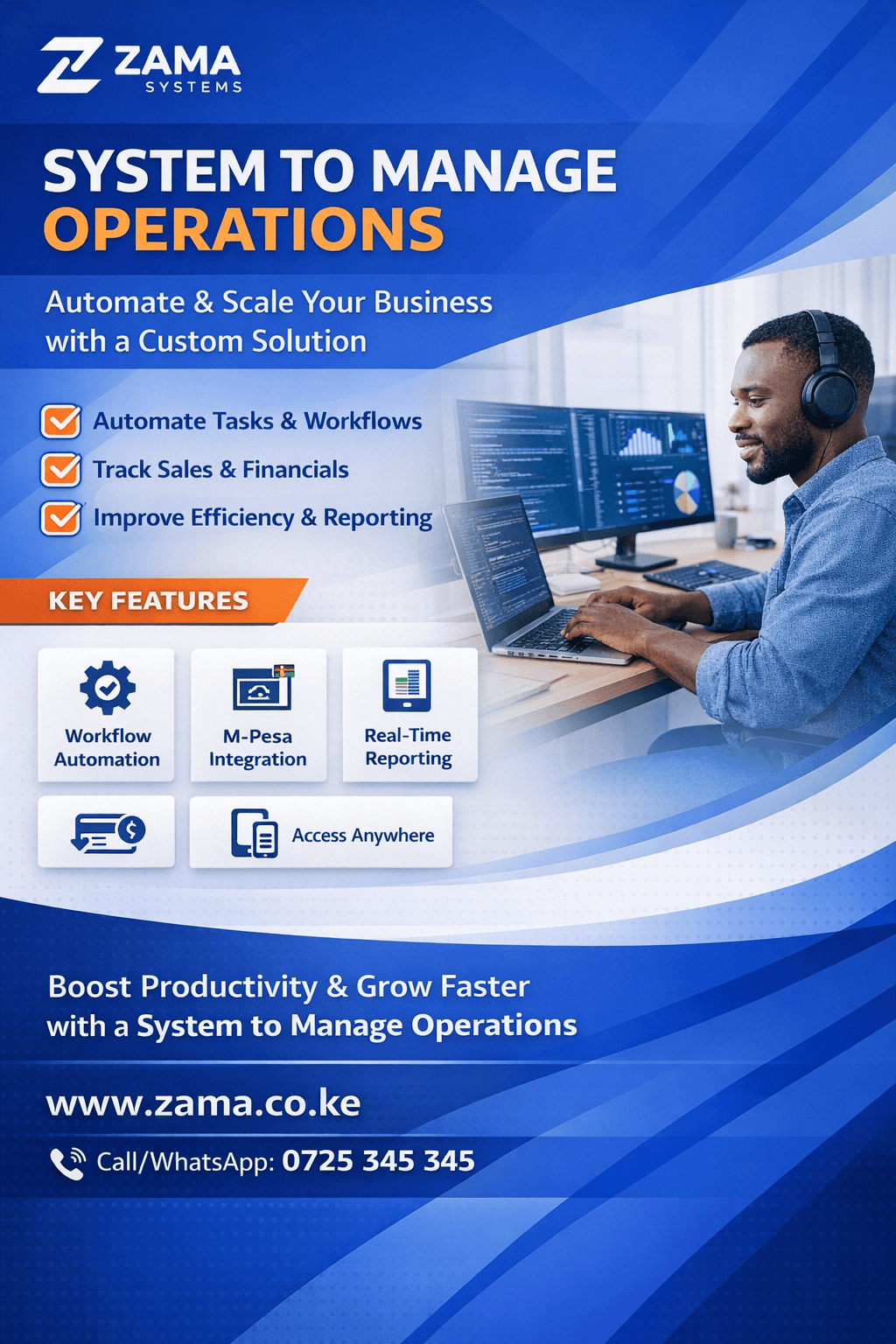
Running a business without a system to manage operations is one of the biggest mistakes many companies make.
If you’re still relying on:
- Excel spreadsheets
- Manual record keeping
- Phone calls and WhatsApp tracking
- Paper-based processes
Then your business is losing time, money, and efficiency every day.
In today’s fast-moving digital world, every serious business needs a centralized system to manage operations — one that automates workflows, tracks activities, and gives real-time visibility.
At Zama Systems LTD, we build custom systems that help businesses across Kenya:
- Automate operations
- Improve efficiency
- Track performance
- Scale with confidence
What Is a System to Manage Operations?
A system to manage operations is a software platform designed to handle and automate the daily activities of a business.
It connects different parts of your operations into one system.
Core Functions Include:
✔ Task management
✔ Workflow automation
✔ Data tracking
✔ Financial reporting
✔ Customer management
✔ Inventory and logistics
Simple Explanation
Think of it as the engine of your business — it keeps everything running smoothly.
Instead of managing everything manually, the system:
- Tracks what is happening
- Automates repetitive tasks
- Alerts you when action is needed
Why Every Business Needs a System to Manage Operations
Businesses that implement a system to manage operations gain a massive advantage over competitors.
1. Eliminate Manual Work
Manual processes are slow and prone to errors.
With a system:
- Tasks are automated
- Processes run faster
- Errors are reduced
2. Improve Efficiency
A well-built system ensures:
- Faster workflows
- Clear processes
- Reduced delays
3. Real-Time Visibility
You can see:
- Sales performance
- Operational status
- Financial reports
👉 All in one dashboard.
4. Better Decision Making
With accurate data:
- You make smarter decisions
- You identify problems early
- You plan better
5. Scalability
Without a system:
❌ Growth becomes chaotic
With a system:
✔ Growth becomes structured
Types of Systems to Manage Operations
Different businesses require different systems.
1. Business Management Systems
Used to handle:
- Daily operations
- Staff tasks
- Reporting
2. Enterprise Resource Planning (ERP)
For large organizations:
- Finance
- HR
- Inventory
- Procurement
3. Customer Relationship Management (CRM)
Manages:
- Leads
- Customers
- Communication
4. Inventory & POS Systems
Tracks:
- Stock
- Sales
- Revenue
5. Workflow Automation Systems
Automates:
- Approvals
- Notifications
- Processes
Key Features of a Good System to Manage Operations
When choosing or building a system, ensure it includes:
✔ Centralized Dashboard
A single place to monitor everything.
✔ Automation Capabilities
- Auto invoices
- Notifications
- Task triggers
✔ Reporting & Analytics
- Financial reports
- Performance tracking
✔ User Roles & Permissions
Control who can access what.
✔ Mobile Accessibility
Works on phones and tablets.
✔ Integration with Payment Systems
Especially important in Kenya:
- M-Pesa integration
- Payment tracking
Real Business Use Cases in Kenya
Real Estate Companies
Using a system to manage operations, they:
- Track rent payments
- Manage tenants
- Generate reports
Retail Businesses
They:
- Track inventory
- Manage sales
- Monitor profits
Transport & Logistics
They:
- Track vehicles
- Manage drivers
- Monitor routes
Service Businesses (Salons, Clinics)
They:
- Manage bookings
- Track customers
- Automate payments
Manual vs Automated Operations (Important Comparison)
| Feature | Manual System | Automated System |
|---|---|---|
| Speed | Slow | Fast |
| Accuracy | Low | High |
| Scalability | Limited | Unlimited |
| Reporting | Difficult | Instant |
| Cost | Hidden losses | Cost-effective |
👉 The difference is clear.
How to Choose the Right System to Manage Operations
Step 1: Identify Your Needs
Ask:
- What problems do I have?
- What processes need automation?
Step 2: Decide Custom vs Ready-Made
Ready-Made:
✔ Cheap
❌ Limited
Custom (Recommended):
✔ Tailored
✔ Scalable
Step 3: Choose the Right Developer
Look for:
- Experience
- Proven systems
- Local understanding
Why Custom Systems Are Better
A custom system to manage operations is built specifically for your business.
Benefits:
✔ Matches your workflow
✔ Scales with growth
✔ Competitive advantage
✔ Full ownership
Cost of Building a System to Manage Operations in Kenya
Pricing depends on complexity:
- Basic system → KES 80,000 – 150,000
- Medium system → KES 150,000 – 400,000
- Advanced system → KES 400,000 – 1M+
👉 Investment in a system = long-term savings.
Implementation Process (How It Works)
1. Requirement Gathering
Understand your business.
2. System Design
Plan architecture and UI.
3. Development
Build features and integrations.
4. Testing
Ensure everything works perfectly.
5. Deployment
Launch system live.
6. Support & Scaling
Continuous improvements.
Common Mistakes to Avoid
❌ Choosing cheap developers
❌ Not defining requirements
❌ Ignoring scalability
❌ No training for staff
❌ Skipping maintenance
Future of Business Operations in Kenya
The future is:
- Automation
- Cloud-based systems
- AI-driven decisions
- SaaS platforms
Businesses that adopt early will:
✔ Grow faster
✔ Operate efficiently
✔ Outperform competitors
Why Choose Zama Systems LTD?
We specialize in building systems to manage operations for Kenyan businesses.
What We Offer:
✔ Custom software development
✔ M-Pesa integration
✔ Business automation systems
✔ Scalable SaaS platforms
Our Experience:
We have built:
- Property management systems
- POS systems
- Business automation platforms
Our Advantage:
✔ Local expertise
✔ Fast delivery
✔ Full system ownership
Call to Action
Get Your System to Manage Operations Today
Stop running your business manually.
Start automating and scaling with a powerful system.
Contact Zama Systems LTD
🌐 Website: https://zama.co.ke
📞 Call/WhatsApp: +254 725 345 345
Conclusion
A system to manage operations is no longer optional.
It is the foundation of:
- Efficiency
- Growth
- Profitability
If you want to build a serious business, you need a system that works for you.
Core Modules Every Operations System Must Have
To build a powerful system to manage operations, you need the right modules working together.
Think of your system like a machine — each part plays a role.
1. User Management Module
This controls:
- Staff accounts
- Roles and permissions
- Access levels
👉 Example:
- Admin → Full control
- Staff → Limited access
2. Task & Workflow Management
This is where operations happen:
✔ Assign tasks
✔ Track progress
✔ Set deadlines
✔ Automate workflows
3. Financial Management Module
Tracks all money-related activities:
- Invoices
- Payments
- Expenses
- Reports
👉 In Kenya, this should include:
✔ M-Pesa integration
✔ Automatic reconciliation
4. Reporting & Analytics Module
This gives you insights:
- Daily reports
- Monthly performance
- Revenue tracking
👉 This is where business decisions come from.
5. Notification System
Keeps everyone updated:
- SMS alerts
- Email notifications
- System reminders
6. Integration Layer
Your system should connect with:
- Payment gateways
- External APIs
- Third-party tools
Architecture of a Modern Operations System
A modern system to manage operations should follow this structure:
Backend (Engine)
Handles:
- Logic
- Data processing
- Security
Frontend (User Interface)
What users interact with:
- Dashboard
- Forms
- Reports
Database (Storage)
Stores:
- Users
- Transactions
- Reports
API Layer
Connects:
- External services
- Mobile apps
👉 This structure ensures scalability and performance.
Cloud vs Offline Systems (Important Decision)
Cloud-Based Systems (Recommended)
✔ Accessible anywhere
✔ Automatic backups
✔ Scalable
✔ Secure
Offline Systems
❌ Limited access
❌ Risk of data loss
❌ Hard to scale
👉 Always go cloud for modern businesses.
Automation Opportunities in Operations
A good system to manage operations should automate:
✔ Invoicing
Auto-generate invoices monthly
✔ Payments
Trigger STK Push automatically
✔ Notifications
Send SMS reminders
✔ Reporting
Generate reports instantly
✔ Task Assignments
Auto-assign tasks based on triggers
👉 Automation reduces workload by up to 70%.
Industry-Specific Systems (Deep Insight)
Real Estate Operations System
Features:
- Tenant management
- Rent tracking
- Lease management
Retail Operations System
Features:
- POS
- Inventory
- Sales reports
Transport Operations System
Features:
- Vehicle tracking
- Driver management
- Payment tracking
Healthcare Operations System
Features:
- Patient records
- Appointments
- Billing
👉 Each industry needs a customized system to manage operations.
Scaling Your Business Using an Operations System
Growth without a system leads to:
❌ Chaos
❌ Errors
❌ Lost revenue
With a system:
✔ Processes are standardized
✔ Operations are controlled
✔ Growth becomes predictable
👉 This is how big companies scale.
Turning Your Operations System into a SaaS Product
This is a high-level business strategy 👇
Instead of building a system for internal use only:
👉 Turn it into a product you can sell.
Example:
You build:
- A property management system
Then:
- Offer it to landlords as a subscription
Result:
✔ Recurring revenue
✔ Scalable income
✔ High valuation business
👉 This is how SaaS companies grow.
Data-Driven Operations (Future of Business)
Modern systems use data to:
- Predict trends
- Identify problems
- Optimize performance
👉 Example:
Instead of guessing:
- You KNOW which area is underperforming
Security & Compliance (Critical Section)
Your system to manage operations must include:
✔ Secure login systems
✔ Data encryption
✔ Regular backups
✔ Role-based access
👉 Data security builds trust.
Performance Optimization Tips
Your system should:
✔ Load in under 3 seconds
✔ Handle multiple users
✔ Be mobile-friendly
👉 Speed affects user experience and revenue.
Training Your Team to Use the System
Even the best system fails without proper usage.
Do this:
✔ Train staff
✔ Create simple guides
✔ Monitor usage
👉 Adoption = success.
Maintenance & Continuous Improvement
After launch:
- Fix bugs
- Add features
- Improve performance
👉 A system is a living product.
ROI: Return on Investment of an Operations System
Let’s break it down:
Without System:
- Time wasted
- Errors
- Lost revenue
With System:
- Faster processes
- Accurate data
- Higher profits
👉 ROI is usually achieved within 3–6 months.
Common Questions (FAQ Section – SEO Boost)
What is a system to manage operations?
A system to manage operations is software that automates and controls business processes such as tasks, payments, and reporting.
Why do businesses need an operations system?
To improve efficiency, reduce errors, and scale operations.
How much does it cost in Kenya?
Costs range from KES 80,000 to over 1M, depending on complexity.
Can small businesses use it?
Yes — even small businesses benefit from automation.
Is M-Pesa integration necessary?
In Kenya — YES, especially for payment-based systems.
Final High-Converting Section
Build Your System to Manage Operations Today
If you are serious about growing your business, you need a system that works for you 24/7.
Work With Zama Systems LTD
We help you:
✔ Automate your operations
✔ Build scalable systems
✔ Increase efficiency and profits
Contact Us
🌐 Website: https://zama.co.ke
📞 Call/WhatsApp: +254 725 345 345
Final Thought
A business without a system is like a car without an engine.
👉 It may move — but it will never go far.