
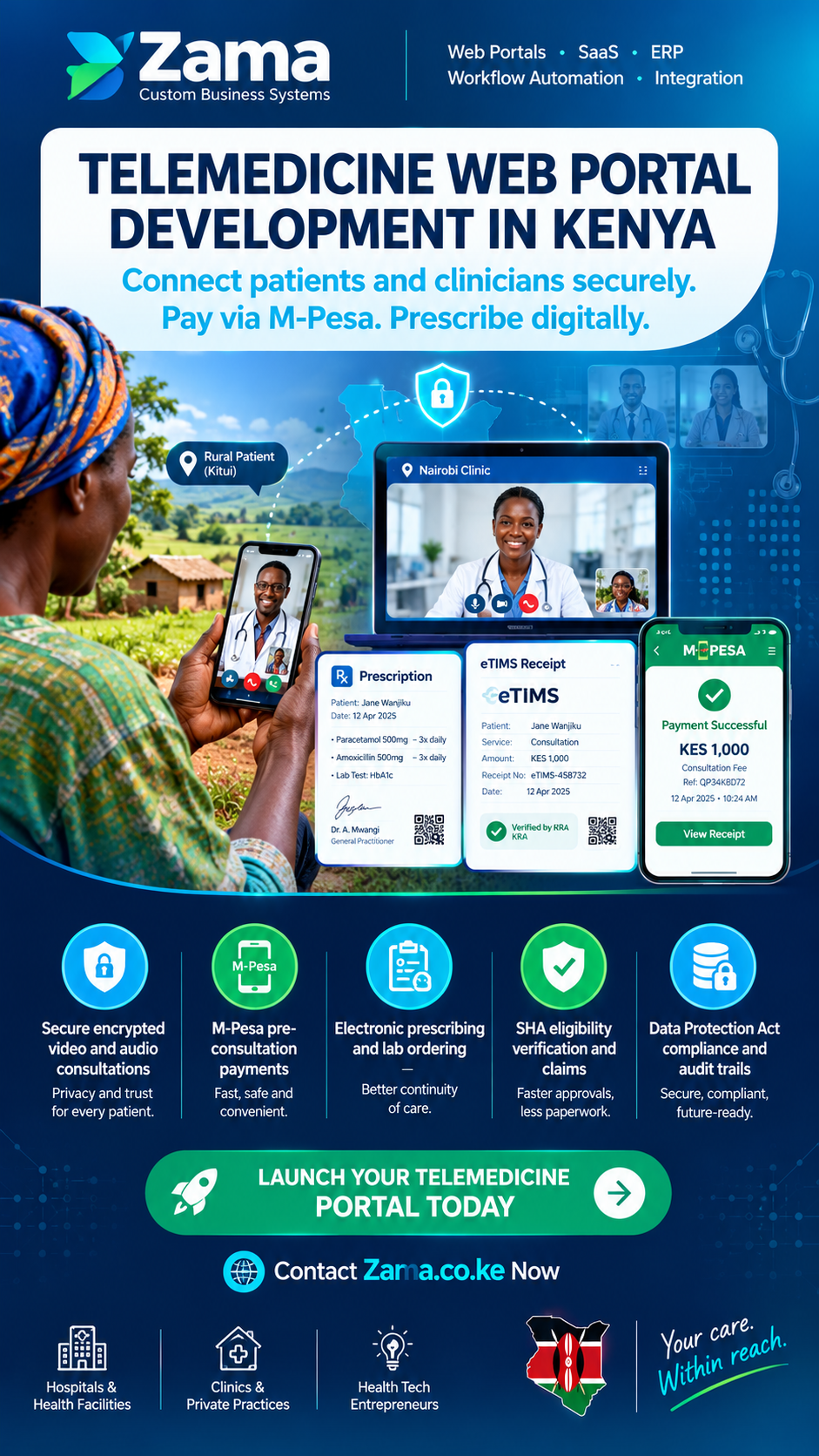
Telemedicine web portal development in Kenya is a question that every hospital administrator, clinic owner, and health technology entrepreneur must answer in 2026. With Kenyan patients in remote counties facing long journeys to access specialists, urban professionals seeking convenient consultations without leaving their offices, and the Social Health Authority reshaping how care is financed and delivered, the demand for virtual care has moved from novelty to necessity. At zama.co.ke, we’ve helped numerous healthcare providers across Kenya design and build secure telemedicine portals that connect patients and clinicians safely, compliantly, and reliably. This comprehensive guide explores telemedicine web portal development in Kenya, from understanding what a telemedicine portal delivers to selecting the right development approach for your organization.
What Telemedicine Web Portal Development Actually Delivers
Before diving into telemedicine web portal development in Kenya, it’s essential to understand what this technology actually does. A telemedicine web portal is a secure, browser-based platform that enables patients to consult with clinicians remotely—through video, audio, or secure messaging—while managing the entire clinical and financial workflow around that consultation. It connects patient registration, appointment scheduling, payment, consultation, prescription, and follow-up into a single digital journey.
A proper telemedicine web portal development in Kenya delivers far more than a video call link. It provides secure patient authentication, appointment booking with clinician availability, M-Pesa payment before consultation, encrypted video and audio consultation, clinical documentation during the consultation, electronic prescribing, laboratory and radiology ordering, referral to in-person care where needed, and secure delivery of consultation summaries and prescriptions to the patient.
For a Kenyan healthcare provider, the practical definition of telemedicine web portal development in Kenya is this: the platform that lets a patient in any county consult a clinician in Nairobi securely, pay via M-Pesa, receive a valid prescription, and access follow-up care—without travelling, without queuing, and without compromising the confidentiality of their medical information.
Why Kenyan Healthcare Providers Need Telemedicine Portals
When evaluating telemedicine web portal development in Kenya, consider the compelling reasons for adoption:
Geographic Access Barriers
Kenya’s specialist clinicians are concentrated in Nairobi, Mombasa, and a handful of referral hospitals. Patients in Turkana, Mandera, Lamu, or rural parts of the Rift Valley may travel hundreds of kilometres for a consultation that lasts fifteen minutes. The cost of travel, accommodation, and lost workdays often exceeds the cost of the consultation itself—and many patients simply do not make the journey.
A modern telemedicine web portal development in Kenya removes the geographic barrier. A patient in Lodwar can consult a cardiologist in Nairobi the same day. A mother in Kilifi can have her child reviewed by a paediatrician without a six-hour journey. Access improves dramatically, and outcomes follow.
The Urban Convenience Demand
Urban Kenyan professionals—particularly in Nairobi, Mombasa, and Kisumu—increasingly prefer remote consultations for follow-ups, chronic disease reviews, minor ailments, and mental health support. They value the time saved, the privacy, and the convenience of consulting from home or office. Providers who cannot offer this convenience are losing patients to those who can.
A proper telemedicine web portal development in Kenya meets this demand. Patients book from their phones, consult during a lunch break, receive prescriptions digitally, and pay via M-Pesa—all without a physical visit.
Chronic Disease Management
Kenya faces a rising burden of chronic disease—hypertension, diabetes, cardiovascular disease, and mental health conditions. These conditions require regular monitoring and medication adjustments, but not necessarily physical examinations at every visit. Telemedicine is well suited to chronic disease follow-up.
A comprehensive telemedicine web portal development in Kenya supports chronic care through scheduled virtual reviews, medication adherence tracking, remote monitoring of patient-reported outcomes, and secure messaging between visits. Patients stay engaged with their care, and clinicians catch deterioration earlier.
Mental Health Access
Mental health services in Kenya are scarce, and stigma remains a significant barrier to in-person care. Telemedicine addresses both problems—increasing access to a limited pool of mental health professionals and offering privacy that encourages help-seeking.
A quality telemedicine web portal development in Kenya provides secure, confidential video consultations for mental health, with the privacy controls and consent management that this sensitive area demands.
Pandemic and Emergency Preparedness
The COVID-19 pandemic demonstrated that in-person care can be disrupted suddenly. Providers with telemedicine capability maintained continuity of care during lockdowns and surges; those without lost patients and revenue. Building telemedicine capability is now a form of resilience planning.
A proper telemedicine web portal development in Kenya ensures that care can continue even when physical access is restricted—whether due to pandemic, civil disruption, or natural disaster.
Specialist Shortage Optimization
Kenya has far too few specialists for its population. A cardiologist’s time is precious. Telemedicine allows specialists to see more patients per day by eliminating travel between facilities and reducing the overhead of physical clinic space. It also enables specialists to support rural facilities through remote consultation, extending their reach without relocating them.
A comprehensive telemedicine web portal development in Kenya supports specialist efficiency through streamlined scheduling, pre-consultation information gathering, and structured clinical documentation.
Data Protection Act Compliance
Telemedicine handles the most sensitive category of personal data—health information. Kenya’s Data Protection Act, enforced actively by the Office of the Data Protection Commissioner, imposes strict requirements on how this data is collected, stored, transmitted, and accessed. A portal that is not built with compliance in mind is a legal and ethical liability.
A compliant telemedicine web portal development in Kenya implements end-to-end encryption for consultations and records, role-based access, explicit consent management, audit trails for every access, and retention policies aligned with medical records regulations.
SHA Integration and Financial Sustainability
The Social Health Authority has restructured healthcare financing in Kenya. Providers need to verify patient eligibility, submit claims, and track reimbursements digitally. A telemedicine portal that integrates with SHA can confirm eligibility before the consultation begins, reducing rejected claims and unpaid consultations.
A quality telemedicine web portal development in Kenya integrates SHA eligibility verification and claims submission, alongside M-Pesa payment for patients paying out of pocket.
Key Features of a Telemedicine Web Portal Built in Kenya
When evaluating telemedicine web portal development in Kenya, focus on these core features:
1. Secure Patient Authentication and Identity Verification
Telemedicine requires confidence that the person consulting is who they claim to be. A proper telemedicine web portal development in Kenya implements multi-factor authentication, identity verification through national ID or phone number matching, and, where appropriate, biometric or document verification for first-time patients.
2. Appointment Booking with Clinician Availability
Patients should see real-time clinician availability and book a slot that suits them. A comprehensive telemedicine web portal development in Kenya integrates with the provider’s scheduling system, respects clinician availability and specialties, and allows patients to select consultation type—video, audio, or secure messaging.
3. M-Pesa Payment Before Consultation
Payment should be settled before the clinician’s time is committed. A quality telemedicine web portal development in Kenya integrates M-Pesa Daraja API for STK Push and PayBill payments, confirms payment instantly, and releases the consultation slot only upon payment confirmation—or applies SHA or insurance eligibility verification where applicable.
4. Encrypted Video and Audio Consultation
The core of telemedicine is the consultation itself. A proper telemedicine web portal development in Kenya provides high-quality, end-to-end encrypted video and audio consultation that works on low-bandwidth connections, supports screen sharing for reviewing results, and degrades gracefully when connectivity is poor.
5. Clinical Documentation During Consultation
Clinicians must document the consultation as they would an in-person visit. A comprehensive telemedicine web portal development in Kenya provides structured clinical notes, diagnosis coding, and linkage to the patient’s longitudinal record—so the telemedicine consultation becomes part of the patient’s permanent medical history.
6. Electronic Prescribing
A telemedicine consultation often results in a prescription. A quality telemedicine web portal development in Kenya generates a valid electronic prescription that the patient can present at a pharmacy, that links to pharmacy dispensing records, and that complies with PPB requirements for prescription documentation.
7. Laboratory and Radiology Ordering
Clinicians often need investigations. A proper telemedicine web portal development in Kenya allows ordering of laboratory and radiology tests during the consultation, with results delivered back to the clinician and the patient through the portal.
8. Secure Messaging and Follow-Up
Not every interaction needs a video call. A comprehensive telemedicine web portal development in Kenya supports secure asynchronous messaging for follow-up questions, medication adjustments, and sharing of results, with appropriate response-time expectations and documentation.
9. Consultation Summaries and Patient Access
After the consultation, patients should receive a summary. A quality telemedicine web portal development in Kenya delivers consultation notes, prescriptions, and follow-up instructions to the patient through the portal, in language they can understand.
10. Referral to In-Person Care
Telemedicine is not appropriate for every condition. A proper telemedicine web portal development in Kenya supports referral to in-person care when examination or procedures are needed, with the referral documented and communicated to both the patient and the receiving facility.
What Makes Telemedicine Web Portal Development in Kenya Different
Telemedicine web portal development in Kenya has unique characteristics that global solutions often lack:
M-Pesa as the Payment Foundation
In many markets, telemedicine payments run on cards. In Kenya, M-Pesa dominates. A portal built for Kenya integrates Daraja API natively, with STK Push and PayBill payment confirmation releasing the consultation slot.
SHA Integration
Kenyan healthcare now runs through the Social Health Authority. A portal built for Kenya verifies eligibility and supports claims submission for telemedicine consultations covered under SHA.
Bandwidth Reality
Connectivity across Kenya varies widely. A portal built for Kenya is engineered for low bandwidth—adaptive video quality, audio fallback, and asynchronous messaging alternatives—so that patients in remote areas can still access care.
Regulatory Compliance for Remote Prescribing
The Pharmacy and Poisons Board regulates prescribing in Kenya. A portal built for Kenya ensures that electronic prescriptions comply with PPB requirements and that controlled substances are handled appropriately.
Data Protection Act Alignment
Health data is sensitive personal data under Kenya’s Data Protection Act. A compliant portal implements consent, encryption, role-based access, and audit trails aligned with the Act and medical records regulations.
Multi-Language Support
Kenyan patients use English and Swahili. A portal built for Kenya supports both languages, with the option for additional local languages.
Local Clinical Workflow Alignment
Kenyan clinical practice has its own patterns—triage protocols, referral pathways, and documentation conventions. A portal built for Kenya aligns with these rather than imposing foreign workflows.
Local Support
Kenyan providers need support in their timezone and language. Local support is a practical requirement.
Key Factors That Determine Cost
When analysing cost, several factors directly influence pricing:
1. Number of Clinicians and Specialties
More clinicians and specialties mean more complex scheduling, credentialing, and consultation configuration.
2. Consultation Volume
Higher volumes require more robust video infrastructure and support capacity.
3. Integration Depth
Integration with the hospital management system, laboratory, pharmacy, SHA, and M-Pesa determines complexity.
4. Video and Audio Quality Requirements
High-definition video with screen sharing and recording requires more infrastructure than audio-only consultation.
5. Number of Features
Secure messaging, e-prescribing, lab ordering, referrals—each feature adds to the build.
6. Security and Compliance Requirements
End-to-end encryption, identity verification, audit trails, and Data Protection Act compliance add to development effort.
7. Mobile App Requirements
A native mobile app adds cost compared with a mobile-responsive web portal.
8. Deployment Model
Cloud, on-premise, or hybrid deployment affects cost and ongoing support.
9. Training and Ongoing Support
Training clinicians and administrative staff, plus ongoing support, contributes to total cost.
For a transparent quote based on your organization’s specific requirements, contact zama.co.ke today.
Use Cases
Private Hospitals
Private hospitals use telemedicine portals to extend specialist reach, offer convenient follow-up care, and differentiate their service offering.
County and Referral Hospitals
Public facilities use telemedicine to connect rural clinics with specialist support, reducing unnecessary referrals and improving local care.
Specialised Clinics
Dermatology, mental health, chronic disease, and fertility clinics use telemedicine for consultations that do not require physical examination.
Diagnostic Centres
Diagnostic centres use telemedicine for pre-test consultations, results review, and follow-up.
Corporate Wellness Providers
Corporate wellness providers use telemedicine to offer employees convenient access to consultations.
NGOs and Outreach Programs
NGOs use telemedicine to extend care to underserved communities and support community health workers with remote clinical guidance.
The Zama.co.ke Approach to Telemedicine Web Portal Development in Kenya
When considering telemedicine web portal development in Kenya, zama.co.ke follows a structured approach:
Clinical and Operational Discovery
We map patient journeys, clinician workflows, consultation types, payment structures, and regulatory obligations.
Portal Design
We design authentication, scheduling, video infrastructure, clinical documentation, and payment flows.
Development and Integration
We build the portal, integrate M-Pesa Daraja API, SHA, eTIMS, laboratory and pharmacy systems, and configure notifications.
Security and Compliance Testing
We conduct security testing—vulnerability scanning and penetration testing—and verify Data Protection Act alignment.
Training and Support
We train clinicians and administrative staff, and provide patient onboarding materials.
Post-Launch Optimization
We monitor consultation quality, connection reliability, and patient satisfaction, then refine the portal.
The ROI
When evaluating telemedicine web portal development in Kenya, the ROI is compelling:
Extended Reach: Providers serve patients beyond their physical catchment area.
Improved Clinician Utilization: Specialists see more patients per day without travel.
Reduced No-Shows: Virtual appointments have lower no-show rates than physical ones.
Faster Payment Collection: Pre-consultation M-Pesa payment eliminates billing delays.
Compliance Protection: Data Protection Act controls and PPB-compliant prescribing are built in.
Continuity of Care: Care continues during disruptions that would halt in-person visits.
Competitive Differentiation: Telemedicine capability positions the provider as modern and accessible.
Implementation Considerations
Assess Your Clinical Requirements
Document which consultation types are suitable for telemedicine, which clinicians will participate, and what documentation and prescribing requirements apply.
Choose the Right Development Partner
Select a partner with healthcare experience, video infrastructure expertise, and a proven security track record.
Plan for Connectivity Reality
Design for low bandwidth and intermittent connectivity from the outset.
Train Your Team
Clinicians need training on remote consultation technique and documentation; administrative staff need training on scheduling and payments.
Ensure Compliance
Build Data Protection Act, PPB, and SHA controls in from day one.
Test Thoroughly
Test video quality on low bandwidth, payment flows, prescribing, and record integration.
Consider a Phased Rollout
Start with follow-up consultations and chronic care, then expand to broader use cases.
The Cost of Delaying
While providers evaluate telemedicine web portal development in Kenya, the cost of inaction compounds daily. Every month without telemedicine is patients lost to providers who offer it. Every month without virtual follow-up is preventable complications. Every month without digital prescribing is pharmacy errors and non-adherence.
Why Contact Zama.co.ke
When researching telemedicine web portal development in Kenya, providers should contact zama.co.ke because:
Healthcare Expertise: We understand clinical workflows, telemedicine practice, and Kenyan regulation.
M-Pesa Expertise: We integrate Daraja API for pre-consultation payments and automatic reconciliation.
eTIMS Expertise: We generate compliant invoices and receipts in real time.
SHA Integration: We connect eligibility verification and claims submission.
Security Focus: We implement end-to-end encryption, identity verification, and audit trails aligned with the Data Protection Act.
Bandwidth Engineering: We build for Kenyan connectivity realities.
Transparent Pricing: No hidden fees and full source-code ownership.
Ongoing Support: We stay available as your telemedicine service grows.
For a custom quote based on your organization’s specific requirements, contact zama.co.ke today.
Telemedicine web portal development in Kenya is essential for any healthcare provider seeking to extend reach, improve access, and meet the expectations of a digitally connected population. From secure authentication and M-Pesa payments to encrypted video consultations, e-prescribing, and SHA integration, the right portal transforms how care is delivered.
At zama.co.ke, we’ve helped healthcare providers across Kenya build telemedicine portals that deliver measurable results. Our approach ensures you get exactly what your organization needs—nothing more, nothing less.
Don’t let the complexity of telemedicine web portal development in Kenya hold you back. Whether you run a private hospital, a county facility, or a specialised clinic, we have the expertise to guide you through every step.
Contact zama.co.ke today for a custom quote based on your organization’s specific requirements.