
UI/UX Design Kenya: The Ultimate Guide to Creating Exceptional Digital Experiences for Business Success
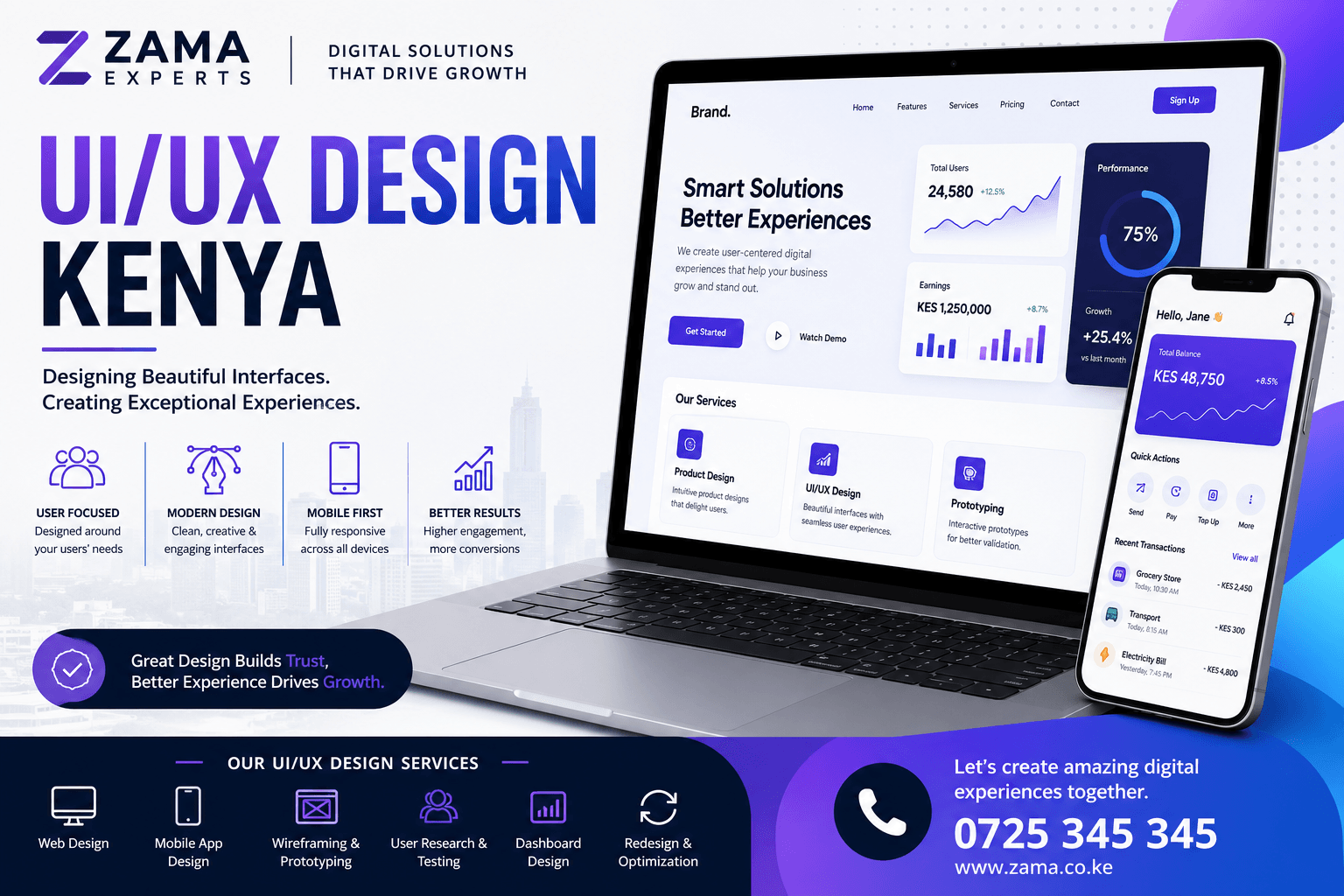
In today’s highly competitive digital world, a beautiful website or mobile application is no longer enough. Customers expect digital products that are easy to navigate, visually appealing, fast, and enjoyable to use. This is where UI/UX Design Kenya has become one of the most valuable investments for businesses seeking to attract, engage, and retain customers.
Whether you operate a startup in Nairobi, a hotel in Mombasa, a university in Eldoret, a SACCO in Kisumu, or an e-commerce business serving customers across Kenya, quality UI/UX design can significantly improve customer satisfaction, increase conversions, and strengthen your brand.
As more Kenyan consumers embrace online shopping, digital banking, mobile applications, and self-service platforms, businesses must deliver seamless user experiences that inspire confidence and encourage repeat visits. Investing in UI/UX Design Kenya helps businesses meet these expectations while gaining a competitive advantage in an increasingly digital economy.
This comprehensive guide explores everything you need to know about UI/UX Design Kenya, including its importance, principles, benefits, process, emerging trends, case studies, testimonials, and how professional UI/UX services can transform your business.
What is UI/UX Design Kenya?
UI/UX design combines two closely related disciplines that work together to create outstanding digital experiences.
What is User Interface (UI) Design?
User Interface (UI) Design focuses on the visual appearance of a digital product.
It includes:
- Buttons
- Icons
- Typography
- Layouts
- Colors
- Navigation menus
- Images
- Forms
- Interactive elements
A well-designed user interface ensures that users can interact with a website or application intuitively while reinforcing the company’s brand identity.
What is User Experience (UX) Design?
User Experience (UX) Design focuses on how users feel when interacting with a digital product.
UX involves understanding user behavior and creating experiences that are:
- Easy to use
- Efficient
- Accessible
- Enjoyable
- Helpful
- Fast
- Logical
Good UX design ensures users can complete tasks with minimal effort and frustration.
UI vs UX: Understanding the Difference
Although often mentioned together, UI and UX serve different purposes.
| UI Design | UX Design |
|---|---|
| Visual appearance | Overall user experience |
| Colors and typography | User journey |
| Buttons and icons | User satisfaction |
| Branding | Functionality |
| Layout | Ease of use |
| Visual consistency | Problem solving |
Both are essential. A visually attractive interface without a good user experience can frustrate users, while excellent functionality presented through a poor interface can reduce engagement.
Why UI/UX Design Kenya Matters
Kenya has become one of Africa’s leading technology hubs, with businesses rapidly adopting digital platforms to serve customers.
Consumers now expect websites and applications to be:
- Mobile-friendly
- Fast-loading
- Secure
- Easy to navigate
- Visually engaging
- Accessible across devices
Professional UI/UX Design Kenya helps businesses meet these expectations while building trust and improving customer loyalty.
The Growth of Digital Business in Kenya
Digital transformation continues to reshape industries across Kenya.
Organizations are increasingly investing in:
- E-commerce platforms
- Mobile banking
- Online learning
- Property management systems
- Customer portals
- Healthcare applications
- Logistics platforms
- Government digital services
Each of these platforms relies on exceptional UI/UX design to provide users with seamless experiences.
Why Businesses Need Professional UI/UX Design Kenya
Many organizations focus heavily on software functionality but overlook user experience.
Poor design often results in:
- High bounce rates
- Low conversion rates
- Customer frustration
- Negative reviews
- Increased support requests
- Reduced sales
Professional UI/UX Design Kenya addresses these issues by creating digital experiences that are intuitive, engaging, and user-centered.
Benefits of Professional UI/UX Design Kenya
1. Better Customer Experience
Customers are more likely to stay on websites that are:
- Clean
- Organized
- Responsive
- Easy to navigate
Positive experiences encourage repeat visits and stronger customer relationships.
2. Increased Conversion Rates
A well-designed interface guides users toward desired actions, such as:
- Making purchases
- Filling out forms
- Booking appointments
- Requesting quotations
- Contacting your business
Effective UI/UX design removes friction from the customer journey, resulting in higher conversion rates.
3. Improved Brand Credibility
Your website often creates the first impression of your business.
Professional UI/UX design demonstrates:
- Credibility
- Reliability
- Professionalism
- Attention to detail
Customers are more likely to trust businesses with polished and user-friendly digital platforms.
4. Higher Customer Retention
Users return to platforms that are enjoyable and efficient to use.
By simplifying navigation and improving usability, businesses encourage repeat engagement and foster long-term loyalty.
5. Better Mobile Experience
Kenya has one of the highest mobile internet usage rates in Africa.
Responsive UI/UX ensures that websites and applications perform well on:
- Smartphones
- Tablets
- Laptops
- Desktop computers
This improves accessibility and customer satisfaction across all devices.
6. Reduced Development Costs
Investing in UX research and testing early in the development process helps identify usability issues before launch.
Fixing problems during the design phase is generally more cost-effective than making changes after deployment.
7. Stronger Search Engine Performance
Although UI/UX design is not a direct ranking factor, it contributes to SEO by improving:
- Page speed
- Mobile usability
- User engagement
- Session duration
- Bounce rates
These improvements create positive user signals that support better search engine visibility.
Key Principles of Great UI/UX Design Kenya
Successful digital products follow proven design principles.
Simplicity
Simple designs reduce confusion.
Avoid:
- Unnecessary animations
- Overcrowded pages
- Excessive colors
- Complicated menus
Clean layouts help users focus on important content and actions.
Consistency
Consistent design creates familiarity.
Consistency should apply to:
- Fonts
- Colors
- Buttons
- Icons
- Navigation
- Forms
- Page layouts
Users should experience a predictable interface throughout the platform.
Accessibility
Inclusive design ensures that digital products can be used by people with diverse abilities.
Accessibility considerations include:
- Readable fonts
- Adequate color contrast
- Keyboard navigation
- Screen reader compatibility
- Alternative text for images
- Clear form labels
Accessible design expands your audience and enhances usability for everyone.
Fast Performance
Users expect quick-loading websites and applications.
Slow performance can lead to:
- Abandoned sessions
- Lost revenue
- Lower customer satisfaction
Optimizing images, minimizing scripts, and using efficient coding practices contribute to a better experience.
User-Centered Design
Every design decision should prioritize the needs of users.
This involves:
- Conducting user research
- Understanding customer goals
- Mapping user journeys
- Testing prototypes
- Refining designs based on feedback
A user-centered approach ensures the final product solves real problems effectively.
The UI/UX Design Kenya Process
Professional UI/UX Design Kenya follows a structured process to create effective digital experiences.
1. Research and Discovery
Designers begin by understanding:
- Business objectives
- Target audience
- Competitors
- User behavior
- Technical requirements
Research forms the foundation for informed design decisions.
2. User Personas
Personas represent typical users based on research.
They include details such as:
- Age
- Occupation
- Goals
- Challenges
- Technical skills
- Preferred devices
Personas help designers create solutions tailored to real user needs.
3. Information Architecture
Information architecture organizes content logically.
This includes:
- Navigation structure
- Content hierarchy
- Menus
- Categories
- User flows
A clear structure enables users to find information quickly.
4. Wireframing
Wireframes are simplified layouts that outline page structure without focusing on visual design.
They help teams:
- Plan content placement
- Test navigation
- Gather stakeholder feedback
- Identify usability improvements early
5. Prototyping
Interactive prototypes simulate how users will navigate the product.
They allow teams to test functionality and user flows before development begins, reducing costly changes later in the project.
Why Choose Zama Experts for UI/UX Design Kenya?
At Zama Experts, we create intuitive, engaging, and conversion-focused digital experiences tailored to the Kenyan market. Our UI/UX design services combine creativity, user research, and the latest design standards to deliver websites and applications that users love.
Our UI/UX Design Services Include:
- UI Design for Websites
- UX Research and Strategy
- Mobile App UI/UX Design
- Web Application Design
- Wireframing and Prototyping
- User Journey Mapping
- Dashboard and Portal Design
- E-commerce UI/UX Design
- SaaS Product Design
- Usability Testing
- Design System Development
- Responsive Design
- Accessibility Optimization
- UI Redesign and Modernization
We work with startups, SMEs, NGOs, educational institutions, healthcare providers, financial organizations, and government agencies to build digital products that improve user satisfaction and business performance.
UI/UX Design Kenya Process: From Idea to Outstanding Digital Experience
Creating exceptional digital products requires more than attractive visuals. Professional UI/UX Design Kenya follows a structured process that ensures every design decision is based on user needs and business goals.
Step 1: User Research
Every successful UI/UX project begins with understanding the users.
Research helps answer questions such as:
- Who are the users?
- What problems are they trying to solve?
- Which devices do they use?
- What frustrates them?
- What motivates them?
Research methods include:
- Customer interviews
- Surveys
- Website analytics
- Competitor analysis
- Market research
- Customer feedback
Good research reduces guesswork and ensures the final product addresses real user needs.
Step 2: Competitor Analysis
Before designing a solution, professionals analyze competing websites and applications.
This helps identify:
- Industry best practices
- Design trends
- Customer expectations
- Missing opportunities
- Competitive advantages
For Kenyan businesses, competitor analysis may include both local and international digital platforms to ensure the final product meets global standards while remaining relevant to local users.
Step 3: User Journey Mapping
A user journey map shows every step a customer takes when interacting with a product.
For example:
Customer visits website
↓
Reads product information
↓
Compares pricing
↓
Registers an account
↓
Makes payment
↓
Receives confirmation
↓
Contacts support if needed
Mapping these interactions helps eliminate unnecessary steps and improve customer satisfaction.
Step 4: Wireframing
Wireframes are low-fidelity layouts that show where content, buttons, forms, and navigation will appear.
Benefits include:
- Faster planning
- Better collaboration
- Easier revisions
- Improved stakeholder feedback
- Reduced development costs
Wireframes focus on functionality before visual design begins.
Step 5: High-Fidelity UI Design
Once the wireframes are approved, designers create visually polished interfaces that reflect the brand.
This stage includes:
- Color palettes
- Typography
- Icons
- Illustrations
- Buttons
- Cards
- Navigation menus
- Forms
- Dashboards
Consistency across every screen improves usability and creates a professional appearance.
Step 6: Interactive Prototyping
Interactive prototypes simulate the behavior of the final product.
Users can:
- Click buttons
- Navigate pages
- Fill forms
- Complete transactions
Testing prototypes before development helps identify usability issues early, saving both time and money.
Step 7: Usability Testing
Real users interact with the prototype while designers observe how easily they complete tasks.
Usability testing helps answer questions such as:
- Can users find information quickly?
- Are forms easy to complete?
- Is navigation intuitive?
- Are buttons clearly visible?
- Are users becoming frustrated?
Feedback collected during testing is used to refine the design before development.
Step 8: Developer Handoff
After approval, the finalized designs are shared with developers.
This includes:
- Design specifications
- Fonts
- Icons
- Color codes
- Spacing
- Interactive behaviors
- Responsive layouts
A smooth handoff ensures the final product matches the approved design.
Latest UI/UX Design Trends in Kenya
Businesses embracing modern UI/UX Design Kenya trends gain a competitive advantage.
Minimalist Interfaces
Modern users appreciate clean interfaces with:
- Plenty of white space
- Simple navigation
- Clear typography
- Limited distractions
Minimalism improves readability and enhances the overall user experience.
Mobile-First Design
Most internet users in Kenya access digital platforms through smartphones.
Designers prioritize:
- Mobile navigation
- Touch-friendly buttons
- Fast-loading pages
- Responsive layouts
- Optimized images
A mobile-first approach ensures excellent usability across all devices.
Dark Mode
Many applications now offer dark mode to reduce eye strain and improve user comfort, especially during extended use.
Benefits include:
- Modern appearance
- Reduced battery consumption on some devices
- Improved accessibility for certain users
Personalized User Experiences
Modern applications increasingly provide personalized experiences by:
- Recommending relevant content
- Saving user preferences
- Displaying customized dashboards
- Providing contextual notifications
Personalization enhances engagement and customer satisfaction.
Micro-Interactions
Micro-interactions are subtle animations or visual responses that improve usability.
Examples include:
- Button hover effects
- Progress indicators
- Success notifications
- Loading animations
- Swipe gestures
These small details make applications feel more responsive and enjoyable.
AI-Powered User Experiences
Artificial intelligence is transforming UI/UX Design Kenya through features such as:
- Smart search
- Personalized recommendations
- AI chatbots
- Voice assistants
- Predictive text
- Automated support
AI helps users complete tasks more efficiently while improving engagement.
UI/UX Design Kenya for Different Industries in Kenya
Banking and Financial Services
Banks require interfaces that emphasize:
- Security
- Simplicity
- Fast transactions
- Mobile accessibility
- Trust
Well-designed banking applications improve customer confidence and reduce support requests.
Healthcare
Healthcare platforms benefit from intuitive designs for:
- Appointment booking
- Telemedicine
- Patient records
- Prescription management
- Online payments
User-friendly healthcare systems improve patient experiences and operational efficiency.
Education
Schools and universities increasingly rely on digital platforms for:
- Student portals
- E-learning
- Online examinations
- Admissions
- Fee management
Effective UI/UX ensures students and staff can access these services easily.
Real Estate
Property management systems should provide intuitive experiences for:
- Tenant registration
- Rent payments
- Maintenance requests
- Property listings
- Financial reporting
Professional UI/UX simplifies property management while improving tenant satisfaction.
E-Commerce
Online stores require optimized user experiences to increase sales.
Important features include:
- Fast product search
- High-quality images
- Secure checkout
- Wishlist functionality
- Mobile responsiveness
- Multiple payment options
Great UI/UX directly impacts conversion rates and customer loyalty.
Essential UI/UX Design Tools
Professional designers use industry-leading tools such as:
- Figma
- Adobe XD
- Sketch
- Photoshop
- Illustrator
- InVision
- Maze
- Miro
- FigJam
- Zeplin
These tools support collaboration, prototyping, and efficient design workflows.
How UI/UX Design Improves SEO
Many businesses do not realize that UI/UX Design Kenya contributes to better search engine performance.
Benefits include:
Lower Bounce Rates
Visitors stay longer on websites that are easy to navigate and visually appealing.
Faster Loading Pages
Optimized layouts and images improve page speed, which enhances both user experience and search visibility.
Better Mobile Experience
Responsive designs ensure content is accessible across smartphones, tablets, and desktops.
Improved User Engagement
Engaging interfaces encourage users to:
- Read more pages
- Complete forms
- Watch videos
- Make purchases
Higher engagement sends positive signals to search engines.
Better Accessibility
Accessible websites provide improved experiences for all users and align with modern web standards.
Case Study 1: E-Commerce Business in Nairobi
A Nairobi-based fashion retailer experienced a high shopping cart abandonment rate due to a complicated checkout process and cluttered product pages.
Challenges
- Poor mobile navigation
- Slow checkout
- Confusing product categories
- Low customer retention
Solution
The business invested in a complete UI/UX redesign that included:
- Simplified navigation
- Mobile-first layouts
- One-page checkout
- Improved product search
- Better product images
Results
Within six months:
- Online sales increased by 42%
- Cart abandonment reduced by 35%
- Mobile conversions increased by 48%
- Average session duration improved by 55%
The redesign significantly enhanced customer satisfaction and revenue growth.
Case Study 2: Property Management Company
A property management company serving landlords across Kenya struggled with an outdated tenant portal that generated frequent support requests.
Challenges
- Complex navigation
- Difficult payment process
- Poor dashboard design
- High customer support workload
Solution
A modern UI/UX redesign introduced:
- Simplified dashboards
- Mobile-responsive design
- Improved payment workflows
- Clear maintenance request forms
- Intuitive tenant communication tools
Results
The company achieved:
- 40% reduction in customer support inquiries
- Faster online rent payments
- Increased tenant satisfaction
- Improved property manager productivity
Customer Testimonials
★★★★★ James K., CEO – Technology Startup
“Working with Zama Experts completely transformed our web application. The new interface is clean, intuitive, and our customers find it much easier to use. Engagement has increased significantly.”
★★★★★ Grace W., Operations Manager
“Our old system was difficult to navigate, but after the UI/UX redesign, staff training became much easier and customer feedback has been overwhelmingly positive.”
★★★★★ Peter M., Property Manager
“The tenant portal designed by Zama Experts has simplified rent payments and maintenance requests. It has saved us time while improving communication with tenants.”
★★★★★ Sarah A., E-Commerce Business Owner
“The redesign exceeded our expectations. Customers now spend more time browsing products, and our online sales have grown considerably since launching the new user interface.”