
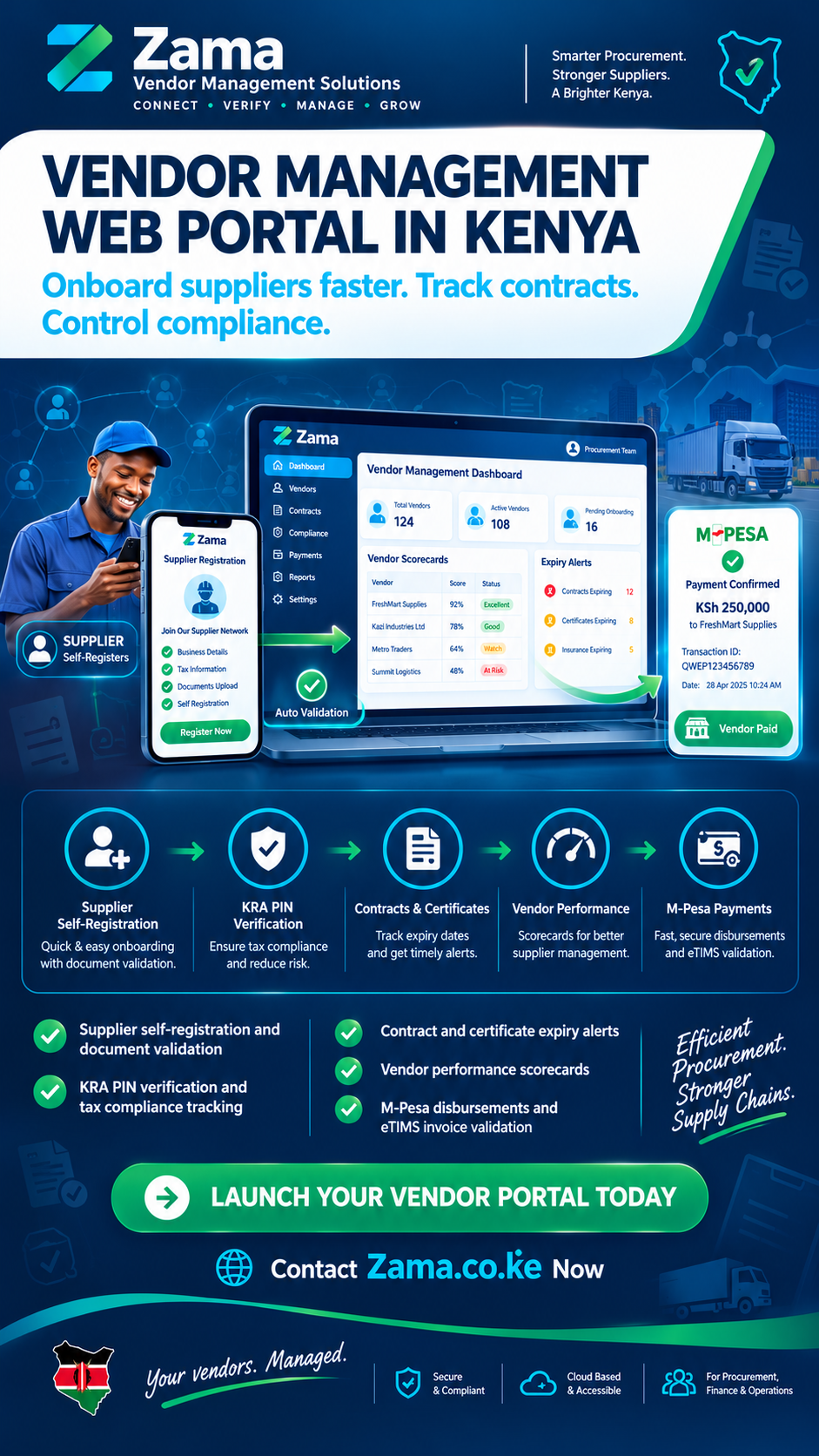
Vendor management web portal in Kenya is a question that every procurement director, finance manager, and operations leader must answer in 2026. With Kenyan organizations working with dozens or hundreds of suppliers across goods, works, and services, and with vendor records scattered across spreadsheets, email inboxes, and paper files, the ability to manage suppliers through a single secure portal has become essential for cost control, compliance, and supply chain resilience. At zama.co.ke, we’ve helped numerous organizations across Kenya implement custom vendor management web portals that centralize supplier records, automate onboarding, track performance, and integrate payments with M-Pesa. This comprehensive guide explores the vendor management web portal in Kenya, from understanding what these portals deliver to selecting the right development approach for your organization.
What a Vendor Management Web Portal Actually Delivers
Before diving into the vendor management web portal in Kenya, it’s essential to understand what this technology actually does. A vendor management web portal is a secure, browser-based platform where organizations manage their entire supplier relationship lifecycle—from initial registration and prequalification through contract award, performance monitoring, invoice submission, and payment. It replaces scattered vendor files, email-based document exchange, and manual performance tracking with a centralized, auditable system accessible to both the organization’s procurement team and its suppliers.
A proper vendor management web portal in Kenya does far more than store supplier contact details. It enables suppliers to self-register and submit compliance documents, verifies supplier details against government registries, manages prequalification and categorization, tracks contracts and expiry dates, records vendor performance and incidents, receives invoices, reconciles them against purchase orders, and triggers payment through M-Pesa or bank transfer.
For a Kenyan organization, the practical definition of a vendor management web portal in Kenya is this: the platform that tells you exactly who your approved vendors are, exactly what they are qualified to supply, exactly how they are performing, exactly when their contracts and compliance documents expire, and exactly how much they are owed—all in real time, from any device, with workflows tailored to your procurement policies.
Why Kenyan Organizations Need a Vendor Management Web Portal
When evaluating the vendor management web portal in Kenya, consider the compelling reasons for adoption:
The Cost of Fragmented Vendor Records
Most Kenyan organizations manage vendor information across multiple disconnected systems. Procurement keeps supplier lists in spreadsheets. Finance keeps payment details in the accounting system. Departments keep their own contact lists. Compliance documents sit in email attachments or filing cabinets. When a supplier disputes a payment or an auditor requests documentation, staff spend days reconstructing the record.
A modern vendor management web portal in Kenya eliminates this fragmentation. Every vendor has a single, authoritative record. Every document is stored in one place. Every interaction is logged. When questions arise, answers are immediate.
Supplier Onboarding Takes Too Long
Supplier onboarding in many Kenyan organizations takes weeks. A new supplier submits documents by email. Procurement reviews them. Finance requests bank details separately. Compliance asks for KRA PIN and tax compliance certificates. Documents are lost, requested again, and reviewed by different people. The supplier is frustrated, and the organization’s own projects are delayed.
A proper vendor management web portal in Kenya streamlines onboarding dramatically. Suppliers self-register and upload required documents once. The portal validates formats, checks completeness, and routes the submission for review. Approvers see a complete package. The onboarding cycle drops from weeks to days.
KRA Compliance and Supplier Verification
Since January 2024, all VAT-registered businesses in Kenya must transmit invoices to KRA through eTIMS. Organizations also need to verify that their suppliers are tax compliant before making payments—an invalid PIN or an expired tax compliance certificate creates withholding tax complications and audit risk.
A comprehensive vendor management web portal in Kenya verifies supplier details against KRA records, tracks tax compliance certificate validity, and ensures that every supplier invoice received through the portal is eTIMS compliant. When documents expire, the portal alerts both the organization and the supplier.
Contract and Document Expiry Risk
Vendor contracts have start dates, end dates, and renewal terms. Insurance certificates expire. Business permits expire. Tax compliance certificates expire. Professional certifications expire. Managing these dates manually means something slips through—and a lapsed contract or expired certificate exposes the organization to risk.
A quality vendor management web portal in Kenya tracks every expiry date and sends automated alerts weeks in advance. Procurement teams see a dashboard of upcoming renewals. Suppliers receive reminders to upload updated documents. Nothing lapses unnoticed.
Vendor Performance and Risk Management
Not all vendors perform equally. Some deliver on time; others do not. Some meet quality specifications; others repeatedly fall short. Some carry unacceptable compliance or reputational risk. Without systematic performance tracking, procurement decisions are made on memory and impressions.
A proper vendor management web portal in Kenya records performance systematically—delivery timeliness, quality acceptance rates, incident reports, and dispute outcomes. It generates scorecards that inform future award decisions and supplier development conversations.
M-Pesa and Invoice Payment Workflows
Vendor payments in Kenya increasingly run through M-Pesa. A proper vendor management web portal in Kenya receives supplier invoices through the portal, matches them against purchase orders and goods receipts, routes them through approval, and triggers payment via M-Pesa B2C or bank transfer upon approval. Suppliers see payment status without calling the finance office.
Data Protection Act Compliance
Kenya’s Data Protection Act imposes strict requirements on how organizations handle personal data, including sole traders’ personal details and individual contacts at supplier organizations. A compliant vendor management web portal in Kenya implements access controls, audit trails, retention policies, and data subject rights aligned with the Act.
Key Features of a Vendor Management Web Portal in Kenya
When evaluating the vendor management web portal in Kenya, focus on these core features:
1. Supplier Self-Registration
Suppliers should be able to register themselves rather than requiring procurement staff to enter their details. A proper vendor management web portal in Kenya provides a public registration form where suppliers enter their business details, upload documents, and select the categories they wish to be considered for. The submission enters a review queue with completeness checks.
2. Document Collection and Validation
Vendor management depends on documentation—registration certificates, KRA PIN certificates, tax compliance certificates, business permits, insurance certificates, professional certifications, and bank details. A comprehensive vendor management web portal in Kenya collects these documents, validates formats, checks expiry dates, and stores them securely with access controls.
3. Prequalification and Categorization
Not every supplier should be eligible for every opportunity. A quality vendor management web portal in Kenya supports prequalification workflows where suppliers are evaluated against criteria and categorized by the goods, works, or services they are approved to supply. Procurement teams can then restrict invitations to qualified suppliers.
4. Contract Management
Contracts are the foundation of vendor relationships. A proper vendor management web portal in Kenya stores contract records with start and end dates, values, terms, and attachments. It sends renewal alerts and tracks amendments. It links contracts to purchase orders, invoices, and performance records.
5. Vendor Performance Scorecards
Performance management requires systematic data. A comprehensive vendor management web portal in Kenya records delivery timeliness, quality acceptance, responsiveness, and incident history. It calculates performance scores and generates scorecards used in supplier review meetings and future award decisions.
6. Invoice Submission and Three-Way Matching
Suppliers should submit invoices through the portal rather than by email. A quality vendor management web portal in Kenya receives invoices, matches them against purchase orders and goods receipt notes, flags discrepancies, and routes matched invoices for payment approval.
7. M-Pesa and Bank Payment Integration
Upon approval, payments should flow automatically. A proper vendor management web portal in Kenya integrates M-Pesa B2C and bank payment files, triggers payment upon approval, receives confirmation, and updates supplier account status in real time.
8. Compliance and Expiry Monitoring
Expiry management is essential. A comprehensive vendor management web portal in Kenya monitors every expiry date—contracts, certificates, insurance—and sends automated alerts to procurement teams and suppliers weeks in advance.
9. Supplier Portal Access
Suppliers need their own view. A quality vendor management web portal in Kenya provides a supplier-facing portal where vendors can view their registration status, upload updated documents, see purchase orders, submit invoices, and track payment status.
10. Reporting and Dashboards
Procurement leadership needs visibility. A proper vendor management web portal in Kenya provides dashboards showing vendor counts by category, spend by vendor, contract renewals due, expiring documents, performance rankings, and payment status.
What Makes a Vendor Management Web Portal Different in Kenya
The vendor management web portal in Kenya has unique characteristics that global solutions often lack:
KRA PIN and Tax Compliance Verification
Kenyan organizations must verify supplier tax compliance. A portal built for Kenya validates KRA PINs and tracks tax compliance certificate validity as a core function.
eTIMS-Compliant Supplier Invoices
Every supplier invoice received must be eTIMS compliant. A Kenyan portal validates that invoices received through the portal carry valid eTIMS references.
M-Pesa as a Payment Rail
Kenyan vendors increasingly expect M-Pesa payments. A portal built for Kenya integrates Daraja API B2C disbursements natively.
PPADA Awareness for Public Entities
Public entities operate under the Public Procurement and Asset Disposal Act. A portal serving public organizations supports the registration, categorization, and reporting structures the Act requires, alongside e-GP integration where applicable.
Mobile-First Supplier Experience
Many Kenyan suppliers—particularly small and medium enterprises—operate from phones. A portal built for Kenya is mobile-first and usable on low-end devices with limited bandwidth.
Data Protection Act Compliance
Kenyan portals handle personal data of sole traders and supplier contacts. Compliance with the Data Protection Act is built in rather than bolted on.
Local Support
Kenyan organizations need support in their timezone and language. Local support is a practical requirement, not a luxury.
Key Factors That Determine Cost
When analysing cost, several factors directly influence pricing:
1. Number of Vendors and Users
More vendors and internal users mean more provisioning, permissions, and support.
2. Onboarding Workflow Complexity
Prequalification, multi-level review, and category-specific requirements add complexity.
3. Integration Scope
Integration with procurement, accounting, M-Pesa, KRA verification, and eTIMS determines effort.
4. Contract Management Depth
Contract records, renewals, amendments, and linked documents add complexity.
5. Performance Management Requirements
Scorecards, incident tracking, and review workflows add to the build.
6. Supplier Portal Scope
A supplier-facing portal with document upload, invoice submission, and payment visibility adds significant work.
7. Deployment Model
Cloud, on-premise, or hybrid deployment affects cost and ongoing support.
8. Customization
Custom forms, reports, and approval rules add to the build.
9. Training and Ongoing Support
Training procurement, finance, and suppliers, plus ongoing support, contribute to total cost.
For a transparent quote based on your organization’s specific requirements, contact zama.co.ke today.
Use Cases
Corporate Enterprises
Corporate organizations use vendor portals to manage hundreds of suppliers across categories, centralizing records and enforcing compliance.
Public Sector Entities
Public entities use vendor portals to manage supplier registration and prequalification transparently, with structured reporting.
Manufacturing Companies
Manufacturers use vendor portals to manage raw material and component suppliers, tracking delivery performance and quality acceptance.
Banks and Financial Institutions
Financial institutions use vendor portals to manage suppliers with strict compliance requirements, including due diligence documentation.
Healthcare Facilities
Hospitals use vendor portals to manage pharmaceutical, equipment, and service suppliers with batch-level and certification tracking.
NGOs and Development Organizations
NGOs use vendor portals to manage suppliers across donor-funded programs, with procurement transparency requirements.
The Zama.co.ke Approach to Vendor Management Web Portal Development
When considering the vendor management web portal in Kenya, zama.co.ke follows a structured approach:
Requirements Discovery
We map your vendor categories, onboarding rules, approval hierarchies, contract terms, and payment workflows.
Portal Design
We design supplier self-registration, document management, prequalification, contract tracking, and performance scorecards.
Development and Integration
We build the portal, integrate M-Pesa Daraja API, KRA verification, eTIMS validation, and your accounting system, and configure notifications.
Testing and Data Migration
We test registration, document validation, approval flows, invoice matching, and payments, then migrate existing vendor records.
Training and Support
We train procurement and finance teams, and provide supplier onboarding guidance.
Post-Launch Optimization
We monitor usage, gather feedback, and refine the portal.
The ROI
When evaluating the vendor management web portal in Kenya, the ROI is compelling:
Faster Onboarding: Supplier registration and approval cycles drop from weeks to days.
Eliminated Duplicate Records: A single vendor record prevents duplicate and inconsistent supplier data.
Compliance Protection: Verified PINs, valid certificates, and eTIMS-compliant invoices reduce audit and penalty risk.
Reduced Expiry Risk: Automated alerts prevent lapsed contracts and certificates.
Improved Vendor Performance: Systematic scorecards drive better supplier outcomes.
Faster Payments: Invoice matching and M-Pesa disbursement reduce payment delays.
Better Spend Visibility: Dashboards show spend by vendor and category for better negotiation.
Implementation Considerations
Assess Your Vendor Landscape
Document your vendor categories, volumes, compliance requirements, and current pain points before designing.
Choose the Right Solution
Match complexity to your organization. A private company needs less public-sector reporting than a government entity.
Plan for Data Migration
Migrate vendor records, contracts, and compliance documents carefully, validating data accuracy.
Train Your Team and Suppliers
Procurement and finance staff need training, and suppliers need clear onboarding instructions.
Ensure Compliance
Build Data Protection Act, KRA verification, and eTIMS controls in from day one.
Test Thoroughly
Test registration, document validation, approvals, invoice matching, and payment flows.
Consider a Phased Rollout
Start with one category or department before going organization-wide.
The Cost of Delaying
While organizations evaluate the vendor management web portal in Kenya, the cost of inaction compounds. Every month of fragmented records is audit risk. Every month of slow onboarding is delayed procurement. Every month of untracked performance is avoidable supplier risk.
Why Contact Zama.co.ke
When researching the vendor management web portal in Kenya, organizations should contact zama.co.ke because:
Procurement Expertise: We understand vendor onboarding, prequalification, contracts, and performance management.
M-Pesa Expertise: We integrate Daraja API for vendor disbursements and reconciliation.
eTIMS Expertise: We validate supplier invoices and transmit compliant documents in real time.
Compliance Focus: We build Data Protection Act and KRA verification controls in from day one.
Custom Development: We build portals matched to your categories, hierarchies, and reporting needs.
Transparent Pricing: No hidden fees and full source-code ownership.
Ongoing Support: We stay available as your vendor base grows.
For a custom quote based on your organization’s specific requirements, contact zama.co.ke today.
The vendor management web portal in Kenya is essential for any organization seeking to centralize supplier records, accelerate onboarding, control compliance risk, and pay vendors efficiently. From supplier self-registration and document validation to contract tracking, performance scorecards, and M-Pesa payments, the right portal changes how procurement operates.
At zama.co.ke, we’ve helped organizations across Kenya implement vendor management portals that deliver measurable results. Our approach ensures you get exactly what your organization needs—nothing more, nothing less.
Don’t let the complexity of a vendor management web portal in Kenya hold you back. Whether you manage a handful of strategic suppliers or hundreds of transactional vendors, we have the expertise to guide you through every step.
Contact zama.co.ke today for a custom quote based on your organization’s specific requirements.