
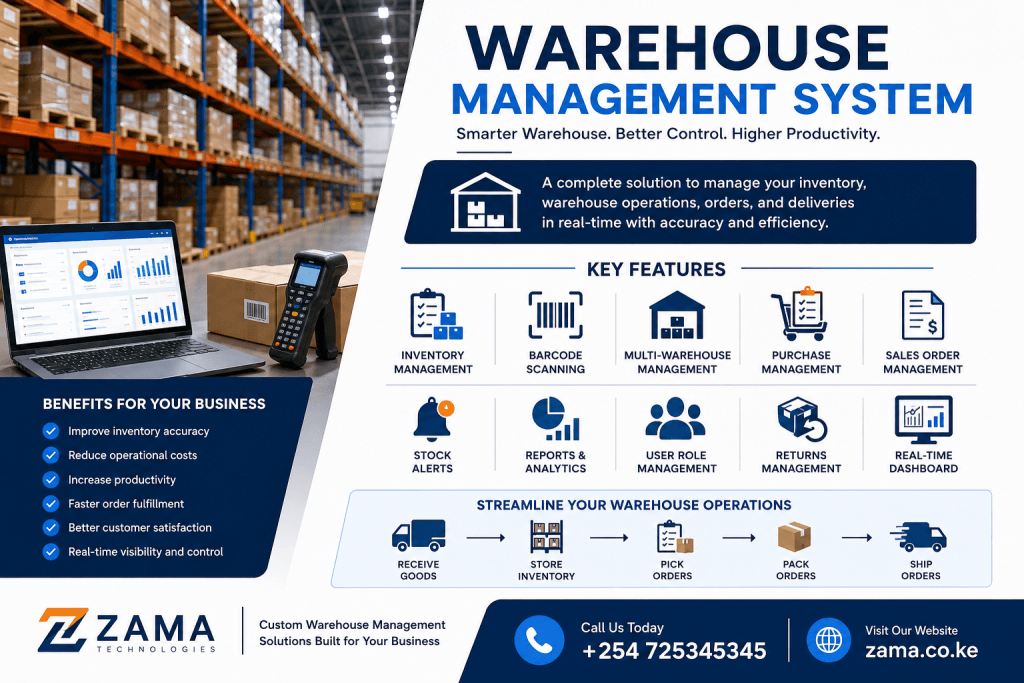
Warehouse Management System: The Ultimate Solution for Modern Inventory Control
Managing a warehouse efficiently is one of the biggest challenges businesses face today. Whether you operate a retail shop, wholesale business, manufacturing company, pharmaceutical store, supermarket, distribution center, or eCommerce business, keeping track of inventory manually can lead to costly mistakes.
A Warehouse Management System is designed to eliminate these challenges by automating warehouse operations, improving inventory accuracy, reducing operational costs, and increasing productivity. Businesses across Kenya are adopting a Warehouse Management System to remain competitive, improve customer satisfaction, and maximize profits.
At Zama Technologies (Zama.co.ke), we specialize in developing modern, cloud-based, and customized Warehouse Management System solutions for businesses of all sizes. Our software helps organizations automate warehouse processes while giving managers complete visibility over inventory movement.
If you’re looking for a professional Warehouse Management System, contact us today on +254 725345345 for a customized solution that meets your business needs.
What is a Warehouse Management System?
A Warehouse Management System (WMS) is software that helps businesses control, monitor, and optimize warehouse operations from the moment goods enter the warehouse until they are dispatched to customers.
Instead of using spreadsheets or paper records, a Warehouse Management System automates inventory tracking, stock movement, receiving, storage, picking, packing, shipping, and reporting.
A modern Warehouse Management System gives business owners real-time information about inventory, allowing them to make informed decisions while minimizing losses.
The main objective of a Warehouse Management System is to ensure every product is stored correctly, located quickly, and delivered accurately.
Why Every Business Needs a Warehouse Management System
As businesses grow, managing inventory becomes increasingly difficult.
Without a proper Warehouse Management System, businesses experience:
- Lost inventory
- Overstocking
- Understocking
- Delayed deliveries
- Human errors
- Duplicate entries
- Theft
- Poor reporting
- Customer complaints
- Reduced profitability
Implementing a Warehouse Management System solves these problems while creating a highly organized warehouse.
Businesses using a Warehouse Management System often experience:
- Faster order fulfillment
- Better stock visibility
- Reduced operational costs
- Improved employee productivity
- Increased customer satisfaction
- Better decision making
How a Warehouse Management System Works
A Warehouse Management System follows inventory throughout its lifecycle.
The process includes:
Receiving Goods
When products arrive, the Warehouse Management System records:
- Supplier information
- Product name
- Quantity
- Batch number
- Purchase order
- Date received
The inventory is immediately updated.
Product Storage
The Warehouse Management System assigns products to their correct storage locations.
This eliminates confusion and makes locating products much easier.
Inventory Tracking
Every movement inside the warehouse is recorded by the Warehouse Management System.
Managers can instantly see:
- Available stock
- Reserved stock
- Damaged stock
- Returned items
- Items in transit
Picking Orders
Once customers place orders, the Warehouse Management System identifies the exact storage location.
Employees spend less time searching for products.
Packing
The software verifies the correct products before packing.
This reduces shipping errors significantly.
Shipping
When goods leave the warehouse, the Warehouse Management System automatically updates inventory.
Customers receive accurate deliveries.
Key Features of a Warehouse Management System
An effective Warehouse Management System should include comprehensive features that simplify warehouse operations.
Inventory Management
Inventory management is the heart of every Warehouse Management System.
Features include:
- Real-time stock updates
- Stock transfers
- Batch management
- Product categorization
- Inventory valuation
- Stock adjustments
Barcode Management
A modern Warehouse Management System supports barcode technology.
Benefits include:
- Faster stock scanning
- Reduced manual entry
- Improved accuracy
- Faster stock audits
Multi-Warehouse Management
Many businesses operate several warehouses.
A Warehouse Management System allows users to manage:
- Branch warehouses
- Regional warehouses
- Distribution centers
- Retail outlets
All inventory is synchronized in one dashboard.
Supplier Management
The Warehouse Management System stores supplier information including:
- Contact details
- Purchase history
- Payment status
- Product catalog
This simplifies procurement.
Purchase Order Management
Businesses can create purchase orders directly within the Warehouse Management System.
Managers can monitor:
- Pending orders
- Approved orders
- Delivered orders
- Outstanding deliveries
Sales Order Integration
An advanced Warehouse Management System integrates sales and inventory.
Whenever sales occur, inventory updates automatically.
This prevents overselling.
Stock Alerts
The Warehouse Management System automatically sends notifications when:
- Stock is low
- Products expire soon
- Inventory exceeds limits
- Orders are delayed
Managers respond quickly before problems escalate.
Reporting Dashboard
Reports generated by a Warehouse Management System include:
- Daily inventory reports
- Stock valuation
- Sales reports
- Warehouse performance
- Supplier reports
- Purchase reports
- Movement history
Managers make data-driven decisions.
Industries That Need a Warehouse Management System
Almost every business storing physical products benefits from a Warehouse Management System.
Manufacturing Companies
Manufacturers require a Warehouse Management System to monitor:
- Raw materials
- Finished goods
- Production inventory
- Components
Wholesale Businesses
Wholesalers handle thousands of products daily.
A Warehouse Management System helps manage:
- Bulk inventory
- Deliveries
- Customer orders
- Supplier shipments
Retail Businesses
Retailers use a Warehouse Management System to synchronize warehouse inventory with physical stores.
Supermarkets
A Warehouse Management System manages:
- Food inventory
- Beverage stock
- Household items
- Expiry dates
Pharmaceutical Companies
Medicine requires strict inventory control.
A Warehouse Management System monitors:
- Batch numbers
- Expiry dates
- Storage conditions
- Stock levels
Construction Companies
Construction firms manage:
- Building materials
- Equipment
- Spare parts
A Warehouse Management System prevents material shortages.
eCommerce Businesses
Online businesses rely heavily on a Warehouse Management System for:
- Fast order fulfillment
- Real-time inventory
- Shipping accuracy
- Customer satisfaction
Benefits of Using a Warehouse Management System
Improved Inventory Accuracy
Manual inventory often contains mistakes.
A Warehouse Management System provides accurate inventory records.
Faster Warehouse Operations
Employees locate products much faster using a Warehouse Management System.
This improves productivity.
Lower Operating Costs
A Warehouse Management System reduces:
- Labor costs
- Storage costs
- Inventory losses
- Manual paperwork
Better Customer Satisfaction
Customers receive:
- Correct products
- Faster deliveries
- Accurate invoices
A Warehouse Management System improves customer experience.
Reduced Human Errors
Automation minimizes mistakes caused by manual data entry.
A Warehouse Management System ensures reliable operations.
Increased Productivity
Employees spend less time searching for products.
The Warehouse Management System handles repetitive tasks automatically.
Real-Time Visibility
Managers can monitor inventory anytime from anywhere.
Cloud-based Warehouse Management System solutions provide live updates.
Essential Modules of a Warehouse Management System
An enterprise-grade Warehouse Management System should include:
- Inventory Management
- Warehouse Dashboard
- Barcode Management
- Purchase Orders
- Sales Orders
- Supplier Management
- Customer Management
- Stock Transfers
- Multi-Warehouse Management
- Returns Management
- User Access Control
- Audit Logs
- Reports & Analytics
- Notifications
- Mobile Accessibility
Signs Your Business Needs a Warehouse Management System
Your organization likely needs a Warehouse Management System if you experience:
- Missing inventory
- Frequent stock-outs
- Overstocking
- Slow order fulfillment
- Manual spreadsheets
- Inventory discrepancies
- Poor warehouse organization
- Difficulty locating products
- Delayed customer deliveries
- High warehouse operating costs
If these challenges sound familiar, investing in a Warehouse Management System can transform your warehouse operations.
Why Choose Zama Technologies for Your Warehouse Management System?
At Zama Technologies, we design and develop customized Warehouse Management System software tailored to your business processes rather than forcing your business to adapt to generic software.
Our solutions are:
- Fully customized
- Cloud-based
- Secure
- Fast
- Mobile-friendly
- Scalable
- Easy to use
- Affordable
- Integrated with existing business systems
- Supported by experienced software developers
Whether you’re a small business or a large enterprise, we can build a Warehouse Management System that grows with your organization.
For consultations, demonstrations, or a customized quote, contact Zama Technologies today at +254 725345345.
Advanced Warehouse Technology, Best Practices, Future Trends, and Conclusion
As businesses continue to expand, warehouse operations become more complex. Managing thousands of products, multiple suppliers, and growing customer demands requires more than manual record-keeping. Modern businesses need smart technology, streamlined workflows, and reliable systems that help them operate efficiently while maintaining accuracy.
A well-designed warehouse solution not only keeps inventory organized but also supports better planning, faster fulfillment, and stronger customer relationships. Businesses that invest in digital warehouse operations are better positioned to compete in today’s fast-paced market.
Barcode and QR Code Integration
One of the most valuable additions to any warehouse operation is barcode and QR code technology.
Instead of entering product details manually, warehouse personnel can scan product labels using handheld barcode scanners, mobile devices, or tablets. This significantly reduces typing errors and speeds up daily warehouse activities.
Barcode integration makes it possible to:
- Identify products instantly
- Update inventory in real time
- Reduce data entry mistakes
- Speed up receiving and dispatching
- Perform faster stock counts
- Improve employee productivity
QR codes can also store additional product information such as batch numbers, manufacturing dates, supplier details, and warranty information, making product identification even more efficient.
RFID Technology in Modern Warehouses
Radio Frequency Identification (RFID) technology is becoming increasingly popular among businesses handling large inventories.
Unlike traditional barcodes that require direct scanning, RFID tags can be detected automatically from a distance. This allows businesses to monitor inventory movement without manually scanning every item.
Benefits include:
- Faster inventory counting
- Improved stock visibility
- Better theft prevention
- Reduced labor requirements
- Improved shipment verification
- Automated inventory updates
Although RFID implementation requires a higher initial investment, many growing organizations recover the cost through increased efficiency and reduced operational losses.
Mobile Warehouse Operations
Warehouse employees are no longer tied to desktop computers.
Modern systems support smartphones and tablets, allowing employees to perform warehouse tasks while moving throughout the facility.
Using mobile devices, staff can:
- Receive deliveries
- Scan products
- Confirm dispatches
- Update inventory
- Check stock availability
- Locate storage locations
- Process returns
Managers can also monitor warehouse performance remotely, giving them greater flexibility and control.
Cloud-Based Warehouse Solutions
Cloud technology has transformed the way businesses manage warehouse operations.
Unlike traditional software installed on a single computer, cloud-based systems allow authorized users to access information securely from anywhere with an internet connection.
Advantages include:
- Automatic backups
- Lower maintenance costs
- Remote access
- Easy software updates
- Enhanced security
- Multi-branch synchronization
- Scalability as the business grows
Cloud solutions are particularly useful for businesses operating warehouses in multiple locations.
Automation in Warehouse Operations
Automation is changing warehouse management around the world.
Routine tasks that once required manual intervention can now be completed automatically.
Examples include:
- Automatic stock updates
- Purchase order generation
- Inventory alerts
- Shipment notifications
- Customer communication
- Stock replenishment reminders
- Report generation
Automation reduces repetitive work while allowing employees to focus on higher-value tasks.
Artificial Intelligence in Warehouse Management
Artificial Intelligence (AI) is helping businesses make smarter decisions by analyzing large amounts of warehouse data.
AI-powered systems can:
- Predict future demand
- Identify fast-moving products
- Forecast seasonal inventory
- Recommend reorder quantities
- Detect unusual inventory activity
- Improve warehouse layout planning
- Optimize picking routes
Instead of relying solely on historical reports, businesses can use predictive insights to improve operational efficiency.
Business Intelligence and Analytics
Warehouse data becomes much more valuable when transformed into meaningful reports and dashboards.
Managers should be able to view information such as:
- Inventory valuation
- Stock turnover
- Best-selling products
- Slow-moving inventory
- Order fulfillment rates
- Employee productivity
- Supplier performance
- Customer demand trends
Visual dashboards allow executives to identify opportunities and address problems before they become costly.
Warehouse Security
Warehouse security extends beyond locking doors.
Digital systems help protect inventory by recording every transaction and tracking user activities.
Important security features include:
User Roles
Different employees should have different permissions.
For example:
- Administrators
- Managers
- Supervisors
- Warehouse staff
- Sales personnel
- Auditors
Each role should only access information relevant to their responsibilities.
Audit Logs
Every inventory transaction should be recorded.
Audit logs help answer questions such as:
- Who adjusted inventory?
- When was stock transferred?
- Who approved dispatch?
- Which employee processed a return?
These records improve accountability.
Data Backup
Regular backups protect businesses from:
- Hardware failure
- Cyber attacks
- Human error
- Power outages
- Accidental deletion
Automatic cloud backups provide peace of mind.
Warehouse Layout Optimization
Technology alone cannot improve warehouse performance if products are poorly organized.
An efficient warehouse layout should:
- Separate receiving and dispatch areas
- Provide clear walking paths
- Group similar products together
- Store frequently sold products near dispatch points
- Allocate secure storage for high-value inventory
- Maintain proper safety standards
A well-organized warehouse reduces employee movement and increases productivity.
Managing Seasonal Inventory
Many businesses experience seasonal demand fluctuations.
Examples include:
- School supplies
- Christmas products
- Agricultural inputs
- Construction materials
- Holiday merchandise
Historical sales reports help businesses prepare for busy seasons by ordering appropriate inventory levels in advance.
This minimizes shortages while avoiding unnecessary overstocking.
Handling Product Returns
Returns are a normal part of business operations.
An organized return process helps maintain accurate inventory while improving customer satisfaction.
Returned products should be classified as:
- Resalable items
- Damaged products
- Defective goods
- Supplier returns
- Customer exchanges
Proper documentation ensures inventory records remain accurate.
Warehouse Performance Metrics
Successful warehouse managers continuously monitor key performance indicators (KPIs).
Important metrics include:
- Order accuracy
- Inventory accuracy
- Picking speed
- Packing efficiency
- Shipping time
- Inventory turnover
- Order cycle time
- Storage utilization
- Employee productivity
- Return rates
Monitoring these indicators helps businesses identify areas requiring improvement.
Employee Training
Even the best software requires knowledgeable users.
Training should cover:
- Receiving procedures
- Product scanning
- Inventory adjustments
- Order processing
- Stock transfers
- Safety procedures
- Reporting tools
Regular refresher training ensures employees continue using the system correctly as new features are introduced.
Common Warehouse Challenges
Many organizations encounter similar operational challenges.
These include:
- Limited warehouse space
- Inaccurate inventory counts
- Poor product labeling
- Slow picking processes
- Delayed supplier deliveries
- Overstocking
- Stock shortages
- Employee turnover
- Manual paperwork
- Lack of operational visibility
Identifying these challenges early allows businesses to implement appropriate solutions before they impact customer satisfaction.
Tips for Choosing the Right Software Provider
Selecting the right technology partner is just as important as selecting the software itself.
Consider the following factors:
Industry Experience
Choose a company with experience developing business management solutions for different industries.
Customization
Every business has unique processes. The software should adapt to your workflow instead of forcing you to change your operations.
Technical Support
Reliable customer support ensures issues are resolved quickly whenever assistance is needed.
Scalability
Your software should continue supporting your business as it grows.
Security
Ensure the solution includes strong authentication, encryption, backups, and user access controls.
Integration
The software should integrate easily with accounting systems, ERP platforms, eCommerce stores, POS systems, CRM software, and payment platforms.
Future Trends in Warehouse Management
Technology continues to reshape warehouse operations.
Future developments are expected to include:
- AI-driven inventory optimization
- Autonomous warehouse robots
- Drone-assisted inventory counting
- Voice-directed picking
- Smart shelves
- Internet of Things (IoT) sensors
- Digital twins for warehouse simulation
- Advanced predictive analytics
- Sustainable warehouse operations
- Paperless warehouse environments
Businesses that embrace innovation today will be better prepared for tomorrow’s challenges.
Why Partner with Zama Technologies?
At Zama Technologies, we understand that every business operates differently. Our goal is to build software that reflects your unique operational requirements while remaining easy to use and scalable.
Our development team delivers solutions that combine performance, reliability, and flexibility. Whether you operate a single warehouse or manage multiple distribution centers across different regions, we can design a platform that supports your long-term growth.
Our services include:
- Custom software development
- Warehouse management solutions
- Inventory management systems
- ERP integration
- Mobile application development
- Cloud deployment
- API integrations
- Data migration
- User training
- Technical support and maintenance
- Software upgrades and enhancements
From consultation and system design to deployment and ongoing support, we work closely with clients to ensure successful implementation and measurable business improvements.
Frequently Asked Questions
Can the software support multiple warehouses?
Yes. Multi-location management allows businesses to monitor inventory across several warehouses from one centralized dashboard.
Is it suitable for small businesses?
Absolutely. Small businesses can start with essential features and expand functionality as operations grow.
Can existing inventory data be imported?
Yes. Historical inventory data can typically be imported from spreadsheets or legacy systems during implementation.
Is the system secure?
Modern solutions include encrypted communication, role-based permissions, secure authentication, audit trails, and automated backups to protect business data.
Can it integrate with other business systems?
Yes. Integration with accounting software, ERP platforms, online stores, CRM systems, and payment gateways is possible depending on business requirements.
Can users access the system remotely?
Cloud deployment enables authorized users to securely access the platform from offices, warehouses, or remote locations using internet-connected devices.
Conclusion
Efficient warehouse operations are no longer a competitive advantage—they are a business necessity. Organizations that rely on manual processes often face inventory inaccuracies, delayed deliveries, rising operational costs, and limited visibility into stock movement. By embracing digital warehouse management, businesses gain greater control over inventory, improve productivity, and provide faster, more reliable service to customers.
As technology continues to evolve, investing in scalable and intelligent warehouse solutions positions your business for long-term growth. Whether you are managing a retail store, wholesale operation, manufacturing facility, pharmaceutical warehouse, or eCommerce fulfillment center, the right software can simplify daily operations while providing valuable insights for better decision-making.
If you’re ready to modernize your warehouse operations with a customized solution built around your business needs, Zama Technologies is here to help.
Contact Zama Technologies today
Website: zama.co.ke
Phone: +254 725345345
Let us help you build a smarter, faster, and more efficient warehouse management solution that supports your business today and into the future.