
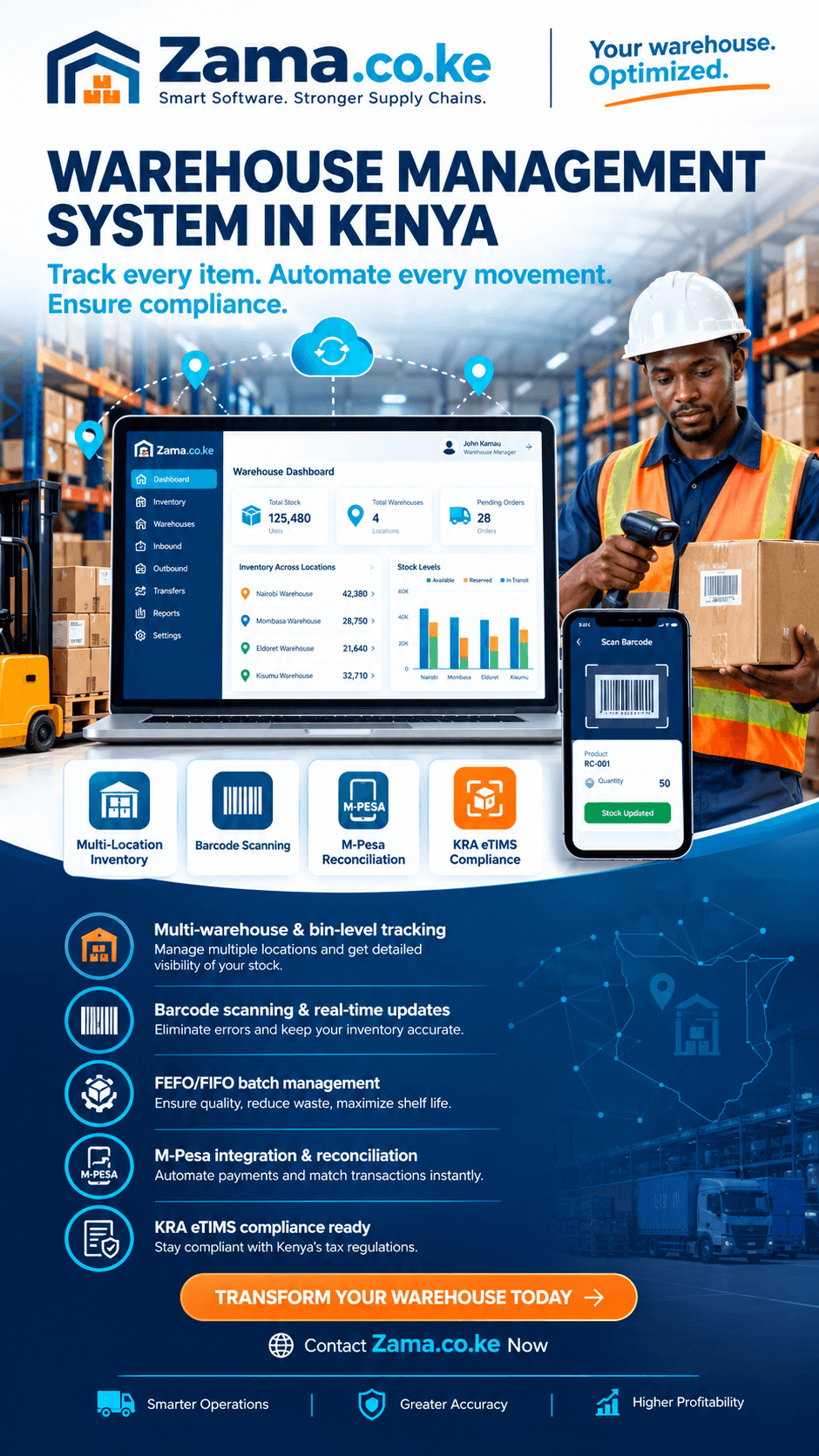
Warehouse Management System in Kenya is a question that every logistics manager, warehouse operator, and supply chain director must answer in 2026. With Kenya’s e-commerce market growing at 15-20% annually and projected to increase from $2.3 billion in 2023 to $3.8 billion by 2028, the demand for efficient warehouse operations has never been greater. At zama.co.ke, we’ve helped numerous logistics businesses across Kenya build custom warehouse management solutions that address their unique operational challenges. This comprehensive guide explores warehouse management system in Kenya, from understanding core requirements to selecting the right solution for your warehouse operations.
The Cost of Poor Warehouse Management in Kenya
Before diving into warehouse management system in Kenya, it’s essential to understand the current challenges. Most warehouses in East Africa still organize fulfillment with manual processes and lists, leading to errors and delivery delays. A Nairobi-based agro-processor recently printed 37 versions of their inventory report in a single month because their generic ERP couldn’t track batch expiry dates by location—resulting in KSh 510,000 lost in one week from expired products.
Kenyan SMEs lose an estimated KSh 4.7 billion annually to software failures, system crashes, and poorly integrated digital tools. For warehouse operations, the costs are specific and severe. Research on warehouse management in Kenyan sugar companies found that companies were unable to meet demand with perennial stock outs and cane shortages whose visibility could be controlled directly from the warehouse.
When evaluating warehouse management system in Kenya, consider the hidden costs:
Inventory Chaos: Generic software assumes real-time updates and stable connectivity. In Kenya, warehouses face intermittent power, fluctuating 3G/4G networks, and multi-region stock movements across Nairobi, Mombasa, Kisumu, and Kakamega. Off-the-shelf systems treat every county like a warehouse zone in Chicago—resulting in overstock in Nairobi and stockouts in Kakamega.
Expiry and Batch Management Failures: Groceries and pharmaceuticals expire fast—expiry-by-batch is non-negotiable. Generic software often cannot track batch expiry dates by location, leading to expired products being sold and significant financial losses.
Regulatory Compliance Gaps: Every time KRA tweaks eTIMS or updates VAT thresholds, generic accounting software crashes. Kenyan warehouses need systems built for local regulatory realities, not coded in Zurich.
Manual Reconciliation Burden: Without integrated systems, staff spend hours reconciling M-Pesa payments, stock movements, and supplier invoices. The average SME in Nairobi spends significant amounts monthly on manual processes that software could automate.
What a Warehouse Management System Actually Does
A Warehouse Management System (WMS) is software that controls and tracks the physical operations of a warehouse. A proper warehouse management system in Kenya answers the operational questions that accounting or basic inventory systems cannot: where exactly is this item located right now, which bin should the receiving team place it in, which batch should the picker select to fulfil this order, and what is the exact stock count in warehouse B at this moment without anyone making a phone call.
A warehouse management system in Kenya is not a separate product that connects to your ERP. It is the stock and warehouse module built directly into the platform. This matters because every warehouse transaction—whether a goods receipt, a stock transfer, a pick list, or a stock reconciliation—updates the same database used by accounting, purchasing, sales, and manufacturing modules simultaneously. A stock movement in the warehouse is an accounting entry, a cost update, and a purchasing trigger all at once.
For a Kenyan business, the practical definition of warehouse management system in Kenya is this: the system that tells you exactly what stock you have, exactly where it is, exactly how much it is worth, and exactly who moved it last, across every warehouse, godown, and branch, in real time, from a single dashboard accessible on any device.
Essential Features of a Warehouse Management System in Kenya
When evaluating warehouse management system in Kenya, focus on these core features:
1. Multi-Warehouse Management
A proper warehouse management system in Kenya supports unlimited warehouses organised in a parent-child hierarchy. A business in Kenya can configure a head office warehouse in Nairobi, a regional godown in Mombasa, and branch store warehouses in Kisumu and Nakuru, all visible from one dashboard. Each warehouse has its own stock levels, its own accounts, and its own movement history. Stock transfers between locations are tracked with full documentation.
2. Bin-Level and Zone Tracking
Within each warehouse, a comprehensive warehouse management system in Kenya supports granular location structures: zones, aisles, racks, shelves, and bins. Every item can be tracked to its exact location, eliminating the time wasted searching for products.
3. Barcode Scanning and Real-Time Updates
Manual data entry error rates in high-volume warehouse operations typically range from 1% to 3%. A warehouse management system in Kenya with barcode scanning capability eliminates these errors. Staff can scan products with smartphones, updating stock in seconds. Barcode scanning ensures that goods receipt, putaway, picking, packing, and shipping are all recorded accurately and instantly.
4. FEFO and FIFO Management
For industries like pharmaceuticals, FMCG, and agro-processing, expiry management is critical. A warehouse management system in Kenya should support FEFO (First Expiry First Out) for pharma and cold chain, and FIFO (First In First Out) for FMCG products. Auto-select batches keeps rotation tight and prevents expired products from being shipped.
5. Goods Receipt Note (GRN) with Short-Supply Check
When receiving stock at the Mombasa port or upcountry godown, a warehouse management system in Kenya validates received quantities against ordered quantities. It flags shortfalls to the head office for credit note or claim. This catches short-supply at the dock, not weeks later.
6. Inter-Warehouse Transfers with In-Transit Visibility
For businesses moving consignment stock from the Mombasa port to Nairobi, Eldoret, or Kisumu depots, a warehouse management system in Kenya provides in-transit visibility. Inter-godown transfer orders, receiving confirmation flows, and transit duration tracking ensure that stock in transit does not double-count between depots.
7. M-Pesa and Payment Integration
M-Pesa integration is non-negotiable for any warehouse management system in Kenya. The system should dispatch with M-Pesa reference, pick, pack, post the delivery note, and attach the M-Pesa or PesaLink reference for handling charges. M-Pesa collections auto-allocate to invoices. Cash-flow dashboards let warehouse managers see in minutes which suppliers are due and when the next M-Pesa payout will hit the account.
8. Batch and Serial Traceability
Every movement of every batch or serial number surfaces in stock traceability for KEBS audits. A warehouse management system in Kenya provides per-SKU tracking by batch, expiry, or serial. This is essential for industries regulated by KEBS, PPB, and KEPHIS.
9. Reporting and Analytics
A warehouse management system in Kenya should generate comprehensive reports: Warehouse Stock, Stock Ledger, Inward, Outward, Aging, and Traceability reports. KES reports and CSV export capabilities ensure that data can be shared with finance teams and auditors.
10. Offline Capability and Mobile-First Design
Kenyan warehouses face connectivity challenges. A proper warehouse management system in Kenya should work even with 2G signal. Operations heads configure rules in the portal, and godown teams execute on the app—same data, same accuracy.
What Makes a Kenyan Warehouse Management System Different
A warehouse management system in Kenya has unique characteristics that global solutions often lack:
M-Pesa First Design
Kenyan warehouse operations must be designed around M-Pesa as the primary payment channel. The system should support M-Pesa and PesaLink collections auto-allocating to KES invoices. Drivers collect payments at delivery, and customers receive confirmation on their phones.
KRA eTIMS Compliance
Kenya Revenue Authority mandates the use of the Electronic Tax Invoice Management System (eTIMS). Any warehouse management system in Kenya must integrate flawlessly with eTIMS, generating eTIMS-ready invoices for every transaction. The system should support system-to-system integration for businesses that already have invoicing or ERP systems.
Mombasa-to-Upcountry Logistics
Kenyan supply chains run from the Mombasa port to upcountry godowns. A warehouse management system in Kenya must handle consignment intake at the port, inter-godown transfers, and in-transit visibility across Nairobi, Eldoret, and Kisumu depots.
Low-Bandwidth Optimization
Internet in Kenya is not always reliable. Good warehouse management system in Kenya should work with minimal data usage and function offline when needed.
Local Language and Context
The best systems are built for Kenyan realities—navigating Nairobi traffic delays, fluctuating 3G/4G networks, and multi-tier supply chains. Generic software assumes Kenya operates like Germany or Japan.
Multi-Client and Modular Structure
Most warehouses in Kenya are small to medium-sized. A warehouse management system in Kenya should be immediately deployable without high investments, time-consuming efforts, or lengthy training. It should adapt precisely to specific requirements through modular structure.
The Kenyan Warehouse Management Landscape
Several solutions are emerging to address warehouse management system in Kenya needs:
ERPNext WMS
ERPNext Warehouse Management System is the built-in module within ERPNext that controls the physical movement, storage, and tracking of stock across one or more warehouse locations in real time. For businesses in Kenya managing warehouses across Nairobi, Mombasa, Kisumu, or any combination of branches and godowns, it provides real-time visibility, barcode scanning capability, bin-level tracking, and automated replenishment. Businesses report 35% improvement in overall warehouse efficiency after implementing ERPNext stock and warehouse automation.
Wemalo Cloud-WMS
Wemalo offers the first cloud-based warehouse management system for efficient multi-client management, specifically tailored to modern logistics service providers and fulfillment companies. With an office in Nairobi, Wemalo enables small and medium-sized warehouse service providers to get started immediately—without high investments or lengthy training. The solution adapts precisely to specific requirements through modular structure.
1Channel Cloud AI WMS
1Channel provides Cloud AI Warehouse Management Software built for Kenyan distributors running consignments from the Mombasa port to upcountry depots, with batch traceability and KES reconciliation. Features include multi-godown inventory control, Mombasa-to-upcountry transfers, GRN with short-supply check, FEFO dispatch, and batch plus serial traceability.
Savannah Software Solutions
Savannah builds custom warehouse solutions that address the specific challenges of Kenyan businesses—inventory chaos from Mombasa to Mandera, KRA compliance, and supply chains that run on WhatsApp.
For businesses seeking a truly custom warehouse management system in Kenya built for their specific workflows, zama.co.ke provides tailored solutions that integrate GPS tracking, batch traceability, M-Pesa reconciliation, and eTIMS compliance—all designed for Kenyan warehouse realities.
The Zama.co.ke Approach
When considering warehouse management system in Kenya, zama.co.ke follows a structured approach:
Operational Discovery
We define your warehouse workflows: goods receipt, putaway, storage, picking, packing, shipping, returns, and the reports leadership needs. This includes mapping current workflows, identifying pain points, and defining success metrics.
System Design
Modules, data structure, permissions, user journeys, and reporting layers are planned so the platform supports your warehouse operations coherently.
Build and Integrate
Core modules, dashboards, automation logic, and external connections are developed in stages with review checkpoints against agreed requirements. Important integrations include M-Pesa, KRA eTIMS, and logistics platforms.
Validation and Rollout Readiness
We test critical workflows, user roles, integrations, calculations, and reporting behavior so the system can be adopted with confidence.
Post-Launch Support
After go-live, we support stabilization, user feedback, ongoing maintenance, and the next round of improvements informed by real usage.
The ROI of a Warehouse Management System in Kenya
When evaluating warehouse management system in Kenya, the ROI is compelling:
35% Improvement in Warehouse Efficiency: Businesses report significant efficiency gains after implementing warehouse automation.
25% Reduction in Stock Discrepancies: Real-time stock tracking and barcode integration eliminate manual errors.
1-3% Error Rate Reduction: Manual data entry error rates drop dramatically with barcode scanning.
30-40% Reduction in Post-Harvest Losses: For agricultural warehouses, the eWRS-CR system cuts post-harvest losses.
Compliance Protection: Audit-ready eTIMS integration prevents KRA penalties.
Scalability: Automation enables warehouses to handle more volume without proportional increases in staff.
Warehouse management system in Kenya is essential for any logistics business operating in 2026. From multi-warehouse management and barcode scanning to M-Pesa integration and KRA eTIMS compliance, the right software transforms how warehouses operate.
At zama.co.ke, we’ve helped logistics businesses across Kenya build custom warehouse management solutions that streamline operations and improve performance. Our approach ensures you get exactly what your warehouse needs—nothing more, nothing less.
Don’t let the complexity of warehouse management system in Kenya hold you back. Whether you’re a small godown or a large distribution centre, we have the expertise to guide you through every step.
Contact zama.co.ke today and let us help you build a warehouse management system that transforms your operations.