
Web Application Development Kenya: The Complete Guide to Building Powerful Digital Solutions
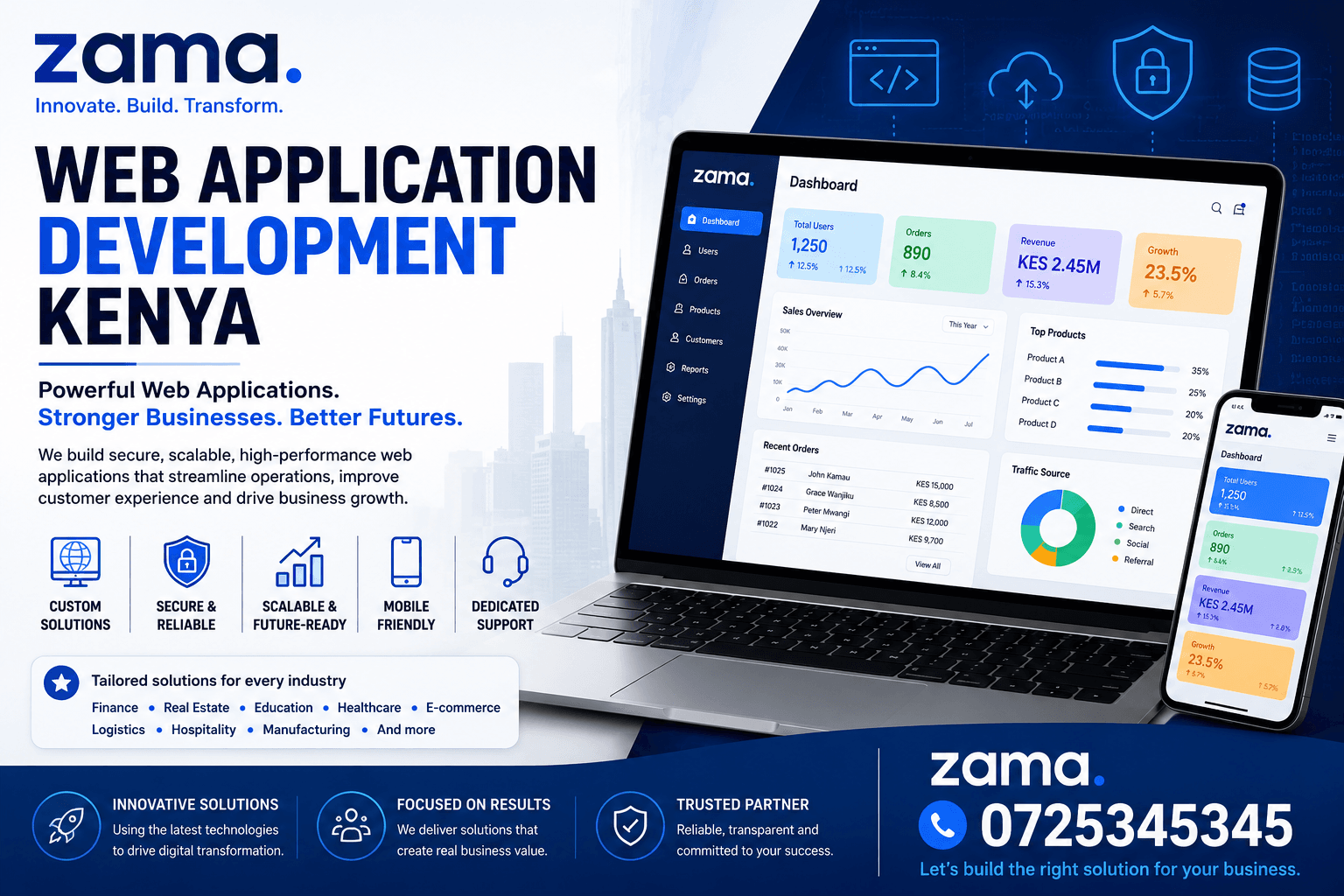
Businesses in Kenya are rapidly embracing digital technology to improve customer experiences, automate operations, increase productivity, and compete in an increasingly connected economy. From financial institutions and logistics companies to retailers, schools, healthcare providers, real estate businesses, and professional service firms, organizations are investing in applications that can be accessed through web browsers from computers and mobile devices.
Web Application Development Kenya has therefore become an important part of digital transformation for businesses that want to replace inefficient manual processes with reliable, scalable, and user-friendly digital platforms.
A web application can do much more than display information. It can enable customers to create accounts, make payments, submit applications, communicate with businesses, manage documents, monitor orders, access services, generate reports, and complete transactions online. For internal teams, web applications can automate workflows, centralize information, improve collaboration, and provide management with real-time insights.
The growth of e-commerce, mobile payments, cloud computing, artificial intelligence, remote work, and digital customer service has increased the demand for customized web applications in Kenya. Businesses no longer have to depend entirely on generic software that may not match their processes. Instead, they can invest in platforms designed around their specific needs.
This guide explores the importance of Web Application Development Kenya, the types of web applications businesses can build, the development process, technologies involved, benefits, costs, security considerations, common challenges, and how to choose the right development partner.
What Is Web Application Development?
Web application development involves designing, building, testing, deploying, and maintaining software applications that users access through web browsers.
Unlike a simple website, a web application is interactive and often performs specific business functions.
Examples include:
- Customer portals
- Employee portals
- School management platforms
- Hospital management systems
- E-commerce platforms
- Booking systems
- Property management platforms
- Accounting systems
- Inventory management applications
- CRM systems
- Help desk platforms
- Project management systems
- Logistics platforms
- Online marketplaces
- Business dashboards
A web application can be accessible through browsers such as Chrome, Edge, Safari, or Firefox without requiring users to install traditional desktop software.
The scope of Web Application Development Kenya can range from relatively simple customer-facing applications to complex enterprise platforms supporting thousands of users.
Why Web Application Development Kenya Is Growing
The Kenyan business environment is experiencing rapid digital transformation.
Customers increasingly expect organizations to provide convenient online services. Employees expect access to information from anywhere. Managers want real-time reports. Business owners want automation and better control over operations.
This has created strong demand for customized web applications.
Web Application Development Kenya enables organizations to build digital systems that respond to these changing expectations.
Several factors are contributing to this growth.
Increasing Internet Access
More Kenyans are accessing digital services through smartphones, computers, and other connected devices. This gives businesses an opportunity to serve customers beyond physical locations.
Mobile Money Adoption
Mobile payment services have made digital transactions more accessible. Businesses can integrate payment functionality into web applications, making it easier for customers to purchase products, pay invoices, make bookings, or settle bills.
Growing E-Commerce
Kenyan consumers are increasingly comfortable researching and purchasing products online. Businesses therefore need digital platforms that provide convenient shopping experiences.
Demand for Automation
Organizations want to reduce repetitive administrative tasks. A web application can automate workflows that would otherwise require spreadsheets, paperwork, emails, and manual data entry.
Remote and Distributed Teams
Businesses increasingly require employees to access systems outside traditional offices. Browser-based applications can make remote access more convenient when properly designed and secured.
Web Application Development Kenya for Different Industries
One of the biggest advantages of web applications is their flexibility.
A properly designed platform can be customized to address the requirements of almost any industry.
Financial Services
Financial institutions and fintech businesses can use web applications for customer portals, loan applications, transaction management, account services, reporting, and customer support.
Security is particularly important in financial applications because they may handle sensitive personal and financial information.
Real Estate
Property businesses can use web applications to manage properties, tenants, rent payments, maintenance, property listings, leads, and financial records.
A customized platform can bring multiple property management activities into one centralized system.
Healthcare
Healthcare providers can use applications for appointment scheduling, patient records, billing, communication, inventory management, and administrative workflows.
Healthcare platforms must place significant emphasis on privacy, security, reliability, and appropriate access controls.
Education
Schools, colleges, universities, and training institutions can use web applications for student registration, fee management, examinations, learning resources, communication, staff administration, and reporting.
Logistics
Logistics businesses can build platforms for order management, dispatching, fleet tracking, customer communication, delivery management, invoicing, and reporting.
Retail
Retailers can use web applications for online shopping, inventory tracking, customer accounts, order processing, payments, promotions, and customer service.
Hospitality
Hotels, restaurants, resorts, and travel businesses can use applications for bookings, reservations, customer management, payments, room management, and service requests.
The flexibility of Web Application Development Kenya allows businesses in different sectors to build solutions around their unique workflows.
Types of Web Applications Businesses Can Build
There is no single type of web application.
The appropriate solution depends on the business objective, users, processes, and required features.
Customer Portals
Customer portals allow users to log in and access personalized services.
A portal might allow customers to:
- View account information
- Download documents
- Submit requests
- Make payments
- Track orders
- Contact support
- Update profiles
- View transaction histories
Employee Portals
Organizations can create employee portals for:
- Leave applications
- Payroll information
- Internal communication
- Performance management
- Document access
- Attendance
- Employee records
E-Commerce Applications
E-commerce applications provide functionality for:
- Product catalogs
- Shopping carts
- Customer accounts
- Online payments
- Order processing
- Delivery management
- Promotions
- Inventory
Booking Applications
Booking systems can be developed for hotels, restaurants, events, transportation, healthcare providers, salons, consultants, and other businesses.
Business Management Systems
Companies can build customized platforms for managing internal processes such as sales, procurement, inventory, accounting, customer relationships, and operations.
SaaS Applications
Software-as-a-Service applications allow customers to subscribe to software through the internet.
SaaS products can serve businesses across Kenya and international markets.
Custom Web Applications vs Off-the-Shelf Software
Businesses often face a choice between buying existing software and developing a custom solution.
Off-the-shelf software can be useful when a business has standard requirements.
However, generic software may not always fit unique workflows.
Custom Web Application Development Kenya allows a business to create functionality specifically around its operations.
For example, a logistics company may have a unique process for receiving delivery requests, assigning vehicles, managing drivers, confirming delivery, invoicing customers, and generating reports.
Instead of forcing the company to change its entire process to fit generic software, custom development can create a system that supports the existing workflow while improving it.
Custom development can also provide greater flexibility for future changes.
Key Features of a Modern Web Application
A successful web application should provide functionality that genuinely supports users and business objectives.
Important features can include:
User Registration and Authentication
Users should be able to create accounts and securely log in.
Role-Based Access
Different users may require different permissions.
For example, an administrator may access everything, while an employee may only access specific modules.
Dashboards
Dashboards provide users with an overview of important information.
Management dashboards may display:
- Sales
- Revenue
- Orders
- Customers
- Expenses
- Tasks
- Performance indicators
Search and Filtering
Users should be able to quickly find relevant records.
Notifications
Notifications can inform users about payments, tasks, approvals, deadlines, messages, or other events.
Payment Integration
Applications can integrate appropriate payment methods to facilitate online transactions.
Reporting
Reports allow businesses to transform raw information into actionable insights.
Document Management
Some applications need to store invoices, contracts, receipts, reports, images, and other documents.
Communication
Applications can include messaging, email notifications, support tickets, or other communication functionality.
The Web Application Development Process
Professional development requires a structured process.
A good development team does not simply start writing code. It first seeks to understand the business.
1. Business Requirements Analysis
The first stage involves understanding what the business wants to achieve.
Questions may include:
- What problem is the application solving?
- Who will use it?
- What processes should it automate?
- What information must it store?
- What integrations are required?
- What reports are needed?
- What security requirements exist?
Clear requirements reduce misunderstandings later in development.
2. Planning
The development team creates a roadmap covering features, technology, timelines, resources, and milestones.
3. UI/UX Design
The user interface determines how users interact with the application.
Designers create layouts, navigation structures, dashboards, forms, buttons, menus, and other components.
Good UX design focuses on making tasks simple and intuitive.
4. Front-End Development
The front end is the part of the application users interact with directly.
Common technologies include:
- HTML
- CSS
- JavaScript
- React
- Angular
- Vue
5. Back-End Development
The back end handles application logic, databases, authentication, integrations, and server-side operations.
Technologies may include:
- PHP
- Laravel
- Python
- Django
- Node.js
- Java
- .NET
The appropriate technology depends on the project.
6. Database Development
The database stores information such as customers, products, transactions, payments, orders, documents, and other records.
7. API and Integration Development
Applications often need to communicate with other systems.
APIs can facilitate integrations with:
- Payment platforms
- SMS providers
- Email services
- Accounting software
- CRM systems
- Maps
- Government services
- Third-party applications
8. Testing
Testing identifies defects before users encounter them.
Testing can include:
- Functional testing
- Security testing
- Performance testing
- Usability testing
- Compatibility testing
- Integration testing
- User acceptance testing
9. Deployment
After successful testing, the application is deployed to a production environment.
10. Maintenance and Improvement
Development does not end at launch.
Applications require maintenance, security updates, monitoring, backups, performance optimization, and feature improvements.
Benefits of Web Application Development Kenya
Investing in a web application can create significant advantages for a business.
Improved Efficiency
Automation reduces repetitive manual work.
Instead of entering the same information into multiple spreadsheets, teams can use a centralized system.
Better Data Management
A web application can provide a single source of truth for business information.
Increased Accessibility
Authorized users can access web applications from different locations and devices.
Improved Customer Experience
Customers can access services without always needing to visit a physical office or make phone calls.
Reduced Administrative Work
Automated workflows can reduce the burden on administrative teams.
Better Reporting
Management can access dashboards and reports that support decision-making.
Scalability
A well-designed system can evolve as the organization grows.
Integration
Web applications can connect with other business tools and services.
Competitive Advantage
Businesses that provide convenient digital experiences can differentiate themselves in competitive markets.
These benefits explain why Web Application Development Kenya continues to attract interest from businesses seeking long-term digital transformation.
Mobile-Responsive Web Applications
A significant portion of internet activity in Kenya occurs through mobile devices.
A web application that only works well on desktop computers can therefore create a poor user experience.
Responsive design allows an application to adapt to different screen sizes.
Users should be able to interact with the system comfortably on:
- Smartphones
- Tablets
- Laptops
- Desktop computers
Mobile responsiveness should be considered from the beginning rather than added as an afterthought.
Security in Web Application Development
Security should be treated as a core requirement rather than an optional feature.
Web applications can contain valuable business and customer information.
Security measures may include:
- Secure authentication
- Password protection
- Role-based permissions
- Data encryption
- Secure APIs
- Input validation
- Session management
- Activity logging
- Regular security updates
- Backups
- Monitoring
Businesses should also consider relevant Kenyan data protection requirements when handling personal information.
Security requirements will vary depending on the nature of the application and the information being processed.
Cloud-Based Web Applications
Cloud infrastructure has transformed the way applications are hosted and accessed.
Instead of maintaining physical servers in an office, businesses can use cloud infrastructure to host applications.
Cloud hosting can provide:
- Scalability
- Remote accessibility
- Backup options
- Infrastructure flexibility
- Improved deployment workflows
- Monitoring capabilities
However, cloud adoption should still be accompanied by appropriate security, backup, access-control, and disaster-recovery practices.
APIs and Third-Party Integrations
Modern businesses rarely operate in isolation.
A web application may need to communicate with multiple external systems.
For example, an e-commerce platform may connect with payment services, SMS providers, accounting systems, shipping platforms, and email services.
APIs make many of these connections possible.
Well-designed integrations can prevent employees from manually transferring information between systems.
This is another area where Web Application Development Kenya can deliver substantial operational value.
Artificial Intelligence in Web Applications
Artificial intelligence is increasingly becoming part of modern business applications.
AI features can be integrated into web applications for purposes such as:
- Customer support chatbots
- Document analysis
- Automated responses
- Recommendations
- Data classification
- Predictive analytics
- Content assistance
- Search optimization
- Fraud detection
AI should be applied where it solves a genuine business problem rather than simply being added because it is fashionable.
Case Study: A Kenyan Retail Business
Consider a hypothetical retail company with several branches.
The company previously used spreadsheets to monitor stock and manually consolidated sales information.
This created delays and inconsistencies.
The company commissions a custom web application.
The platform connects:
- Products
- Inventory
- Branches
- Sales
- Customers
- Suppliers
- Reports
Employees can update stock information from different locations.
Managers can view consolidated dashboards.
The finance team can access transaction records more efficiently.
Customers can also interact with the company through an online ordering interface.
The result is a more connected business operation.
Case Study: A Property Management Company
Imagine a Kenyan property management business managing hundreds of rental units.
Previously, the company relied on spreadsheets and manual payment reconciliation.
The company develops a centralized web application.
The platform allows staff to manage:
- Properties
- Units
- Tenants
- Rent
- Payments
- Arrears
- Maintenance
- Expenses
- Reports
Management can see outstanding balances more quickly.
Property owners can receive clearer reports.
Tenants have better communication channels.
The application becomes a central operating system for the company.
How to Choose a Web Application Development Company
Choosing a development partner is an important decision.
Businesses should consider several factors.
Technical Experience
Look at the developer’s experience with relevant technologies.
Portfolio
Review previous applications and projects.
Understanding of Business Requirements
A good development company should understand the business problem rather than simply build features.
UI/UX Capabilities
The application should be easy to use and visually professional.
Security Practices
Ask how the company approaches application security.
Communication
Clear communication is essential throughout the project.
Maintenance and Support
Find out what happens after launch.
Scalability
Ensure the application can support future growth.
Ownership
Clarify ownership of source code, data, intellectual property, and other project assets.
Choosing the right partner can significantly influence the success of Web Application Development Kenya projects.
Common Mistakes to Avoid
Businesses sometimes make mistakes when starting application development.
Focusing Only on Features
A long feature list does not automatically create a successful application.
The focus should be on solving real user problems.
Ignoring Users
Developers should understand how actual users will interact with the system.
Poor Planning
Insufficient requirements analysis can cause scope changes and delays.
Neglecting Security
Security should be considered throughout development.
Ignoring Mobile Users
Mobile responsiveness is essential for many Kenyan audiences.
No Maintenance Plan
Applications require continuous monitoring and improvement.
Choosing Solely on Price
The cheapest option may not provide the quality, security, or scalability the business needs.
How to Make a Web Application Successful
Building an application is only the beginning.
Businesses should continuously evaluate:
- User adoption
- Performance
- Customer feedback
- Conversion rates
- Error rates
- Security
- System availability
- Business outcomes
Analytics can help management understand how users interact with the application.
Regular improvements can then be based on evidence rather than assumptions.
Why Local Development Expertise Matters
Working with a development team familiar with the Kenyan business environment can provide useful advantages.
Local developers may understand common requirements involving:
- Mobile payments
- Kenyan business workflows
- Local customer expectations
- Regional communication channels
- Local compliance considerations
- Kenyan SMEs
- East African expansion
This does not mean every project must use a local team, but local market understanding can be valuable when the application’s users and operations are primarily based in Kenya.
Future Trends in Web Application Development Kenya
The web development industry is evolving rapidly.
Several trends are likely to influence future applications.
Web Application Development Kenya Artificial Intelligence
AI-powered functionality will become increasingly common.
Progressive Web Applications
PWAs can combine web accessibility with features associated with mobile applications.
Cloud-Native Development
More businesses will use scalable cloud infrastructure.
Web Application Development Kenya API-First Architecture
Businesses will increasingly build systems designed to communicate with multiple platforms.
Web Application Development Kenya Advanced Analytics
Businesses will rely more heavily on real-time data for decision-making.
Web Application Development Kenya Voice Interfaces
Voice-based interaction may become more common in selected applications.
Web Application Development Kenya Automation
More repetitive workflows will become automated.
Stronger Cybersecurity
As digital systems become more important, security will become an even greater priority.
These trends make Web Application Development Kenya an increasingly strategic investment for organizations seeking sustainable digital growth.
Frequently Asked Questions
What is Web Application Development Kenya?
Web Application Development Kenya refers to the process of designing, building, testing, deploying, and maintaining web-based software applications for Kenyan businesses, organizations, and users.
How is a web application different from a website?
A website primarily provides information, while a web application allows users to perform interactive tasks such as making payments, managing accounts, submitting forms, tracking orders, or generating reports.
How long does web application development take?
The timeline depends on complexity. A simple application may take weeks, while a complex enterprise platform can require several months or longer.
Can web applications integrate with M-Pesa?
Yes, where the required API access and technical integration are available, applications can be designed to interact with mobile payment services.
Can a Web Application Development Kenya work on smartphones?
Yes. Responsive web applications can be designed to work across smartphones, tablets, laptops, and desktop computers.
Can I request custom features?
Yes. Custom development is particularly useful when standard software does not support a company’s unique requirements.
Is Web Application Development Kenya expensive?
The cost varies depending on complexity, features, integrations, design, security, and development requirements. A proper requirements analysis is needed before providing an accurate estimate.
Can Web Application Development Kenya support many users?
Yes. Applications can be designed and hosted to support different user volumes. Scalability should be considered during architecture and infrastructure planning.
Can I add features later?
Yes. A well-designed application can be developed incrementally, allowing additional modules and features to be introduced as the business grows.
Does a web application require maintenance?
Yes. Maintenance is necessary for security updates, bug fixes, performance improvements, backups, monitoring, and new features.
Ready to Build Your Web Application?
Whether you need a customer portal, e-commerce platform, business management system, SaaS product, booking platform, employee portal, logistics solution, or a completely customized application, the first step is understanding your business requirements.
A professional development team can help transform your concept into a functional, secure, responsive, and scalable digital platform.
Start by identifying the problem you want to solve, the users you want to serve, the processes you want to automate, and the results you want to achieve.
Then turn those requirements into a digital solution designed for your business.
Web Application Development Kenya is not simply about creating software. It is about creating technology that helps businesses work smarter, serve customers better, reduce inefficiencies, and build sustainable digital growth.