
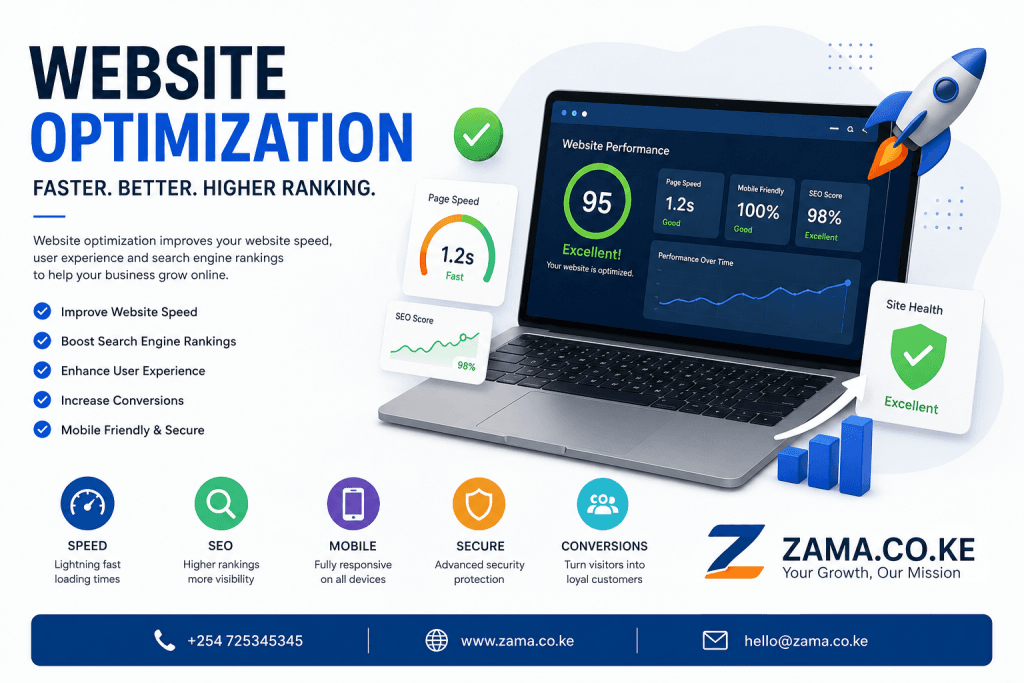
A well-optimized website is no longer a luxury—it is a necessity for businesses that want to succeed online. Whether you own a small business, an eCommerce store, a corporate website, or a personal blog, website optimization ensures that your site performs efficiently, ranks higher on search engines, loads quickly, and converts visitors into customers.
At Zama.co.ke, we specialize in professional website optimization services that help businesses improve website speed, enhance user experience, increase search engine visibility, and maximize conversions. If your website is slow, difficult to navigate, or struggling to rank on Google, professional website optimization can transform your online presence.
Need professional website optimization services?
Website: Zama.co.ke
Call: +254 725345345
What is Website Optimization?
Website optimization is the process of improving various aspects of a website to ensure it performs at its highest potential. It involves enhancing speed, security, search engine optimization (SEO), user experience, mobile responsiveness, content quality, technical performance, and conversion rates.
The primary goal of website optimization is to provide visitors with the best possible experience while helping search engines understand and rank your website more effectively.
A properly optimized website offers:
- Faster loading times
- Better search engine rankings
- Improved user experience
- Higher conversion rates
- Increased online visibility
- Better security
- Lower bounce rates
- Improved customer satisfaction
- Increased sales and leads
Without proper website optimization, even a beautifully designed website may struggle to generate traffic or convert visitors into customers.
Why Website Optimization Matters
Many businesses invest heavily in website development but overlook optimization. However, launching a website is only the beginning. Continuous website optimization ensures that your website remains competitive as search engine algorithms, customer expectations, and technology continue to evolve.
Website optimization helps businesses:
- Increase organic traffic
- Improve Google rankings
- Reduce loading times
- Enhance customer engagement
- Increase online sales
- Generate more inquiries
- Build trust with visitors
- Improve mobile performance
- Reduce website abandonment
Every second counts online. Studies consistently show that users abandon websites that take too long to load. Investing in website optimization ensures visitors stay longer and engage more.
Benefits of Website Optimization
Improved Website Speed
Website speed directly affects user experience and search rankings.
A fast-loading website provides:
- Better user satisfaction
- Lower bounce rates
- Higher conversion rates
- Better Google rankings
- Increased page views
Website optimization focuses on reducing unnecessary code, compressing images, optimizing servers, minimizing CSS and JavaScript files, and implementing caching technologies.
Better Google Rankings
Google prioritizes websites that deliver excellent user experiences.
Website optimization improves ranking factors including:
- Core Web Vitals
- Mobile usability
- Secure HTTPS connections
- Structured data
- Website speed
- Internal linking
- Content quality
Businesses investing in website optimization often experience significant improvements in organic search traffic.
Higher Conversion Rates
Traffic alone is not enough.
Professional website optimization focuses on converting visitors into customers by improving:
- Landing pages
- Call-to-action buttons
- Contact forms
- Checkout process
- Navigation
- Trust signals
When visitors can easily find what they need, they are more likely to contact your business or make a purchase.
Improved User Experience
Visitors expect websites that are:
- Fast
- Easy to navigate
- Mobile-friendly
- Secure
- Visually appealing
Website optimization ensures every visitor enjoys a seamless browsing experience regardless of device.
Better Mobile Performance
Today, most internet users browse using smartphones.
Website optimization ensures:
- Responsive layouts
- Faster mobile loading
- Optimized images
- Touch-friendly navigation
- Mobile SEO compliance
Google’s mobile-first indexing makes mobile optimization more important than ever.
Key Components of Website Optimization
Website optimization involves several interconnected areas.
These include:
Search Engine Optimization (SEO)
SEO helps search engines understand your website.
This includes:
- Keyword optimization
- Meta titles
- Meta descriptions
- Header tags
- Internal linking
- Image optimization
- Content optimization
- URL structure
- Schema markup
SEO is one of the most important aspects of website optimization.
Website Speed Optimization
Speed optimization includes:
- Browser caching
- Image compression
- Code minification
- CDN implementation
- Server optimization
- Lazy loading
- Database optimization
- File compression
Fast websites improve both user experience and search rankings.
Technical Website Optimization
Technical optimization ensures search engines can crawl and index your website efficiently.
It involves:
- XML sitemaps
- Robots.txt optimization
- Canonical URLs
- HTTPS implementation
- Structured data
- Crawl error fixes
- Redirect management
- Broken link repair
Technical SEO forms the backbone of successful website optimization.
Content Optimization
High-quality content attracts visitors and improves rankings.
Content optimization includes:
- Keyword research
- Content updates
- Readability improvements
- Proper headings
- Internal links
- Multimedia integration
- User intent optimization
Fresh, informative content keeps users engaged.
Image Optimization
Images significantly affect loading speed.
Website optimization includes:
- Image compression
- Modern formats like WebP
- Alt text optimization
- Responsive image sizing
- Lazy loading
Optimized images improve both speed and accessibility.
Mobile Optimization
A mobile-friendly website should have:
- Responsive design
- Fast loading
- Easy navigation
- Clickable buttons
- Readable fonts
Website optimization ensures excellent performance across all devices.
Signs Your Website Needs Optimization
Many businesses unknowingly operate poorly optimized websites.
Common warning signs include:
- Slow loading pages
- Low Google rankings
- High bounce rates
- Poor mobile performance
- Low conversions
- Broken links
- Outdated content
- Security warnings
- Poor navigation
- Frequent downtime
If you experience these issues, professional website optimization can make a significant difference.
Website Speed Optimization Techniques
Professional website optimization uses multiple methods.
Compress Images
Large images slow websites dramatically.
Modern optimization tools compress images while maintaining visual quality.
Enable Browser Caching
Caching stores website files on visitor devices, reducing loading times for repeat visits.
Minify CSS and JavaScript
Removing unnecessary spaces and code reduces file sizes and improves loading speeds.
Use a Content Delivery Network (CDN)
A CDN distributes website content across global servers, improving loading speeds for visitors regardless of location.
Optimize Hosting
Even the best website struggles on poor hosting.
Reliable hosting contributes significantly to website optimization.
Database Optimization
Cleaning unnecessary database entries improves website performance.
This is especially important for WordPress websites.
SEO and Website Optimization
SEO and website optimization work together.
Important SEO elements include:
Keyword Research
Understanding what customers search helps businesses create relevant content.
Examples include:
- Website optimization
- Website optimization services
- Professional website optimization
- Website speed optimization
- SEO website optimization
- Website optimization company
- Website optimization Kenya
These keywords help improve visibility when naturally incorporated into quality content.
Optimized Meta Titles
Meta titles should:
- Include primary keywords
- Stay under recommended length
- Encourage clicks
Example:
Website Optimization Services in Kenya | Zama.co.ke
Meta Descriptions
A compelling description increases click-through rates.
Example:
“Professional website optimization services in Kenya. Improve website speed, SEO, security, and user experience. Call +254 725345345 today.”
Internal Linking
Link related pages together.
Benefits include:
- Better navigation
- Improved SEO
- Increased session duration
- Better crawlability
URL Optimization
Good URLs are:
- Short
- Descriptive
- Keyword-rich
- Easy to read
Example:
zama.co.ke/website-optimizationUser Experience Optimization
Visitors judge websites within seconds.
Good user experience includes:
- Clear menus
- Simple layouts
- Fast pages
- Easy contact information
- Visible call-to-actions
- Readable fonts
- Professional branding
Website optimization focuses heavily on improving these areas.
Security Optimization
Website security protects both businesses and customers.
Website optimization includes:
- SSL certificates
- Malware scanning
- Firewall implementation
- Regular updates
- Secure passwords
- Backup systems
- Two-factor authentication
Secure websites build trust and improve search rankings.
Conversion Rate Optimization
Website optimization aims to turn visitors into customers.
Conversion optimization includes:
- Better landing pages
- Clear CTAs
- Faster checkout
- Simplified forms
- Trust badges
- Testimonials
- Live chat
- Improved navigation
Businesses can significantly increase sales without increasing traffic simply by optimizing conversions.
Common Website Optimization Mistakes
Avoid these common mistakes:
- Ignoring mobile users
- Using oversized images
- Poor hosting
- Duplicate content
- Broken links
- Missing meta descriptions
- Slow server response
- Keyword stuffing
- Poor navigation
- Lack of HTTPS
Professional website optimization identifies and fixes these issues before they impact performance.
Industries That Benefit from Website Optimization
Nearly every industry benefits from website optimization, including:
- Retail and eCommerce
- Healthcare
- Law firms
- Educational institutions
- Hotels and hospitality
- Real estate agencies
- Financial services
- Manufacturing companies
- NGOs
- Government organizations
- Construction companies
- Technology firms
- Professional service providers
No matter your industry, investing in website optimization helps attract more visitors, improve user satisfaction, and increase business growth.
Website Optimization Best Practices for Long-Term Success
Website optimization is not a one-time project. It is an ongoing process that involves monitoring your website, analyzing performance, updating content, improving security, and adapting to changes in search engine algorithms. Businesses that continuously invest in website optimization often enjoy better rankings, more traffic, and higher conversion rates than competitors who neglect their websites.
A successful optimization strategy requires consistent attention to both technical performance and user experience. Every update, whether it is improving page speed, refreshing content, or enhancing mobile usability, contributes to the overall effectiveness of your website.
Advanced Website Optimization Strategies
While basic optimization techniques provide a strong foundation, advanced strategies help businesses achieve even better performance.
Improve Core Web Vitals
Google uses Core Web Vitals as part of its ranking factors. These metrics measure how users experience your website.
Important Core Web Vitals include:
Largest Contentful Paint (LCP)
This measures how quickly the largest visible element appears on the screen.
To improve LCP:
- Optimize server response time
- Compress large images
- Remove unnecessary scripts
- Use faster hosting
- Implement caching
Interaction to Next Paint (INP)
This measures how responsive your website is when users interact with it.
Improve responsiveness by:
- Reducing JavaScript execution
- Eliminating unnecessary plugins
- Optimizing third-party scripts
- Improving browser rendering
Cumulative Layout Shift (CLS)
This measures visual stability.
Reduce layout shifts by:
- Setting image dimensions
- Reserving space for advertisements
- Loading fonts properly
- Avoiding unexpected content movement
Improving these metrics enhances both SEO and user satisfaction.
Website Optimization for WordPress
Since WordPress powers millions of websites worldwide, optimizing it correctly is essential.
Professional WordPress website optimization includes:
- Removing unused plugins
- Updating themes
- Optimizing the database
- Cleaning revisions
- Compressing images
- Enabling caching
- Using lightweight themes
- Optimizing PHP versions
- Implementing CDN services
- Reducing plugin conflicts
A properly optimized WordPress website loads significantly faster while remaining secure and easy to manage.
Website Optimization for eCommerce Websites
Online stores face unique challenges because they often contain thousands of products, images, and dynamic pages.
Effective eCommerce website optimization includes:
- Fast product page loading
- Optimized product images
- Secure payment gateways
- Simplified checkout process
- Mobile-friendly shopping
- Structured product data
- Customer reviews
- Inventory synchronization
- Internal product linking
- Category optimization
These improvements increase sales while reducing abandoned carts.
Local SEO and Website Optimization
Businesses targeting local customers should combine website optimization with local SEO strategies.
Important local optimization techniques include:
- Location-specific keywords
- Google Business Profile optimization
- Local landing pages
- Customer reviews
- Local schema markup
- Consistent business information
- Location-based content
- Local backlinks
For businesses in Kenya, local website optimization helps customers easily find services through Google Search and Google Maps.
Content Marketing and Website Optimization
Quality content remains one of the strongest ranking factors.
Content optimization involves creating useful, engaging, and informative articles that answer customer questions.
Examples include:
- Industry guides
- How-to articles
- Frequently asked questions
- Case studies
- Customer success stories
- Product comparisons
- Service explanations
- News updates
Publishing valuable content regularly demonstrates expertise while attracting organic traffic.
Image Optimization Best Practices
Images should enhance your website without slowing it down.
Best practices include:
- Using compressed images
- Choosing modern formats such as WebP
- Writing descriptive file names
- Adding optimized ALT text
- Implementing lazy loading
- Serving responsive image sizes
These improvements help both SEO and accessibility.
Video Optimization
Videos increase engagement but can negatively affect website speed if not optimized.
Recommendations include:
- Hosting videos efficiently
- Compressing video files
- Using thumbnails
- Enabling lazy loading
- Providing captions
- Adding video schema markup
Optimized videos improve user engagement while maintaining excellent website performance.
Website Navigation Optimization
Navigation plays a critical role in user experience.
A well-optimized website should have:
- Clear menus
- Logical categories
- Search functionality
- Breadcrumb navigation
- Internal links
- Easy access to important pages
Visitors should never struggle to locate information.
Technical Website Optimization Checklist
Every optimized website should include:
- HTTPS security
- XML sitemap
- Robots.txt file
- Canonical URLs
- Structured data
- Mobile responsiveness
- Optimized page titles
- Meta descriptions
- Clean URLs
- Error-free redirects
- Fast loading pages
- Broken link monitoring
Technical optimization ensures search engines crawl and index your website effectively.
Website Security Optimization
Security remains one of the most important aspects of website optimization.
Essential security practices include:
- SSL certificates
- Firewall protection
- Malware scanning
- Regular software updates
- Strong passwords
- Two-factor authentication
- Daily backups
- Login protection
- Secure hosting
- Access control
A secure website protects customer information while building trust.
Website Optimization Tools
Professional developers use various tools to analyze website performance.
Common optimization tools include:
- Google PageSpeed Insights
- Google Search Console
- Google Analytics
- GTmetrix
- Lighthouse
- Pingdom Tools
- Screaming Frog SEO Spider
- Ahrefs
- SEMrush
- Cloudflare
These tools help identify opportunities for improving speed, SEO, and usability.
Measuring Website Optimization Success
Businesses should regularly monitor performance indicators.
Important metrics include:
- Organic traffic
- Keyword rankings
- Bounce rate
- Average session duration
- Conversion rate
- Pages per session
- Website loading speed
- Core Web Vitals
- Mobile usability
- Customer inquiries
Regular reporting helps identify areas requiring improvement.
Website Optimization for Mobile Devices
Most online visitors now access websites using smartphones.
Mobile optimization should focus on:
- Responsive layouts
- Fast loading pages
- Touch-friendly buttons
- Readable typography
- Simplified navigation
- Optimized images
- Mobile-friendly forms
A positive mobile experience directly influences conversions and search rankings.
Common Website Optimization Challenges
Businesses often encounter challenges such as:
Slow Hosting
Poor hosting limits website performance regardless of optimization efforts.
Large Media Files
Oversized images and videos increase loading times.
Poor Website Structure
Confusing navigation frustrates visitors.
Outdated Content
Old information reduces credibility.
Excessive Plugins
Too many plugins slow WordPress websites.
Technical SEO Errors
Broken links, duplicate content, and indexing issues negatively affect rankings.
Professional website optimization addresses these problems systematically.
Website Optimization for Lead Generation
Lead generation improves when websites provide visitors with a seamless journey.
Important optimization techniques include:
- Strong headlines
- Clear value propositions
- Contact forms
- Live chat
- Click-to-call buttons
- Testimonials
- Case studies
- Free consultations
- Downloadable resources
Each page should encourage visitors to take the next step.
Why Businesses in Kenya Need Website Optimization
Kenya’s digital economy continues to grow rapidly. More customers search online before purchasing products or services.
Website optimization enables Kenyan businesses to:
- Reach more customers
- Improve Google visibility
- Increase inquiries
- Enhance customer trust
- Compete nationally and internationally
- Improve online sales
- Build stronger brands
Whether you operate in Nairobi, Mombasa, Kisumu, Nakuru, Eldoret, Thika, or any other town, website optimization can significantly improve your online presence.
Choosing the Right Website Optimization Company
When selecting a website optimization partner, consider:
- Industry experience
- Technical expertise
- SEO knowledge
- Transparent reporting
- Customer support
- Proven portfolio
- Performance monitoring
- Ongoing maintenance
- Affordable pricing
Working with experienced professionals ensures long-term success.
Why Choose Zama.co.ke for Website Optimization?
At Zama.co.ke, we provide comprehensive website optimization services designed to help businesses achieve measurable results.
Our services include:
- Website speed optimization
- Technical SEO
- On-page SEO
- Mobile optimization
- WordPress optimization
- Image optimization
- Security enhancements
- Database optimization
- Website audits
- Performance monitoring
- Website maintenance
- Conversion rate optimization
Our experienced team uses industry best practices and the latest technologies to improve website performance while delivering an exceptional user experience.
Whether your website needs a complete optimization or targeted improvements, we are ready to help.
Frequently Asked Questions About Website Optimization
How long does website optimization take?
The duration depends on the size and complexity of the website. Small websites may take a few days, while larger websites require ongoing optimization and monitoring.
Does website optimization improve Google rankings?
Yes. Website optimization enhances many ranking factors, including speed, mobile usability, technical SEO, and content quality, all of which contribute to better search engine visibility.
Is website optimization a one-time process?
No. Search engines update their algorithms regularly, and customer expectations continue to evolve. Continuous optimization is essential for maintaining strong performance.
Can website optimization increase sales?
Absolutely. Faster loading speeds, better navigation, improved user experience, and optimized landing pages help convert more visitors into paying customers.
Is website optimization important for small businesses?
Yes. Small businesses benefit significantly because optimization helps them compete with larger companies by improving visibility, credibility, and customer engagement.
Can an old website be optimized?
Yes. Most existing websites can be improved through technical enhancements, SEO updates, content optimization, speed improvements, and security upgrades.
The Future of High-Performing Business Websites
The digital landscape continues to evolve at a remarkable pace. Customer expectations, search engine algorithms, web technologies, and online security standards are constantly changing, making it essential for businesses to view their websites as living assets rather than static projects. A website that performs exceptionally well today may require updates and refinements tomorrow to remain competitive. Organizations that embrace continuous improvement are often better positioned to adapt to new trends and maintain a strong online presence.
One of the most significant developments in recent years has been the growing emphasis on user expectations. Modern visitors expect websites to load almost instantly, display perfectly on every device, and provide clear, intuitive navigation. They also expect secure browsing, accurate information, and seamless interactions. Businesses that consistently meet these expectations create positive first impressions that encourage visitors to explore further, engage with content, and ultimately become customers.
Accessibility has also become an increasingly important consideration for organizations of every size. A website should be designed so that people with different abilities can navigate and interact with its content comfortably. Clear typography, sufficient color contrast, descriptive alternative text for images, keyboard navigation support, and properly structured headings all contribute to a more inclusive online experience. Beyond meeting accessibility standards, these improvements also enhance usability for every visitor.
Consistency is another hallmark of successful websites. Branding elements such as logos, colors, typography, and messaging should remain uniform across every page. When visitors encounter a consistent visual identity, they develop greater confidence in the professionalism and reliability of the business. Consistency also simplifies navigation because users become familiar with the layout and know where to find important information.
Businesses should also pay close attention to the quality of their written content. Every page should provide genuine value to visitors rather than simply filling space. Well-written content answers common questions, explains products and services clearly, and helps customers make informed decisions. Regularly reviewing and updating existing articles, service descriptions, and company information ensures that visitors always receive accurate and relevant information.
Trust plays a major role in influencing customer decisions. Visitors are more likely to engage with businesses that demonstrate credibility through testimonials, case studies, client success stories, certifications, awards, and transparent business information. Displaying genuine customer feedback and showcasing completed projects can reassure potential clients that they are dealing with an experienced and dependable company.
Clear communication is equally important. Contact information should be easy to locate, and businesses should provide multiple ways for customers to get in touch, whether through phone calls, email, contact forms, or messaging platforms. Fast responses to inquiries create a positive customer experience and can significantly improve conversion rates.
Another area that deserves attention is website scalability. As businesses grow, their websites should be able to accommodate increased traffic, additional content, new services, and expanded functionality without compromising performance. Planning for future growth from the beginning helps avoid costly redesigns and minimizes disruptions as the business evolves.
Businesses should also develop a structured content strategy. Publishing articles, guides, news updates, announcements, and educational resources on a regular basis demonstrates expertise within an industry while keeping the website active. Fresh content provides additional opportunities to engage visitors and encourages repeat visits from existing customers.
Visual elements should complement written content rather than overwhelm it. High-quality photographs, illustrations, icons, and graphics can make information easier to understand and create a more engaging browsing experience. However, visuals should always support the message and maintain a consistent style throughout the website.
Performance monitoring is another essential practice. Rather than making assumptions about how visitors use a website, businesses should regularly review analytical data to understand user behavior. Metrics such as page views, visitor journeys, average session duration, and conversion rates reveal valuable insights that can guide future improvements. Data-driven decisions are generally more effective than relying solely on intuition.
Customer feedback also provides valuable opportunities for improvement. Encouraging visitors to share their experiences, report issues, or suggest enhancements helps businesses identify areas that may not be immediately apparent through analytics alone. Listening to customers and implementing reasonable improvements demonstrates a commitment to continuous service excellence.
Security should remain a long-term priority rather than a one-time setup. Cyber threats continue to evolve, making routine software updates, secure hosting environments, strong authentication practices, and regular backups essential components of responsible website management. A secure website not only protects sensitive information but also strengthens customer confidence.
Another important consideration is integration with other digital business tools. Modern websites often connect with customer relationship management systems, inventory software, payment gateways, marketing platforms, email automation tools, booking systems, and analytics dashboards. Well-planned integrations reduce manual work, improve operational efficiency, and create smoother experiences for both staff and customers.
As technology advances, automation is becoming increasingly valuable. Features such as automated appointment scheduling, chatbot assistance, online quotations, customer portals, and self-service account management can improve operational efficiency while providing visitors with faster access to the information and services they need. Automation should always be implemented thoughtfully to enhance convenience without replacing meaningful human support where it is most valuable.
Environmental sustainability is also gaining attention in the digital world. Efficient websites consume fewer server resources and transfer less data, reducing energy consumption over time. Optimized code, compressed media files, and streamlined page structures contribute not only to better performance but also to a smaller environmental footprint.
Finally, businesses should remember that a website represents far more than an online brochure. It serves as a digital storefront, customer service representative, marketing platform, sales channel, and brand ambassador operating around the clock. Every improvement made to its design, functionality, content, or performance contributes to stronger customer relationships and greater business success over the long term.
Organizations that commit to continuous improvement, embrace innovation, and prioritize the needs of their users are better equipped to compete in an increasingly digital marketplace. By regularly evaluating performance, adopting new technologies when appropriate, and maintaining high standards of quality, businesses can ensure that their websites remain valuable assets capable of supporting growth for many years to come.
Final Thoughts
Your website is often the first impression potential customers have of your business. If it loads slowly, performs poorly, or fails to rank on search engines, you may be losing valuable opportunities every day. Investing in website optimization ensures that your website works efficiently, attracts more visitors, and converts those visitors into loyal customers.
Whether you need improved page speed, enhanced SEO, better mobile performance, stronger security, or higher conversion rates, professional website optimization delivers measurable results. Continuous optimization keeps your website competitive in an ever-changing digital landscape and helps your business grow sustainably.
At Zama.co.ke, we are committed to helping businesses build high-performing websites that generate real value. Our experienced team provides customized website optimization solutions tailored to your business goals, ensuring your website remains fast, secure, user-friendly, and optimized for search engines.
Contact Zama.co.ke Today
Ready to improve your website’s performance and grow your online presence?
Zama.co.ke offers professional Website Optimization services for businesses of all sizes.
📞 Call us today: +254 725345345
Partner with Zama.co.ke and let us transform your website into a faster, more visible, and more profitable digital asset through expert website optimization services.