
Table of Contents
ToggleWholesale Shop Management Software Kenya: Complete Guide for Retail Businesses in 2026
Running a retail business in Kenya has become more competitive than ever. Whether you operate a supermarket, mini-mart, electronics store, pharmacy, hardware shop, fashion boutique, wholesaler, agrovet, cosmetics shop, or convenience store, managing stock, sales, expenses, customers, and staff manually is becoming increasingly difficult.
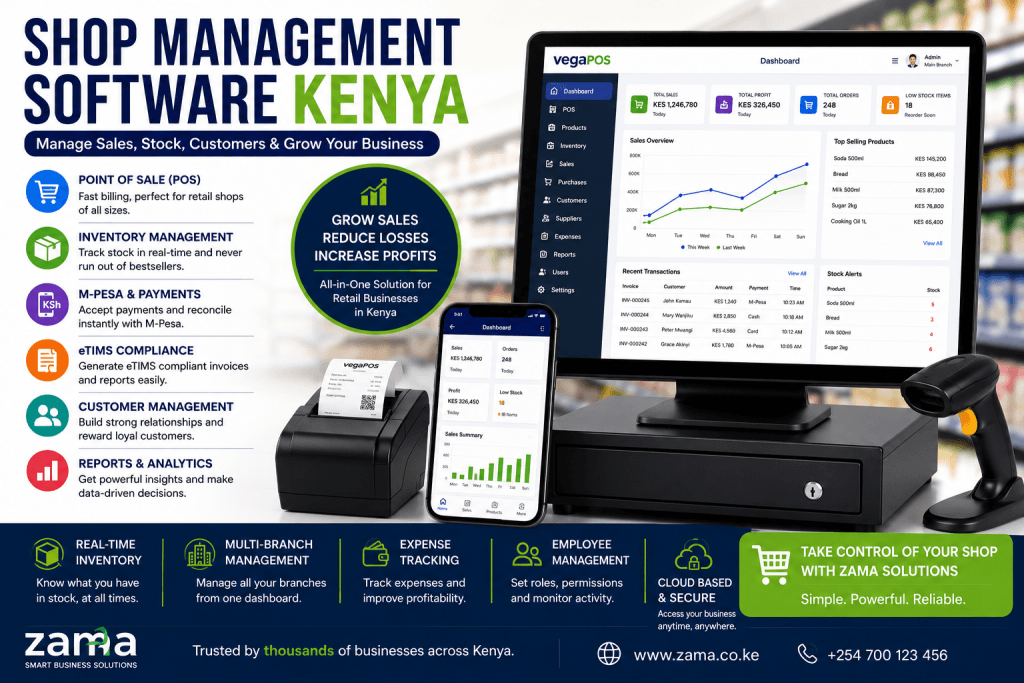
This is why wholesale Shop Management Software Kenya solutions have become one of the most important technology investments for modern businesses. Leading software providers in Kenya emphasize inventory control, sales tracking, M-Pesa integration, eTIMS compliance, reporting, and customer management as the key reasons retailers are moving away from manual operations.
Don’t be left behind. Get your shop a management system by Zama and maximize your profits.
Many retail software websites make vague claims such as “increase profits,” “reduce losses,” or “grow faster.” However, they rarely explain the actual business impact. For example, if a shop loses KES 3,000 worth of stock daily through poor inventory tracking, that equals approximately KES 90,000 monthly and over KES 1 million annually. Preventing even half of those losses can generate significant returns.
This guide explores everything business owners need to know about wholesale Shop Management Software Kenya, including key features, practical business benefits, risks, implementation considerations, and whether the investment is truly worthwhile.
What Is Wholesale Shop Management Software?
Wholesale Shop Management Software Kenya refers to digital systems that help retailers manage sales, inventory, purchases, suppliers, customers, expenses, employees, reports, and business operations from a centralized platform.
Instead of using notebooks, spreadsheets, and disconnected systems, businesses can automate daily operations using a single dashboard.
Modern shop management systems typically include:
- Point of Sale (POS)
- Inventory management
- Customer management
- Supplier tracking
- Expense recording
- M-Pesa integration
- Barcode support
- Reporting
- Multi-branch management
- Staff controls
Many leading Kenyan retail software providers position their systems as all-in-one business management platforms combining inventory, sales, accounting, reporting, and payment management.
Why Kenyan Businesses Are Adopting Wholesale Shop Management Software Kenya
Retail businesses generate thousands of transactions every month.
Without proper systems, owners often struggle to answer simple questions:
- What products are selling fastest?
- Which items are almost out of stock?
- How much profit was made last month?
- Which employee processed a transaction?
- Which customers buy most frequently?
- How much cash should be in the till?
Manual methods make it difficult to obtain accurate answers.
Modern Wholesale Shop Management Software Kenya solutions provide instant visibility into business performance.
Instead of waiting until month-end, business owners can monitor operations in real time.
This explains why thousands of Kenyan retailers have adopted POS and business management systems over the last few years. Several providers report serving hundreds or even thousands of businesses across Kenya.
Common Problems Facing Retail Shops
Most retail businesses face similar operational challenges.
Stock discrepancies are among the biggest problems.
Products disappear from shelves.
Employees make pricing errors.
Manual records become inaccurate.
Physical stock differs from recorded stock.
Cash reconciliation becomes difficult.
Many business owners discover losses only after conducting stock takes.
A shop generating KES 50,000 daily sales processes approximately KES 1.5 million monthly.
Even a 2% inventory loss represents KES 30,000 per month.
This is one reason why Wholesale Shop Management Software Kenya continues gaining popularity.
The software provides visibility and accountability that manual systems simply cannot match.
How Wholesale Shop Management Software Kenya Helps Reduce Business Losses
One of the biggest challenges facing retail businesses in Kenya is hidden losses. Many shop owners focus on increasing sales while overlooking the small operational leakages that quietly reduce profits every day. These losses often come from inventory shrinkage, pricing mistakes, expired products, unrecorded sales, supplier discrepancies, and poor stock management practices.
Implementing Wholesale Shop Management Software Kenya gives business owners complete visibility into daily operations. Every sale, stock movement, product return, and inventory adjustment is recorded automatically. This level of accountability makes it much easier to identify where losses are occurring and take corrective action.
For example, consider a supermarket that carries inventory worth KES 2 million. If inventory discrepancies average just 2% per month, the business loses approximately KES 40,000 monthly. Over a year, that equals KES 480,000. By using Wholesale Shop Management Software Kenya, managers can monitor inventory movements in real time and significantly reduce such losses.
Another common problem is price inconsistency. Staff may accidentally sell products below intended prices or apply incorrect discounts. Modern shop management systems automatically apply predefined pricing rules, reducing human errors and protecting profit margins.
Retail businesses also lose money through expired inventory. Without proper tracking, products may remain on shelves beyond their expiration dates. Advanced Wholesale Shop Management Software Kenya platforms provide expiry tracking and notifications, helping businesses rotate stock efficiently and minimize waste.
The result is improved profitability without necessarily increasing sales volume. By reducing unnecessary losses, retailers can strengthen their bottom line and improve overall financial performance.
Why Data-Driven Retail Management Matters
The retail industry has become increasingly competitive. Business owners can no longer rely solely on instinct when making operational decisions. Successful retailers use accurate business data to guide inventory purchases, marketing campaigns, staffing decisions, and expansion strategies.
This is where Wholesale Shop Management Software Kenya delivers substantial value. Instead of manually compiling reports from notebooks or spreadsheets, managers gain access to real-time analytics and performance metrics.
For example, a retailer may assume that a particular product category generates the highest profits. However, detailed reports may reveal that another category generates higher margins and sells more consistently throughout the year. Armed with this information, the business can allocate resources more effectively.
Sales trend analysis is another powerful feature. Retailers can identify seasonal patterns, monitor customer demand, and prepare inventory accordingly. During peak periods such as back-to-school seasons, holidays, or festive events, businesses can ensure sufficient stock levels and avoid missed sales opportunities.
Employee performance monitoring also becomes easier. Managers can track sales activity, transaction volumes, discounts issued, and overall staff productivity. This accountability helps improve operational efficiency while reducing opportunities for fraud or misuse.
The ability to make informed decisions based on reliable data is one of the primary reasons why more businesses are investing in Wholesale Shop Management Software Kenya.
The Role of Wholesale Shop Management Software Kenya in Business Growth
Growth is the goal of most retail businesses. However, growth often creates operational challenges that manual systems struggle to handle effectively.
A small shop with a few hundred products may operate successfully using notebooks and spreadsheets. As inventory expands into thousands of products and daily transaction volumes increase, manual methods become inefficient and prone to errors.
Wholesale Shop Management Software Kenya provides the infrastructure needed to support sustainable growth. Business owners can add products, manage multiple suppliers, track customer activity, and monitor inventory without dramatically increasing administrative workloads.
Expansion into multiple locations becomes much easier with centralized management systems. Instead of relying on separate records at each branch, managers can access consolidated information from a single dashboard. Inventory transfers, sales reporting, and branch performance comparisons become simple and efficient.
Customer growth also becomes more manageable. As businesses acquire more customers, maintaining detailed records manually becomes nearly impossible. Shop management software automatically stores customer information, purchase histories, and transaction records, allowing businesses to provide better service and build stronger relationships.
As competition intensifies across Kenya’s retail sector, businesses that embrace automation gain a significant advantage. They operate more efficiently, respond to market changes faster, and scale with fewer operational bottlenecks.
Choosing the Right Wholesale Shop Management Software Kenya Solution
Not all retail software solutions are created equal. Selecting the right platform requires careful evaluation of business requirements, operational goals, and future growth plans.
The first consideration should be ease of use. Employees need a system that can be learned quickly and used efficiently. Complex software often results in low adoption rates and operational frustration.
Inventory management capabilities should also receive close attention. Since inventory represents one of the largest investments for most retailers, businesses should prioritize systems that offer real-time tracking, stock alerts, barcode support, and inventory reporting.
Payment integration is another important factor. The ideal Wholesale Shop Management Software Kenya solution should support cash transactions, M-Pesa payments, card payments, and other digital payment methods commonly used by customers.
Reporting functionality should not be overlooked. Comprehensive reports provide valuable insights into sales performance, inventory trends, profitability, and customer behavior. Businesses should ensure the software offers customizable reporting options that align with their operational needs.
Scalability is equally important. The software selected today should continue supporting the business as it grows. Features such as multi-branch management, cloud access, and advanced analytics become increasingly valuable over time.
Security is another critical consideration. Business data must be protected through encryption, access controls, backups, and secure hosting environments. Retailers should evaluate the vendor’s security practices before implementation.
Finally, local support matters. Choosing a provider that understands Kenyan business requirements and can offer responsive technical support often leads to a smoother implementation experience.
The Future of Wholesale Shop Management Software Kenya
Retail technology continues evolving rapidly. Future developments will make Wholesale Shop Management Software Kenya even more powerful and valuable for businesses of all sizes.
Artificial intelligence will play a larger role in inventory forecasting and demand prediction. Systems will analyze historical sales data and automatically recommend optimal stock levels. This will help retailers avoid both stock shortages and excess inventory.
Automation will continue expanding beyond sales and inventory management. Future systems may automate supplier ordering, customer engagement campaigns, and financial reconciliation processes with minimal human intervention.
Mobile technology will become increasingly important. Business owners already expect access to real-time information from smartphones and tablets. Future shop management platforms will provide even greater mobility and flexibility.
Cloud-based systems will remain dominant due to their accessibility, scalability, and cost-effectiveness. Retailers will continue moving away from traditional on-premise software toward modern cloud solutions.
Integration capabilities will also improve. Future Wholesale Shop Management Software Kenya platforms will connect seamlessly with accounting systems, e-commerce stores, delivery services, CRM platforms, and marketing tools.
Ultimately, businesses that embrace these innovations will be better positioned to compete in an increasingly digital marketplace. By investing in modern shop management technology today, retailers can build stronger foundations for long-term growth, profitability, and operational excellence.
15 Powerful Features of Wholesale Shop Management Software Kenya
1. Point of Sale (POS) Automation
POS functionality allows businesses to process transactions quickly and accurately.
Modern systems support:
- Cash payments
- M-Pesa payments
- Card payments
- Mixed payments
Leading Kenyan POS providers highlight fast billing and simplified checkout processes as core advantages.
2. Real-Time Inventory Tracking
Inventory is often the largest asset in a retail business.
Wholesale Shop Management Software Kenya provides real-time stock visibility.
Business owners know exactly what products are available and where inventory is located.
3. Low Stock Alerts
Running out of popular products results in lost sales.
Automated alerts notify managers before inventory reaches critical levels.
Several inventory systems in Kenya now offer automated stock monitoring and restocking notifications.
4. Barcode Management
Barcode scanning improves speed and accuracy.
Instead of manually entering product information, staff scan items instantly.
This reduces billing errors.
5. M-Pesa Integration
M-Pesa remains one of the most important payment channels in Kenya.
Many Wholesale Shop Management Software Kenya platforms integrate directly with M-Pesa for payment reconciliation and transaction tracking.
6. eTIMS Compliance
KRA compliance has become essential.
Several leading Kenyan shop management platforms provide eTIMS integration and automated invoice generation.
7. Customer Management
Customer databases help retailers understand buying patterns.
Businesses can track:
- Purchase history
- Spending trends
- Customer loyalty
- Contact information
This improves marketing effectiveness.
8. Supplier Management
Managing supplier relationships manually can become difficult.
Software helps track:
- Purchase orders
- Supplier balances
- Deliveries
- Outstanding payments
9. Expense Tracking
Expenses directly affect profitability.
Wholesale Shop Management Software Kenya enables businesses to record and categorize operational expenses.
This creates better financial visibility.
10. Employee Access Control
Not every employee should access every function.
Role-based permissions improve accountability and security.
11. Multi-Branch Management
Businesses operating multiple stores require centralized oversight.
Modern systems allow managers to monitor all branches from one dashboard.
12. Stock Transfer Management
Retailers with multiple branches often transfer inventory between locations.
Automation simplifies transfer approvals and tracking.
13. Reporting and Analytics
Business decisions should be based on data.
Reports typically include:
- Sales reports
- Inventory reports
- Profit reports
- Employee reports
- Customer reports
Several retail platforms emphasize real-time dashboards and business analytics.
14. Cloud Access
Cloud technology enables remote business management.
Owners can monitor operations even when away from the shop.
15. Mobile Accessibility
Modern Wholesale Shop Management Software Kenya solutions often provide mobile apps for business monitoring and management.
Real Financial Benefits for Retailers
Many software vendors promise increased profitability without showing practical examples.
Consider a mini-mart generating KES 100,000 daily sales.
Monthly sales equal approximately KES 3 million.
If inventory losses average 3%, the business loses around KES 90,000 monthly.
Reducing losses to 1% saves approximately KES 60,000 monthly.
Annual savings exceed KES 700,000.
Similarly, improved stock management prevents stockouts.
If a shop misses KES 2,000 sales daily because popular products are unavailable, annual lost revenue exceeds KES 700,000.
These examples illustrate why Wholesale Shop Management Software Kenya often delivers measurable returns.
Inventory Management and Stock Control
Inventory management is arguably the most valuable component of retail software.
Without proper stock visibility, retailers struggle with:
- Overstocking
- Understocking
- Theft
- Expired products
- Inventory discrepancies
Several Kenyan inventory systems focus heavily on real-time stock management and automated inventory controls.
Better inventory management improves cash flow and profitability.
M-Pesa and Digital Payment Integration
Digital payments continue growing rapidly.
Retail businesses increasingly rely on:
- M-Pesa
- Bank transfers
- Debit cards
- Credit cards
Modern Wholesale Shop Management Software Kenya integrates these payment methods into a single reporting environment.
Instead of checking multiple systems, businesses obtain consolidated financial records.
This improves reconciliation and reduces administrative effort.
Multi-Branch Management
As businesses expand, operational complexity increases.
Managing multiple branches manually often results in:
- Stock inconsistencies
- Reporting delays
- Inventory transfer issues
- Limited visibility
Centralized management platforms solve these challenges.
Owners can compare branch performance, monitor inventory, and review sales activity from anywhere.
This functionality has become increasingly important for growing retail businesses.
Customer Management Features
Acquiring customers is expensive.
Retaining existing customers is usually more profitable.
Wholesale Shop Management Software Kenya helps businesses strengthen customer relationships by maintaining purchase histories and customer profiles.
This information enables targeted promotions and loyalty programs.
Retailers can identify their highest-value customers and tailor marketing efforts accordingly.
Reporting and Business Intelligence
Business intelligence is becoming a major competitive advantage.
Rather than relying on assumptions, retailers can use data to make decisions.
Reports reveal:
- Top-selling products
- Slow-moving inventory
- Peak sales periods
- Staff performance
- Customer trends
Several Kenyan retail systems highlight real-time analytics and reporting as major benefits.
The result is smarter decision-making and improved operational efficiency.
Risks and How to Mitigate Them
Every technology investment carries risks.
One risk involves selecting software that lacks required features.
Businesses should define requirements before purchasing.
Another risk is inadequate staff training.
Employees must understand how to use the system correctly.
Data migration errors can also create challenges.
Businesses should verify inventory records before implementation.
Security risks exist as well.
Retailers should choose vendors offering backups, encryption, and access controls.
Proper planning significantly reduces implementation risks.
Is Wholesale Shop Management Software Kenya Worth It?
For most businesses, yes.
Very small shops with limited inventory may survive using manual methods.
However, as transaction volumes increase, manual systems become inefficient.
Businesses processing hundreds of transactions weekly need visibility, accuracy, and automation.
The benefits include:
- Better inventory control
- Improved accountability
- Faster sales processing
- Better reporting
- Enhanced customer management
- Reduced losses
For growing retailers, Wholesale Shop Management Software Kenya is usually one of the most valuable operational investments available.
Frequently Asked Questions
1. What is the main benefit of Wholesale Shop Management Software Kenya?
The biggest benefit is operational visibility. Business owners can monitor sales, inventory, expenses, and profitability in real time.
2. Can Wholesale Shop Management Software Kenya work with M-Pesa?
Yes. Many systems support M-Pesa integration and payment reconciliation.
3. Is Wholesale Shop Management Software Kenya suitable for small businesses?
Yes. Many solutions are designed specifically for SMEs and growing retailers.
4. Does the software support multiple branches?
Most modern platforms support multi-branch operations and centralized reporting.
5. Can shop management software help reduce stock losses?
Yes. Inventory tracking, user accountability, and stock monitoring significantly reduce inventory discrepancies.
Explore More Business Software from the Zama Ecosystem
Businesses interested in digital transformation can also explore:
- Vega POS – https://vega.co.ke
- Pawa Hotspot Billing – https://pawa.co.ke
- RentalDesk – https://rentaldesk.co.ke
- PMS Kenya – https://pms.co.ke
- EstateAdmin – https://estateadmin.co.ke
- Prim Salon Software – https://prim.co.ke
- Dexa Business Software – https://dexa.co.ke
- Ratibu School Management – https://ratibu.co.ke
- ChurchesAdmin – https://churchesadmin.com
- KayaPro360 – https://kayapro360.com
- Zivo Customer Communication Platform – https://zivo.co.ke
- Fama Platform – https://fama.co.ke
- Jaat Platform – https://jaat.co.ke
These platforms help businesses manage property operations, salons, retail stores, WiFi billing, customer communication, HR processes, schools, churches, campaigns, attendance, and enterprise workflows from modern cloud-based systems.
Business owners evaluating Shop Management Software Kenya solutions can also learn more from these trusted industry resources:
- Kenya Revenue Authority (KRA): https://www.kra.go.ke
- eTIMS Information Portal: https://etims.kra.go.ke
- Safaricom M-Pesa for Business: https://www.safaricom.co.ke/business
- Micro and Small Enterprises Authority (MSEA): https://www.msea.go.ke
Start With Zama Today
The future of retail belongs to businesses that operate using accurate data, efficient processes, and modern automation tools.
If your business still relies on spreadsheets, notebooks, or disconnected systems, now is the right time
to upgrade.
Wholesale Wholesale Shop Management Software Kenya provides the visibility, efficiency, and control needed to grow profitably in 2026 and beyond.
Visit Zama today and discover how modern business automation can help you streamline operations, reduce losses, improve customer service, and scale your retail business with confidence.