
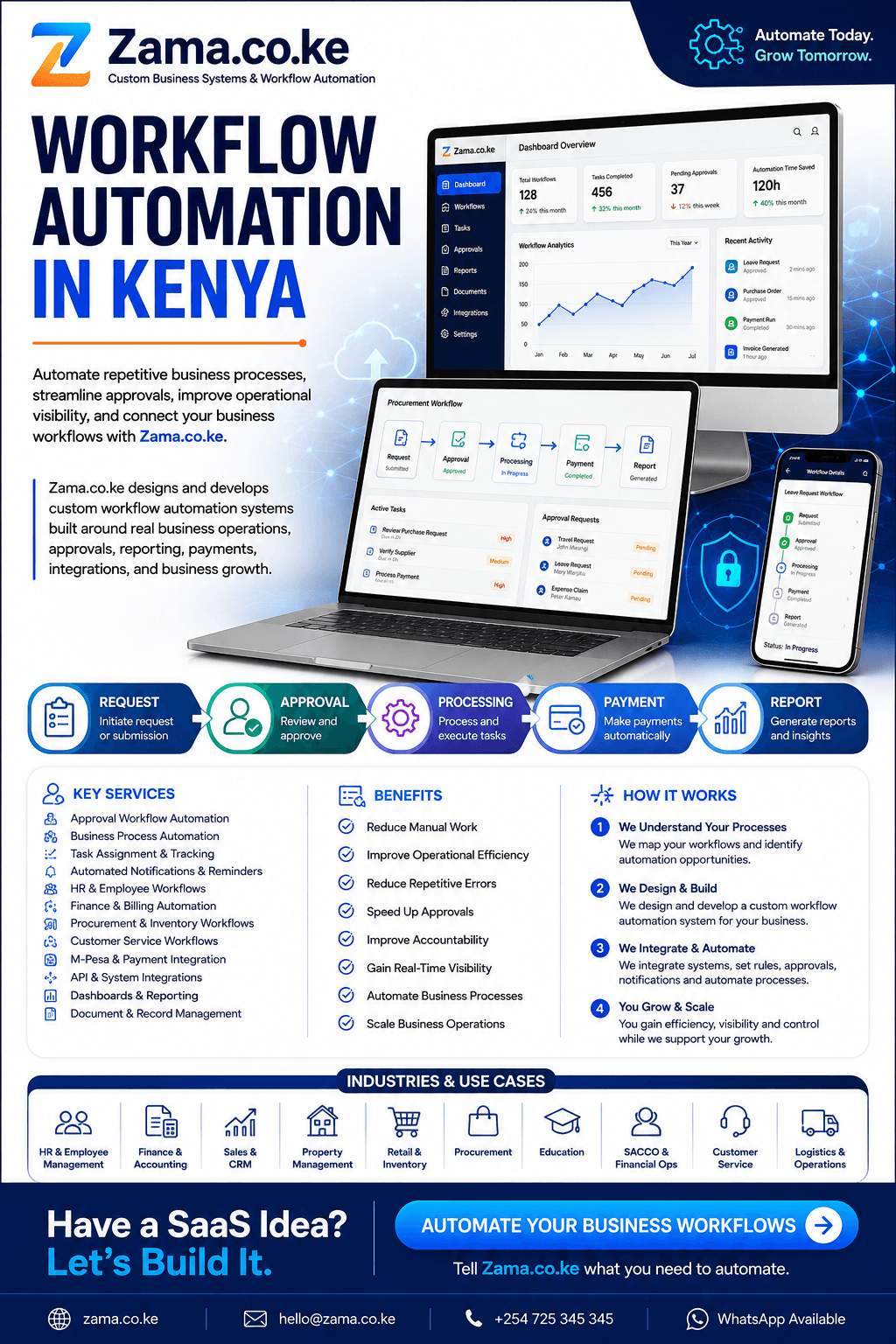
Workflow automation in Kenya is becoming an important part of how modern organizations manage daily operations, approvals, customer requests, reporting, payments, employee processes, and business administration. As businesses grow, manual processes can become difficult to control. Repetitive data entry, paper-based approvals, follow-ups, spreadsheets, emails, messages, and disconnected processes can consume valuable time and make it harder for management to see what is happening across the organization.
Zama.co.ke develops custom digital systems designed around real business workflows. Its business automation services focus on removing repetitive manual work, improving visibility, connecting approvals and reporting, and integrating important business processes.
For a business looking for workflow automation in Kenya, the objective should not simply be to introduce technology. The objective should be to identify processes that are repetitive, slow, difficult to track, or vulnerable to human error and then transform those processes into structured digital workflows.
Zama.co.ke approaches automation from a workflow-first perspective. This means understanding how an organization operates before designing the technology around it. The result can be a centralized business system where tasks, approvals, records, notifications, reports, and integrations work together.
This article explains workflow automation in Kenya, how it works, why businesses need it, what processes can be automated, how Zama.co.ke approaches automation, and how a customized automation system can help organizations improve operational efficiency.
What Is Workflow Automation in Kenya?
Workflow automation in Kenya refers to using software and digital systems to automatically move business processes from one step to another according to predefined rules.
Instead of relying on employees to manually remember every step, an automated workflow can assign tasks, request approvals, update records, send notifications, generate reports, and trigger subsequent actions.
For example, consider a simple approval process.
An employee submits a request. The system sends the request to a manager. The manager reviews it. If approved, the system forwards it to the next person or department. The employee receives a notification, and the transaction is recorded.
Without automation, these steps may depend on emails, phone calls, paper forms, spreadsheets, or messaging applications.
With workflow automation in Kenya, the process can be structured inside a digital system.
Zama.co.ke describes workflow automation as a way of automating repetitive tasks such as staff approvals, task assignments, internal communication, and document processing.
The same principle can be applied to many business processes.
A customized workflow automation system can help manage:
- Approval requests
- Employee processes
- Customer requests
- Sales processes
- Invoices
- Payments
- Procurement
- Inventory
- Documents
- Reporting
- Notifications
- Task assignments
- Service requests
- Internal communication
- Data collection
The exact workflow depends on the organization.
Why Workflow Automation in Kenya Matters for Modern Businesses
Many businesses begin with manual processes because they are simple and inexpensive when the organization is small.
A few employees can communicate directly. Managers can approve requests through messages. Reports can be prepared manually. Documents can be stored in folders. Customer requests can be followed up by phone.
However, as an organization grows, the same processes become increasingly difficult to manage.
There may be more:
- Employees
- Customers
- Transactions
- Branches
- Documents
- Requests
- Approvals
- Suppliers
- Managers
- Departments
This is where workflow automation in Kenya can become valuable.
A properly designed system can create a consistent process for handling recurring activities.
Instead of asking:
“Who is supposed to approve this?”
the system can determine the appropriate approval route.
Instead of asking:
“Has this customer request been handled?”
the system can display the current status.
Instead of manually compiling information for management, the system can generate dashboards and reports from operational data.
Zama.co.ke’s business automation solutions are designed around these types of challenges, including approval workflows, task visibility, reporting, integrations, dashboards, and audit logs.
Workflow Automation in Kenya and Manual Business Processes
Manual processes can create several operational challenges.
1. Delayed approvals
A request may remain on someone’s desk, in an inbox, or in a message thread.
2. Repeated data entry
Employees may enter the same information into multiple documents or systems.
3. Limited visibility
Managers may not know the current status of important tasks.
4. Human error
Manual data entry and calculations can create mistakes.
5. Weak accountability
It can become difficult to determine who handled a request and when.
6. Difficult reporting
Employees may spend hours compiling reports from different records.
7. Poor scalability
Processes that work for ten employees may become difficult when the organization grows.
Workflow automation in Kenya addresses these challenges by creating structured digital processes.
Zama.co.ke’s software development offering specifically emphasizes workflow-first systems mapped to actual business operations, together with role-based access, audit controls, dashboards, automation, and integrations.
Benefits of Workflow Automation in Kenya
There are many reasons organizations invest in workflow automation in Kenya.
Faster Operations
Automation can reduce the time required to complete repetitive tasks.
A request can automatically move to the next stage instead of waiting for manual intervention.
Notifications can be triggered automatically.
Reports can be generated from stored data.
Tasks can be assigned according to predefined rules.
This allows employees to focus more attention on work that requires human judgment.
Reduced Manual Work
One of the main purposes of workflow automation in Kenya is reducing repetitive administrative work.
For example, a system can automatically:
- Create records
- Assign tasks
- Send reminders
- Generate notifications
- Update statuses
- Calculate totals
- Create reports
- Record approvals
- Track deadlines
Zama.co.ke’s business automation solutions are designed to reduce repetitive manual work while improving operational visibility.
Improved Accuracy
Automation can reduce mistakes caused by repetitive manual processes.
When a workflow follows predefined rules, the system can consistently perform the same steps.
This is particularly useful for:
- Calculations
- Data validation
- Notifications
- Approvals
- Reporting
- Record creation
- Status updates
Automation does not eliminate the need for human oversight, but it can reduce unnecessary manual intervention.
Better Accountability
A properly designed workflow system can record important actions.
For example, the system may record:
- Who submitted a request
- When it was submitted
- Who reviewed it
- When it was approved
- What action was taken
- When the process was completed
Zama.co.ke highlights audit logs and controlled permissions as features of its business automation approach.
This can improve accountability across departments.
Workflow Automation in Kenya for Approvals
Approvals are among the most common processes that can benefit from automation.
Businesses may require approvals for:
- Leave
- Expenses
- Purchases
- Payments
- Discounts
- Procurement
- Contracts
- Documents
- Customer requests
- Operational activities
With workflow automation in Kenya, approval processes can be configured according to business rules.
For example:
Request → Manager Review → Finance Review → Final Approval → Completion
Each stage can have its own user, permission, notification, and status.
Zama.co.ke specifically identifies multi-level approvals, task assignment, tracking, notifications, and reminders among business automation capabilities.
This makes approval workflows easier to monitor.
Workflow Automation in Kenya for Human Resources
Human resource departments handle many recurring workflows.
These may include:
- Leave applications
- Employee onboarding
- Employee requests
- Attendance processes
- Performance processes
- Document management
- Approvals
- Payroll-related workflows
A customized workflow automation in Kenya solution can centralize these activities.
For example, an employee can submit a leave request through a portal.
The system can then:
- Record the request.
- Notify the relevant manager.
- Allow the manager to approve or reject it.
- Update the employee’s leave record.
- Notify the employee.
- Record the approval history.
Zama.co.ke identifies HR and payroll workflows among its enterprise software capabilities.
This approach can reduce administrative follow-ups and create better visibility.
Workflow Automation in Kenya for Finance
Finance departments frequently handle repetitive processes involving invoices, expenses, payments, approvals, reconciliations, and reporting.
Workflow automation in Kenya can help organize these activities.
A finance workflow might look like:
Invoice Received → Verification → Approval → Payment Processing → Record Update → Report
Instead of manually tracking every step, the system can maintain a digital record.
Zama.co.ke’s business management systems include finance and accounting functionality such as automated invoicing, expense tracking, financial reporting, and payment-related workflows.
This can improve financial visibility while reducing repetitive administration.
Workflow Automation in Kenya for Invoicing
Invoices can be generated automatically based on business events.
For example, when a customer completes a transaction, the system can create an invoice.
The system may then:
- Assign an invoice number
- Record the customer
- Calculate the amount
- Apply applicable charges
- Generate the document
- Send a notification
- Track payment status
- Update financial records
This is a practical application of workflow automation in Kenya.
Zama.co.ke develops business systems that include billing, payment tracking, statements, and financial reporting.
Workflow Automation in Kenya for M-Pesa Processes
Payment integration is important for many Kenyan businesses.
Zama.co.ke develops systems that can integrate M-Pesa and other APIs into business workflows. Its published capabilities include M-Pesa payment workflows, payment tracking, reconciliation, and integrations.
For workflow automation in Kenya, payment automation can create a sequence such as:
Payment Initiated → Payment Confirmed → Transaction Recorded → Customer Notified → Account Updated
This can reduce the need for employees to manually confirm and record every transaction.
M-Pesa integration can also be incorporated into property management, finance, retail, subscription, and other business workflows where appropriate.
Workflow Automation in Kenya for Sales
Sales teams manage many repetitive activities.
These can include:
- Lead registration
- Customer follow-up
- Quotations
- Sales approvals
- Invoicing
- Order processing
- Customer notifications
- Reporting
A workflow automation in Kenya platform can create structured sales processes.
For example:
New Lead → Qualification → Follow-Up → Quotation → Approval → Sale → Invoice
The system can help sales teams know which stage each customer is currently in.
Zama.co.ke identifies CRM and customer lifecycle modules as part of its enterprise software capabilities.
Workflow Automation in Kenya for Customer Service
Customer service processes can become difficult to manage when requests arrive through different channels.
A customer portal can centralize service requests.
A workflow may look like:
Customer Request → Ticket Created → Assignment → Investigation → Resolution → Customer Notification → Closure
The system can track each stage.
Zama.co.ke develops customer portals that allow clients to submit requests, track service tickets, access invoices, and download documents.
This is a strong example of workflow automation in Kenya applied to customer service.
Workflow Automation in Kenya for Procurement
Procurement often involves multiple approval stages.
A purchase request might need to go through:
- Employee submission
- Department review
- Manager approval
- Procurement review
- Finance approval
- Purchase order
- Supplier processing
- Delivery
- Record update
With workflow automation in Kenya, these stages can be digitized.
The system can assign tasks to the appropriate people and provide visibility into outstanding requests.
Zama.co.ke’s business automation and business management systems include procurement workflows, inventory management, supplier management, and purchase order processes.
Workflow Automation in Kenya for Inventory Management
Inventory management can involve frequent updates.
Businesses need to know:
- What stock is available
- What has been sold
- What has been ordered
- What has been received
- What needs replenishment
Workflow automation in Kenya can connect inventory events to operational processes.
For example:
Stock Reaches Minimum Level → Reorder Alert → Purchase Request → Approval → Purchase Order → Goods Received → Inventory Updated
Zama.co.ke’s business automation systems include inventory and procurement management.
Workflow Automation in Kenya for Property Management
Property management involves multiple recurring workflows.
These may include:
- Tenant registration
- Rent invoicing
- Payment tracking
- Maintenance requests
- Statements
- Notifications
- Property reporting
Zama.co.ke develops property management systems that automate billing, tenant dashboards, payment reconciliation, and landlord reporting.
For property businesses, workflow automation in Kenya can create a centralized system for managing tenants, payments, properties, and operational requests.
Workflow Automation in Kenya for Education
Schools and training institutions manage many processes involving students, parents, teachers, administrators, and finance departments.
Possible automated workflows include:
- Student admissions
- Fee management
- Parent communication
- Examination processes
- Teacher workflows
- Attendance
- Documents
- Reporting
Zama.co.ke develops education systems and identifies school management and learning platforms among its digital system capabilities.
This means workflow automation in Kenya can be applied to educational administration as well as commercial businesses.
Workflow Automation in Kenya for SACCOs and Financial Organizations
SACCOs and other membership-based organizations have workflows involving members, contributions, approvals, financial transactions, statements, and reporting.
A digital system can organize these processes.
Zama.co.ke identifies SACCO management systems among its business software use cases, including member management, contributions, shares, dividends, and self-service functionality.
A customized workflow automation in Kenya platform can help organize these activities while giving authorized users better visibility.
Workflow Automation in Kenya for Logistics
Logistics companies deal with tasks involving:
- Orders
- Drivers
- Vehicles
- Deliveries
- Customers
- Tracking
- Proof of delivery
- Reporting
A workflow system can automatically assign and track operational tasks.
For example:
Order Received → Driver Assigned → Pickup → Transit → Delivery → Confirmation → Invoice
Zama.co.ke’s software development services include industry-specific systems for logistics and fleet operations.
Workflow Automation in Kenya for Management Reporting
Management needs timely information to make decisions.
However, reporting can become difficult when data is stored in multiple spreadsheets, documents, and disconnected processes.
Workflow automation in Kenya can create centralized dashboards.
Management may be able to see:
- Pending approvals
- Sales
- Revenue
- Expenses
- Customer activity
- Operational performance
- Outstanding tasks
- Staff activity
- Payment status
Zama.co.ke develops operational dashboards with performance reporting, approval visibility, alerts, and business KPIs.
Workflow Automation in Kenya and Real-Time Visibility
One major advantage of digital workflows is improved visibility.
Instead of waiting for a report at the end of the week or month, management can access information from the system.
For example, a dashboard could show:
Pending approvals: 24
Open customer requests: 15
Outstanding invoices: 37
Completed tasks: 84
Pending procurement requests: 9
This type of information can help managers identify bottlenecks.
Zama.co.ke’s business automation platform emphasizes operational visibility, approvals, dashboards, integrations, and reporting.
Workflow Automation in Kenya and Notifications
Notifications are an important component of automated workflows.
A system can notify users when:
- A request is submitted
- An approval is required
- A task is overdue
- A payment is received
- An invoice is generated
- A customer submits a request
- A workflow reaches the next stage
Zama.co.ke identifies notifications and reminders as features within its business automation systems.
This reduces the need for employees to constantly follow up manually.
Workflow Automation in Kenya and Document Management
Organizations handle many documents.
These may include:
- Contracts
- Invoices
- Receipts
- Employee documents
- Procurement documents
- Reports
- Customer records
- Approval documents
A workflow system can associate documents with the correct business process.
For example:
Document Uploaded → Review → Approval → Storage → Notification
Zama.co.ke’s business automation services include document and record management.
This can create a more structured digital record-keeping environment.
Workflow Automation in Kenya and Role-Based Access
Not every employee should have access to every part of a business system.
Role-based access can control what users are allowed to view and do.
For example:
Employee
Can submit requests.
Manager
Can review and approve requests.
Finance
Can process financial information.
Administrator
Can manage system settings and users.
Executive
Can view management reports.
Zama.co.ke emphasizes role-based secure platforms, permissions, and audit controls within its software development services.
This makes access management an important part of workflow automation in Kenya.
Workflow Automation in Kenya and Audit Trails
An audit trail records important actions inside a system.
This can include:
- User
- Action
- Date
- Time
- Record
- Status
- Approval
Audit trails can help businesses understand how a process moved through the system.
Zama.co.ke identifies audit logs as a capability of its business automation systems.
For organizations managing approvals, finance, customer requests, or employee workflows, this visibility can be valuable.
Workflow Automation in Kenya and Business Integration
Modern organizations often need their systems to communicate.
A workflow platform may need to integrate with:
- M-Pesa
- SMS services
- Payment gateways
- CRM systems
- Accounting systems
- Websites
- Mobile applications
- External APIs
Zama.co.ke specifically provides integration capabilities for M-Pesa, SMS, CRMs, ERPs, payment gateways, and third-party APIs.
Integration is important because automation becomes more useful when information can move between relevant parts of the business.
Workflow Automation in Kenya and APIs
Application Programming Interfaces, commonly called APIs, allow different software services to communicate.
For example, a business application can send information to an approved payment service and receive a response.
The workflow can then continue automatically.
A typical process might be:
Customer Payment → API Request → Payment Confirmation → Database Update → Notification
Zama.co.ke lists API integrations among its software capabilities.
A well-designed API architecture can also make it easier to add new integrations in the future.
Workflow Automation in Kenya and Cloud-Based Systems
Cloud infrastructure can make business applications accessible through the internet.
This can be particularly useful for organizations with:
- Multiple branches
- Remote employees
- Field teams
- Managers who travel
- Customers in different locations
Zama.co.ke develops cloud-based business systems and identifies cloud infrastructure among its technology capabilities.
A cloud-based approach can allow authorized users to access the system from supported devices and locations.
Workflow Automation in Kenya and Mobile Access
Employees and managers may not always be sitting at a desk.
Mobile access can allow users to:
- Approve requests
- Check dashboards
- Submit forms
- Receive notifications
- View records
- Track tasks
Zama.co.ke supports mobile applications and mobile-friendly digital systems as part of its wider software development services.
For organizations with field teams, mobile access can make workflow automation in Kenya more practical.
Workflow Automation in Kenya and Artificial Intelligence
Artificial intelligence can add another layer to automation.
Depending on the use case, AI can potentially assist with:
- Document classification
- Data extraction
- Customer requests
- Business insights
- Content processing
- Automated responses
- Workflow recommendations
Zama.co.ke also provides AI automation services focused on reducing repetitive work, improving productivity, and connecting workflows with services such as WhatsApp, M-Pesa, websites, email, SMS, and internal dashboards.
However, AI should be introduced according to an organization’s actual requirements.
The foundation should remain a well-designed workflow.
Workflow Automation in Kenya and Business Process Mapping
Before automating a process, the organization needs to understand how the process currently works.
This is known as process mapping.
For example:
Current process
Employee → Email → Manager → WhatsApp → Finance → Spreadsheet → Report
The automation process could become:
Automated process
Employee Portal → Approval Workflow → Finance → System Record → Dashboard
This is why workflow automation in Kenya should begin with business analysis rather than simply selecting software features.
Zama.co.ke’s software development process begins with discovery, business analysis, scope definition, and technical planning.
Workflow Automation in Kenya and Custom Business Systems
Every organization has different processes.
One company may have a three-stage approval system.
Another may need five stages.
One business may require M-Pesa integration.
Another may need inventory and procurement.
A custom system can be designed around those differences.
Zama.co.ke develops custom business systems that are mapped to real operational workflows, with modules, integrations, reporting, permissions, and automation based on business requirements.
This makes custom development useful for businesses with complex processes.
Workflow Automation in Kenya for SMEs
Small and medium-sized businesses can benefit from automation just as much as larger organizations.
An SME may start with a few basic workflows:
- Customer management
- Invoicing
- Approvals
- Employee requests
- Reporting
- Payments
As the business grows, additional workflows can be added.
Zama.co.ke’s business management systems are designed for Kenyan businesses and African enterprises, with automation, reporting, finance, HR, inventory, sales, and operational modules.
A scalable approach allows an SME to begin with its most important processes and expand later.
Workflow Automation in Kenya for Growing Organizations
Growth creates complexity.
A business that begins with one branch may eventually operate several branches.
A team of five employees may become fifty.
A small customer base may become thousands of customers.
As this happens, manual processes become harder to control.
Workflow automation in Kenya can create standardized processes that remain consistent as the organization grows.
For example, every branch can use the same:
- Approval structure
- Customer process
- Reporting format
- Procurement workflow
- Payment process
- Employee request process
Zama.co.ke highlights scalable systems that support teams, branches, and business growth.
Workflow Automation in Kenya and Data Management
Automated workflows generate structured information.
This information can be used for:
- Reports
- Dashboards
- Performance monitoring
- Audits
- Planning
- Forecasting
- Decision-making
Instead of collecting information manually, managers can access data from the system.
This makes data architecture an important part of workflow automation in Kenya.
Zama.co.ke uses technologies such as MySQL and PostgreSQL for business systems, with the technology stack selected according to workflow complexity, reporting requirements, data volume, and long-term support needs.
Workflow Automation in Kenya and Security
Business systems can contain important information.
Security should therefore be considered during design.
Potential security controls include:
- Secure authentication
- Role-based permissions
- Access controls
- Audit logs
- Secure APIs
- Data protection
- Backups
- Monitoring
Zama.co.ke’s software development approach emphasizes secure architecture, controlled permissions, audit controls, and business risk considerations.
Security should be treated as an ongoing process rather than a feature added at the end.
Workflow Automation in Kenya and Scalability
An automation system should be designed for the organization’s expected growth.
Scalability involves considering:
- Number of users
- Number of transactions
- Database size
- Number of branches
- Reporting requirements
- Integrations
- Storage
- Performance
Zama.co.ke describes its architecture as scalable and designed to support additional modules, users, teams, and operational complexity over time.
This is important because replacing a system every time a business grows can be disruptive.
Workflow Automation in Kenya: Zama.co.ke Development Process
Zama.co.ke follows a structured development process for business systems.
1. Discovery
The process begins by understanding the organization.
Zama.co.ke identifies business problems, user roles, workflows, integrations, and technical requirements during discovery.
Questions may include:
- What processes are currently manual?
- Where do delays occur?
- Which approvals are required?
- What information needs to be captured?
- Who needs access?
- What reports are required?
- What integrations are needed?
2. System Design
After understanding the requirements, the system structure can be designed.
This can include:
- Database architecture
- User roles
- Interfaces
- Workflow logic
- Integrations
- Reports
- Permissions
Zama.co.ke describes system design as the stage where architecture, interfaces, permissions, and rollout planning are mapped.
3. Development
The platform is then developed in structured stages.
The development can include:
- Web interfaces
- Dashboards
- Workflow engines
- Databases
- APIs
- Payment integrations
- Notifications
- Reporting
- Administration
4. Testing
Testing is performed across important workflows.
This can include:
- Functionality
- Permissions
- Integrations
- Responsiveness
- Stability
- Business processes
Zama.co.ke’s published delivery process includes testing of workflows, permissions, integrations, responsiveness, and stability before launch.
5. Deployment
After testing, the system can be deployed.
Deployment may include:
- Cloud configuration
- Database setup
- Security configuration
- Domain setup
- User configuration
- Data migration
- Monitoring
6. Training
Employees need to understand how to use the new system.
Training can cover:
- Login
- Dashboards
- Requests
- Approvals
- Reports
- Administration
7. Support and Optimization
After launch, workflows may need improvement.
Zama.co.ke provides ongoing maintenance, monitoring, issue resolution, updates, and optimization after deployment.
Why Choose Zama.co.ke for Workflow Automation in Kenya?
Zama.co.ke is a Kenya-based software development agency focused on web portals, SaaS platforms, M-Pesa-integrated systems, and custom business software.
For businesses seeking workflow automation in Kenya, Zama.co.ke provides a business-focused approach.
Business-First Approach
The technology is designed around the organization’s workflow.
Custom Development
Systems can be built around specific business requirements.
M-Pesa Integration
Payment workflows can incorporate M-Pesa where required.
API Integration
Relevant external services can be connected through APIs.
Reporting
Dashboards and reports can provide operational visibility.
Secure Access
Role-based access and audit controls can be incorporated.
Scalable Architecture
The system can be designed to support future growth.
Long-Term Support
Zama.co.ke remains available for maintenance and improvements after launch.
How to Identify Processes for Workflow Automation in Kenya
Not every business process needs automation immediately.
A useful starting point is identifying activities that are:
- Repetitive
- Time-consuming
- Frequently delayed
- Prone to errors
- Difficult to monitor
- Dependent on manual follow-up
- Involve several departments
- Require frequent reporting
For example, if managers spend hours every week following up on approvals, approval automation may be a good starting point.
If employees repeatedly enter the same data into different records, data automation may be appropriate.
If management spends days compiling reports, automated reporting may provide significant value.
Zama.co.ke’s business automation approach begins by identifying operational friction and then redesigning the process in software.