
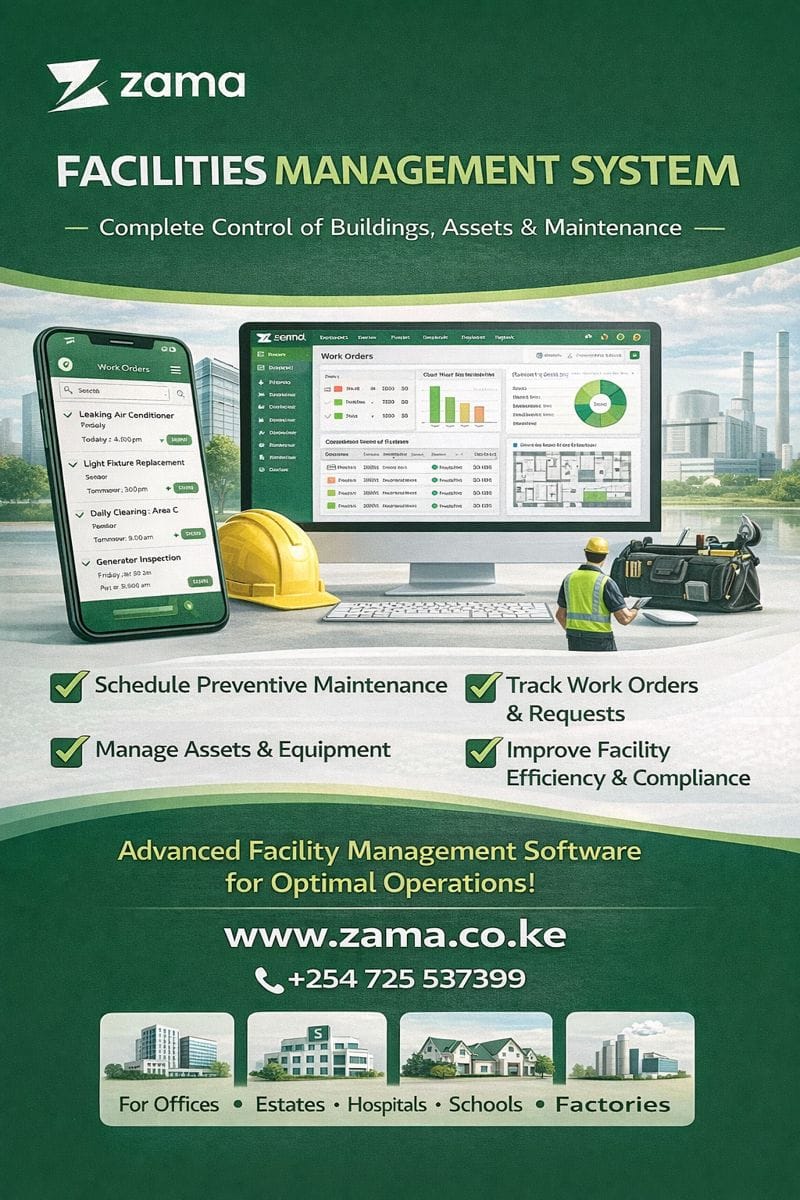
A facilities management system is essential for organizations that manage buildings, equipment, utilities, and service teams. From offices and schools to hospitals, estates, malls, and industrial facilities, effective facilities management ensures safety, efficiency, cost control, and uninterrupted operations.
At Zama, we build modern, scalable facilities management systems that centralize maintenance, assets, requests, and reporting—giving organizations full visibility and control over their facilities.
What Is a Facilities Management System?
A facilities management system (FMS) is a digital platform used to manage physical assets, buildings, maintenance activities, service requests, and operational resources in one centralized system.
It replaces manual logs, spreadsheets, and phone calls with structured workflows, real-time tracking, and data-driven insights.
Why Your Organization Needs a Facilities Management System
Without a proper facilities management system, organizations often face:
Unplanned breakdowns and downtime
Poor asset visibility
Delayed maintenance responses
High operational and repair costs
Lack of accountability
Compliance and safety risks
A modern facilities management system eliminates these challenges by automating and standardizing facility operations.
Core Features of a Modern Facilities Management System
1. Asset & Equipment Management
Asset registration and categorization
Equipment lifecycle tracking
Service history and documentation
Warranty and replacement planning
2. Maintenance Management (Preventive & Reactive)
Preventive maintenance schedules
Work order creation and tracking
Emergency repair handling
Maintenance completion logs
3. Service Request Management
Centralized service request portal
Request assignment to technicians
Status tracking and resolution timelines
Reduced response time
4. Facility & Space Management
Building and room records
Space utilization tracking
Facility availability management
Optimized space planning
5. Vendor & Contractor Management
Contractor profiles
Assigned tasks and SLAs
Performance tracking
Payment and service records
6. Reporting & Analytics
Maintenance cost reports
Asset performance insights
Downtime analysis
Compliance and audit reports
Who Uses a Facilities Management System?
A Zama-built facilities management system is ideal for:
Commercial buildings & offices
Residential estates & property managers
Hospitals & healthcare facilities
Schools, colleges & universities
Hotels & hospitality facilities
Factories & industrial plants
Churches & large institutions
Any organization managing physical infrastructure benefits from a structured system.
Preventive Maintenance = Lower Costs
One of the biggest advantages of a facilities management system is preventive maintenance:
Detect issues early
Reduce emergency repairs
Extend asset lifespan
Lower long-term maintenance costs
Prevention is always cheaper than breakdowns.
Centralized Visibility for Management
With a facilities management system, managers gain:
Real-time visibility of all facilities
Open and closed maintenance tasks
Technician workloads
Asset condition and risk areas
This visibility enables proactive decision-making.
Improved Accountability & Compliance
A professional facilities management system ensures:
Clear task ownership
Time-stamped maintenance records
Audit-ready documentation
Safety and compliance tracking
This is critical for regulated environments like healthcare, education, and industry.
Mobile-Friendly for Technicians & Staff
Zama facilities management systems are:
Cloud-based
Mobile-friendly
Accessible on-site and remotely
Easy to use with minimal training
Technicians can update tasks in real time, improving accuracy and speed.
Custom Facilities Management System vs Generic Software
| Generic Software | Zama Facilities Management System |
|---|---|
| Fixed workflows | Tailored to your operations |
| Limited asset control | Full asset lifecycle tracking |
| Basic reports | Advanced operational insights |
| Vendor dependency | Full system ownership |
A custom facilities management system becomes a long-term operational asset.
Integration with Other Business Systems
Our facilities management systems can integrate with:
Property management systems
Billing & invoicing systems
Asset finance and accounting tools
HR and technician scheduling systems
This creates a unified operational ecosystem.
Security & Role-Based Access
Facilities data must be protected. Zama systems include:
Role-based access control
Secure authentication
Activity logs and audit trails
Controlled data visibility
Only authorized users access sensitive information.
Scalable for Growing Organizations
As your facilities grow, your system must scale. Zama facilities management systems are designed to:
Support multiple buildings and locations
Handle increasing assets and tasks
Maintain performance under load
Expand without system rebuilds
Facilities Management as a Strategic Advantage
A well-implemented facilities management system:
Reduces operational costs
Improves asset reliability
Enhances safety and compliance
Increases service quality
Supports long-term growth
Facilities management moves from reactive to strategic.
Build Your Facilities Management System with Zama
If you want better control, lower costs, and reliable facility operations, a custom facilities management system is the solution.
👉 Visit https://zama.co.ke and let Zama build a facilities management system designed for efficiency, accountability, and growth.
Advanced Facilities Management System Capabilities for Complex Operations
As organizations expand, facilities operations become more complex—multiple buildings, diverse assets, contractors, compliance requirements, and tight budgets. A modern facilities management system (FMS) must move beyond basic maintenance tracking and become a central command platform for all facility-related activities.
At Zama, we design facilities management systems that scale with your organization and adapt to real-world operational demands.
End-to-End Facilities Lifecycle Management
A professional facilities management system covers the entire lifecycle of facilities and assets:
Facility onboarding and documentation
Asset acquisition and registration
Preventive and corrective maintenance
Performance monitoring and optimization
Asset replacement and decommissioning
This lifecycle view ensures nothing falls through the cracks.
Preventive Maintenance Automation
Reactive maintenance is costly and disruptive. Our facilities management systems emphasize preventive maintenance by enabling:
Scheduled maintenance plans
Usage- or time-based triggers
Automated reminders and work orders
Maintenance history analysis
Preventive automation significantly reduces downtime and emergency repairs.
Work Order & Task Management
A core component of any facilities management system is structured task handling:
Work order creation and assignment
Technician scheduling
Priority and SLA management
Real-time task status updates
Completion verification
This ensures faster response times and clear accountability.
Technician & Resource Management
Facilities teams are only as effective as their coordination. A modern facilities management system supports:
Technician profiles and skill sets
Task allocation based on availability
Workload balancing
Performance tracking
Managers can deploy the right resources at the right time.
Space & Occupancy Optimization
Beyond maintenance, facilities management includes space utilization. Our facilities management systems help you:
Track room and space usage
Optimize occupancy
Plan renovations or expansions
Improve resource allocation
Better space management directly reduces operational costs.
Health, Safety & Compliance Tracking
Compliance is critical in facilities operations. A professional facilities management system ensures:
Safety inspection schedules
Compliance documentation storage
Incident reporting and follow-up
Audit-ready records
This is especially vital for hospitals, schools, factories, and large estates.
Vendor & Contractor Oversight
External vendors play a major role in facilities operations. Our facilities management systems include:
Contractor onboarding
Assigned scopes of work
SLA and performance tracking
Cost and service history
This improves service quality and cost control.
Data-Driven Facilities Decisions
A facilities management system generates actionable insights such as:
Maintenance cost trends
Asset reliability scores
High-risk equipment identification
Budget forecasting
Data transforms facilities management from reactive to strategic.
Multi-Facility & Multi-Location Support
For organizations managing multiple sites, a facilities management system must support:
Multiple buildings and campuses
Location-based reporting
Centralized oversight with local controls
Comparative performance analysis
Zama systems are designed for both single-site and enterprise-scale deployments.
Integration with Property, Finance & HR Systems
Facilities operations rarely exist in isolation. Our facilities management systems integrate seamlessly with:
Property management systems
Billing and invoicing platforms
Finance and accounting software
HR and staff scheduling tools
This creates a unified operational ecosystem.
Mobile Access for On-Site Teams
Modern facilities teams are mobile. Zama facilities management systems are:
Cloud-based
Mobile-friendly
Accessible on phones and tablets
Easy to use with minimal training
Technicians update tasks on-site, improving accuracy and speed.
Security, Access Control & Audit Trails
Facilities data must be protected. Our systems include:
Role-based access control
Secure authentication
Activity and change logs
Data integrity safeguards
This ensures trust, accountability, and compliance.
Custom Facilities Management System vs Off-the-Shelf Tools
| Generic Tool | Zama Facilities Management System |
|---|---|
| Fixed workflows | Tailored to your operations |
| Limited scalability | Enterprise-ready architecture |
| Basic reporting | Advanced operational analytics |
| Vendor lock-in | Full system ownership |
A custom facilities management system becomes a long-term operational asset.
Facilities Management as a Strategic Advantage
Organizations that invest in a strong facilities management system achieve:
Lower maintenance costs
Higher asset reliability
Improved safety and compliance
Better service quality
Predictable operational planning
Facilities management shifts from firefighting to foresight.
Build a Future-Ready Facilities Management System with Zama
Whether you manage offices, estates, campuses, hospitals, or industrial facilities, a custom facilities management system gives you control, visibility, and scalability.
👉 Visit https://zama.co.ke and let Zama build a facilities management system designed for efficiency, accountability, and long-term growth.
Facilities Management System for Enterprise Governance & Growth
As organizations mature, facilities operations must align with governance, budgeting, and strategic planning. A modern facilities management system (FMS) becomes the connective tissue between day-to-day maintenance and executive oversight—turning facilities into a managed portfolio rather than a cost center.
Governance, Policies & Standard Operating Procedures (SOPs)
A robust facilities management system embeds governance directly into workflows:
Digitized SOPs for maintenance and inspections
Mandatory checklists before task closure
Approval gates for high-risk or high-cost work
Consistent standards across sites and teams
This ensures compliance and consistency, even as teams scale.
Budgeting, Cost Control & Forecasting
Facilities costs can spiral without visibility. An advanced FMS enables:
Maintenance budgets by building, asset, or category
Real-time spend tracking vs budget
Forecasting based on asset age and usage
Cost-per-asset and cost-per-square-meter insights
Finance teams gain predictability; operations teams gain accountability.
Capital Planning & Asset Replacement Strategy
Not all assets should be repaired indefinitely. A facilities management system supports:
Asset health scoring
Repair vs replace decision models
Capital expenditure (CapEx) planning
Replacement timelines aligned to budgets
This shifts decisions from reactive fixes to strategic investments.
Inspection Management & Quality Assurance
Routine inspections are critical for safety and uptime. A professional FMS provides:
Scheduled inspection cycles
Digital inspection forms
Photo and document attachments
Non-conformance tracking and follow-ups
Quality assurance becomes auditable and repeatable.
Energy, Utilities & Sustainability Tracking
Facilities management increasingly includes sustainability goals. An FMS can help track:
Utility usage (water, power, fuel)
Abnormal consumption alerts
Maintenance actions tied to efficiency gains
Sustainability KPIs for reporting
This supports cost savings and environmental responsibility.
Incident, Risk & Emergency Management
When incidents occur, response time matters. A facilities management system enables:
Incident logging and classification
Immediate task escalation
Root cause analysis
Preventive actions to avoid recurrence
Risk management becomes structured and data-driven.
Service Level Agreements (SLAs) & Performance Measurement
For internal teams and external vendors, SLAs must be measurable. An FMS tracks:
Response and resolution times
SLA compliance by team/vendor
Repeat issues and rework rates
Performance trends over time
Objective metrics replace guesswork.
Cross-Department Collaboration
Facilities work touches many departments. A centralized FMS improves collaboration by:
Providing shared visibility to stakeholders
Enabling request prioritization by business impact
Reducing email and phone coordination
Keeping everyone aligned on timelines
Operations move faster with fewer handoffs.
Multi-Tenant & Portfolio Management (For Property Owners)
For property owners and managers, an FMS can support:
Multiple properties under one system
Isolated data per building or client
Portfolio-level reporting
Centralized governance with local autonomy
This is ideal for estates, campuses, and commercial portfolios.
Change Management & Continuous Improvement
Facilities operations evolve. A modern system supports continuous improvement through:
Trend analysis and benchmarking
Post-maintenance reviews
Policy updates rolled out system-wide
Training alignment based on performance gaps
The system improves as the organization improves.
Security, Privacy & Data Integrity (Enterprise Ready)
Facilities data is sensitive. An enterprise-grade FMS includes:
Role-based access and least-privilege design
Secure authentication and session controls
Immutable logs for audits
Data retention and privacy controls
Trust is built into the platform.
High Availability, Reliability & Scale
Facilities operations can’t stop. A production-ready FMS is built for:
High uptime and redundancy
Fast performance across many users
Scalable storage for years of records
Seamless expansion to new sites
Reliability is non-negotiable.
Facilities Management as a Competitive Differentiator
Organizations that master facilities management:
Lower total cost of ownership (TCO)
Reduce downtime and service disruptions
Improve safety and compliance
Enhance occupant and staff satisfaction
Plan growth with confidence
Facilities become a strategic advantage, not just an expense.
Build a Long-Term Facilities Management Platform
A custom facilities management system is an investment in resilience, efficiency, and growth. It aligns operations with strategy, empowers teams with clarity, and gives leadership the insights they need.
👉 Visit https://zama.co.ke to design a facilities management system that fits your operations today—and scales with your future.