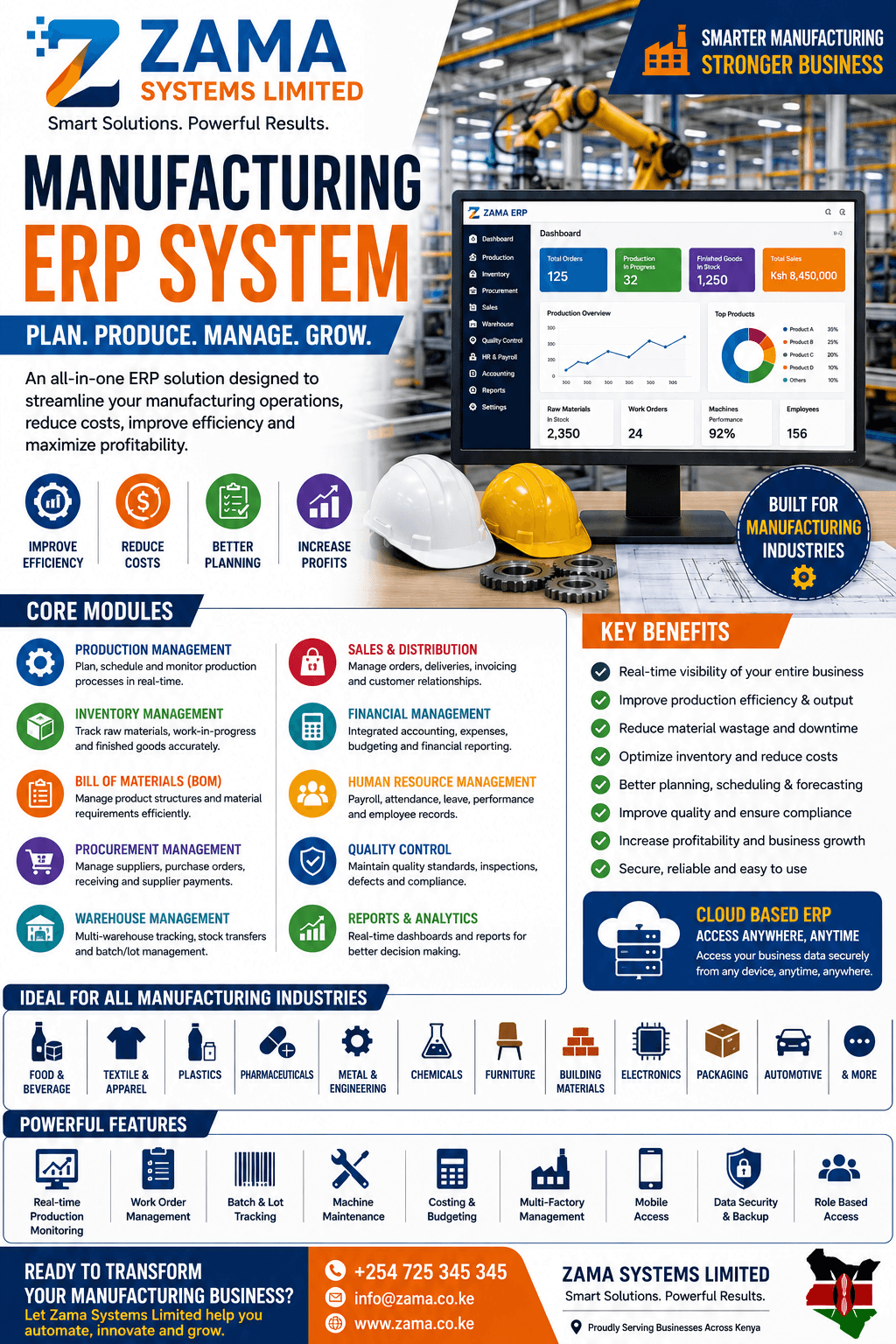
Manufacturing ERP System – Complete Guide for Modern Manufacturing Businesses in Kenya

Manufacturing ERP System
Manufacturing industries are becoming increasingly competitive and technology-driven. Businesses that still rely on manual processes often struggle with production delays, inventory losses, inaccurate reporting, poor planning, and inefficient operations. A modern Manufacturing ERP System helps businesses automate operations, improve productivity, reduce costs, and increase profitability.

Whether you operate a food processing factory, textile company, plastics manufacturing plant, construction materials factory, pharmaceutical company, or industrial production business, implementing a Manufacturing ERP System is essential for growth and operational efficiency.

At Zama Systems Limited, we provide reliable and scalable ERP solutions designed to help manufacturers streamline operations and manage their entire business from one centralized platform.

Table of Contents

What Is a Manufacturing ERP System?

A Manufacturing ERP System is enterprise software designed to integrate and automate all manufacturing business processes into one system.

ERP stands for Enterprise Resource Planning.

The system connects departments such as:

  • Production
  • Inventory
  • Procurement
  • Accounting
  • Sales
  • Human resources
  • Warehouse management
  • Supply chain management

This allows businesses to manage operations efficiently and access real-time information.

Why Manufacturing Businesses Need an ERP System

Manufacturing operations involve many complex processes.

Without automation, businesses often face:

  • Production delays
  • Inventory inaccuracies
  • Poor planning
  • Material wastage
  • Financial mismanagement
  • Lack of visibility

A Manufacturing ERP System solves these challenges through centralized automation.

Core Features of a Manufacturing ERP System

Production Management

Production management helps manufacturers plan and monitor production processes.

The system tracks:

  • Production schedules
  • Work orders
  • Production stages
  • Output quantities
  • Machine utilization

This improves operational efficiency.

Inventory Management

Inventory control is critical in manufacturing.

The system tracks:

  • Raw materials
  • Work-in-progress inventory
  • Finished goods
  • Stock movement
  • Reorder levels

This reduces wastage and stock shortages.

Bill of Materials (BOM)

A Bill of Materials lists all components required to manufacture a product.

The ERP system helps manage:

  • Raw material requirements
  • Product structures
  • Manufacturing formulas
  • Material consumption

This improves production accuracy.

Procurement Management

Manufacturers work with many suppliers.

The ERP system manages:

  • Supplier records
  • Purchase orders
  • Supplier quotations
  • Goods receiving
  • Outstanding balances

This improves procurement efficiency.

Warehouse Management

Warehouse management helps track inventory across storage locations.

The system monitors:

  • Warehouse stock levels
  • Product movement
  • Stock transfers
  • Batch tracking

This improves inventory organization.

Sales and Distribution Management

Manufacturing ERP systems help businesses manage customer orders.

Features include:

  • Sales orders
  • Quotations
  • Invoicing
  • Delivery tracking
  • Customer records

This improves order fulfillment.

Financial Management

ERP systems provide integrated accounting features.

The system tracks:

  • Revenue
  • Expenses
  • Profit and loss
  • Tax records
  • Supplier payments
  • Customer balances

This improves financial visibility.

Human Resource Management

Manufacturing businesses manage many employees.

The ERP system helps track:

  • Attendance
  • Payroll
  • Staff performance
  • Leave management
  • Shift scheduling

This improves workforce management.

Production Planning and Scheduling

Production planning ensures efficient resource utilization.

The system helps manage:

  • Machine schedules
  • Workforce allocation
  • Production timelines
  • Manufacturing priorities

This improves operational flow.

Quality Control Management

Quality assurance is critical in manufacturing.

The system tracks:

  • Product inspections
  • Defective products
  • Quality standards
  • Batch testing

This improves product quality.

Manufacturing ERP System Benefits

Improved Efficiency

Automation reduces repetitive manual tasks.

Employees work faster and more accurately.

Reduced Operational Costs

ERP systems reduce:

  • Material wastage
  • Inventory losses
  • Production delays
  • Administrative costs

This improves profitability.

Better Inventory Control

Real-time inventory tracking prevents shortages and overstocking.

Improved Production Planning

Manufacturers can forecast production needs accurately.

Real-Time Reporting

Business owners access live operational data instantly.

Better Decision Making

Accurate analytics improve strategic planning.

Improved Customer Satisfaction

Efficient operations improve order fulfillment and delivery times.

Enhanced Data Accuracy

Automation minimizes human errors.

Manufacturing ERP System for Small Businesses

Small manufacturing businesses also benefit from ERP systems.

Advantages include:

  • Better organization
  • Reduced wastage
  • Improved reporting
  • Operational efficiency

Small businesses can scale more effectively.

Manufacturing ERP System for Large Factories

Large factories require advanced ERP features such as:

  • Multi-factory management
  • Supply chain integration
  • Enterprise analytics
  • Advanced reporting

This improves scalability.

Real-Time Production Monitoring

Managers can monitor production in real time.

The system tracks:

  • Current production status
  • Machine performance
  • Output quantities
  • Delays and bottlenecks

This improves operational visibility.

Material Requirement Planning (MRP)

MRP helps manufacturers calculate production material needs.

Benefits include:

  • Accurate procurement
  • Reduced stock shortages
  • Better production planning

This improves resource management.

Batch and Lot Tracking

Manufacturing businesses often require batch tracking.

The ERP system tracks:

  • Product batches
  • Manufacturing dates
  • Expiry dates
  • Batch movements

This improves traceability.

Manufacturing ERP System and Supply Chain Management

Supply chain coordination is essential.

The system improves:

  • Supplier communication
  • Procurement planning
  • Delivery coordination
  • Inventory synchronization

This improves operational efficiency.

Cloud-Based Manufacturing ERP System

Cloud ERP systems provide flexibility and remote access.

Benefits include:

  • Automatic backups
  • Access from anywhere
  • Real-time synchronization
  • Lower infrastructure costs

This improves business continuity.

Mobile ERP Access

Managers can access ERP systems using smartphones or tablets.

Features include:

  • Viewing reports
  • Monitoring production
  • Approving transactions
  • Tracking inventory

This improves convenience.

Manufacturing ERP System Security Features

ERP systems contain sensitive business information.

Security features include:

  • User permissions
  • Audit logs
  • Password protection
  • Secure backups

This protects business data.

Manufacturing ERP System and Accounting Integration

Integrated accounting improves financial management.

The ERP system automates:

  • Invoicing
  • Expense tracking
  • Tax calculations
  • Financial reporting

This reduces accounting errors.

Manufacturing ERP System for Food Processing Companies

Food manufacturers require additional tracking features such as:

  • Expiry date management
  • Batch tracking
  • Quality control
  • Supplier traceability

This improves compliance and safety.

ERP for Textile Manufacturing

Textile businesses require inventory and production tracking.

The ERP system helps manage:

  • Fabric inventory
  • Production stages
  • Orders
  • Supplier coordination

This improves operational efficiency.

Manufacturing ERP for Pharmaceutical Companies

Pharmaceutical companies require strict compliance and traceability.

ERP systems help manage:

  • Batch records
  • Quality testing
  • Inventory tracking
  • Regulatory compliance

This improves operational control.

Manufacturing ERP for Plastic Industries

Plastic manufacturing companies use ERP systems to monitor:

  • Raw material usage
  • Production output
  • Machine performance
  • Inventory levels

This improves productivity.

Managing Machine Maintenance

ERP systems can track equipment maintenance schedules.

Benefits include:

  • Reduced downtime
  • Improved machine lifespan
  • Better production continuity

This improves operational reliability.

Production Cost Analysis

Manufacturers need accurate cost calculations.

The ERP system tracks:

  • Material costs
  • Labor costs
  • Operational expenses
  • Production profitability

This improves financial planning.

Manufacturing ERP Reporting and Analytics

Reports help businesses understand operational performance.

The system generates:

  • Production reports
  • Inventory reports
  • Financial reports
  • Employee reports
  • Supplier reports

This supports better decisions.

Why Kenyan Manufacturers Are Adopting ERP Systems

Manufacturing businesses in Kenya are embracing automation because of:

  • Increased competition
  • Need for efficiency
  • Rising operational costs
  • Customer expectations

ERP systems improve competitiveness.

Digital Transformation in Manufacturing

Manufacturing is becoming increasingly technology-driven.

Businesses using ERP systems enjoy:

  • Faster operations
  • Better visibility
  • Improved planning
  • Increased profitability

Technology improves growth potential.

Why Choose Zama Systems Limited

Zama Systems Limited provides modern Manufacturing ERP Systems tailored for businesses in Kenya.

Our solutions include:

  • Production management
  • Inventory control
  • Procurement management
  • Accounting integration
  • Warehouse management
  • Real-time reporting

We help manufacturers streamline operations and grow efficiently.

Industries We Serve

Our ERP systems are suitable for:

  • Food processing companies
  • Textile manufacturers
  • Pharmaceutical companies
  • Plastic industries
  • Construction material manufacturers
  • Industrial production businesses

We customize solutions based on business needs.

Affordable ERP Solutions in Kenya

We provide cost-effective ERP solutions suitable for:

  • Small manufacturers
  • Medium enterprises
  • Large factories

Our systems are scalable and future-ready.

Future of Manufacturing ERP Systems

ERP technology continues evolving rapidly.

Future innovations include:

  • Artificial intelligence
  • Predictive analytics
  • Smart manufacturing
  • IoT integration
  • Automated production forecasting

Businesses adopting modern ERP systems gain a major competitive advantage.

Final Thoughts

A Manufacturing ERP System is essential for modern manufacturing businesses. From production management to inventory control and financial reporting, ERP automation improves every aspect of manufacturing operations.

Businesses using ERP systems benefit from:

  • Improved efficiency
  • Reduced operational costs
  • Better inventory management
  • Accurate reporting
  • Improved planning
  • Increased profitability

At Zama Systems Limited, we provide reliable and scalable Manufacturing ERP solutions designed to help businesses across Kenya modernize operations and achieve sustainable growth.

Whether you run a small factory or a large industrial operation, our ERP systems can help transform your manufacturing business with smart technology.

Advanced Modules in a Manufacturing ERP System

Modern manufacturing businesses require more than basic inventory management. A powerful Manufacturing ERP System integrates every operational process into one intelligent platform.

Advanced ERP modules help manufacturers automate operations, improve productivity, and reduce inefficiencies.

Production Workflow Automation

Production workflow automation simplifies manufacturing processes.

The ERP system automates:

  • Work order creation
  • Production approvals
  • Task assignments
  • Material allocation
  • Production tracking

This improves operational efficiency and reduces delays.

Work Order Management

Work orders are essential in manufacturing operations.

The system tracks:

  • Production requests
  • Assigned staff
  • Production timelines
  • Material usage
  • Output quantities

This improves accountability and monitoring.

Shop Floor Management

Shop floor management helps businesses monitor factory operations in real time.

The ERP system tracks:

  • Production lines
  • Machine activity
  • Workforce productivity
  • Downtime
  • Production targets

This improves factory visibility.

Raw Material Tracking

Manufacturers depend heavily on raw materials.

The ERP system tracks:

  • Material consumption
  • Material wastage
  • Supplier deliveries
  • Inventory levels

This improves resource management.

Finished Goods Management

The system monitors finished products from production to delivery.

Features include:

  • Product labeling
  • Warehouse storage
  • Batch management
  • Shipment tracking

This improves order fulfillment.

Manufacturing Cost Control

Cost management is critical for profitability.

The ERP system helps monitor:

  • Production costs
  • Labor costs
  • Utility costs
  • Raw material expenses

This improves financial control.

Demand Forecasting

Forecasting helps businesses prepare for future demand.

The ERP system analyzes:

  • Historical sales
  • Seasonal demand
  • Customer trends
  • Production capacity

This improves planning accuracy.

Production Capacity Planning

Manufacturers need to understand production capabilities.

The ERP system tracks:

  • Machine capacity
  • Workforce availability
  • Production schedules
  • Resource allocation

This improves operational planning.

Multi-Factory Management

Large manufacturing businesses often operate multiple factories.

The ERP system enables:

  • Centralized monitoring
  • Unified reporting
  • Inter-factory stock transfers
  • Standardized workflows

This improves coordination.

Manufacturing ERP and Supply Chain Visibility

Supply chain visibility improves operational efficiency.

The system helps monitor:

  • Supplier deliveries
  • Shipment tracking
  • Procurement timelines
  • Inventory availability

This reduces delays.

Vendor Relationship Management

Strong supplier relationships improve manufacturing operations.

The ERP system stores:

  • Supplier contracts
  • Payment history
  • Supplier performance
  • Delivery timelines

This improves procurement decisions.

Manufacturing ERP and Compliance Management

Many industries require regulatory compliance.

The ERP system helps businesses comply with:

  • Tax regulations
  • Manufacturing standards
  • Quality requirements
  • Audit requirements

This improves operational accountability.

Audit Trails and Activity Logs

The ERP system records all activities for accountability.

It tracks:

  • User actions
  • Inventory changes
  • Financial transactions
  • Production updates

This improves transparency.

ERP Integration with Barcode Technology

Barcode systems improve manufacturing efficiency.

Benefits include:

  • Faster inventory tracking
  • Accurate product identification
  • Reduced manual errors

This simplifies operations.

QR Code Integration in Manufacturing

QR codes help businesses improve traceability.

The system can use QR codes for:

  • Product identification
  • Batch tracking
  • Inventory management
  • Delivery tracking

This improves operational control.

ERP and IoT Integration

Modern manufacturing systems increasingly integrate with IoT devices.

IoT integration helps monitor:

  • Machine performance
  • Production efficiency
  • Equipment health
  • Energy usage

This improves predictive maintenance.

Predictive Maintenance Management

Unexpected machine breakdowns can disrupt operations.

The ERP system helps schedule:

  • Preventive maintenance
  • Machine servicing
  • Equipment inspections

This reduces downtime.

Energy Consumption Monitoring

Manufacturing businesses consume large amounts of energy.

The ERP system tracks:

  • Electricity consumption
  • Fuel usage
  • Machine efficiency

This improves cost management.

ERP for Chemical Manufacturing

Chemical manufacturers require strict inventory and compliance management.

ERP systems help manage:

  • Chemical formulations
  • Batch production
  • Hazard tracking
  • Regulatory compliance

This improves operational safety.

ERP for Furniture Manufacturing

Furniture manufacturers use ERP systems to track:

  • Raw materials
  • Production stages
  • Custom orders
  • Deliveries

This improves operational efficiency.

ERP for Construction Material Manufacturing

Construction material manufacturers require inventory and logistics management.

ERP systems help track:

  • Cement production
  • Steel inventory
  • Delivery coordination
  • Warehouse management

This improves operational flow.

ERP for Beverage Manufacturing

Beverage manufacturers need systems that manage:

  • Production batches
  • Expiry dates
  • Distribution
  • Inventory tracking

This improves efficiency and compliance.

ERP for Packaging Industries

Packaging manufacturers use ERP systems for:

  • Material planning
  • Production scheduling
  • Inventory tracking
  • Customer order management

This improves operational control.

Manufacturing ERP and Business Intelligence

Business intelligence tools help manufacturers make smarter decisions.

The ERP system provides insights into:

  • Production performance
  • Profitability
  • Operational bottlenecks
  • Inventory turnover

This supports strategic growth.

Real-Time Dashboards

ERP dashboards provide instant business visibility.

Managers can monitor:

  • Current production
  • Inventory status
  • Financial performance
  • Machine efficiency

This improves decision making.

Employee Productivity Monitoring

Manufacturing businesses need workforce efficiency.

The ERP system tracks:

  • Employee attendance
  • Production output
  • Shift performance
  • Overtime hours

This improves workforce management.

Payroll Integration

Payroll integration automates salary calculations.

The system tracks:

  • Working hours
  • Overtime
  • Deductions
  • Allowances

This improves payroll accuracy.

Manufacturing ERP and Customer Relationship Management (CRM)

CRM integration improves customer management.

The ERP system tracks:

  • Customer orders
  • Payment history
  • Customer communication
  • Product preferences

This improves customer service.

Managing Manufacturing Projects

Some manufacturers handle custom production projects.

The ERP system helps manage:

  • Project timelines
  • Production milestones
  • Resource allocation
  • Project costs

This improves project coordination.

ERP System Scalability

As manufacturing businesses grow, ERP systems scale with them.

The system supports:

  • More users
  • Additional factories
  • Increased inventory
  • Larger production volumes

This supports long-term growth.

ERP Data Backup and Disaster Recovery

Business data is critical.

Cloud ERP systems provide:

  • Automatic backups
  • Secure cloud storage
  • Disaster recovery

This protects business continuity.

Cybersecurity in Manufacturing ERP Systems

Manufacturing businesses handle sensitive operational data.

Security features include:

  • Data encryption
  • User authentication
  • Secure cloud hosting
  • Activity monitoring

This protects against cyber threats.

Why Cloud ERP Is Growing in Kenya

Kenyan manufacturers are increasingly adopting cloud ERP because of:

  • Lower infrastructure costs
  • Remote accessibility
  • Better scalability
  • Easier maintenance

Cloud technology improves operational flexibility.

ERP Implementation Process

Successful ERP implementation includes:

  • Business analysis
  • System customization
  • Data migration
  • Staff training
  • Technical support

This ensures smooth adoption.

Staff Training for ERP Systems

Proper training improves system utilization.

Training includes:

  • System navigation
  • Inventory management
  • Reporting
  • Production management

This improves productivity.

Technical Support and ERP Maintenance

Reliable support ensures continuous operations.

Businesses require assistance with:

  • Troubleshooting
  • Updates
  • Security maintenance
  • Feature improvements

This improves system reliability.

Manufacturing ERP System Customization

Every manufacturing business has unique workflows.

Customized ERP systems provide:

  • Industry-specific modules
  • Specialized reporting
  • Custom dashboards
  • Workflow automation

This improves usability and efficiency.

Why Choose Zama Systems Limited for Manufacturing ERP Solutions

Zama Systems Limited provides advanced Manufacturing ERP Systems tailored for businesses in Kenya.

Our ERP solutions include:

  • Production management
  • Inventory control
  • Procurement management
  • Warehouse management
  • Accounting integration
  • Real-time analytics

We help businesses modernize manufacturing operations efficiently.

ERP Solutions for Kenyan Manufacturers

Our ERP systems are suitable for:

  • Food processing companies
  • Plastic manufacturers
  • Pharmaceutical industries
  • Textile businesses
  • Packaging companies
  • Industrial factories

We provide customized solutions based on operational needs.

Affordable Manufacturing ERP Systems in Kenya

We provide scalable ERP solutions suitable for:

  • Small factories
  • Medium manufacturing businesses
  • Large industrial enterprises

Our systems are designed for long-term growth and operational efficiency.

Future of Smart Manufacturing

Manufacturing is rapidly evolving toward Industry 4.0.

Future trends include:

  • Artificial intelligence
  • Smart factories
  • Robotics integration
  • Predictive analytics
  • IoT-enabled manufacturing

Businesses adopting smart ERP systems gain major competitive advantages.

Final Conclusion

A Manufacturing ERP System is one of the most valuable investments for modern manufacturing businesses. From production management to inventory tracking, accounting, procurement, and reporting, ERP systems improve every aspect of operations.

Manufacturers using ERP systems benefit from:

  • Increased productivity
  • Reduced operational costs
  • Better inventory control
  • Improved production planning
  • Accurate financial reporting
  • Better business visibility

At Zama Systems Limited, we provide reliable and scalable ERP solutions designed to help manufacturing businesses across Kenya automate operations and achieve sustainable growth.

Whether you operate a small manufacturing plant or a large industrial factory, our Manufacturing ERP System can help transform your business with smart technology.

Integration Capabilities of a Manufacturing ERP System

Modern manufacturing businesses rely on multiple technologies. A powerful Manufacturing ERP System integrates with various tools and platforms to create a seamless operational environment.

Integration improves data flow, operational visibility, and decision making.

ERP and POS System Integration

Manufacturers with retail outlets can integrate ERP systems with POS systems.

Benefits include:

  • Real-time inventory synchronization
  • Centralized sales tracking
  • Unified financial reporting
  • Better stock visibility

This improves operational coordination.

ERP and E-Commerce Integration

Manufacturing companies selling products online require integrated systems.

The ERP system can synchronize:

  • Online orders
  • Product inventory
  • Customer records
  • Delivery tracking

This improves online business management.

ERP and Accounting Software Integration

Financial integration simplifies bookkeeping.

The ERP system can connect with accounting software to automate:

  • Invoice generation
  • Expense tracking
  • Profit calculations
  • Tax reporting

This improves financial accuracy.

ERP and Mobile Applications

Mobile integration allows businesses to manage operations remotely.

Managers can:

  • Approve purchases
  • Monitor inventory
  • View production reports
  • Track sales performance

This improves operational flexibility.

ERP and Biometric Systems

Manufacturing businesses often integrate biometric systems for staff management.

The ERP system can track:

  • Employee attendance
  • Shift schedules
  • Overtime
  • Payroll calculations

This improves workforce accountability.

Manufacturing ERP and Automation Technologies

Automation technologies improve manufacturing efficiency.

ERP systems integrate with:

  • Production machines
  • Barcode systems
  • Sensors
  • Smart devices

This improves operational monitoring.

Digital Transformation in Manufacturing Industries

Digital transformation is reshaping global manufacturing.

Businesses adopting ERP systems benefit from:

  • Faster operations
  • Better data visibility
  • Improved customer satisfaction
  • Increased competitiveness

Technology is becoming essential for survival.

ERP for Export Manufacturing Businesses

Export manufacturers require advanced operational management.

ERP systems help manage:

  • International orders
  • Shipment tracking
  • Export documentation
  • Currency management

This improves global trade operations.

ERP for Automotive Manufacturing

Automotive manufacturers require detailed production tracking.

ERP systems help monitor:

  • Spare parts inventory
  • Assembly lines
  • Supplier coordination
  • Production schedules

This improves operational efficiency.

ERP for Electronics Manufacturing

Electronics businesses require precision inventory management.

The ERP system tracks:

  • Components
  • Product assembly
  • Batch production
  • Supplier deliveries

This improves production accuracy.

ERP for Metal Fabrication Industries

Metal fabrication companies use ERP systems for:

  • Material planning
  • Production scheduling
  • Project costing
  • Delivery coordination

This improves operational management.

ERP for Printing and Packaging Companies

Printing industries require efficient workflow management.

ERP systems help track:

  • Printing jobs
  • Raw material usage
  • Production timelines
  • Customer orders

This improves productivity.

ERP and Quality Assurance Automation

Quality control improves product standards.

The ERP system automates:

  • Inspection scheduling
  • Quality reporting
  • Defect tracking
  • Compliance monitoring

This improves product reliability.

Managing Production Bottlenecks

Production bottlenecks reduce efficiency.

The ERP system helps identify:

  • Delayed production stages
  • Resource shortages
  • Machine downtime
  • Workforce limitations

This improves productivity.

Real-Time Notifications and Alerts

ERP systems provide automatic alerts for important activities such as:

  • Low inventory
  • Delayed production
  • Overdue supplier payments
  • Maintenance schedules

This improves operational responsiveness.

Workflow Approval Systems

Manufacturing businesses often require approval workflows.

The ERP system supports approvals for:

  • Purchase requests
  • Production orders
  • Expense claims
  • Inventory transfers

This improves accountability.

Manufacturing ERP and Sustainability

Modern manufacturers focus on sustainability.

ERP systems help monitor:

  • Material wastage
  • Energy consumption
  • Resource efficiency
  • Environmental compliance

This supports sustainable operations.

Lean Manufacturing Support

Lean manufacturing focuses on reducing waste.

ERP systems support lean principles by improving:

  • Inventory control
  • Production planning
  • Resource allocation
  • Operational efficiency

This improves profitability.

Manufacturing ERP and Data Centralization

Data centralization improves operational visibility.

All departments access information from one platform including:

  • Production
  • Procurement
  • Sales
  • Finance
  • HR

This improves coordination.

ERP and Business Expansion

As businesses expand, ERP systems support growth through:

  • Multi-location management
  • Centralized reporting
  • Standardized workflows
  • Shared operational data

This improves scalability.

Manufacturing ERP and Competitive Advantage

Businesses using ERP systems gain advantages such as:

  • Faster operations
  • Better customer service
  • Reduced operational costs
  • Improved planning

Technology improves competitiveness.

ERP Reporting and KPI Monitoring

KPIs help businesses measure performance.

The ERP system tracks:

  • Production efficiency
  • Inventory turnover
  • Profit margins
  • Order fulfillment rates

This supports business improvement.

Financial Forecasting in Manufacturing ERP

Forecasting improves financial planning.

The ERP system analyzes:

  • Revenue trends
  • Operational costs
  • Profit projections
  • Cash flow

This improves financial management.

Manufacturing ERP and Procurement Optimization

Efficient procurement improves manufacturing operations.

The ERP system helps businesses:

  • Compare supplier pricing
  • Monitor supplier performance
  • Track procurement timelines

This improves purchasing efficiency.

Smart Inventory Optimization

ERP systems help optimize inventory levels.

Benefits include:

  • Reduced holding costs
  • Faster stock movement
  • Better warehouse utilization

This improves profitability.

ERP and Customer Order Tracking

Manufacturers can track customer orders in real time.

The system monitors:

  • Order status
  • Production progress
  • Delivery timelines
  • Customer communication

This improves customer satisfaction.

Manufacturing ERP and Logistics Management

Logistics management is essential for product distribution.

The ERP system helps manage:

  • Delivery schedules
  • Transport coordination
  • Shipment tracking
  • Distribution planning

This improves supply chain efficiency.

ERP and Remote Manufacturing Management

Cloud ERP systems allow remote factory monitoring.

Business owners can:

  • Access reports anywhere
  • Monitor production remotely
  • Approve transactions online

This improves operational flexibility.

AI and Predictive Analytics in Manufacturing ERP

Artificial intelligence is transforming manufacturing operations.

AI-powered ERP systems help businesses:

  • Predict demand
  • Forecast machine failures
  • Analyze production efficiency
  • Improve inventory planning

This improves decision making.

Smart Factory Integration

Industry 4.0 technologies enable smart factories.

ERP systems integrate with:

  • Robotics
  • IoT sensors
  • Automated machines
  • Smart production systems

This improves automation.

ERP for Contract Manufacturing

Contract manufacturers require project-based production management.

ERP systems help track:

  • Client contracts
  • Production timelines
  • Material costs
  • Deliverables

This improves project coordination.

ERP for Custom Manufacturing Businesses

Custom manufacturers require flexible workflows.

ERP systems support:

  • Custom product specifications
  • Special production orders
  • Customer-specific pricing

This improves operational adaptability.

Manufacturing ERP and Employee Collaboration

ERP systems improve collaboration between departments.

Teams can share:

  • Production updates
  • Inventory information
  • Procurement requests
  • Operational reports

This improves communication.

Data-Driven Manufacturing Decisions

Modern manufacturing depends on accurate data.

ERP systems provide:

  • Real-time analytics
  • Operational dashboards
  • Performance reports

This supports smarter decisions.

Manufacturing ERP System Scalability for Future Growth

As production volumes increase, ERP systems support:

  • More inventory
  • Additional users
  • More factories
  • Expanded operations

This ensures long-term operational sustainability.

Why Manufacturers Trust Zama Systems Limited

Zama Systems Limited provides advanced ERP solutions designed for Kenyan manufacturers.

Our ERP systems are:

  • Scalable
  • Secure
  • User-friendly
  • Cloud-enabled
  • Fully customizable

We help businesses modernize operations and improve productivity.

ERP Implementation Services

We provide complete ERP implementation services including:

  • Business process analysis
  • ERP customization
  • Data migration
  • Staff training
  • Technical support

This ensures successful deployment.

Manufacturing ERP Support Services

Our support services include:

  • System maintenance
  • Security updates
  • Troubleshooting
  • Performance optimization

This ensures continuous reliability.

Future of Manufacturing ERP Systems in Kenya

Manufacturing technology adoption is increasing rapidly in Kenya.

Businesses embracing ERP systems are better positioned to:

  • Compete globally
  • Improve efficiency
  • Reduce operational costs
  • Scale operations

ERP systems are becoming essential for modern manufacturing success.

Final Summary

A Manufacturing ERP System is a complete business automation solution that transforms manufacturing operations through centralized management, automation, analytics, and real-time visibility.

Businesses using ERP systems benefit from:

  • Improved production efficiency
  • Better inventory management
  • Reduced operational costs
  • Faster decision making
  • Improved financial control
  • Better customer satisfaction

At Zama Systems Limited, we provide reliable and scalable Manufacturing ERP Systems designed to help businesses across Kenya modernize operations and achieve long-term growth.

Whether you operate a food processing company, textile factory, plastics industry, pharmaceutical plant, or industrial manufacturing business, our ERP solutions can help automate operations and transform your business through smart technology.

Leave a Reply