
Managing rental properties can become stressful when rent collection is done manually. Many landlords still depend on caretakers to collect rent, record payments in books, send reminders through calls, and report arrears at the end of the month. While this method may work for a small number of tenants, it becomes difficult when the number of houses, tenants, payments, and arrears increases.
This is where caretaker rent collection systems become useful.
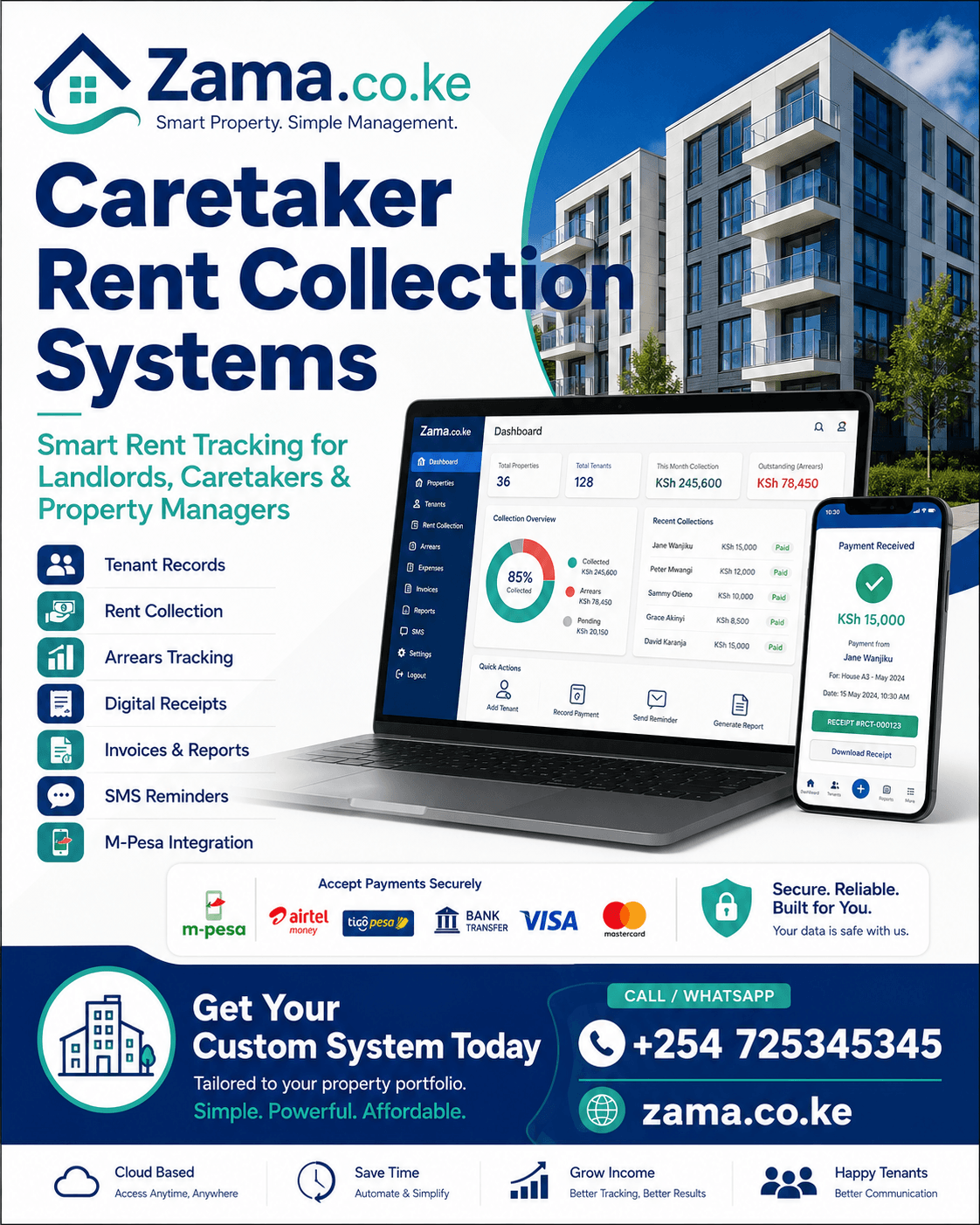
A caretaker rent collection system is a digital platform that helps caretakers, landlords, property managers, and real estate agents manage rent payments, tenant records, arrears, invoices, receipts, and reports in one place. Instead of relying on handwritten records, WhatsApp messages, or manual follow-ups, everything is captured in a clear and organized system.
At Zama.co.ke, we develop smart digital systems for landlords, property managers, agencies, caretakers, and real estate businesses that want to manage rental payments professionally.
What Are Caretaker Rent Collection Systems?
Caretaker rent collection systems are software platforms designed to help caretakers collect and monitor rent on behalf of landlords or property owners. The system allows the caretaker to record tenant payments, view pending balances, issue receipts, track arrears, and generate rent reports.
In a well-built system, the landlord can also log in and see real-time information. This means the landlord does not have to wait for the caretaker to send manual reports. The system provides transparency and accountability between the landlord, caretaker, and tenants.
A caretaker rent collection system can help manage:
- Tenant details
- House or unit records
- Monthly rent invoices
- Rent payments
- Deposits
- Service charges
- Water bills
- Garbage fees
- Arrears
- Receipts
- SMS reminders
- Payment reports
- Caretaker activity reports
This makes rental management easier, faster, and more professional.
Why Landlords Need Caretaker Rent Collection Systems
Many landlords lose money because rent collection is not properly monitored. Some tenants delay payments. Others make partial payments. Sometimes records are misplaced, receipts are not issued properly, or caretakers fail to provide accurate updates.
A digital system reduces these problems.
With a caretaker rent collection system, landlords can clearly see who has paid, who has not paid, how much was collected, and how much is still pending. This improves decision-making and reduces confusion.
For landlords with several rental units, manual rent tracking can easily lead to mistakes. A system helps organize all property income in a clean and professional way.
Common Problems in Manual Rent Collection
Manual rent collection may look simple, but it creates many hidden challenges.
1. Poor Record Keeping
When rent is recorded in books or simple spreadsheets, records can be lost, edited, or forgotten. This can create disputes between tenants, caretakers, and landlords.
2. Delayed Reports
Many landlords only receive rent updates after calling the caretaker. This wastes time and causes stress, especially when managing many tenants.
3. Payment Disputes
A tenant may claim they paid rent, while the caretaker may have no clear record. Without digital receipts and proper payment history, solving disputes becomes difficult.
4. Hidden Arrears
Some tenants continue accumulating balances because there is no automatic arrears tracking. By the time the landlord notices, the debt may already be too high.
5. Lack of Transparency
A landlord may not know the exact amount collected daily, weekly, or monthly. This creates mistrust between the landlord and caretaker.
6. Difficulty Managing Multiple Properties
If a landlord owns houses in different locations, relying on one caretaker or several caretakers without a centralized system becomes complicated.
A good caretaker rent collection system solves these issues by giving every transaction a clear digital record.
Key Features of a Good Caretaker Rent Collection System
A powerful caretaker rent collection system should not only record payments. It should help the landlord and caretaker manage the whole rental process from tenant onboarding to rent reporting.
1. Tenant Management
The system should store tenant details such as name, phone number, house number, rent amount, deposit, move-in date, and lease status.
This helps the caretaker know who occupies each unit and how much each tenant should pay.
2. House and Unit Management
Every rental unit should be listed in the system. The landlord or caretaker should be able to see vacant units, occupied units, and units with unpaid balances.
This helps in property planning and occupancy tracking.
3. Rent Invoicing
The system should generate monthly rent invoices automatically. Each tenant should have a clear invoice showing the amount due, due date, service charge, arrears, and any extra charges.
This reduces confusion and helps tenants understand what they are paying for.
4. Payment Recording
Caretakers should be able to record payments easily when tenants pay rent. The system should capture the amount paid, payment date, payment method, and balance remaining.
This creates a clean payment history.
5. Automatic Arrears Tracking
One of the most important features of caretaker rent collection systems is arrears tracking. The system should automatically show tenants who have not paid fully.
This allows the caretaker or landlord to follow up early before balances become too high.
6. Digital Receipts
After payment is recorded, the system should generate a receipt. A receipt helps reduce disputes and gives tenants confidence that their payments have been captured.
7. SMS or WhatsApp Reminders
A good system can send payment reminders to tenants before or after the due date. This improves rent collection and reduces the need for manual calls.
8. Landlord Dashboard
The landlord should have access to a dashboard showing total rent expected, total collected, total arrears, vacant units, and tenant payment status.
This gives the landlord full control even when away from the property.
9. Caretaker Dashboard
The caretaker should have a simple dashboard showing daily collections, pending payments, tenant balances, and tasks.
The system should be simple enough for a caretaker to use without technical difficulties.
10. Reports and Statements
The system should generate monthly reports, tenant statements, rent collection summaries, arrears reports, and property income reports.
These reports help landlords make better financial decisions.
Benefits of Caretaker Rent Collection Systems
1. Improved Rent Collection
When tenants receive clear invoices and reminders, they are more likely to pay on time. The caretaker can also follow up faster because the system shows exactly who has not paid.
2. Reduced Rent Disputes
Digital records reduce arguments. Every payment is captured with date, amount, balance, and receipt.
3. Better Accountability
The landlord can see what the caretaker has collected. This improves transparency and reduces mismanagement.
4. Faster Reporting
Instead of waiting for manual reports, the landlord can log in and view rent collection progress anytime.
5. Easy Arrears Management
The system automatically calculates unpaid balances. This helps landlords take action early.
6. Professional Property Management
A digital system makes the property look more organized and professional. Tenants also appreciate clear communication and receipts.
7. Saves Time
Caretakers no longer need to spend hours writing records manually. The system handles calculations and reports automatically.
8. Supports Multiple Properties
Landlords with different rental properties can manage all of them under one system.
Who Can Use Caretaker Rent Collection Systems?
Caretaker rent collection systems are useful for many groups in the property sector.
Landlords
Landlords can use the system to monitor rent collection, track arrears, manage tenants, and view financial reports.
Caretakers
Caretakers can use the system to record rent payments, issue receipts, check balances, and report to landlords.
Property Managers
Property managers can manage several properties, tenants, and caretakers from one dashboard.
Real Estate Agencies
Agencies can use the system to manage rent collection for clients and provide professional reports.
Apartment Owners
Owners of apartments, flats, bedsitters, hostels, commercial spaces, and rental homes can use the system to simplify rent collection.
Why Caretakers Need a Digital Rent Collection System
Caretakers are often the first contact between tenants and landlords. They receive complaints, follow up on rent, monitor vacant rooms, and communicate with tenants daily.
Without a proper system, the caretaker can easily become overwhelmed.
A digital system helps the caretaker work better by providing:
- Clear tenant list
- Payment status for each tenant
- Automatic balance calculation
- Easy receipt generation
- Simple reporting
- Arrears tracking
- Better communication with landlord
This makes the caretaker more efficient and trustworthy.
Caretaker Rent Collection Systems in Kenya
In Kenya, many landlords depend on caretakers to manage rental houses, apartments, bedsitters, single rooms, hostels, and commercial units. However, rent collection is still manual in many areas.
This creates serious challenges, especially when tenants pay through cash, M-Pesa, bank transfer, or partial payments.
A digital rent collection system for caretakers in Kenya can help landlords manage payments more clearly. It can also be customized to support Kenyan rental needs such as:
- M-Pesa payment tracking
- Tenant phone number records
- Monthly rent billing
- Service charge billing
- Water billing
- Garbage collection fees
- Deposit records
- Arrears follow-up
- SMS reminders
- Caretaker commission reports
- Landlord income reports
At Zama.co.ke, we can develop a rent collection system that fits the Kenyan property market.
How a Caretaker Rent Collection System Works
A simple caretaker rent collection system works in the following way:
Step 1: Add Properties
The landlord or admin adds properties into the system. This may include apartments, flats, commercial buildings, or rental houses.
Step 2: Add Units
Each house or room is added as a unit. The system records the unit number, rent amount, status, and tenant details.
Step 3: Add Tenants
Tenant details are entered into the system. This includes name, phone number, house number, move-in date, rent amount, and deposit information.
Step 4: Generate Rent Invoices
The system creates monthly rent invoices for each tenant.
Step 5: Record Payments
When tenants pay, the caretaker records the payment or the system captures it automatically if integrated with payment methods.
Step 6: Track Balances
The system calculates the amount paid and the balance remaining.
Step 7: Send Reminders
Tenants with pending balances can receive reminders.
Step 8: Generate Reports
The landlord can view rent collection reports, arrears reports, and tenant statements.
This process makes rent management simple and transparent.
Important Modules in a Caretaker Rent Collection System
A complete system should include several modules.
Tenant Module
This manages tenant profiles, contact details, lease status, rent amount, and payment history.
Property Module
This manages property details, unit numbers, occupancy status, rent rates, and location.
Invoice Module
This creates rent invoices and extra charges.
Payment Module
This records tenant payments and payment methods.
Receipt Module
This generates receipts after payment.
Arrears Module
This tracks unpaid rent and tenant balances.
SMS Module
This sends payment reminders and notices.
Reports Module
This generates financial reports for landlords and managers.
User Management Module
This controls who can access the system. For example, the landlord, admin, caretaker, accountant, and property manager may have different permissions.
Why Choose Zama.co.ke for Caretaker Rent Collection Systems?
Zama.co.ke develops practical digital systems for businesses, landlords, schools, clinics, salons, agencies, and organizations. We understand that every property owner has different needs.
That is why we can build a caretaker rent collection system based on your real workflow.
We Build Custom Systems
Your rental business may not operate like another landlord’s property. We can customize the system to match your process.
We Understand Local Needs
We understand the Kenyan market, including M-Pesa payments, caretaker operations, rent arrears, tenant follow-up, and landlord reporting.
We Focus on Simple Design
A good system should be easy to use. We design dashboards that caretakers, landlords, and property managers can understand quickly.
We Support Growth
Whether you have 10 units or 1,000 units, the system can be designed to grow with your property business.
We Build Long-Term Business Systems
At Zama, we do not only build websites. We build digital systems that solve real business problems.
Features Zama Can Include in Your Rent Collection System
At Zama.co.ke, we can develop a caretaker rent collection system with features such as:
- Landlord dashboard
- Caretaker dashboard
- Tenant registration
- Property and unit management
- Rent invoice generation
- Deposit tracking
- Service charge tracking
- Water bill tracking
- Garbage fee tracking
- Payment recording
- M-Pesa integration
- Receipt generation
- Arrears tracking
- SMS reminders
- Tenant statements
- Monthly reports
- Caretaker reports
- Admin user roles
- Export to PDF
- Export to Excel
- Mobile-friendly dashboard
- Secure login
- Data backup
- Multi-property management
This gives landlords and property managers a complete solution for rental operations.
Caretaker Rent Collection System with M-Pesa Integration
M-Pesa is one of the most common payment methods in Kenya. A rent collection system can be integrated with M-Pesa so that tenant payments are easier to track.
With M-Pesa integration, the system can help capture:
- Tenant payment amount
- Phone number used
- Transaction code
- Payment date
- House number
- Balance after payment
This reduces manual entry and improves accuracy.
For landlords, M-Pesa integration can make rent collection more transparent and efficient.
Caretaker Rent Collection Systems for Small Landlords
A landlord with only a few houses may think they do not need a system. However, even small landlords face challenges such as late rent, missing records, and tenant disputes.
A simple rent collection system can help small landlords:
- Know who has paid
- Track balances
- Keep tenant records
- Send reminders
- Avoid confusion
- Generate reports
This makes rental income easier to manage.
Caretaker Rent Collection Systems for Large Property Owners
Large property owners need even stronger systems. Managing many tenants manually can lead to serious financial losses.
A digital system helps large landlords and agencies manage:
- Multiple properties
- Multiple caretakers
- Hundreds of tenants
- Different rent amounts
- Service charges
- Deposits
- Arrears
- Monthly reports
- Staff accountability
This creates better control and professionalism.
How Caretaker Rent Collection Systems Improve Accountability
Accountability is one of the biggest reasons landlords should use a digital system.
When payments are recorded digitally, every action can be traced. The landlord can see when a payment was recorded, who recorded it, and which tenant paid.
This reduces errors and builds trust between the landlord and caretaker.
A system can also limit user permissions. For example, a caretaker may only record payments and view tenant balances, while the landlord can access full financial reports.
This protects sensitive information and improves control.
Best Practices for Using a Caretaker Rent Collection System
To get the best results, landlords should use the system properly.
Keep Tenant Records Updated
Every tenant should have correct details, including phone number, house number, rent amount, and move-in date.
Record Payments Immediately
Caretakers should record payments as soon as they are received.
Review Reports Weekly
Landlords should check reports regularly instead of waiting until the end of the month.
Send Reminders Early
Do not wait until arrears become too high. Send reminders before and after the due date.
Train Caretakers
Caretakers should be trained on how to use the system properly.
Use Secure Access
Every user should have their own login details. This improves security and accountability.
Why Manual Rent Collection Is No Longer Enough
Property management is becoming more digital. Tenants expect better communication, landlords need accurate reports, and caretakers need tools that make work easier.
Manual rent collection is slow, risky, and difficult to scale.
A caretaker rent collection system helps property owners move from confusion to control. It gives landlords real-time access to rent information and helps caretakers manage tenants better.
For serious landlords, digital rent collection is no longer optional. It is a smart investment.
Caretaker Rent Collection Systems and Tenant Satisfaction
A good system does not only help landlords. It also improves the tenant experience.
Tenants benefit from:
- Clear invoices
- Proper receipts
- Accurate balances
- Easy payment confirmation
- Better communication
- Reduced disputes
When tenants know their payments are properly recorded, they feel more confident and respected.
Custom Caretaker Rent Collection System Development by Zama
Every landlord has a different way of managing rent. Some collect rent monthly. Others collect weekly. Some include water bills separately. Others include service charges or garbage fees.
That is why a custom system is better than a one-size-fits-all solution.
At Zama.co.ke, we can develop a custom caretaker rent collection system based on your exact needs. Whether you manage residential houses, apartments, hostels, commercial spaces, or mixed properties, we can build a solution that fits your operations.
Conclusion
Caretaker rent collection systems are essential for landlords, caretakers, and property managers who want better control over rent payments, tenant records, arrears, receipts, and reports.
Instead of depending on manual books, phone calls, and scattered records, a digital system gives you one clear platform for managing rental income.
If you want a professional rent collection system for your property business, Zama.co.ke can help you build a reliable, secure, and easy-to-use solution.
Visit https://zama.co.ke today and get a custom caretaker rent collection system for your rental business.
Why Caretaker Rent Collection Systems Are Becoming Important
The rental business is growing fast. More people are building apartments, bedsitters, hostels, commercial spaces, and rental houses. As the number of tenants increases, landlords need better ways to manage money, records, communication, and reports.
In the past, many landlords depended fully on caretakers. The caretaker would know who has paid, who has delayed, who has moved out, and who has complaints. This made the caretaker very powerful in the daily running of the property. However, the landlord was often left depending on verbal reports.
This is risky.
A landlord should not only depend on phone calls or notebooks to know what is happening in the property. A landlord needs a system that gives clear information at any time. That is the main reason caretaker rent collection systems are becoming more important.
A digital rent collection system gives the landlord direct visibility. It also helps the caretaker perform duties better. The caretaker does not have to struggle with manual records, calculations, or repeated follow-ups. Everything becomes easier to track.
For a modern landlord, a caretaker rent collection system is not just a luxury. It is a business tool.
The Role of a Caretaker in Rent Collection
A caretaker plays a very important role in rental property management. In many properties, the caretaker is the person tenants meet first when they have issues. The caretaker may also be responsible for checking vacant houses, reporting repairs, collecting rent, recording payments, and following up with tenants.
However, without a proper system, the caretaker’s work can become disorganized.
A caretaker may be expected to:
- Know all tenants by name
- Know each tenant’s house number
- Know how much each tenant should pay
- Record rent payments
- Follow up on late payments
- Report vacant houses
- Handle tenant complaints
- Send rent updates to the landlord
- Keep payment records safely
- Prepare end-month reports
This is a lot of responsibility.
A caretaker rent collection system supports the caretaker by providing a structured platform where all this information is stored. The caretaker can log in, check tenant balances, record payments, view arrears, and generate reports.
This improves accuracy and reduces pressure.
How a Digital Rent Collection System Reduces Landlord Stress
Many landlords become stressed during rent collection periods. They have to call the caretaker, call tenants, confirm payments, check M-Pesa messages, compare notes, and calculate balances. This can take a lot of time.
A digital system reduces this stress because the landlord can see everything from one dashboard.
The landlord can quickly check:
- Total rent expected this month
- Total rent already collected
- Tenants who have paid fully
- Tenants with partial payments
- Tenants with arrears
- Vacant units
- Deposits collected
- Service charges collected
- Caretaker activity
- Monthly income reports
This makes property management more peaceful.
Instead of asking, “Who has paid?” the landlord simply logs into the system. Instead of waiting for manual reports, the landlord can view real-time updates. Instead of guessing whether money has been received, the system provides clear records.
This gives landlords confidence and control.
Why Manual Rent Books Are Risky
Many rental properties still use manual rent books. While this may look cheap, it can create serious problems.
Manual books can get lost. Pages can be torn. Records can be changed. Handwriting may be unclear. Calculations may be wrong. Receipts may not match actual payments. Tenants may claim they paid when the record is missing.
These small problems can lead to serious financial loss.
A manual book also makes it difficult to generate reports. The caretaker may need to spend hours calculating rent collected, unpaid balances, deposits, and expenses. If the landlord owns many units, the process becomes even harder.
A digital system solves this by storing data safely and calculating balances automatically.
With a caretaker rent collection system, every payment has a clear record. The landlord can search tenant history, view receipts, and confirm arrears without going through pages of handwritten notes.
Caretaker Rent Collection Systems for Apartments
Apartments usually have many tenants, different rent amounts, service charges, deposits, and utility bills. Managing all these manually can become complicated.
A caretaker rent collection system helps apartment owners manage:
- Floor numbers
- Unit numbers
- Tenant names
- Monthly rent
- Security deposits
- Water bills
- Service charges
- Parking fees
- Garbage fees
- Maintenance requests
- Rent arrears
- Vacant units
For example, if an apartment has 50 units, the landlord can know exactly how many tenants have paid by the 5th of the month. The system can show the total expected rent, total collected rent, and total pending balance.
This helps apartment owners make decisions quickly.
If a tenant has not paid, the caretaker can follow up immediately. If a unit is vacant, the landlord can know and take action to get a new tenant. If a tenant has arrears, the system keeps a clear history.
This makes apartment management more professional.
Caretaker Rent Collection Systems for Bedsitters and Single Rooms
Bedsitters and single rooms are common rental properties, especially in towns and urban areas. They may have many tenants paying different amounts depending on room size, location, or agreement.
In many cases, tenants in bedsitters may pay rent through M-Pesa, cash, or bank transfer. Some may pay full rent, while others may pay in installments. Without a system, it becomes difficult to know who has cleared and who has not.
A caretaker rent collection system helps manage these situations.
The system can record:
- Tenant name
- Room number
- Monthly rent amount
- Payment date
- Amount paid
- Balance remaining
- Deposit amount
- Move-in date
- Move-out date
- Arrears history
This helps landlords avoid confusion.
For bedsitters and single rooms, fast rent tracking is important because tenants may move frequently. A system helps maintain clean records even when tenants move in and out often.
Caretaker Rent Collection Systems for Commercial Properties
Commercial properties also need strong rent collection systems. Shops, offices, stalls, warehouses, and business spaces often have rent agreements, deposits, service charges, and utility payments.
A caretaker rent collection system for commercial properties can help manage:
- Business tenant details
- Shop or office numbers
- Monthly rent
- Lease period
- Service charges
- Security deposits
- VAT or tax records where applicable
- Arrears
- Rent escalation
- Payment receipts
- Renewal reminders
Commercial tenants may require more formal records than residential tenants. They may need receipts, statements, and invoices for their own accounting. A good system makes this possible.
For landlords with commercial spaces, a digital system improves professionalism and makes rent collection easier to audit.
Caretaker Rent Collection Systems for Hostels
Hostels can be difficult to manage manually because tenants may pay per semester, per month, or per term. Some students may share rooms. Others may move out during holidays. Payments may come from parents, guardians, or students.
A caretaker rent collection system can help hostel owners manage:
- Student tenant details
- Room allocation
- Bed allocation
- Payment plans
- Parent or guardian contacts
- Rent balances
- Deposits
- Damages
- Move-in and move-out dates
- Arrears
- Receipts
- Reports
Hostel owners need clear systems because there may be many students moving in and out within a short time. A digital platform helps avoid confusion and improves accountability.
How the System Handles Partial Payments
Partial payments are common in rental properties. A tenant may pay part of the rent and promise to clear the balance later. If this is recorded manually, it can easily cause confusion.
A caretaker rent collection system handles partial payments clearly.
For example, if a tenant is supposed to pay Ksh 10,000 and pays Ksh 6,000, the system records the Ksh 6,000 and automatically shows a balance of Ksh 4,000.
The caretaker does not need to calculate manually.
The system can also show payment history, such as:
- Rent due: Ksh 10,000
- First payment: Ksh 6,000
- Second payment: Ksh 2,000
- Balance: Ksh 2,000
This makes follow-up easier.
Partial payment tracking is very important because it prevents misunderstandings between tenants, caretakers, and landlords.
How the System Handles Deposits
Deposits are another area where many landlords experience confusion. A tenant may pay rent and deposit together during onboarding. If this is not recorded properly, future disputes may happen when the tenant moves out.
A caretaker rent collection system should separate deposit payments from rent payments.
This means the system should clearly show:
- Rent amount
- Deposit amount
- Service charge
- Water deposit if applicable
- Other onboarding charges
- Total paid
- Balance remaining
When the tenant moves out, the landlord can check the deposit record and decide whether to refund fully, deduct repair costs, or apply it according to the lease agreement.
This creates clean records and reduces disputes.
How the System Handles Service Charges
Many properties have service charges. These may cover security, cleaning, garbage collection, compound maintenance, water pump costs, or general shared services.
If service charges are mixed with rent without clear records, reports become inaccurate.
A good caretaker rent collection system separates service charges from rent. This helps the landlord know exactly how much was collected as rent and how much was collected for service charges.
The system can also show tenants who have paid rent but not service charge.
This is important for clean financial reporting.
Water Billing in Caretaker Rent Collection Systems
Water billing is a major challenge in rental properties. Some landlords charge a fixed water fee. Others use meter readings. Some tenants share meters, while others have individual meters.
A rent collection system can include water billing features such as:
- Monthly water bill entry
- Meter reading records
- Previous reading
- Current reading
- Units consumed
- Rate per unit
- Water balance
- Payment status
This helps avoid arguments over water bills.
If the property uses fixed water charges, the system can automatically add the charge to each tenant’s monthly invoice. If the property uses meter readings, the caretaker can enter readings and the system calculates the amount payable.
This improves accuracy and transparency.
Garbage Fee and Utility Tracking
Apart from rent and water, some properties collect garbage fees, security fees, parking fees, electricity tokens, cleaning fees, or maintenance fees.
A digital system can manage all these charges in one place.
Instead of creating separate notebooks for every charge, the system allows the landlord to add extra charges to tenant invoices. The tenant statement then shows a complete breakdown.
For example:
- Monthly rent: Ksh 12,000
- Water bill: Ksh 500
- Garbage fee: Ksh 300
- Service charge: Ksh 1,000
- Total payable: Ksh 13,800
This makes payments clear and organized.
SMS Reminders for Rent Collection
SMS reminders can greatly improve rent collection. Many tenants delay payments because they forget or wait until they are reminded. A system with SMS reminders can send automatic messages before and after the due date.
Examples of reminders include:
“Dear tenant, your rent for this month is due on 5th. Kindly make payment on time.”
“Dear tenant, our records show your rent balance is Ksh 4,000. Kindly clear your balance.”
These reminders reduce the workload of the caretaker. Instead of calling every tenant, the system can send messages automatically or allow the caretaker to send reminders from the dashboard.
SMS reminders are especially useful for landlords with many tenants.
WhatsApp Communication for Tenants
Some landlords may prefer WhatsApp communication because tenants respond quickly. A rent collection system can also be designed to support WhatsApp reminders or message templates.
The caretaker can send messages about:
- Rent due dates
- Payment confirmations
- Arrears reminders
- Maintenance notices
- Water interruptions
- Vacant house updates
- General announcements
This improves communication between the property management team and tenants.
Reports Generated by Caretaker Rent Collection Systems
Reports are one of the most valuable parts of a rent collection system. Without reports, landlords may not fully understand how their property is performing.
A good system should generate reports such as:
Rent Collection Report
This shows total rent expected, total rent collected, and pending rent.
Arrears Report
This shows tenants with unpaid balances and the amount owed.
Tenant Statement
This shows a tenant’s invoices, payments, and balances over time.
Deposit Report
This shows deposits collected from tenants.
Vacant Units Report
This shows rooms or units that are not occupied.
Caretaker Activity Report
This shows payments recorded by the caretaker and actions performed in the system.
Monthly Income Report
This shows income collected from rent, service charge, water, garbage, and other charges.
These reports help landlords make smart financial decisions.
Security Features in a Caretaker Rent Collection System
Security is very important because a rent collection system contains financial and tenant information.
A good system should include:
- Secure login
- User roles and permissions
- Activity logs
- Data backup
- Password protection
- Restricted access
- Admin approval features
- Secure database storage
For example, a caretaker should not have the same access as the landlord. The caretaker may record payments and view tenant balances, while the landlord can access full reports and financial summaries.
This protects sensitive data and prevents misuse.
User Roles in a Caretaker Rent Collection System
Different users need different access levels.
Admin
The admin controls the full system. This may be the landlord, property owner, or company manager.
Landlord
The landlord views reports, tenant balances, income summaries, and property performance.
Caretaker
The caretaker records payments, updates tenant details, sends reminders, and views assigned properties.
Accountant
The accountant reviews income reports, exports statements, and reconciles payments.
Tenant
The tenant may have access to view invoices, receipts, and balances.
User roles help keep the system organized and secure.
Mobile-Friendly Caretaker Rent Collection Systems
Many caretakers do not work from offices. They move around the property, communicate with tenants, check rooms, and handle daily issues. That is why the system should work well on mobile phones.
A mobile-friendly rent collection system allows the caretaker to:
- Record payments using a phone
- Check tenant balances
- View vacant units
- Send reminders
- Update tenant information
- Generate receipts
- Report maintenance issues
This makes the system practical for daily use.
At Zama.co.ke, we can design systems that work well on phones, tablets, laptops, and desktops.
Cloud-Based Rent Collection Systems
A cloud-based rent collection system allows users to access the platform online. This means the landlord does not need to be physically present at the property.
The landlord can check rent collection from anywhere.
Benefits of a cloud-based system include:
- Access from any location
- Real-time updates
- No need for paper files
- Better data backup
- Easier multi-property management
- Secure online access
- Faster reporting
For landlords living far from their rental properties, a cloud-based system is very useful.
Custom vs Ready-Made Rent Collection Systems
Landlords can choose between ready-made systems and custom-built systems. Both have advantages, but custom systems offer more flexibility.
A ready-made system may have general features, but it may not match your exact workflow. A custom system can be built around how your property operates.
For example, your property may need:
- Special deposit handling
- Unique service charge rules
- Caretaker commission tracking
- M-Pesa integration
- Custom reports
- Multi-branch property management
- Tenant onboarding process
- Lease document upload
- Specific SMS templates
- Approval workflows
A custom caretaker rent collection system gives you more control.
At Zama.co.ke, we can help you build a system that matches your business operations.
How Caretaker Rent Collection Systems Help Property Managers
Property managers handle properties on behalf of landlords. They need accurate records, clear reports, and strong accountability. A caretaker rent collection system makes this easier.
Property managers can use the system to:
- Manage multiple landlords
- Manage multiple properties
- Assign caretakers
- Track payments
- Generate landlord reports
- Monitor arrears
- Manage tenant communication
- Track maintenance issues
- Export financial reports
This helps property managers provide better service to clients.
When reports are accurate and timely, landlords trust the property manager more.
How the System Helps Reduce Fraud
Fraud can happen when rent records are not clear. A tenant may pay rent, but the payment may not be reported correctly. A caretaker may delay reporting collections. Manual records may be changed.
A digital system reduces these risks.
It creates a clear trail of activity. The landlord can see who recorded a payment, when it was recorded, and which tenant account was updated.
If the system is integrated with M-Pesa, payments can be captured directly, reducing the need for manual confirmation.
This improves transparency and reduces financial leakage.
How the System Helps During Tenant Move-In
Tenant onboarding should be organized. When a new tenant moves in, the system can record all important details.
This may include:
- Tenant name
- Phone number
- ID number where required
- House number
- Rent amount
- Deposit amount
- Service charge
- Move-in date
- Lease period
- Emergency contact
- Initial invoice
- Payment status
The system can generate an onboarding invoice showing all amounts due. This helps the tenant understand the payment clearly.
Good onboarding creates clean records from the beginning.
How the System Helps During Tenant Move-Out
When a tenant moves out, the system helps the landlord review the tenant’s financial history.
The landlord can check:
- Rent balance
- Deposit paid
- Damages
- Repair deductions
- Final water bill
- Service charge balance
- Move-out date
- Refund amount if applicable
This makes move-out processing easier and more professional.
Without a system, move-out disputes can be difficult to solve because records may be incomplete.
Maintenance Tracking in Rent Collection Systems
Although the main purpose is rent collection, a good system can also include maintenance tracking.
Tenants may report problems such as:
- Water leakage
- Broken doors
- Electrical issues
- Blocked drainage
- Roof leaks
- Security lights
- Plumbing problems
The caretaker can record these issues in the system. The landlord can view the maintenance requests and track whether they have been resolved.
This improves property management and tenant satisfaction.
Why Zama.co.ke Is the Right Partner
Choosing the right developer is important. A rent collection system should not just look good. It should solve real problems.
At Zama.co.ke, we focus on building business systems that improve operations. We can help you design, develop, and customize a caretaker rent collection system that fits your property management needs.
We can help with:
- System planning
- Dashboard design
- Database structure
- User roles
- Payment workflows
- M-Pesa integration
- SMS integration
- Report generation
- Mobile responsiveness
- Security setup
- Hosting support
- Training and support
Our goal is to help landlords and property managers move from manual rent collection to smart digital management.
How to Get Started with a Caretaker Rent Collection System
Getting started is simple.
First, identify the main problems you want to solve. For example, you may want to reduce arrears, improve reporting, monitor caretakers, manage multiple properties, or automate rent reminders.
Second, list the features you need. This may include tenant management, invoices, payments, receipts, M-Pesa, SMS, reports, and dashboards.
Third, contact Zama.co.ke for system development.
We can help you turn your idea into a working rent collection platform.
Final Thoughts
The rental business needs proper systems. Landlords who continue relying only on manual records may face payment disputes, poor reporting, hidden arrears, and lack of accountability.
Caretaker rent collection systems help solve these problems by giving landlords, caretakers, property managers, and tenants a clear digital platform for rent management.
With the right system, you can collect rent better, track payments faster, reduce arrears, improve transparency, and manage properties professionally.
Whether you own a few rental units or manage many properties, a caretaker rent collection system can help you run your rental business with confidence.
For a custom and reliable solution, visit https://zama.co.ke and let Zama help you build a smart rent collection system for your property business.