
Enterprise Software Development Kenya
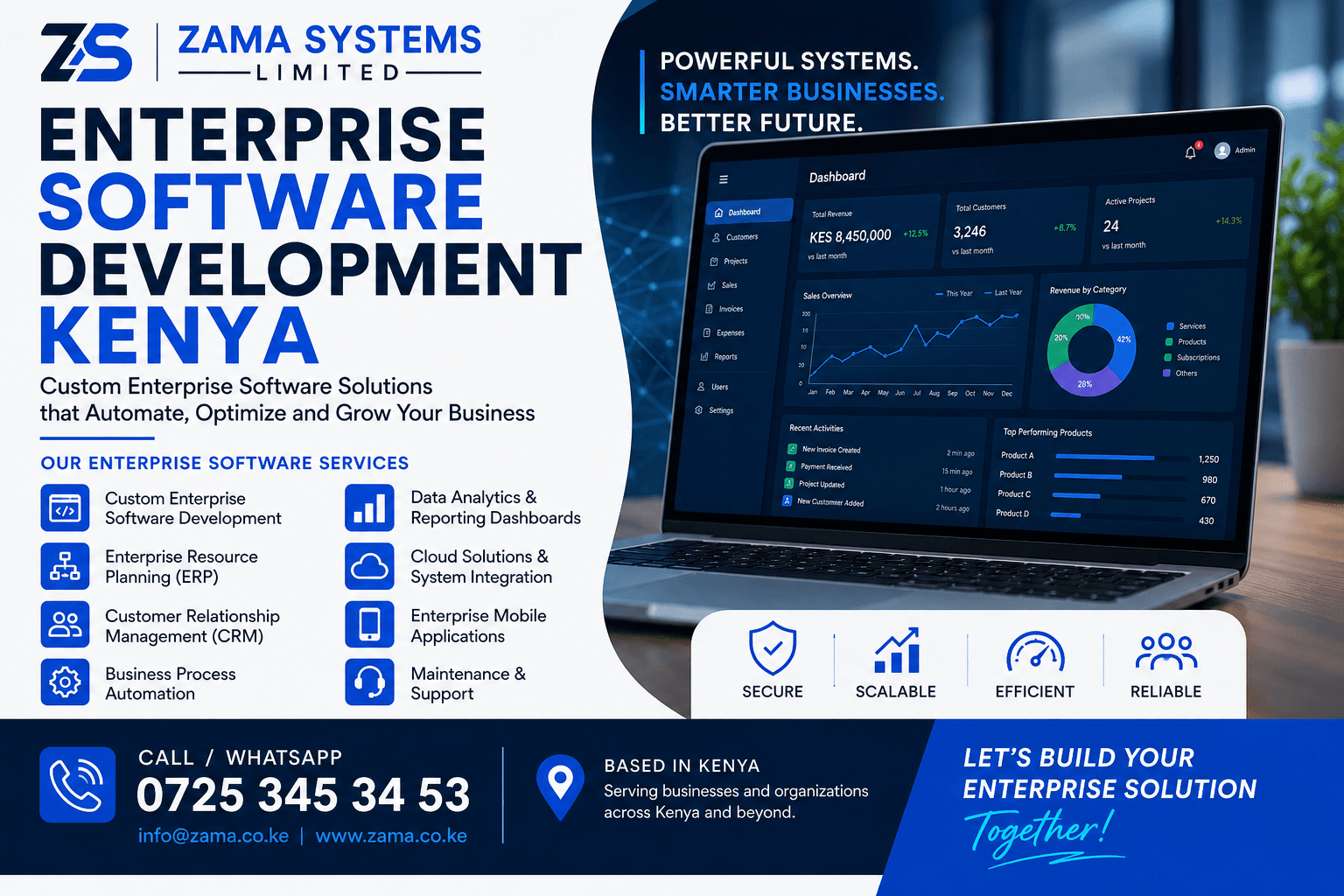
Enterprise software development in Kenya is becoming one of the most important technology services for businesses, institutions, and organizations that want to grow, automate operations, reduce manual work, and improve service delivery. As companies continue to expand, simple websites and basic applications are no longer enough. Businesses now need powerful systems that can manage customers, staff, payments, reports, workflows, stock, communication, projects, field teams, branches, departments, and data from one secure platform.
If you are searching for Enterprise Software Development Kenya, you are likely looking for a professional technology partner who can build a custom software system for your business or organization. You may need a system that can support many users, handle large amounts of data, connect different departments, automate daily tasks, and provide clear reports for management.
At Zama Systems Limited, we help companies, startups, SMEs, schools, hospitals, churches, NGOs, real estate firms, SACCOs, logistics companies, retailers, and service-based businesses develop custom enterprise software solutions that solve real problems. Our goal is to help Kenyan businesses move from manual work, Excel files, scattered records, and disconnected tools to modern digital systems that are secure, fast, scalable, and easy to use.
Enterprise software is not just about building a system. It is about creating a digital foundation for your business. A good enterprise system helps your team work better, makes management easier, improves accountability, reduces errors, and supports long-term business growth.
What Is Enterprise Software Development?
Enterprise software development is the process of designing, building, and maintaining software systems for organizations with complex operations. Unlike a simple website or small application, enterprise software is built to support larger workflows, multiple users, different departments, security levels, reporting needs, integrations, and long-term growth.
Enterprise software can be used to manage business operations such as customer relationship management, employee management, finance, inventory, billing, project management, communication, procurement, sales, reporting, document management, and service delivery.
For example, a real estate company may need enterprise software to manage landlords, properties, tenants, leases, invoices, rent payments, arrears, maintenance requests, caretaker collections, reports, and owner statements. A school may need a system for students, parents, teachers, fees, exams, attendance, communication, transport, library, and reports. A hospital may need a system for patients, appointments, billing, departments, staff, pharmacy, laboratory, and records.
Enterprise software development focuses on building systems that match how an organization works. Instead of forcing your business to use a general system that does not fit your process, custom enterprise software is designed around your actual needs.
This is why enterprise software development in Kenya is becoming important. Kenyan businesses have unique workflows, local payment methods, WhatsApp communication habits, branch operations, field teams, M-Pesa usage, county-based service areas, and industry-specific needs. A custom enterprise system can be designed to support all these requirements.
Why Enterprise Software Development Is Important in Kenya
Kenyan businesses are becoming more digital. Customers expect faster service, management wants better reports, staff need easier tools, and business owners want systems that can help them make better decisions. Manual operations are becoming slower, more expensive, and harder to manage.
Many companies in Kenya still depend on Excel files, WhatsApp messages, paper records, notebooks, phone calls, and separate tools to manage their operations. While these methods may work when the business is small, they become difficult as the business grows.
A company with 20 customers can manage manually. But when the same company grows to 500, 5,000, or 50,000 customers, manual work becomes a serious problem. Records get lost, payments become hard to track, staff fail to follow up, reports take too long, and customers complain because service becomes slow.
Enterprise software solves this problem by bringing operations into one organized digital system. It helps businesses manage information, automate workflows, track performance, and improve communication.
In Kenya, enterprise software is especially useful because many businesses are growing quickly but do not have proper systems. A company may have clients in Nairobi, Mombasa, Kisumu, Nakuru, Eldoret, Kiambu, Machakos, Thika, and other counties, but still manage everything using manual records. This limits growth and creates confusion.
A professional enterprise system allows a business to expand without losing control. It gives owners and managers better visibility into what is happening across the organization.
Benefits of Enterprise Software Development Kenya
1. Better Business Organization
One of the biggest benefits of enterprise software is organization. A good system brings all important information into one place. Customers, payments, staff tasks, invoices, stock, reports, documents, and communication can be managed from one platform.
This makes it easier for the business owner or manager to understand what is happening. Instead of asking many people for updates, management can open the dashboard and see the information clearly.
2. Improved Productivity
Enterprise software improves productivity by reducing repetitive manual work. Tasks such as generating invoices, sending reminders, assigning work, preparing reports, approving requests, tracking payments, and updating records can be automated.
When staff spend less time on repetitive work, they can focus on serving customers, closing sales, solving problems, and improving operations.
3. Reduced Errors
Manual processes often lead to errors. A staff member may enter the wrong amount, forget to update a record, misplace a document, or fail to follow up a client. Enterprise software reduces these mistakes by controlling workflows and keeping data organized.
For example, an invoice system can automatically calculate totals. A payment system can match transactions to customer accounts. A stock system can alert users when inventory is low. A task system can remind staff about pending work.
4. Better Reporting and Decision-Making
Many businesses struggle because they do not have accurate reports. Without proper reports, business owners make decisions based on guesswork. Enterprise software provides real-time reports that help management understand sales, expenses, payments, customer activity, staff performance, and business growth.
With better data, businesses can make better decisions. They can know which services are profitable, which customers need follow-up, which branches are performing well, and where money is being lost.
5. Stronger Customer Service
Customers want fast and professional service. Enterprise software helps businesses respond faster, track customer issues, follow up leads, send updates, and manage communication.
For example, a customer support system can track every inquiry from WhatsApp, email, website forms, and phone calls. Staff can see the customer history and respond more professionally. This improves customer satisfaction and trust.
6. Better Accountability
In many organizations, it is difficult to know who did what, when, and why. Enterprise software improves accountability by recording user actions, task assignments, approvals, comments, and updates.
This helps management monitor staff performance and reduce confusion. If a task is delayed, the system can show who was responsible. If a payment was recorded, the system can show who entered it.
7. Easier Business Growth
As a business grows, manual systems become weak. Enterprise software makes growth easier because it supports more users, more customers, more branches, and more transactions.
A scalable system allows your business to expand without starting from zero every time. You can add more modules, departments, users, and features as the business grows.
8. Better Security
Business data is valuable. Customer information, payment records, staff details, invoices, contracts, and reports must be protected. Enterprise software can include user permissions, secure login, data backups, activity logs, and role-based access.
This ensures that only authorized people can access sensitive information.
Enterprise Software Development Services in Kenya
At Zama Systems Limited, we provide a wide range of enterprise software development services for businesses and organizations across Kenya.
Custom Enterprise Software Development
We build custom enterprise software systems based on your business operations. This means we first understand your workflow, challenges, users, and goals before developing the system.
Custom enterprise software can include dashboards, admin panels, staff portals, customer portals, reports, automation workflows, document management, payment tracking, communication tools, and integrations.
Business Management Systems
A business management system helps companies manage daily operations from one platform. It can include customers, sales, invoices, payments, staff, tasks, reports, expenses, inventory, and communication.
This type of system is useful for SMEs, agencies, service companies, distributors, consultants, and growing businesses.
Customer Relationship Management Systems
A CRM system helps businesses manage leads, clients, communication, sales pipelines, follow-ups, quotations, and customer history. An enterprise CRM can support multiple sales agents, departments, branches, and managers.
With a custom CRM, your business can improve lead management, customer follow-up, and sales conversion.
Enterprise Resource Planning Systems
An ERP system helps organizations manage major business functions such as finance, procurement, inventory, HR, sales, operations, and reporting. ERP systems are useful for businesses that need more control over internal processes.
A custom ERP can be built to match your industry and business model.
Human Resource Management Systems
An HR system helps companies manage employees, attendance, leave, payroll data, performance, documents, departments, and staff records. It can also include onboarding, task assignment, internal communication, and staff evaluation.
This helps organizations improve staff management and accountability.
Inventory and Stock Management Systems
Businesses that sell products need a proper inventory system. Enterprise inventory software can track stock levels, purchases, suppliers, sales, warehouses, branches, stock transfers, and low-stock alerts.
This is useful for retail businesses, supermarkets, hardware shops, pharmacies, distributors, and e-commerce companies.
Financial and Billing Systems
Enterprise billing systems help organizations manage invoices, payments, receipts, expenses, reports, subscriptions, and balances. These systems can integrate with payment channels such as M-Pesa, bank transfers, cards, or manual payment records.
This is useful for SaaS companies, property managers, schools, clinics, SACCOs, and service businesses.
Workflow Automation Systems
Workflow automation systems help businesses automate approvals, task assignment, reminders, follow-ups, reporting, and internal processes. This reduces delays and improves efficiency.
For example, a maintenance request can automatically move from tenant submission to caretaker review, manager approval, technician assignment, and completion report.
Enterprise Web Portals
We develop web portals for customers, staff, suppliers, students, tenants, agents, and managers. A portal allows users to log in and access specific information or services.
For example, a tenant portal can show rent balances, receipts, invoices, and maintenance requests. A student portal can show fees, exams, assignments, and announcements. A customer portal can show orders, support tickets, invoices, and documents.
SaaS Platform Development
SaaS platforms allow businesses to offer software to customers through monthly or yearly subscriptions. We help startups and companies build SaaS systems for industries such as real estate, education, salons, logistics, WiFi billing, customer support, events, and finance.
A SaaS platform can include subscriptions, billing, user accounts, plans, dashboards, roles, and multi-tenant architecture.
Industries That Need Enterprise Software Development Kenya
Real Estate and Property Management
Real estate companies and property managers need systems to manage properties, landlords, tenants, leases, invoices, payments, arrears, deposits, maintenance, caretakers, owner reports, and communication.
Enterprise software can help property businesses reduce manual work, improve rent collection, track arrears, and provide better reports to owners.
Schools and Education Institutions
Schools, colleges, and training institutions need systems for student records, fees, attendance, exams, staff, communication, library, transport, hostels, and reports.
A school management system helps administrators, teachers, parents, and students access information easily.
Healthcare Organizations
Hospitals, clinics, laboratories, and pharmacies can use enterprise systems to manage patients, appointments, billing, departments, staff, medical records, inventory, and reports.
A good system improves service delivery and reduces delays.
Retail and Wholesale Businesses
Retailers and wholesalers need systems for stock, sales, suppliers, purchases, customers, invoices, payments, branches, and reports. Enterprise software helps reduce stock losses and improve sales tracking.
Logistics and Transport Companies
Transport companies need systems for drivers, vehicles, deliveries, routes, fuel, maintenance, customers, invoices, and tracking. Enterprise software improves dispatching, accountability, and performance monitoring.
SACCOs and Financial Institutions
SACCOs and microfinance institutions need secure systems for members, loans, savings, payments, statements, approvals, reports, and communication.
Enterprise software helps financial organizations improve accuracy and security.
NGOs and Churches
NGOs and churches need systems for members, donors, events, contributions, projects, welfare, communication, attendance, and reports. Enterprise software improves transparency and organization.
Manufacturing and Distribution
Manufacturing companies need software for production, stock, suppliers, orders, quality control, dispatch, staff, and reports. Enterprise systems help improve planning and reduce waste.
Key Features of a Good Enterprise Software System
User-Friendly Dashboard
A good dashboard should show important information clearly. Users should be able to see summaries, reports, alerts, charts, and quick actions.
Role-Based Access
Different users should have different permissions. For example, an accountant may access finance records, while a sales agent may only access leads and customers.
Reports and Analytics
Enterprise software should provide clear reports. These may include sales reports, payment reports, staff reports, customer reports, inventory reports, and financial summaries.
Automation
Automation is one of the most important features. The system should reduce manual work by automating reminders, approvals, reports, invoices, task assignment, and notifications.
Integration
A good enterprise system should connect with other tools. This can include M-Pesa, WhatsApp, SMS, email, websites, mobile apps, accounting systems, payment gateways, and APIs.
Security
Security features should include strong login, permissions, activity logs, backups, secure hosting, and data protection.
Mobile-Friendly Design
Many users in Kenya access systems through smartphones. Enterprise software should work well on phones, tablets, laptops, and desktops.
Scalability
The system should grow with the business. It should support more users, data, modules, and branches as the organization expands.
Enterprise Software Development Process
At Zama Systems Limited, we follow a structured process to build reliable enterprise software.
1. Business Analysis
We begin by understanding your business, industry, users, challenges, and goals. This helps us know what the system should solve.
2. Requirements Planning
We define the modules, features, reports, user roles, workflows, and integrations needed for the system.
3. UI and UX Design
We design the system interface so users can understand how the software will look and work. A clean design improves user adoption.
4. System Development
Our development team builds the system using modern and reliable technologies. This includes frontend, backend, database, APIs, security, and admin panels.
5. Testing
We test the system to confirm that features work correctly. Testing helps identify errors before the system goes live.
6. Deployment
We deploy the software on a secure server or cloud environment. This may include domain setup, SSL, hosting, backups, and performance optimization.
7. Training
We train your team on how to use the system. Training is important because even a good system must be understood by users.
8. Support and Improvement
After launch, we provide support, maintenance, updates, and improvements based on user feedback and business growth.
Custom Enterprise Software vs Ready-Made Software
Many businesses ask whether they should buy ready-made software or build custom enterprise software. Ready-made software can be useful for simple needs, but it may not fit your business perfectly.
Custom enterprise software is better when your organization has unique workflows, industry-specific requirements, local integrations, special reports, or plans to grow.
Ready-made software may limit your flexibility. You may be forced to change your business process to fit the software. Custom software is built around your business process.
For example, a Kenyan property company may need rent invoices, M-Pesa reconciliation, caretaker collections, owner statements, lease records, deposits, arrears, and WhatsApp reminders. A general foreign system may not understand all these local needs. A custom system can be designed specifically for the Kenyan market.
This makes custom enterprise software a strong investment for businesses that want long-term control and growth.
Enterprise Software Development Cost in Kenya
The cost of enterprise software development in Kenya depends on the size and complexity of the project. A simple internal business system will cost less than a large multi-branch ERP or SaaS platform.
Factors that affect cost include:
Number of modules
Number of users
Type of dashboards
Reports required
Payment integrations
M-Pesa integration
WhatsApp or SMS integration
Mobile app requirement
Data migration
Security requirements
Hosting needs
Support and maintenance
Custom workflows
AI or automation features
The best way to know the cost is to discuss your business needs first. After understanding your requirements, a proper quotation can be prepared.
At Zama Systems Limited, we help clients start with the most important modules first. This allows your organization to launch faster and add more features later.
Why Choose Zama Systems Limited for Enterprise Software Development Kenya?
Zama Systems Limited is a Kenyan technology company focused on building practical digital systems for businesses and organizations. We understand that enterprise software must be more than a nice-looking dashboard. It must solve real problems, support users, protect data, and help the organization grow.
We Understand Local Business Needs
Kenyan businesses operate differently. Many use M-Pesa, WhatsApp, field teams, branches, agents, caretakers, school administrators, county operations, and manual records. We build systems that understand these real-life workflows.
We Build Custom Systems
We do not force your business into a fixed template. We analyze your needs and build software that matches your operations.
We Focus on Scalability
Your system should support your business today and in the future. We design enterprise systems that can grow with more users, data, branches, and features.
We Provide Support
Software needs support after launch. We help with updates, bug fixes, improvements, training, and technical support.
We Build User-Friendly Interfaces
A system should be easy to use. We design clean and professional dashboards that help users work faster.
We Support Integrations
We can connect your system with WhatsApp, M-Pesa, SMS, email, websites, payment gateways, mobile apps, and other business tools.
Enterprise Software and Digital Transformation in Kenya
Digital transformation means using technology to improve how a business works. Enterprise software is one of the strongest tools for digital transformation because it connects people, data, processes, and reports.
A business that wants to transform digitally must move away from scattered manual systems. It needs one reliable platform where operations can be managed clearly.
Enterprise software helps businesses become faster, more transparent, and more competitive. It also helps owners and managers make decisions based on data instead of guessing.
In Kenya, digital transformation is becoming important for companies that want to compete locally and globally. A business with a strong enterprise system can serve customers better, manage teams better, and scale faster.
Future of Enterprise Software Development in Kenya
The future of enterprise software development in Kenya is strong. More businesses will need custom systems as they grow and compete in digital markets.
We expect more demand for systems that include automation, artificial intelligence, WhatsApp integration, M-Pesa integration, customer portals, analytics dashboards, and mobile-friendly interfaces.
Businesses will also need systems that support remote teams, branch operations, field agents, and real-time reporting.
Companies that invest in enterprise software early will have an advantage because they will operate more efficiently and make better decisions.
Signs Your Business Needs Enterprise Software
Your business may need enterprise software if:
You still depend heavily on Excel files.
Your staff repeat the same manual tasks every day.
You struggle to prepare accurate reports.
Customer records are scattered.
Payments are difficult to track.
Your team does not know who is responsible for tasks.
Your business has grown but your systems have not.
You manage many users, branches, departments, or clients.
You want to automate operations.
You need better data security.
You want to improve customer service.
If you experience these challenges, enterprise software can help your business become more organized and efficient.
Enterprise Software Development for Startups
Startups in Kenya can also benefit from enterprise software development. Many startups want to build platforms that can serve many customers, automate services, and generate recurring revenue.
A startup can build a SaaS product, marketplace, booking platform, fintech tool, real estate platform, logistics platform, school system, or customer support platform.
The best approach is to start with an MVP, which is a simple first version of the system. This allows the startup to test the idea, attract users, and improve based on feedback.
Zama Systems Limited can help startups plan, design, develop, and launch scalable enterprise software platforms.
Enterprise Software Development for SMEs
Small and medium businesses are the backbone of Kenya’s economy. Many SMEs are growing but still use manual systems. Enterprise software can help SMEs become more professional and competitive.
An SME can use enterprise software to manage sales, customers, payments, stock, employees, reports, and communication. This gives the business better control and prepares it for expansion.
Even if your business is not very large, you can start with a simple custom system and add more modules as you grow.
Enterprise Software Development for Large Organizations
Large organizations need strong systems with advanced security, multiple users, branch management, approvals, audit trails, and detailed reports.
Enterprise software for large organizations may include HR, finance, procurement, inventory, project management, document management, customer service, analytics, and integration with other platforms.
Zama Systems Limited can build enterprise systems that support complex operations and long-term digital growth.
Frequently Asked Questions About Enterprise Software Development Kenya
What is enterprise software development?
Enterprise software development is the process of creating custom software systems for organizations with large or complex operations. These systems help manage business processes, users, data, reports, and workflows.
Why do businesses in Kenya need enterprise software?
Businesses in Kenya need enterprise software to reduce manual work, improve reporting, manage customers, track payments, automate workflows, and support growth.
Can enterprise software be customized?
Yes. Enterprise software can be customized based on your business needs, industry, workflow, departments, users, and reports.
Can enterprise software integrate with M-Pesa?
Yes. Enterprise software can be integrated with M-Pesa for payments, billing, receipts, and transaction tracking depending on your requirements.
Can enterprise software connect with WhatsApp?
Yes. Enterprise software can connect with WhatsApp for customer communication, reminders, support, notifications, and lead management.
How much does enterprise software development cost in Kenya?
The cost depends on the number of modules, users, integrations, reports, workflows, and system complexity. A proper quotation is prepared after understanding your requirements.
Which industries need enterprise software?
Industries that need enterprise software include real estate, education, healthcare, retail, logistics, finance, SACCOs, NGOs, churches, manufacturing, hospitality, and service businesses.
How long does it take to build enterprise software?
The timeline depends on the project size and complexity. A small system may take a shorter time, while a large enterprise platform may require more planning, development, testing, and training.
Is enterprise software secure?
Yes. A professionally developed enterprise system can include secure login, user permissions, backups, activity logs, encryption, and access control.
Can Zama Systems Limited build enterprise software for my business?
Yes. Zama Systems Limited builds custom enterprise software systems for businesses, startups, SMEs, institutions, and organizations in Kenya.
Conclusion
Enterprise software development in Kenya is no longer optional for businesses that want to grow and compete. As operations become more complex, companies need reliable systems that can manage data, automate work, improve reporting, support teams, and serve customers better.
Whether you are running a real estate company, school, hospital, SACCO, NGO, retail business, logistics company, church, startup, or large organization, enterprise software can help you move from manual operations to a smarter and more organized digital system.
The keyword Enterprise Software Development Kenya represents the growing demand for custom business systems that are practical, scalable, secure, and built for real business needs.
At Zama Systems Limited, we help businesses in Kenya design, develop, and launch enterprise software solutions that support long-term growth. We build systems that fit your workflow, integrate with your tools, protect your data, and help your team work better.
If your business is ready to improve operations, reduce manual work, and grow with a powerful digital platform, Zama Systems Limited is ready to help.
Call to Action
Contact Zama Systems Limited today for professional Enterprise Software Development in Kenya. Let us help you build a custom enterprise system that improves productivity, automates your operations, and supports your business growth.
