+254725345345

Zama Web Experts

Hospital Management System Kenya: Complete Guide to Modern Healthcare Management Software

July 21, 2026 · esther macharia

Healthcare institutions across KenyaHospital Management System Kenya are embracing digital transformation to improve patient care, streamline operations, and increase efficiency. Managing patient records, appointments, billing, pharmacy inventory, laboratory results, inpatient services, and financial reporting manually is no longer practical in today’s fast-paced healthcare environment.
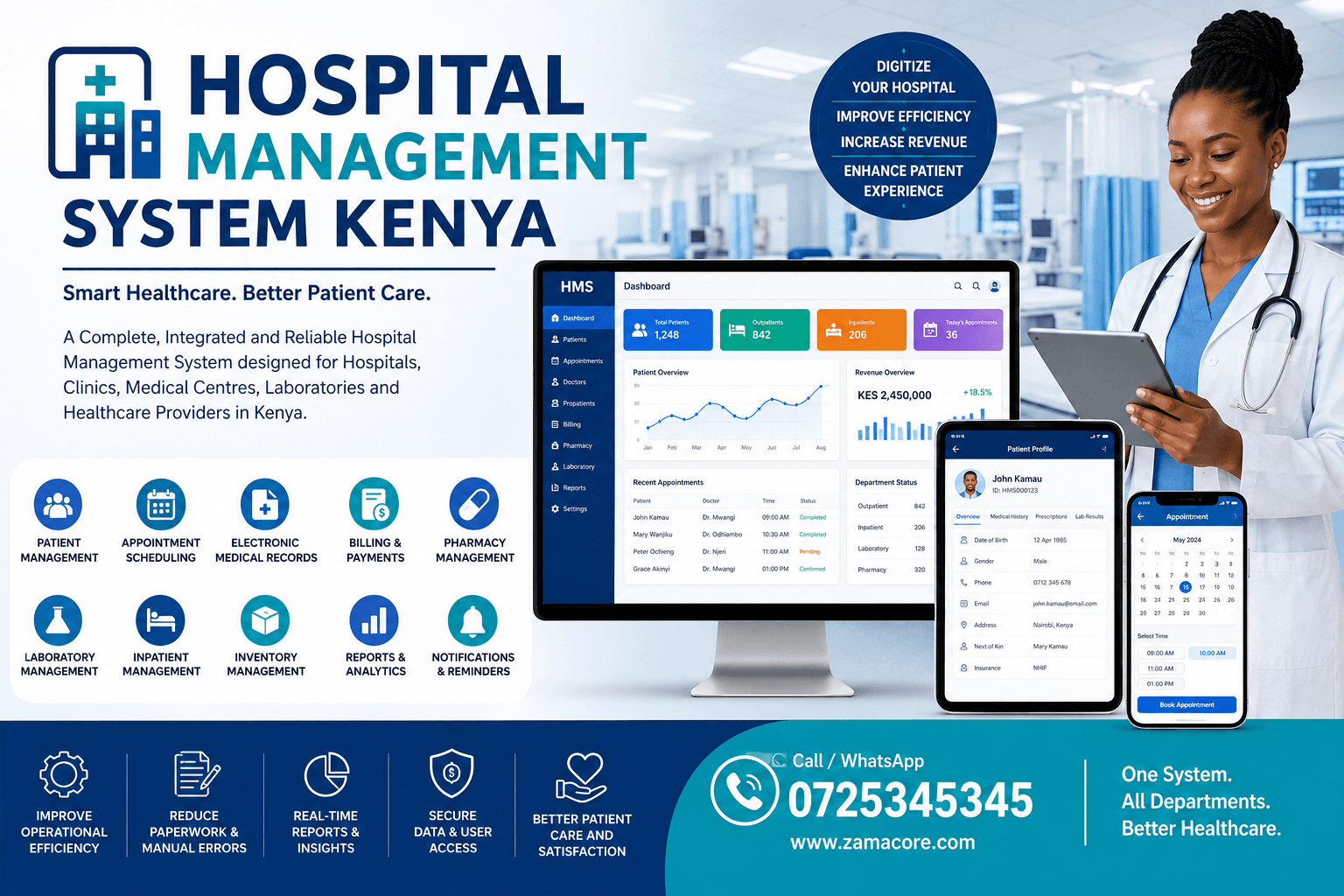
A modern Hospital Management System Kenya enables hospitals, clinics, medical centres, dispensaries, diagnostic laboratories, and specialty healthcare providers to automate daily operations while delivering exceptional patient experiences.

Whether you operate a private hospital, county hospital, maternity hospital, specialist clinic, dental practice, or outpatient medical centre, implementing a reliable Hospital Management System helps reduce paperwork, eliminate errors, improve productivity, and provide better healthcare outcomes.


Table of Contents

Table of Contents

  • What is a Hospital Management System?
  • Why Hospitals in Kenya Need Digital Healthcare Solutions
  • Key Features of Hospital Management Software
  • Modules of a Complete Hospital Management System
  • Benefits of Hospital Management Software
  • Hospital Departments Supported
  • Cloud vs On-Premise Hospital Systems
  • Patient Journey Using HMS
  • Security and Compliance
  • Why Choose Our Hospital Management System
  • Frequently Asked Questions
  • Get Started Today

What is a Hospital Management System?

A Hospital Management System Kenya is a centralized software platform designed to manage all administrative, financial, and clinical activities within a healthcare facility.

Instead of relying on paper records or disconnected software, an integrated Hospital Management System connects every department into a single platform, ensuring accurate information sharing and improved operational efficiency.

A comprehensive Hospital Management System can manage:

  • Patient registration
  • Electronic Medical Records (EMR)
  • Appointment scheduling
  • Consultation notes
  • Laboratory services
  • Radiology
  • Pharmacy
  • Billing
  • Insurance claims
  • Inpatient management
  • Theatre management
  • Inventory
  • Financial reports
  • Human resources
  • Payroll
  • Asset management

By centralizing these operations, hospitals can provide faster, safer, and more reliable healthcare services.


Why Hospitals in Kenya Need Hospital Management Software

Healthcare providers face increasing pressure to improve efficiency while maintaining high standards of patient care.

Common challenges include:

  • Lost patient files
  • Long waiting times
  • Manual billing errors
  • Poor appointment coordination
  • Medicine stock shortages
  • Insurance claim delays
  • Limited reporting
  • Duplicate patient records
  • Difficult financial reconciliation
  • Poor communication between departments

A Hospital Management System addresses these challenges through automation and real-time data access, helping medical facilities operate more efficiently.


Key Features of a Hospital Management System Kenya

Patient Registration

Quickly register new patients while maintaining a unique medical record number for each individual.

Features include:

  • Patient demographics
  • Medical history
  • Emergency contacts
  • Insurance details
  • National ID integration
  • Photo capture

Electronic Medical Records (EMR)

Digital patient records improve continuity of care by allowing authorized healthcare professionals to access medical histories, diagnoses, prescriptions, allergies, laboratory results, and treatment plans from a secure system.

Benefits include:

  • Reduced paperwork
  • Faster diagnosis
  • Better patient safety
  • Improved collaboration
  • Easy retrieval of records

Appointment Scheduling

Healthcare providers can efficiently manage appointments by:

  • Booking consultations
  • Sending reminders
  • Tracking doctor availability
  • Managing queues
  • Reducing patient waiting time

Doctor Management

Manage doctor schedules, specialties, consultations, availability, and workload while improving coordination across departments.


Pharmacy Management

A built-in pharmacy module helps manage:

  • Medicine inventory
  • Prescription dispensing
  • Expiry dates
  • Batch tracking
  • Supplier management
  • Low-stock alerts
  • Purchase orders

Laboratory Management

Laboratory workflows become faster and more accurate through:

  • Test requests
  • Sample tracking
  • Digital results
  • Report generation
  • Doctor notifications

Billing and Payments

Generate accurate invoices for:

  • Consultations
  • Laboratory services
  • Pharmacy purchases
  • Admissions
  • Procedures
  • Theatre services
  • Radiology

The system can also integrate with popular digital payment methods and insurance workflows where applicable.


Inpatient Management

Manage admitted patients with:

  • Bed allocation
  • Ward transfers
  • Nursing notes
  • Medication administration
  • Daily monitoring
  • Discharge summaries

Inventory Management

Track medical supplies, equipment, and consumables with:

  • Stock levels
  • Purchase requests
  • Supplier management
  • Reorder alerts
  • Expiry monitoring

Financial Reporting

Generate reports such as:

  • Revenue analysis
  • Daily collections
  • Outstanding balances
  • Department performance
  • Profit and loss
  • Cash flow
  • Insurance claims

Benefits of Hospital Management System Kenya

A Hospital Management System delivers measurable improvements across clinical, operational, and financial areas.

Key benefits include:

  • Faster patient registration
  • Reduced paperwork
  • Improved accuracy
  • Better coordination between departments
  • Enhanced patient experience
  • Stronger financial control
  • Real-time reporting
  • Reduced operational costs
  • Secure data storage
  • Scalable growth for healthcare facilities

Departments Supported

A modern Hospital Management System can support:

  • Outpatient Department (OPD)
  • Inpatient Department (IPD)
  • Emergency Unit
  • Pharmacy
  • Laboratory
  • Radiology
  • Theatre
  • Maternity
  • Dental
  • Physiotherapy
  • Dialysis
  • ICU
  • Oncology
  • Cardiology
  • Administration
  • Finance
  • Human Resources

Cloud vs On-Premise Hospital Management Systems

Cloud-based Hospital Management Systems offer:

  • Access from multiple locations
  • Automatic backups
  • Lower infrastructure costs
  • Easier updates
  • Improved scalability
  • Better disaster recovery

On-premise systems may suit organizations with strict internal hosting requirements but typically involve higher hardware and maintenance costs.


Why Choose Our Hospital Management System?

We design healthcare software that is:

  • Secure
  • User-friendly
  • Scalable
  • Cloud-enabled
  • Mobile responsive
  • Customizable
  • Reliable
  • Easy to integrate with existing systems
  • Supported by ongoing technical assistance

Our solutions are tailored for hospitals, clinics, specialist practices, and healthcare providers across Kenya.


Frequently Asked Questions

How much does a Hospital Management System cost in Kenya?

Pricing depends on the number of users, required modules, customization needs, and deployment model.

Can the system manage multiple branches?

Yes. Multi-branch healthcare organizations can manage all facilities from a centralized platform.

Is patient information secure?

Yes. The system uses role-based access, authentication, encryption, and audit trails to help protect patient data.

Can it integrate with laboratory and pharmacy modules?

Yes. The platform supports integrated workflows between clinical, pharmacy, laboratory, billing, and administration modules.

Is training provided?

Yes. User training, implementation support, and ongoing maintenance are typically included as part of the deployment process.


Conclusion

The healthcare sector in Kenya continues to evolve, and digital systems have become essential for delivering efficient, high-quality patient care. A Hospital Management System Kenya helps healthcare providers automate operations, improve collaboration, reduce errors, enhance financial management, and deliver a better patient experience.

Whether you manage a hospital, clinic, medical centre, or specialized healthcare practice, implementing the right Hospital Management System provides a strong foundation for sustainable growth and operational excellence.

Modules of a Complete Hospital Management System Kenya

A modern Hospital Management System Kenya is built with interconnected modules that work together to improve efficiency across every department. Instead of using multiple standalone systems, healthcare providers can manage all hospital operations from a single centralized platform.


Outpatient Management (OPD)

The Outpatient Department is often the busiest section of any healthcare facility. A Hospital Management System simplifies patient flow from registration to consultation and billing.

Features

  • Patient registration
  • Digital patient records
  • Appointment scheduling
  • Queue management
  • Doctor consultation notes
  • Prescription management
  • Laboratory requests
  • Radiology requests
  • Follow-up scheduling
  • Consultation billing

Benefits

  • Reduced waiting time
  • Faster consultations
  • Better patient experience
  • Accurate medical records
  • Improved service delivery

Inpatient Management (IPD)

Managing admitted patients requires coordination between multiple departments. A Hospital Management System provides complete visibility into patient admissions and care.

Features

  • Admission management
  • Ward allocation
  • Bed management
  • Nursing observations
  • Medication administration
  • Doctor rounds
  • Treatment plans
  • Transfer between wards
  • Patient discharge
  • Final billing

Healthcare providers can monitor every stage of inpatient care from admission until discharge.


Electronic Medical Records (EMR)

Electronic Medical Records eliminate paper files and allow healthcare providers to access patient information instantly.

The EMR module stores:

  • Patient demographics
  • Medical history
  • Allergies
  • Previous diagnoses
  • Consultation history
  • Laboratory results
  • Imaging reports
  • Medications
  • Surgical history
  • Vaccination records

Doctors can make informed decisions because all patient information is available in one secure location.


Appointment Management

Patients can schedule appointments without unnecessary paperwork.

The appointment module allows:

  • Online booking
  • Walk-in appointments
  • Doctor schedules
  • Automated reminders
  • Calendar management
  • Appointment rescheduling
  • Follow-up visits
  • Queue optimization

Automated reminders reduce missed appointments and improve patient attendance.


Doctor Management

Healthcare facilities can efficiently manage medical practitioners.

Features include:

  • Doctor profiles
  • Specialization management
  • Consultation schedules
  • Availability calendars
  • Workload reports
  • Patient assignments
  • Consultation history

This ensures better coordination among healthcare teams.


Nurse Management

Nursing staff perform critical daily operations.

The system helps nurses manage:

  • Patient observations
  • Medication administration
  • Vital signs
  • Treatment notes
  • Ward rounds
  • Shift handovers
  • Nursing reports

This improves patient monitoring and continuity of care.


Laboratory Management System

Laboratory operations become faster and more accurate with automation.

The laboratory module supports:

  • Test requests
  • Sample collection
  • Barcode generation
  • Sample tracking
  • Test processing
  • Digital laboratory reports
  • Result approval
  • Doctor notifications

Benefits include:

  • Reduced paperwork
  • Faster turnaround time
  • Improved accuracy
  • Easy result retrieval

Radiology Management

Radiology departments can manage imaging services efficiently.

Supported services include:

  • X-Ray
  • CT Scan
  • MRI
  • Ultrasound
  • Mammography
  • ECG
  • Echocardiography

The system allows:

  • Digital imaging requests
  • Radiologist reporting
  • Image storage
  • Report sharing
  • Patient history integration

Pharmacy Management System

Managing hospital pharmacies manually often leads to stock shortages and medication errors.

The pharmacy module includes:

  • Medicine inventory
  • Prescription management
  • Batch tracking
  • Expiry monitoring
  • Supplier management
  • Purchase orders
  • Stock transfers
  • Dispensing records
  • Sales reports

Automated stock alerts help prevent medicine shortages.


Hospital Billing System

One of the most important modules is hospital billing.

The billing system supports:

  • Consultation charges
  • Laboratory billing
  • Pharmacy billing
  • Radiology billing
  • Admission charges
  • Theatre charges
  • Bed charges
  • Insurance billing
  • Payment receipts
  • Credit management

The system generates accurate invoices instantly, reducing billing errors and improving revenue collection.


Insurance Management

Many healthcare facilities serve insured patients.

The insurance module manages:

  • Insurance companies
  • Corporate accounts
  • NHIF/SHIF workflows
  • Insurance approvals
  • Claims tracking
  • Outstanding claims
  • Reconciliation
  • Payment reports

This reduces claim processing time while improving financial management.


Theatre Management

Hospitals performing surgeries require complete theatre coordination.

Features include:

  • Surgery scheduling
  • Theatre booking
  • Surgeon allocation
  • Procedure tracking
  • Surgical notes
  • Operation reports
  • Theatre billing
  • Equipment tracking

Theatre management ensures smooth surgical operations.


Emergency Department Management

Emergency departments require immediate patient attention.

The system supports:

  • Emergency registration
  • Triage
  • Priority classification
  • Emergency treatment notes
  • Admission decisions
  • Emergency billing
  • Ambulance coordination

Healthcare workers can respond quickly during emergencies.


Maternity Management

Hospitals offering maternity services can manage:

  • Antenatal clinics
  • Delivery records
  • Labour monitoring
  • Baby records
  • Postnatal care
  • Vaccination schedules
  • Maternal history

This improves maternal and child healthcare.


Dental Clinic Management

Dental clinics can automate:

  • Patient appointments
  • Dental charting
  • Treatment planning
  • Procedure billing
  • X-Ray records
  • Prescription management
  • Follow-up scheduling

Vaccination Management

Healthcare providers can monitor vaccination programs.

The system tracks:

  • Vaccine inventory
  • Patient vaccination history
  • Due dates
  • Automated reminders
  • Immunization certificates

This helps improve vaccination compliance.


Inventory Management

Hospitals consume thousands of medical supplies every month.

The inventory module tracks:

  • Medical equipment
  • Surgical supplies
  • Office supplies
  • Medicines
  • Laboratory consumables
  • Cleaning materials
  • Protective equipment

Inventory automation reduces waste while preventing stock shortages.


Procurement Management

Healthcare facilities regularly purchase medicines and medical equipment.

The procurement module manages:

  • Supplier database
  • Purchase requests
  • Purchase approvals
  • Quotations
  • Purchase orders
  • Goods received notes
  • Supplier invoices
  • Vendor performance

This creates a transparent procurement process and improves accountability.


Asset Management

Hospitals invest heavily in medical equipment.

The asset management module tracks:

  • MRI machines
  • CT scanners
  • X-Ray machines
  • Ultrasound equipment
  • Hospital beds
  • Ambulances
  • Computers
  • Generators

Healthcare facilities can monitor maintenance schedules, depreciation, servicing, and asset locations from one platform.


Human Resource Management

Hospital staff management becomes easier through an integrated HR module.

Features include:

  • Employee records
  • Attendance tracking
  • Leave management
  • Payroll integration
  • Performance reviews
  • Staff scheduling
  • Training records
  • Contract management

This reduces administrative work and improves workforce management.


Payroll Management

Healthcare organizations can automate payroll processing by calculating salaries, overtime, statutory deductions, allowances, and benefits while generating payslips and payroll reports.


Reporting and Analytics

One of the biggest advantages of a Hospital Management System Kenya is access to real-time data.

Administrators can generate reports for:

  • Daily patient visits
  • Department performance
  • Revenue trends
  • Outstanding payments
  • Medicine consumption
  • Laboratory statistics
  • Pharmacy sales
  • Staff productivity
  • Financial performance
  • Bed occupancy
  • Appointment trends
  • Insurance claims
  • Patient demographics

Interactive dashboards help management make informed decisions based on accurate, up-to-date information.


Why Healthcare Facilities Across Kenya Are Adopting Hospital Management Systems

Hospitals, clinics, and medical centres are increasingly investing in digital healthcare solutions because they deliver measurable improvements in efficiency, patient satisfaction, and financial performance. A comprehensive Hospital Management System Kenya enables healthcare providers to reduce paperwork, streamline clinical workflows, strengthen collaboration across departments, improve billing accuracy, and access reliable reports in real time. As the demand for quality healthcare continues to grow, implementing an integrated Hospital Management System has become a strategic investment for healthcare organizations seeking sustainable growth, regulatory compliance, and improved patient outcomes.

Hospital Management System Workflow

A fully integrated Hospital Management System Kenya connects every hospital department, ensuring patient information flows seamlessly from registration to discharge. This minimizes duplicate data entry, reduces delays, and improves the quality of care.

Step 1: Patient Registration

Every patient is assigned a unique hospital number and their profile is created with details such as:

  • Full name
  • National ID or Passport
  • Date of birth
  • Gender
  • Contact information
  • Next of kin
  • Insurance provider
  • Medical history
  • Allergies

Returning patients can be identified instantly using their patient number, phone number, or ID.


Step 2: Appointment Booking

Patients can schedule appointments through:

  • Reception
  • Online patient portal
  • Mobile application
  • Telephone booking

The system automatically assigns appointments based on the doctor’s availability, reducing scheduling conflicts.


Step 3: Patient Consultation

Doctors access the patient’s complete medical history before beginning treatment.

They can record:

  • Symptoms
  • Diagnosis
  • Vital signs
  • Treatment plan
  • Prescriptions
  • Laboratory requests
  • Radiology requests
  • Follow-up dates

Everything is stored electronically, eliminating paper files.


Step 4: Laboratory Investigation

When laboratory tests are required:

  • The doctor submits a digital request.
  • The laboratory receives it instantly.
  • Samples are collected and tracked.
  • Technologists enter the results.
  • Doctors receive notifications once reports are complete.

Patients no longer need to carry laboratory request forms manually.


Step 5: Pharmacy Dispensing

Approved prescriptions are sent directly to the pharmacy.

The pharmacist can:

  • Verify prescriptions
  • Dispense medicines
  • Check medicine availability
  • Monitor stock levels
  • Record issued medications
  • Update inventory automatically

This minimizes medication errors and keeps inventory accurate.


Step 6: Billing and Payment

Every service provided is automatically added to the patient’s bill.

Charges may include:

  • Consultation fees
  • Laboratory tests
  • Pharmacy purchases
  • Radiology services
  • Admission charges
  • Theatre procedures
  • Ward accommodation
  • Medical consumables

Patients receive a clear, itemized invoice, and payments are recorded instantly.


Step 7: Patient Discharge

For admitted patients, the discharge process includes:

  • Final doctor review
  • Discharge summary
  • Medication instructions
  • Follow-up appointments
  • Final billing
  • Insurance claim preparation

The complete patient history remains securely stored for future visits.


Cloud-Based Hospital Management System Kenya

Cloud technology has transformed how hospitals manage their operations.

Instead of maintaining expensive on-site servers, healthcare facilities can securely access their Hospital Management System through the internet.

Benefits of Cloud Deployment

  • Access from multiple hospital branches
  • Automatic software updates
  • Daily backups
  • Reduced IT costs
  • Better disaster recovery
  • Remote access for authorized users
  • Improved collaboration between departments
  • Easy scalability as the hospital grows

This makes cloud-based Hospital Management Systems an excellent choice for both small clinics and large healthcare networks.


Security Features

Protecting patient information is one of the most important responsibilities of any healthcare institution.

A secure Hospital Management System Kenya includes:

Role-Based Access Control

Doctors, nurses, pharmacists, accountants, laboratory staff, and administrators only access information relevant to their responsibilities.


User Authentication

Users log in using secure credentials, with optional multi-factor authentication for added protection.


Audit Trails

Every activity performed within the system is logged, including:

  • Record creation
  • Record updates
  • Prescription changes
  • Billing adjustments
  • Login history

This supports accountability and troubleshooting.


Data Encryption

Sensitive patient information is encrypted both during transmission and while stored, reducing the risk of unauthorized access.


Automated Backups

Regular backups help protect hospital data against hardware failures, accidental deletion, or other unexpected events.


Mobile Access

Healthcare professionals often need access to information while moving between wards, departments, or satellite clinics.

Mobile-enabled Hospital Management Systems allow authorized users to:

  • View patient records
  • Check appointments
  • Review laboratory results
  • Monitor admissions
  • Approve requests
  • Access reports

This improves responsiveness and supports better patient care.


Multi-Branch Hospital Management

Healthcare organizations operating multiple facilities can manage them from a single platform.

Features include:

  • Centralized administration
  • Branch-specific reports
  • Shared patient records (where appropriate)
  • Consolidated financial reporting
  • Unified inventory management
  • Staff management across branches

This helps organizations maintain consistent standards while simplifying oversight.


Patient Portal

A patient portal empowers individuals to manage aspects of their healthcare online.

Patients can:

  • Book appointments
  • View medical history
  • Access laboratory reports
  • Download prescriptions
  • Review invoices
  • Receive appointment reminders
  • Update personal information

Providing self-service options enhances convenience and reduces administrative workload.


Doctor Portal

Doctors benefit from a dedicated portal where they can:

  • Review daily schedules
  • Access patient records
  • Enter consultation notes
  • Prescribe medications
  • Request laboratory tests
  • View investigation results
  • Manage follow-up appointments

This streamlines clinical workflows and supports informed decision-making.


Management Dashboard

Hospital executives require real-time insights into operations.

A comprehensive dashboard provides key metrics such as:

  • Number of patients seen today
  • Current admissions
  • Bed occupancy rates
  • Daily revenue
  • Outstanding payments
  • Pharmacy sales
  • Laboratory workload
  • Appointment statistics
  • Staff attendance
  • Inventory levels

These insights help management make timely operational and strategic decisions.


Who Can Use a Hospital Management System Kenya?

Hospital Management Software is suitable for a wide range of healthcare providers, including:

  • National referral hospitals
  • County hospitals
  • Private hospitals
  • Mission hospitals
  • Medical centres
  • Outpatient clinics
  • Specialist clinics
  • Dental practices
  • Eye clinics
  • Physiotherapy centres
  • Maternity hospitals
  • Diagnostic laboratories
  • Dialysis centres
  • Oncology centres
  • Rehabilitation facilities

Regardless of the size of the organization, a well-designed Hospital Management System can be configured to meet its specific operational needs.


Future Trends in Hospital Management Systems

Healthcare technology continues to evolve, and modern Hospital Management Systems are incorporating advanced capabilities such as:

  • Artificial intelligence for clinical decision support
  • Predictive analytics for resource planning
  • Telemedicine integration
  • Electronic prescription services
  • Wearable device integration
  • Digital patient engagement tools
  • Automated appointment reminders
  • Business intelligence dashboards
  • Cloud-native infrastructure
  • Mobile-first healthcare applications

Hospitals that adopt these technologies are better positioned to improve patient outcomes, increase operational efficiency, and remain competitive in an increasingly digital healthcare environment.


Why Choose Our Hospital Management System Kenya?

Our Hospital Management System is designed specifically to meet the needs of healthcare providers in Kenya. It offers a scalable, secure, and user-friendly platform that supports hospitals, clinics, laboratories, pharmacies, and multi-branch healthcare organizations.

By automating administrative and clinical processes, improving communication between departments, and providing real-time reporting, our solution helps healthcare facilities deliver efficient, patient-centered care while strengthening financial and operational performance.