
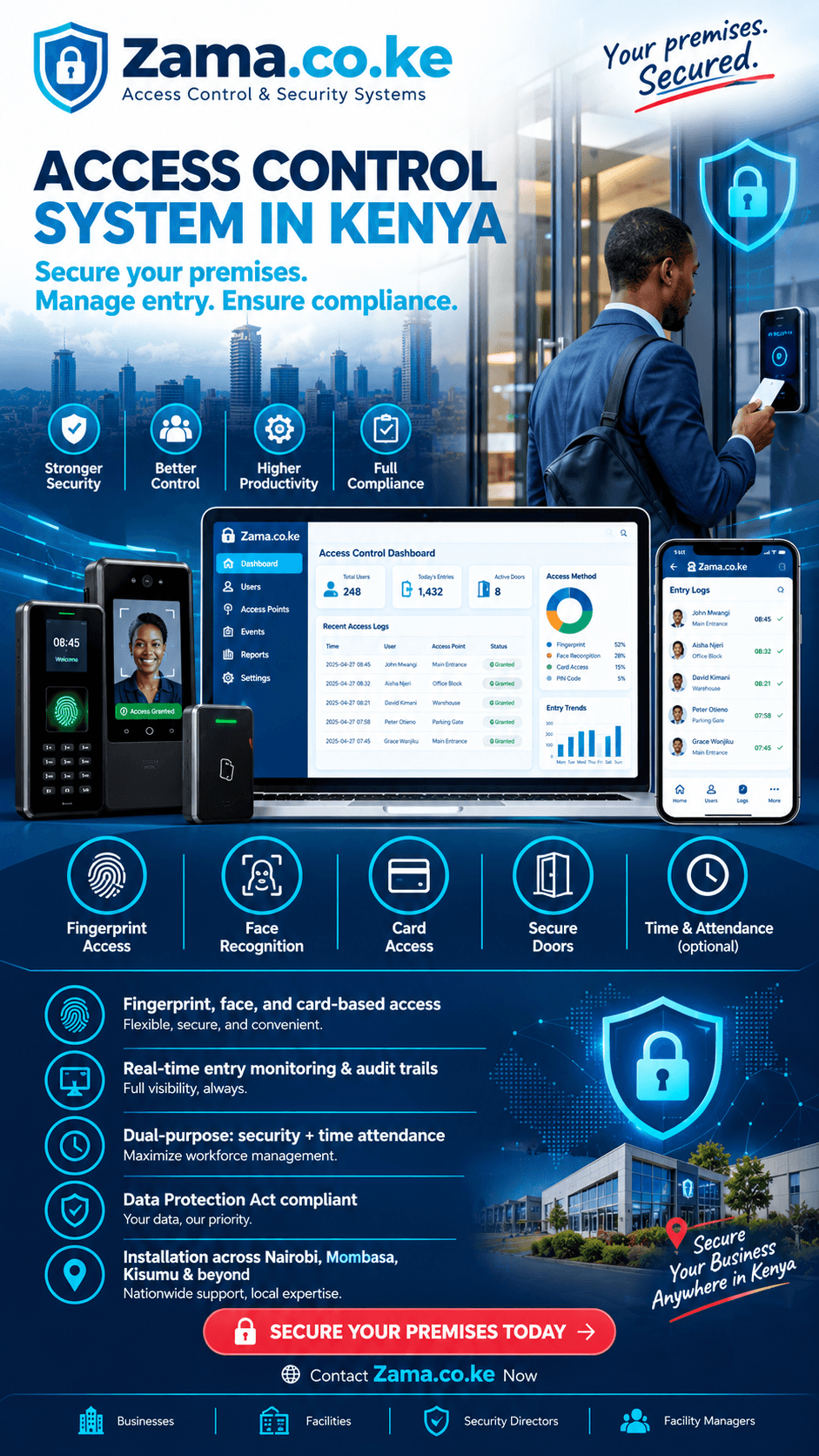
Access control system in Kenya is a question that every business owner, facility manager, and security director must answer in 2026. With Kenya’s growing awareness about security threats and the need for advanced access control solutions across corporate offices, manufacturing plants, schools, and residential estates, the demand for modern security infrastructure has never been higher. At zama.co.ke, we’ve helped numerous businesses across Kenya implement access control solutions that protect assets, manage entry points, and ensure compliance with local regulations. This comprehensive guide explores access control system in Kenya, from understanding different system types to selecting the right solution for your facility.
The Shift from Traditional Keys to Modern Access Control
Before diving into access control system in Kenya, it’s essential to understand why businesses are moving away from traditional security methods. Keys get lost, copied, and never returned by former staff. A door access control system replaces keys with cards, PINs, or fingerprints—so you control exactly who enters which door, and when.
If a card is lost or an employee leaves, you simply deactivate them in seconds instead of changing locks. Access control also gives you a record of every entry: who opened the server room, what time the office was unlocked, and who accessed restricted areas. For offices, banks, clinics, schools, manufacturing plants, and warehouses across Kenya, an access control system in Kenya is now a standard security expectation.
The cost of traditional security is significant. Lost or stolen keys require rekeying locks at KSh 5,000-15,000 per door, and you’ll likely need to do this multiple times as employees come and go. Access cards at KSh 500-1,000 per card, plus replacement costs when employees lose them, add up quickly. According to Kenyan insurance reports, businesses without proper access control face 3x higher theft claims. This is where an access control system in Kenya becomes a smart investment rather than an expensive luxury.
Types of Access Control Systems Available in Kenya
When evaluating access control system in Kenya, several technology options are available:
1. Fingerprint (Biometric) Access Control
Fingerprint readers are the most widely installed biometric access control technology in Kenya. They are affordable, fast, and reliable. Each authorised user’s fingerprint is enrolled in the system. When they place their finger on the reader, the system verifies it against stored templates and opens the door in under a second. This makes an access control system in Kenya with fingerprint technology ideal for offices, schools, hospitals, warehouses, and server rooms.
Prices in Kenya for fingerprint access control range from KSh 8,000–18,000 for standalone fingerprint door locks to KSh 15,000–30,000 for networked fingerprint terminals. Multi-door fingerprint controllers range from KSh 25,000–55,000.
2. Face Recognition Access Control
Face recognition terminals have become significantly more affordable in recent years and are now a popular choice for offices and residential estates in Nairobi. The system captures a 3D or 2D image of the user’s face during enrolment. Entry is granted when the terminal recognises the face—no physical contact required.
This access control system in Kenya is best for high-traffic entry points, reception areas, environments where hygiene is important (hospitals, food facilities), and facilities where users may have dirty or wet hands (factories, workshops). At GITEX Kenya 2026, ZKTeco demonstrated advanced facial recognition and contactless visitor management systems designed to streamline security for corporate offices, campuses, and industrial sites.
Prices range from KSh 20,000–35,000 for basic face recognition terminals to KSh 40,000–80,000 for AI-powered face recognition terminals.
3. Card / Fob Access Control (RFID)
Card-based systems use proximity cards or key fobs that communicate with the reader wirelessly. They do not capture biometric data, making them simpler to set up and acceptable in environments where staff may object to biometric enrolment. Each user is issued a programmed card or fob. Cards can be cancelled instantly if lost or stolen—unlike keys.
This access control system in Kenya is best for apartment blocks, hotels, co-working spaces, and any property with high staff turnover. RFID access control readers cost KSh 5,000–12,000, with proximity cards at KSh 200–500 per card and key fobs at KSh 300–600 per fob.
4. Multi-Factor Access Control
For high-security areas—such as data centres, vaults, pharmacies, or executive offices—you can combine two or more verification methods. For example, a user might need a fingerprint plus a PIN, or a card plus facial recognition. This represents the highest level of access control system in Kenya security.
5. Turnstiles and Barriers
For building lobbies, factories, and high-traffic entrances, turnstiles and barrier systems offer controlled access. Turnstile and barrier systems with access readers range from KSh 150,000–450,000.
Core Components of an Access Control System
An access control system in Kenya consists of several key components that work together:
Reader / Controller: The card, keypad, or fingerprint unit at the door that captures the user’s credential.
Electric Lock: Usually a magnetic lock (maglock) or electric strike that holds the door shut.
Exit Button: To allow staff to leave from inside.
Power Supply & Backup: Keeps the lock working, with a battery so doors are not stuck during blackouts. This is particularly important for an access control system in Kenya given the power fluctuations experienced in many areas.
Software / Management: To add users, set schedules, and view entry logs.
Modern access control solutions in Kenya include the ZKTeco F18 Fingerprint Reader, which is one of Kenya’s most popular biometric access control devices. The ZK Inbio 460 4-Door Fingerprint Card Access Control System stores up to 3,000 fingerprint templates, 30,000 card users, and up to 100,000 events/transactions.
Access Control Prices in Kenya — 2026
When budgeting for an access control system in Kenya, consider these price ranges:
| System Type | Price Range (KES) |
|---|---|
| Single door — RFID/keypad + maglock + installation | 25,000 – 45,000 |
| Single door — fingerprint + card + maglock | 45,000 – 75,000 |
| Multi-door networked system (per door) | 40,000 – 90,000 |
| Turnstile / barrier with access reader | 150,000 – 450,000 |
A standard single-door installation typically starts around KSh 65,000 for a biometric setup including controller, maglock, exit button, power supply, and cabling. Costs scale with the number of doors and whether the system is networked to central software.
Factors That Affect the Cost
Number of doors: Each controlled door adds hardware and cabling.
Authentication method: Keypad is cheapest; fingerprint and combination readers cost more.
Lock type: Heavy glass or metal doors need stronger maglocks.
Integration: Linking to time-attendance, CCTV, or visitor management adds value and cost.
Software & reporting: Networked, log-keeping systems cost more than standalone door units.
Data Protection and Compliance for Access Control Systems
If your access control system in Kenya stores fingerprints or face data, Kenya’s Data Protection Act (2019) applies. You must inform and obtain consent from staff, store the data securely, and not share it without consent.
Reputable systems (ZKTeco, Suprema) store encrypted templates rather than raw images, which supports compliance. The Data Protection Act requires data controllers to implement appropriate technical and organisational measures to safeguard personal data against unauthorised access, loss or misuse.
Additionally, the Act requires that access permissions be reviewed regularly to reflect changes in user roles and responsibilities. Superuser or administrator access must be restricted to a limited number of authorised personnel and subject to controls.
When selecting an access control system in Kenya, ensure your provider can advise on best practices for data protection compliance during setup.
Benefits of Access Control Systems for Kenyan Businesses
1. Eliminate Credential Sharing
With traditional keys or cards, nothing stops employees from sharing access with unauthorised persons. A fingerprint or face? That’s impossible to share. This single feature alone prevents countless security breaches.
2. Real-Time Monitoring and Reports
Modern access control system in Kenya solutions provide detailed logs showing exactly who entered which door and when. This audit trail is invaluable for investigating security incidents, managing employee attendance, demonstrating compliance with insurance requirements, and understanding traffic patterns.
3. Dual-Purpose: Access Control + Time Attendance
Why buy two systems when one does both? An access control system in Kenya can manage both access control and time attendance, eliminating buddy punching (when employees clock in for absent colleagues) and generating accurate payroll data.
4. No More Replacement Costs
Forget about replacing lost cards or rekeying locks. Biometric systems remove these recurring costs almost entirely.
5. Enhanced Professionalism
A modern access control system in Kenya projects professionalism and builds trust with clients, partners, and employees. It signals that you take security seriously.
6. Compliance Protection
With network-based door controllers securing sensitive areas, enforcing permissions, and maintaining detailed audit trails essential for compliance, an access control system in Kenya helps organisations meet regulatory requirements.
Industries Benefiting from Access Control Systems in Kenya
An access control system in Kenya serves diverse sectors:
Office buildings: Control staff access and streamline entry for visitors.
Manufacturing plants: Matrix provided Ellams with an integrated access control solution with card-based entry and exit readers for their manufacturing plant based in Nairobi. The solution included instant alarm notification to take immediate action upon violation of access rules.
Apartment complexes: Secure shared lobbies and pedestrian gates effectively.
Educational institutions: Manage access to labs, administrative areas, and staff zones.
Medical facilities: Safeguard wards, pharmacies, and record rooms.
Commercial sites: Secure cash rooms, storage areas, and other high-security locations.
Government facilities: Deployment of advanced security and access control systems for government facilities across Kenya.
Access Control System Providers in Kenya
The Kenyan market has several providers of access control system in Kenya solutions:
ZKTeco East Africa: A major player in the Kenyan market, ZKTeco offers fingerprint, face recognition, and smart space management solutions. Their systems integrate real-time License Plate Recognition (LPR), automated entry/exit management, and seamless cashless payments.
AUA Industria Ltd: A leading security solutions provider in the Middle East and Africa regions with its headquarters in Nairobi, offering enterprise access control and biometric time and attendance systems.
Matrix: Provides integrated access control solutions for manufacturing plants and other facilities.
Boardtac Solutions: Delivers proven, professionally installed biometric access systems across Nairobi, Mombasa, Kisumu, Eldoret, and other key regions in Kenya.
Dayari Technologies: Specialises in biometric access control solutions, time attendance solutions, and automatic gates.
The Zama.co.ke Approach
When considering an access control system in Kenya, zama.co.ke follows a structured approach:
Security Assessment
We evaluate your facility’s security needs: which areas need controlled access, what level of security is required, how many users need access, and what integration with other systems is needed.
System Design
We design an access control solution tailored to your specific requirements—whether it’s a single-door biometric system or a multi-building networked solution.
Installation and Configuration
We handle all aspects of installation, including electrical wiring, network connectivity, door hardware integration, and software configuration.
Data Protection Compliance
We advise on best practices for Data Protection Act compliance, including staff consent, encrypted data storage, and access permission management.
Post-Installation Support
We remain available for maintenance, troubleshooting, and system upgrades as your security needs evolve.
Access control system in Kenya is essential for any business, institution, or residential property seeking to secure premises, manage entry points, and ensure compliance with data protection regulations. From fingerprint and face recognition to card-based systems and multi-factor authentication, the right access control system in Kenya transforms how you manage security.
At zama.co.ke, we’ve helped businesses across Kenya implement access control solutions that protect assets, streamline operations, and provide peace of mind. Our approach ensures you get exactly what your facility needs—nothing more, nothing less.
Don’t let the complexity of access control system in Kenya hold you back. Whether you’re securing a small office or a large manufacturing plant, we have the expertise to guide you through every step.
Contact zama.co.ke today and let us help you build an access control system that transforms your security operations.