
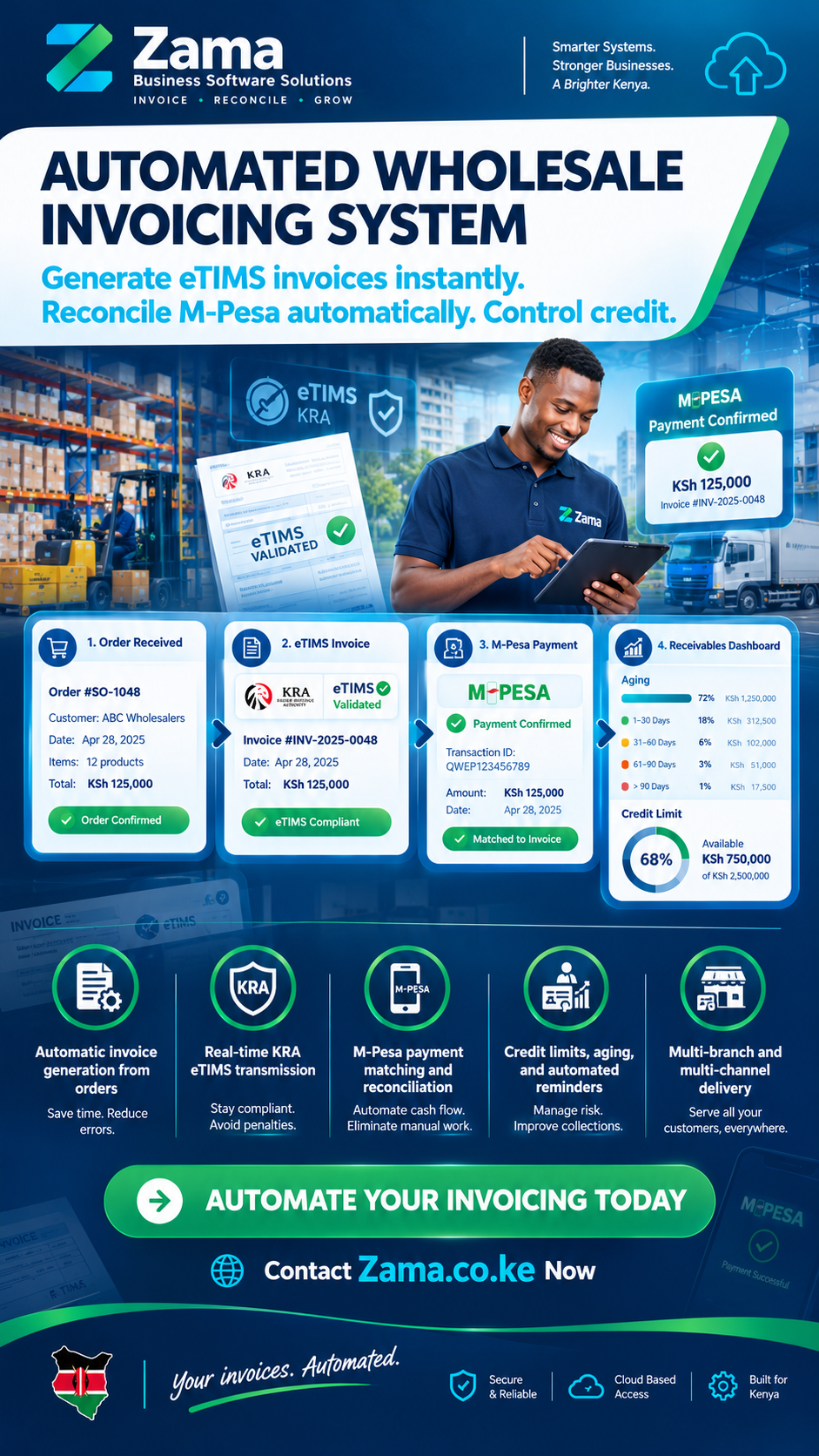
Automated wholesale invoicing system is a question that every wholesaler, distributor, and FMCG supplier in Kenya must answer in 2026. With KRA eTIMS compliance now mandatory for every VAT-registered business, M-Pesa processing over 2 trillion shillings in annual transactions, and wholesale trade running on credit terms that demand precise documentation, the gap between manual invoicing and digital invoicing has become a profitability issue rather than a convenience one. At zama.co.ke, we’ve helped numerous wholesalers across Kenya implement automated invoicing systems that generate compliant tax invoices instantly, reconcile M-Pesa payments automatically, and give finance teams complete control over receivables. This comprehensive guide explores the automated wholesale invoicing system, from understanding what automation delivers to selecting the right approach for your business.
What an Automated Wholesale Invoicing System Actually Delivers
Before diving into the automated wholesale invoicing system, it’s essential to understand what this technology actually does. An automated wholesale invoicing system is a digital platform that generates invoices from sales orders without manual data entry, applies the correct pricing and tax rules, transmits each invoice to KRA through eTIMS in real time, delivers the invoice to the buyer, tracks payment status, and reconciles incoming payments against outstanding invoices.
A proper automated wholesale invoicing system does far more than produce a PDF. It pulls order data from the sales system, calculates line items with tiered pricing and volume discounts, applies VAT at the correct rate, generates a KRA-compliant electronic tax invoice, transmits it to eTIMS, stores it with a validation receipt, sends it to the buyer by email, WhatsApp, or portal, monitors payment status, and escalates overdue invoices automatically.
For a Kenyan wholesaler, the practical definition of an automated wholesale invoicing system is this: the platform that turns every confirmed order into a compliant, delivered, tracked invoice within seconds—without a clerk typing anything—and then follows that invoice through to payment and reconciliation.
Why Kenyan Wholesalers Need Automated Invoicing
When evaluating an automated wholesale invoicing system, consider the compelling reasons for adoption:
The KRA eTIMS Mandate
Since January 2024, every VAT-registered business in Kenya must transmit invoices to KRA through eTIMS. Manual invoicing cannot keep pace. A wholesaler processing 300 orders a day cannot have clerks typing each invoice into a KRA portal. The volume alone makes manual compliance impossible, and the penalties for non-compliance are severe—double the tax due, or a minimum penalty in the region of KSh 100,000 per offence.
An automated wholesale invoicing system generates and transmits eTIMS-compliant invoices at the speed of order confirmation. Every sale is compliant the moment it happens. No backlog, no penalties, no scramble before filing deadlines.
The Volume Problem in Wholesale
Wholesale is a volume business. A single distributor may serve 800 retail customers and process thousands of order lines weekly. Manual invoicing at this scale produces errors, delays, and disputes. An invoice generated manually may have the wrong price tier, a missed discount, a miscalculated line total, or the wrong VAT treatment.
A modern automated wholesale invoicing system eliminates these errors. Pricing is pulled from the product master. Discounts are applied by rule. Line totals are calculated. VAT is applied correctly. The invoice is right the first time.
M-Pesa Reconciliation
Most Kenyan wholesalers collect payments via M-Pesa. Payments arrive with transaction codes, partial amounts, and inconsistent references. Finance teams spend hours matching M-Pesa statements against invoices. The result is delayed reconciliation, aged receivables that are actually settled, and disputes with customers who insist they have paid.
A proper automated wholesale invoicing system reconciles M-Pesa payments against invoices automatically. It matches by account reference, phone number, and amount. It flags partial payments and applies them correctly. It surfaces genuinely unmatched payments for review, rather than forcing staff to review everything.
Credit Terms and Receivables Control
Wholesale trade in Kenya runs on credit. Retailers buy on terms and pay later. Managing this requires precise tracking of what is owed, by whom, for how long, and against what credit limit. Manual systems cannot keep up. Statements go out late. Overdue accounts are discovered only when a customer tries to order again.
An automated automated wholesale invoicing system tracks every invoice from issue to payment. It ages receivables automatically. It calculates credit exposure per customer in real time. It blocks orders when a customer exceeds their limit or has overdue balances. It sends statements and reminders without human intervention.
The Cost of Manual Invoicing
Manual invoicing carries hidden costs. Clerks spend hours typing invoices. Errors require credit notes and rework. Buyers dispute charges and delay payment. Compliance lapses trigger penalties. Management cannot see the true state of receivables because the data is spread across spreadsheets.
A quality automated wholesale invoicing system eliminates these costs. Invoices generate themselves. Errors approach zero. Disputes fall because the invoice matches the order. Receivables become visible in real time.
Buyer Expectations
Kenyan retailers expect digital invoices. A duka owner who receives M-Pesa confirmations instantly expects an invoice the same way. A supermarket buyer expects to download invoices from a portal rather than waiting for an email attachment. A pharmacy expects batch-level documentation with each invoice.
A comprehensive automated wholesale invoicing system delivers invoices the way buyers want them—instantly, by their preferred channel, in a format they can file and search.
Key Features of an Automated Wholesale Invoicing System
When evaluating an automated wholesale invoicing system, focus on these core features:
1. Automatic Invoice Generation from Orders
The core function is converting orders to invoices automatically. A proper system pulls order data from the sales system, applies pricing, applies discounts, calculates totals and VAT, and generates the invoice without manual intervention. It handles credit orders, cash orders, and partial deliveries.
2. KRA eTIMS Integration
Every invoice must be transmitted to KRA. A comprehensive automated wholesale invoicing system integrates with eTIMS—through OSCU for always-online environments or VSCU for intermittent connectivity—transmits invoices in real time, stores the validation receipt, and makes it retrievable for audit.
3. Tiered Pricing and Discount Rules
Wholesale pricing is complex. A quality automated wholesale invoicing system applies customer-specific price lists, volume discounts, promotional pricing, and contract terms automatically. It ensures the buyer is invoiced at the correct price for their tier, without a clerk needing to check a spreadsheet.
4. M-Pesa and Bank Payment Reconciliation
Payment matching is essential. A proper automated wholesale invoicing system receives M-Pesa payment notifications, matches them to invoices by reference and amount, applies them to customer accounts, and updates invoice status automatically. Bank transfers are handled the same way.
5. Credit Control and Aging
Credit management requires visibility. A comprehensive automated wholesale invoicing system maintains customer credit limits, calculates real-time exposure, ages receivables into buckets, generates statements, sends automated reminders, and blocks orders when limits are breached or balances are overdue.
6. Delivery Notes and eTIMS Tax Invoices
Wholesale documentation includes delivery notes and tax invoices. A quality automated wholesale invoicing system generates delivery notes at dispatch and tax invoices at delivery or dispatch as required, ensuring the documentation trail supports both logistics and tax compliance.
7. Multi-Channel Invoice Delivery
Buyers receive invoices through different channels. A proper automated wholesale invoicing system delivers invoices by email, WhatsApp, SMS link, or buyer portal—whichever the buyer prefers—and confirms delivery.
8. Returns and Credit Notes
Wholesale involves returns. A comprehensive automated wholesale invoicing system generates credit notes automatically against the original invoice, transmits them to eTIMS, and adjusts customer balances.
9. Multi-Location and Multi-Branch Support
Distributors operate multiple warehouses and branches. A quality automated wholesale invoicing system generates invoices from any location with the correct location-specific tax details and maintains consolidated receivables reporting.
10. Reporting and Receivables Dashboards
Finance leadership needs visibility. A proper automated wholesale invoicing system provides dashboards showing total invoiced, total collected, outstanding receivables, aging, top debtors, and collection performance.
What Makes an Automated Wholesale Invoicing System Different in Kenya
An automated wholesale invoicing system for the Kenyan market has unique characteristics that global solutions often lack:
eTIMS as a First-Class Requirement
In other markets, tax authority integration is an afterthought. In Kenya, eTIMS is central. A system built for Kenya treats invoice transmission to KRA as a core function, not an add-on.
M-Pesa as the Primary Payment Rail
Kenyan wholesale payments run on M-Pesa. A system built for Kenya integrates Daraja API natively for STK Push, C2B, and reconciliation, rather than treating mobile money as a secondary channel.
Credit Trade Reality
Kenyan wholesale runs on negotiated credit terms. A system built for Kenya supports per-customer terms, credit limits, and relationship-based exceptions rather than forcing standardized net-30 logic.
Intermittent Connectivity
Connectivity outside Nairobi can be unreliable. A system built for Kenya handles offline invoice generation and queues eTIMS transmission until connectivity returns.
Data Protection Act Compliance
Kenyan systems handle personal data. A compliant system implements access controls, audit trails, and retention policies aligned with the Data Protection Act.
Local Support
Kenyan wholesalers need support in their timezone and language. A locally supported system is worth more than a marginally cheaper global one.
Key Factors That Determine Cost
When analysing cost, several factors directly influence pricing:
1. Transaction Volume
Higher invoice volumes require more robust infrastructure and more eTIMS transmissions.
2. Number of Customers and Products
Pricing tiers and customer-specific terms scale with the size of the customer and product base.
3. Integration Scope
Integration with sales, inventory, accounting, M-Pesa, and eTIMS determines complexity.
4. Credit Management Depth
Credit limits, aging, and automated reminders add complexity.
5. Multi-Location Requirements
Multiple branches and warehouses add configuration and reporting complexity.
6. Deployment Model
Cloud, on-premise, or hybrid deployment affects cost and ongoing support.
7. Customization
Custom documents, custom reports, and custom workflows add to the build.
8. Training and Support
Training finance and sales teams, and ongoing support, contribute to total cost.
For a transparent quote based on your business’s specific requirements, contact zama.co.ke today.
Use Cases
FMCG Distributors
FMCG distributors generate hundreds of invoices daily across thousands of SKUs, with M-Pesa collections and credit terms for retail customers.
Pharmaceutical Wholesalers
Pharmaceutical wholesalers require batch-level documentation on invoices, along with eTIMS compliance and credit control for pharmacies.
Building Materials Suppliers
Building materials suppliers invoice contractors across multiple delivery points and projects, requiring accurate delivery notes and project-level reporting.
Agricultural Input Wholesalers
Agricultural input wholesalers handle seasonal volume spikes and credit extended to agro-dealers, requiring flexible invoicing and credit management.
Electronics Distributors
Electronics distributors require serial-number tracking on invoices along with warranty documentation and after-sales reference.
Food and Beverage Wholesalers
Food and beverage wholesalers require invoice generation aligned with delivery routes and temperature-controlled logistics.
The Zama.co.ke Approach to Automated Wholesale Invoicing System Development
When considering an automated wholesale invoicing system, zama.co.ke follows a structured approach:
Requirements Discovery
We map your product catalogue, pricing tiers, customer credit terms, order workflows, payment channels, and eTIMS obligations.
System Design
We design invoice generation logic, eTIMS transmission, payment reconciliation, and credit control.
Development and Integration
We build the system, integrate M-Pesa Daraja API, KRA eTIMS, and your sales and accounting platforms, and configure notification channels.
Testing and Data Migration
We test invoice accuracy, eTIMS transmission, payment matching, and credit control, then migrate customer, product, and historical invoice data.
Training and Support
We train finance and sales teams, and provide documentation for buyers receiving invoices.
Post-Launch Optimization
We monitor invoice throughput, reconciliation rates, and aging, then refine the system.
The ROI
When evaluating an automated wholesale invoicing system, the ROI is compelling:
Eliminated Manual Typing: Finance teams no longer type invoices, freeing hours each day.
Compliance Protection: Every invoice is eTIMS compliant, eliminating penalty risk.
Faster Reconciliation: M-Pesa payments are matched automatically, reducing unapplied cash.
Improved Cash Flow: Automated reminders and statements accelerate collections.
Reduced Disputes: Invoices match orders exactly, reducing queries and credit notes.
Real-Time Receivables Visibility: Management sees the true state of receivables continuously.
Scalable Operations: Invoice volume can grow without adding finance headcount.
Implementation Considerations
Assess Your Current Invoicing Process
Document how invoices are generated today, where errors occur, how payments are reconciled, and how receivables are tracked.
Choose the Right Solution
Match complexity to your volume and credit model. A cash-only wholesaler needs less than a credit distributor.
Plan for Data Migration
Migrate customers, products, price lists, and open receivables carefully.
Train Your Team
Finance, sales, and warehouse staff all interact with invoices and must understand the system.
Ensure Compliance
Build eTIMS and Data Protection Act controls in from day one.
Test Thoroughly
Test invoice accuracy, eTIMS transmission, M-Pesa matching, credit blocks, and credit notes.
Consider a Phased Rollout
Start with one branch or product category before going fully live.
The Cost of Delaying
While wholesalers evaluate an automated wholesale invoicing system, the cost of inaction compounds daily. Every day of manual invoicing is a compliance risk under eTIMS. Every day of manual reconciliation is delayed cash. Every day of invisible receivables is a credit risk.
Why Contact Zama.co.ke
When researching an automated wholesale invoicing system, wholesalers should contact zama.co.ke because:
Wholesale Expertise: We understand tiered pricing, credit terms, and multi-branch distribution.
M-Pesa Expertise: We integrate Daraja API for payment collection and automatic reconciliation.
eTIMS Expertise: We transmit compliant invoices to KRA in real time.
Custom Development: We build systems that match your commercial model.
Transparent Pricing: No hidden fees and full source-code ownership.
Ongoing Support: We stay available as your volumes and product range grow.
For a custom quote based on your business’s specific requirements, contact zama.co.ke today.
An automated wholesale invoicing system is essential for any wholesaler seeking to stay compliant, get paid faster, and scale without adding finance staff. From automatic invoice generation and eTIMS transmission to M-Pesa reconciliation and credit control, the right system changes how your finance function operates.
At zama.co.ke, we’ve helped wholesalers across Kenya implement automated invoicing systems that deliver measurable results. Our approach ensures you get exactly what your business needs—nothing more, nothing less.
Don’t let the complexity of an automated wholesale invoicing system hold you back. Whether you are a small distributor or a large FMCG supplier, we have the expertise to guide you through every step.
Contact zama.co.ke today for a custom quote based on your business’s specific requirements.