
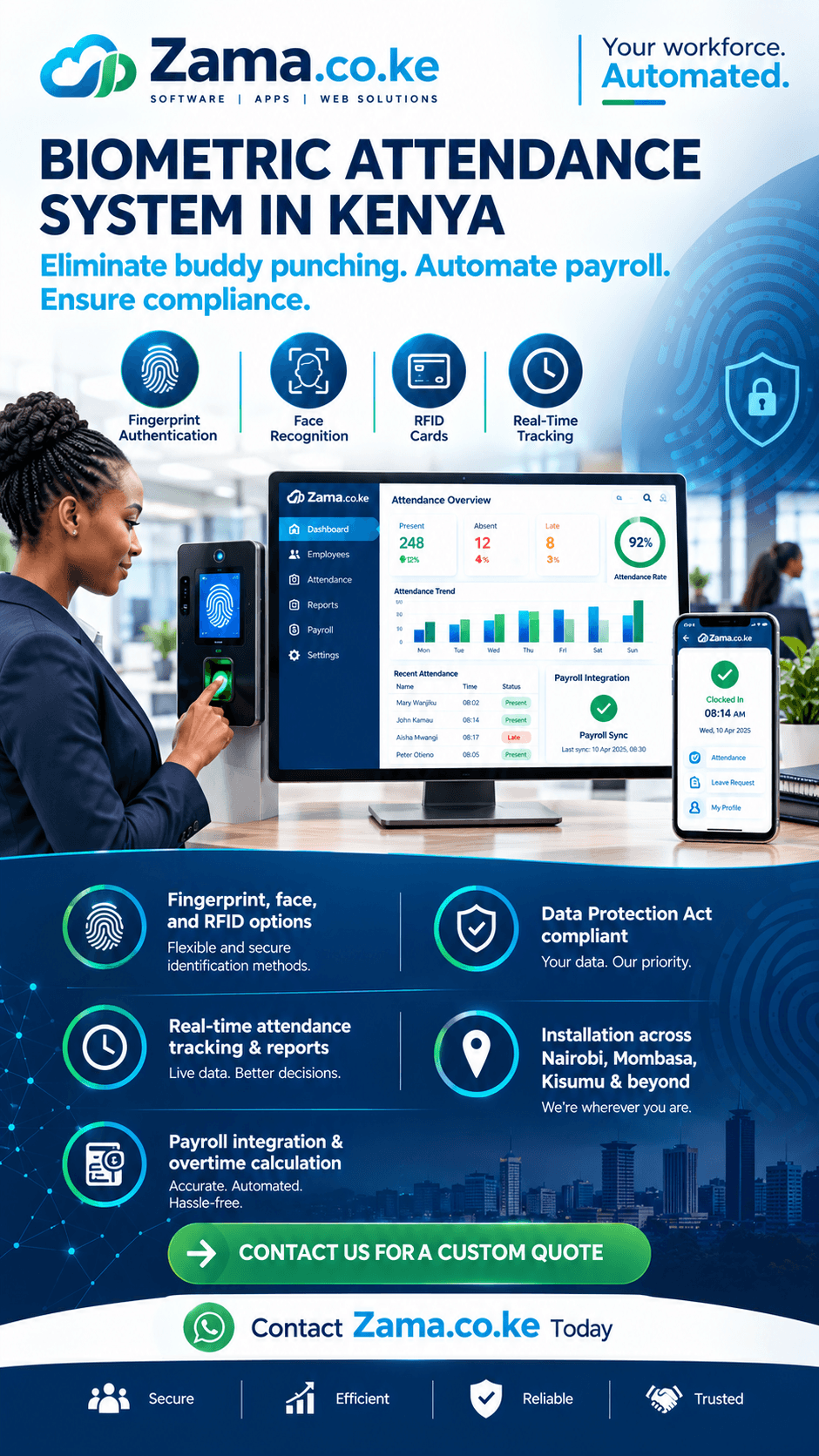
Biometric attendance system in Kenya is a question that every HR manager, business owner, and school administrator must answer in 2026. With Kenyan businesses losing thousands of shillings monthly to buddy punching, payroll errors, and manual attendance tracking, the shift to biometric solutions has become essential for operational efficiency. At zama.co.ke, we’ve helped numerous businesses across Kenya implement biometric attendance systems that eliminate time theft, automate payroll processing, and provide real-time workforce visibility. This comprehensive guide explores biometric attendance system in Kenya, from understanding what it does to selecting the right solution for your organization.
What a Biometric Attendance System Actually Does
Before diving into biometric attendance system in Kenya, it’s essential to understand what this technology actually does. A biometric time and attendance system records exactly when staff arrive and leave using their fingerprint, face, or card—instead of a paper register that can be faked. For businesses, schools, and factories in Kenya, it removes guesswork from payroll and stops one employee clocking in for another.
A proper biometric attendance system in Kenya replaces manual attendance registers, Excel sheets that can be altered, and guesswork during payroll. Instead, you get real-time attendance records, accurate working hours, and clear reports for HR and payroll. Our biometric attendance systems in Kenya use various biometric verification methods such as fingerprint recognition, face recognition, RFID cards, or passwords, ensuring that only the right employee can clock in or out.
For a Kenyan business, the practical definition of biometric attendance system in Kenya is this: the system that tells you exactly when every employee arrived, when they left, how many hours they worked, how much overtime they accrued, and who was absent—all in real time, from a single dashboard accessible on any device.
Why Kenyan Businesses Are Moving to Biometric Attendance Systems
When evaluating biometric attendance system in Kenya, it’s important to understand the problems these systems solve. If any of these sound familiar, you’re not alone:
Employees clocking in for each other (buddy punching)
Disputes over overtime and late reporting
Inaccurate payroll calculations
No visibility when managing multiple branches
HR spending hours compiling attendance reports
A biometric attendance system in Kenya eliminates these issues by automating attendance tracking and giving business owners real control and visibility of their workforce.
The numbers tell a compelling story. Kenyan SMEs lose millions annually to time theft, buddy punching, and payroll errors. One employee clocking in for an absent colleague for just 30 minutes daily adds up to 10 hours monthly—costing a business significantly per month per employee. Multiply that across a workforce of 50, and the losses are staggering. This is where a biometric attendance system in Kenya becomes a smart investment rather than an optional expense.
Types of Biometric Attendance Systems Available in Kenya
When evaluating biometric attendance system in Kenya, several technology options are available:
1. Fingerprint Attendance Systems
Fingerprint-based systems are the most common and affordable biometric attendance solution in Kenya. Employees simply scan their fingerprints to clock in and out, ensuring quick and accurate timekeeping. These systems are reliable, cost-effective, and easy to use.
Popular devices include fingerprint time attendance terminals that support thousands of fingerprints and records, with advanced algorithms for reliability, precision, and excellent matching speed. Tabletop models with built-in Wi-Fi and detachable batteries are ideal for offices with limited space or power interruptions.
2. Face Recognition Attendance Systems
Face recognition terminals have become significantly more affordable and are now a popular choice for Kenyan businesses. They are contactless, great for hygiene and speed, and ideal for environments where hygiene is important.
Popular devices include multi-biometric terminals that support both facial recognition and fingerprint verification with verification under one second. Hybrid terminals combine visible light facial recognition with optical fingerprint scanning, offering intelligent biometric security solutions for secure access management and employee attendance monitoring.
3. RFID Card Attendance Systems
Card-based systems use proximity cards or key fobs that communicate with the reader wirelessly. They are fast to tap in, good for large teams, and do not capture biometric data, making them simpler to set up. Cards can be cancelled instantly if lost or stolen—unlike keys.
4. Multi-Biometric Systems
For the highest accuracy, multi-biometric systems combine multiple verification methods. These terminals support visible light facial recognition, fingerprint, and RFID support, combining time attendance and access control into one intelligent device.
5. Hybrid Systems (Attendance + Access Control)
Many biometric attendance systems in Kenya double as access control systems. Employees can clock in and unlock the door at once. The same terminal can open a door, eliminating the need for separate systems.
Biometric Attendance System Pricing
When budgeting for a biometric attendance system in Kenya, the investment varies based on technology type, user capacity, features, and whether you add networked or cloud software for multiple branches. Installation costs are typically additional. A standard single-device installation with software configuration depends on complexity and site requirements.
For accurate pricing tailored to your specific requirements, contact zama.co.ke today. We provide transparent quotes based on your organization’s size, branch locations, and integration needs.
Software and Reporting
The terminal captures the punches; the software turns them into useful reports. Modern systems let you export timesheets, calculate overtime, and feed hours into payroll.
Web-Based Attendance Software is a powerful platform that supports multi-location employee tracking, biometric device synchronization, and centralized data management. Key features include:
Web-Based Access: Manage time and attendance from any browser
Real-Time Data Sync: Automatically synchronize attendance records from multiple devices and locations
Multi-Device & Multi-Branch Support: Seamless management of all biometric devices in one place
Flexible Shift & Schedule Management: Create and assign unlimited shifts, rosters, and flexible work schedules
Payroll Integration: Generate payroll-ready reports with overtime, late-in, early-out, and absence tracking
Leave & Holiday Management: Track employee leave, holidays, and off days directly
Custom Reports & Dashboards: Visual dashboards, charts, and customizable attendance reports
Cloud options let you see attendance across several branches from one dashboard. This is particularly valuable for Kenyan businesses with operations in Nairobi, Mombasa, Kisumu, Eldoret, and Nakuru.
Standalone vs Networked Systems
When selecting a biometric attendance system in Kenya, consider the deployment model:
Standalone: One terminal, data pulled by USB. Best for a single small office.
Networked (TCP/IP): Terminals report to a central server in real time.
Cloud: View attendance from anywhere; ideal for multi-site businesses.
Compliance: The Data Protection Act and Biometric Attendance
If your biometric attendance system in Kenya stores fingerprints or face data, Kenya’s Data Protection Act (2019) applies. Article 31 of the Kenyan Constitution protects the right to privacy, and the Data Protection Act, 2019, mandates strict safeguards for sensitive data like biometrics.
The Kenya Broadcasting Corporation (KBC) introduced a mandatory facial recognition attendance system for all employees in 2025. The court held that the rollout of the system violated Article 31 of the Constitution and provisions of the Data Protection Act 2019. The corporation introduced an intrusive biometric system without obtaining consent from employees. The court ordered KBC to delete and destroy all facial recognition biometric data collected from employees.
To avoid such legal challenges, a responsible biometric attendance system in Kenya should follow these principles:
Obtain Explicit Consent: Inform employees about the use of biometric data, how it will be processed, stored, and used solely for attendance monitoring purposes.
Data Minimization: Collect only the biometric data necessary for attendance tracking.
Secure Storage: Store encrypted templates rather than raw images or fingerprints. Reputable systems store encrypted templates, which supports compliance.
Data Retention Policies: Define how long biometric data is retained and when it will be deleted.
Access Control: Restrict administrator access to a limited number of authorised personnel.
Data Subject Rights: Employees have the right to access, correct, or request deletion of their biometric data.
Implementation Considerations for Kenyan Businesses
When implementing a biometric attendance system in Kenya, consider these factors:
Employee Enrolment
HR or system administrators register each employee’s fingerprint, face, or card and assign a unique ID. This process typically takes 30-60 seconds per employee and should be conducted with proper privacy safeguards.
Power Backup
Kenya experiences power fluctuations. A good biometric attendance system in Kenya should have battery backup with standby capacity and power bank support.
Offline Capability
Biometric attendance devices store attendance data offline and automatically sync once internet connectivity is restored. This is essential for Kenyan businesses in areas with unreliable internet.
Staff Training
Training conducted once before go-live covering all roles in a single session is a reliable predictor of poor user adoption. Role-specific training delivered closer to go-live using real scenarios consistently produces higher adoption rates.
Integration with Payroll
Time attendance systems can be integrated with payroll systems and used directly for payroll processing, reducing errors and disputes. The system generates payroll-ready data with ease, eliminating manual calculations.
Industries Benefiting from Biometric Attendance Systems in Kenya
A biometric attendance system in Kenya serves diverse sectors:
Corporate Offices: Track employee working hours, manage shift schedules, and automate payroll.
Schools and Educational Institutions: Schools have implemented digital attendance management systems under government initiatives to replace traditional manual registers with secure, accurate, and tamper-proof digital attendance systems. The system enables real-time registration of participants through biometric thumb signatures. Schools can also use biometric systems to track student attendance and send SMS notifications to parents and guardians.
Hospitals and Healthcare Facilities: Track staff attendance across shifts and departments. The Ministry of Health has announced plans to equip all healthcare facilities contracted under the Social Health Authority (SHA) with biometric verification devices to curb fraud.
Manufacturing Plants and Factories: Manage shift schedules, track overtime, and ensure accurate payroll.
Hotels and Hospitality: Manage staff attendance across multiple departments and shifts.
Retail Shops and SMEs: Easy-to-install solutions for small businesses with limited space.
The Zama.co.ke Approach
When considering a biometric attendance system in Kenya, zama.co.ke follows a structured approach:
Workforce Assessment
We evaluate your organization’s size, shift patterns, branch locations, and integration requirements. This includes understanding your current attendance challenges and defining success metrics.
System Design
We design a biometric attendance solution tailored to your specific requirements—whether it’s a single fingerprint terminal for a small office or a multi-branch networked system with face recognition and cloud software.
Installation and Configuration
We handle all aspects of installation, including device mounting, network configuration, power setup, and software configuration. We source genuine devices from official regional distributors and deliver nationwide, including Nairobi, Mombasa, Kisumu, Eldoret, and Nakuru.
Data Protection Compliance
We advise on best practices for Data Protection Act compliance, including staff consent, encrypted data storage, and access permission management. Devices are configured with privacy safeguards built in.
Employee Enrolment and Training
We register employees, configure shift schedules, and provide role-specific training for HR teams and employees. This includes report generation training and payroll integration setup.
Post-Installation Support
We remain available for maintenance, troubleshooting, and system upgrades as your organization evolves.
The ROI of a Biometric Attendance System in Kenya
When evaluating a biometric attendance system in Kenya, the ROI is compelling:
Eliminate Buddy Punching: A fingerprint or face cannot be shared. This single feature prevents countless hours of time theft.
Accurate Payroll: Pay for the exact hours worked. Eliminate payroll disputes and overpayments.
Reduce HR Workload: Automatic reports—late arrivals, overtime, and absences at a glance. HR no longer spends hours compiling attendance reports.
Improve Staff Accountability: Increase staff accountability with real-time tracking.
Dual-Purpose Functionality: The same terminal can double as access control.
Scalable for Growth: Designed to grow with your business, from 10 employees to 1,000+.
Get a Custom Quote: Contact zama.co.ke for a personalized quote based on your organization’s specific needs.
Biometric attendance system in Kenya is essential for any organization seeking to eliminate time theft, automate payroll, and ensure workforce accountability. From fingerprint and face recognition to RFID cards and multi-biometric systems, the right solution transforms how you manage employee attendance.
At zama.co.ke, we’ve helped businesses across Kenya implement biometric attendance systems that deliver measurable results. Our approach ensures you get exactly what your organization needs—nothing more, nothing less.
Don’t let the complexity of biometric attendance system in Kenya hold you back. Whether you’re a small office or a large enterprise with multiple branches, we have the expertise to guide you through every step.
Contact zama.co.ke today and let us help you build a biometric attendance system that transforms your workforce management.