
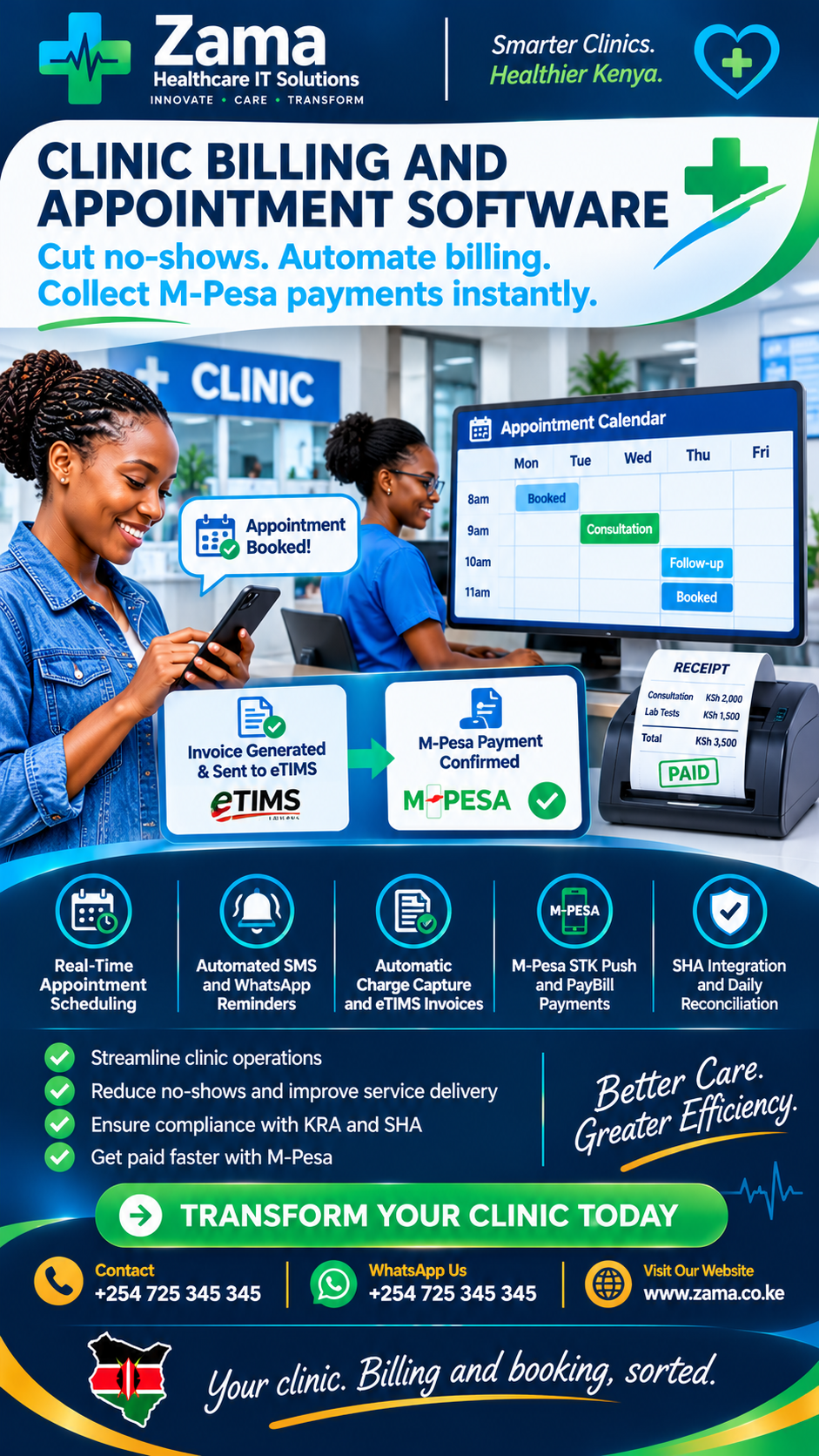
Clinic billing and appointment software is a question that every clinic owner, practice manager, and healthcare administrator in Kenya must answer in 2026. With small and medium clinics handling hundreds of patient visits weekly, appointment no-shows eroding revenue, M-Pesa now the default payment method for most patients, and KRA eTIMS compliance mandatory for every invoice issued, the gap between clinics that run on paper and those that run on integrated software has become a gap in profitability and patient experience. At zama.co.ke, we’ve helped numerous clinics across Kenya implement custom billing and appointment software that eliminates queues, reduces no-shows, and reconciles payments automatically. This comprehensive guide explores clinic billing and appointment software, from understanding what the software delivers to selecting the right approach for your practice.
What Clinic Billing and Appointment Software Actually Delivers
Before diving into clinic billing and appointment software, it’s essential to understand what this technology actually does. Clinic billing and appointment software is a digital platform that manages two connected functions: scheduling patient appointments and processing the financial side of each visit—charges, invoices, payments, and receipts. It replaces paper appointment books, manual billing at the reception desk, and hand-written receipts with a unified system that tracks every booking and every shilling.
A proper clinic billing and appointment software does far more than book slots and print receipts. It shows real-time clinician availability, sends automated appointment reminders via SMS or WhatsApp, manages walk-ins alongside booked patients, captures charges as services are delivered, applies the correct pricing for each patient category, generates KRA eTIMS-compliant invoices, collects payment via M-Pesa STK Push or PayBill, reconciles payments automatically, and produces daily financial and operational reports.
For a Kenyan clinic, the practical definition of clinic billing and appointment software is this: the platform that tells you exactly who is booked today, exactly who has arrived, exactly what each patient was charged, exactly what has been paid, and exactly what is outstanding—all in real time, from any device, without a paper trail.
Why Kenyan Clinics Need Billing and Appointment Software
When evaluating clinic billing and appointment software, consider the compelling reasons for adoption:
The Cost of No-Shows
Appointment no-shows are a major source of lost revenue in Kenyan clinics. A patient books a slot, does not arrive, and the clinician sits idle. Without reminders and without tracking, no-shows can reach 20 to 30 percent of bookings in some clinics. That is a fifth of clinical capacity lost to empty chairs.
A modern clinic billing and appointment software reduces no-shows dramatically. Automated SMS and WhatsApp reminders sent 24 hours and 2 hours before the appointment keep patients aware. Confirmation replies let reception see who is coming. Waitlist functionality fills cancelled slots automatically. Clinics using reminder systems routinely cut no-shows by half or more.
The Chaos of Manual Billing
Manual billing in Kenyan clinics is slow, error-prone, and prone to leakage. Reception staff write charges on paper slips, calculate totals by hand, and issue hand-written receipts. At the end of the day, totals are reconciled against cash and M-Pesa—often revealing gaps that cannot be explained.
A proper clinic billing and appointment software eliminates this chaos. Charges are captured against the patient’s visit, invoices are generated automatically with correct pricing, and payments are recorded against the correct invoice. End-of-day reconciliation shows exactly what was billed, what was collected, and where any discrepancy lies.
M-Pesa Is the Default Payment Method
Kenyan patients expect to pay via M-Pesa. A clinic that only accepts cash creates friction and loses payments. A clinic that accepts M-Pesa but reconciles manually creates a different problem—hours of matching transaction codes to patient visits.
A comprehensive clinic billing and appointment software integrates M-Pesa Daraja API for STK Push and PayBill payments, confirms payment instantly, and reconciles it against the patient’s invoice automatically. The receptionist sees “paid” on the screen before the patient leaves the counter.
KRA eTIMS Compliance
Since January 2024, all VAT-registered businesses in Kenya must transmit invoices to KRA through eTIMS. Clinics issuing invoices for consultations, procedures, laboratory tests, and pharmaceuticals must comply. Non-compliance carries penalties of up to double the tax due, with a minimum in the region of KSh 100,000 per offence.
A quality clinic billing and appointment software generates KRA-compliant tax invoices automatically and transmits them to eTIMS in real time. Compliance becomes invisible—it happens without the clinic staff thinking about it.
Patient Experience and Retention
Patient experience determines whether a clinic retains its patients. Long queues, unclear billing, and repeated visits for results drive patients to competitors. Modern patients expect to book online, receive reminders, pay via M-Pesa, and get a receipt instantly.
A proper clinic billing and appointment software delivers this experience. Patients book from their phones, receive reminders, pay without queuing, and get receipts by SMS or email. Satisfaction rises and retention improves.
Data Protection Act Compliance
Clinic records contain sensitive personal and health data. Kenya’s Data Protection Act, enforced by the Office of the Data Protection Commissioner, requires clinics to handle this data lawfully, store it securely, and grant data subject rights. A manual paper system cannot meet these requirements.
A compliant clinic billing and appointment software implements role-based access, encryption, audit trails, and retention policies aligned with the Act. Patient data is protected by design.
Operational Visibility
Clinic owners and managers need to see how the practice is performing. How many patients were seen this week? Which services generate the most revenue? Which clinician has the highest utilization? Which payment methods dominate? Which patients have outstanding balances?
A quality clinic billing and appointment software provides dashboards and reports answering these questions in real time. Decisions become data-driven rather than based on impressions.
Key Features of Clinic Billing and Appointment Software
When evaluating clinic billing and appointment software, focus on these core features:
1. Appointment Scheduling and Calendar
The foundation of any appointment system is a clear, accurate calendar. A proper clinic billing and appointment software shows clinician availability in real time, supports booking by slot or by duration, handles multiple clinicians and rooms, and manages both booked appointments and walk-ins in the same view.
2. Automated Patient Reminders
Reminders are the single most effective tool against no-shows. A comprehensive clinic billing and appointment software sends SMS and WhatsApp reminders automatically at configurable intervals—24 hours and 2 hours before the appointment are common. Reminders can include a confirmation prompt, letting reception see who has confirmed and who has not.
3. Patient Registration and Records
Billing and appointments require patient records. A quality clinic billing and appointment software maintains a master patient index that prevents duplicates, captures demographic details, links dependants, and connects each visit to a single patient record.
4. Charge Capture and Service Pricing
Accurate billing depends on accurate pricing. A proper clinic billing and appointment software maintains a service catalogue with prices for consultations, procedures, laboratory tests, and pharmaceuticals. Prices can vary by patient category—cash, insurance, corporate, SHA—and the system applies the correct price automatically.
5. Invoice Generation and eTIMS Transmission
Every billable service must be invoiced. A comprehensive clinic billing and appointment software generates invoices automatically from captured charges, applies the correct VAT treatment, transmits the invoice to KRA eTIMS in real time, and stores the validation receipt.
6. M-Pesa Payment Integration
Payment collection must be seamless. A quality clinic billing and appointment software integrates M-Pesa Daraja API for STK Push and PayBill payments, confirms payment in real time, applies it to the correct invoice, and generates an eTIMS-compliant receipt automatically.
7. Multi-Payment Method Support
Patients pay in different ways. A proper clinic billing and appointment software supports cash, M-Pesa, card, bank transfer, and insurance or SHA claims, recording each payment against the correct invoice with a complete audit trail.
8. Insurance and SHA Claims
For clinics accepting insurance or SHA, claims management is essential. A comprehensive clinic billing and appointment software tracks claims from submission to reimbursement, flags rejected claims, and reconciles reimbursements against invoices.
9. Daily Reconciliation and Reports
End-of-day reconciliation is essential. A quality clinic billing and appointment software shows daily billings, collections by payment method, outstanding balances, and any discrepancies—making reconciliation a five-minute task rather than a nightly investigation.
10. Patient Statements and Outstanding Balances
Clinics extend credit in some cases. A proper clinic billing and appointment software tracks outstanding balances, generates patient statements, and supports automated reminders for overdue payments.
What Makes Clinic Billing and Appointment Software Different in Kenya
Clinic billing and appointment software has unique characteristics that global solutions often lack:
M-Pesa as the Primary Payment Rail
In other markets, card payments dominate. In Kenya, M-Pesa dominates. A system built for Kenya integrates Daraja API natively, not as an afterthought.
KRA eTIMS as a Core Requirement
Every invoice must be eTIMS compliant. A system built for Kenya transmits invoices to KRA in real time as a native function.
SHA Integration
Kenyan healthcare now runs through the Social Health Authority. A system built for Kenya supports SHA eligibility verification and claims submission.
SMS-First Patient Communication
Kenyan patients use SMS and WhatsApp as primary communication channels. A system built for Kenya sends reminders via these channels, not only email.
Low-Bandwidth and Offline-Tolerant Design
Connectivity can be intermittent outside major urban centres. A system built for Kenya operates offline for critical functions and syncs when connectivity returns.
Multi-Language Support
Kenyan clinics serve patients in English and Swahili. A system built for Kenya supports both languages.
Data Protection Act Alignment
Clinic records are sensitive. A system built for Kenya implements consent, access controls, and audit trails aligned with the Data Protection Act.
Local Support
Kenyan clinics need support in their timezone and language. Local support is a practical requirement.
Key Factors That Determine Cost
When analysing cost, several factors directly influence pricing:
1. Number of Clinicians and Rooms
More clinicians and rooms mean more complex scheduling and more licensing.
2. Patient Volume
Higher patient volumes require more robust infrastructure and more support.
3. Number of Services in the Catalogue
More services mean more configuration and more pricing rules.
4. SHA and Insurance Integration Depth
Eligibility verification, claims submission, and reimbursement tracking add complexity.
5. M-Pesa and eTIMS Integration
Payment and tax compliance integrations must be built carefully and maintained.
6. Number of Locations
Multiple clinic branches add configuration and consolidated reporting complexity.
7. Deployment Model
Cloud, on-premise, or hybrid deployment affects cost and ongoing support.
8. Customization
Custom workflows, reports, and branding add to the build.
9. Training and Ongoing Support
Training clinical and reception staff, plus ongoing support, contributes to total cost.
For a transparent quote based on your clinic’s specific requirements, contact zama.co.ke today.
Use Cases
Small Private Clinics
Small clinics use billing and appointment software to reduce no-shows, collect M-Pesa payments efficiently, and produce eTIMS-compliant invoices without hiring finance staff.
Multi-Doctor Group Practices
Group practices use the software to manage scheduling across multiple clinicians and rooms, ensuring optimal utilization and fair distribution of walk-ins.
Specialised Clinics
Fertility, dental, optical, and dermatology clinics use custom-configured software for their specific service catalogues and pricing structures.
Paediatric and Family Clinics
Family clinics use the software to manage dependants, link family records, and handle repeat visits efficiently.
Diagnostic and Laboratory Clinics
Diagnostic clinics use the software to schedule test appointments, deliver results, and bill for services with eTIMS compliance.
Corporate Wellness Clinics
Clinics serving corporate clients use the software to manage employee wellness packages, bill against corporate contracts, and reconcile payments.
The Zama.co.ke Approach to Clinic Billing and Appointment Software Development
When considering clinic billing and appointment software, zama.co.ke follows a structured approach:
Clinical and Operational Discovery
We map your patient journeys, service catalogue, pricing structures, payment methods, and reporting needs.
System Design
We design scheduling logic, charge capture, invoice generation, and payment reconciliation.
Development and Integration
We build the software, integrate M-Pesa Daraja API, KRA eTIMS, and SHA where applicable, and configure notifications.
Testing and Data Migration
We test scheduling, billing, payments, and reconciliation, then migrate existing patient records.
Training and Support
We train reception, clinical, and administrative staff, and provide documentation.
Post-Launch Optimization
We monitor no-show rates, payment collection, and staff workflow, then refine the system.
The ROI
When evaluating clinic billing and appointment software, the ROI is compelling:
Reduced No-Shows: Automated reminders cut missed appointments by half or more.
Faster Payment Collection: In-portal M-Pesa payments accelerate settlement.
Eliminated Billing Leakage: Charges captured automatically as services are delivered.
Compliance Protection: Every invoice is eTIMS compliant.
Improved Patient Experience: Patients book, pay, and receive receipts without queuing.
Real-Time Visibility: Daily reports show exactly what was billed and collected.
Scalable Operations: The clinic can grow without adding reception staff proportionally.
Implementation Considerations
Assess Your Current Process
Document how appointments are booked, how charges are captured, how payments are collected, and where leakage occurs today.
Choose the Right Solution
Match complexity to your clinic. A single-doctor clinic needs less than a multi-specialty group.
Plan for Data Migration
Migrate patient records and service catalogues carefully.
Train Your Team
Reception, clinicians, and administrators all interact with the system.
Ensure Compliance
Build eTIMS and Data Protection Act controls in from day one.
Test Thoroughly
Test scheduling, reminders, billing, M-Pesa payments, and reconciliation.
Consider a Phased Rollout
Start with scheduling and reminders, then add billing and payments.
The Cost of Delaying
While clinics evaluate clinic billing and appointment software, the cost of inaction compounds daily. Every week of no-shows is lost clinician time. Every day of manual billing is revenue leakage. Every invoice outside eTIMS is compliance risk.
Why Contact Zama.co.ke
When researching clinic billing and appointment software, clinics should contact zama.co.ke because:
Healthcare Expertise: We understand clinical workflows, clinic billing, and SHA processes.
M-Pesa Expertise: We integrate Daraja API for in-portal payments with automatic reconciliation.
eTIMS Expertise: We transmit compliant invoices to KRA in real time.
SHA Integration: We connect eligibility verification and claims submission.
Custom Development: We build software matched to your service catalogue and pricing.
Transparent Pricing: No hidden fees and full source-code ownership.
Ongoing Support: We stay available as your clinic grows.
For a custom quote based on your clinic’s specific requirements, contact zama.co.ke today.
Clinic billing and appointment software is essential for any clinic seeking to reduce no-shows, eliminate billing leakage, and meet modern patient expectations. From online booking and automated reminders to charge capture, M-Pesa payments, and eTIMS invoices, the right system changes how your clinic operates.
At zama.co.ke, we’ve helped clinics across Kenya implement billing and appointment software that delivers measurable results. Our approach ensures you get exactly what your practice needs—nothing more, nothing less.
Don’t let the complexity of clinic billing and appointment software hold you back. Whether you run a single-doctor clinic or a multi-site group practice, we have the expertise to guide you through every step.
Contact zama.co.ke today for a custom quote based on your clinic’s specific requirements.