
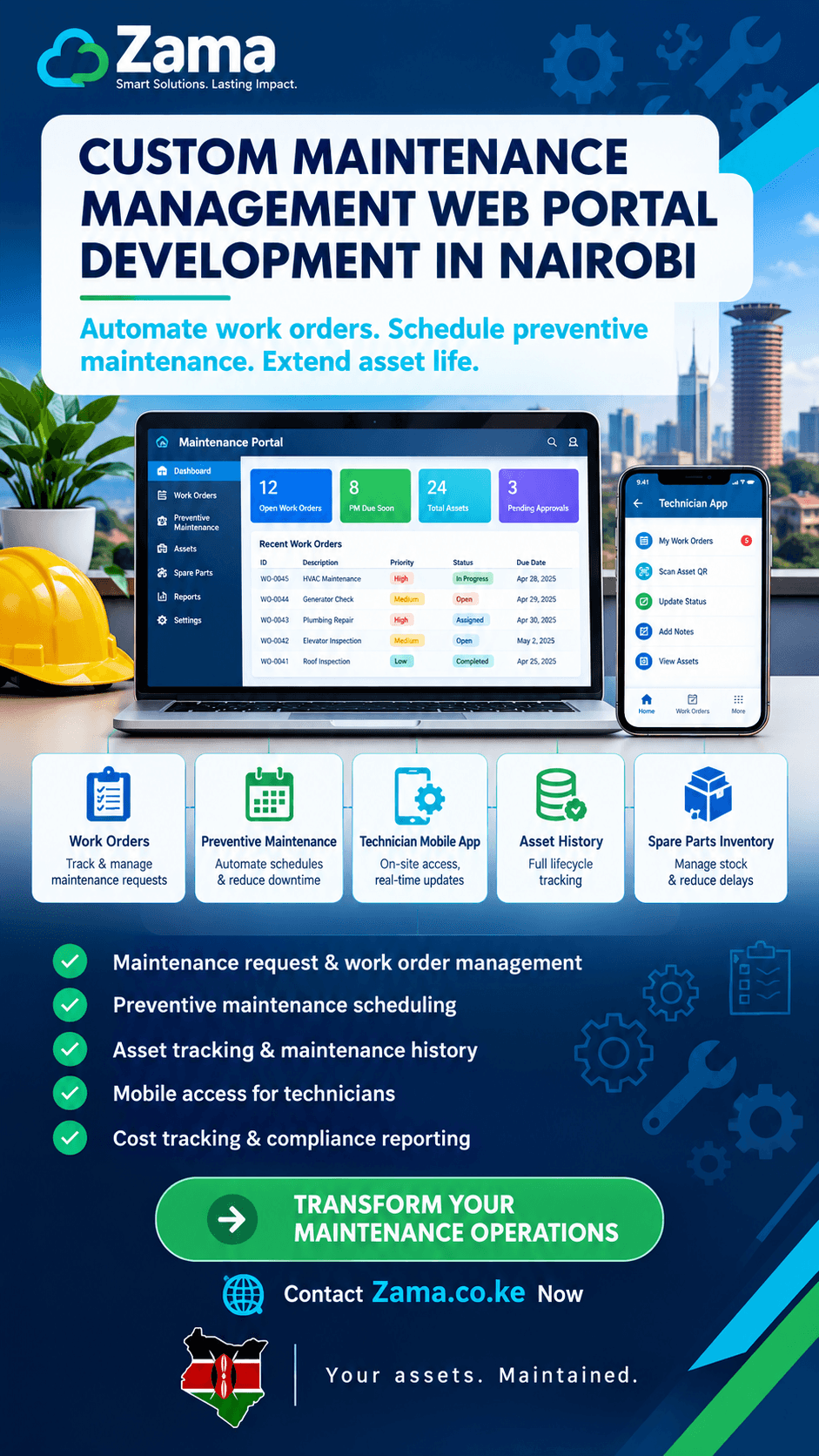
Custom maintenance management web portal development in Nairobi is a question that every facility manager, operations director, and property owner in Kenya’s capital must answer in 2026. With Nairobi’s commercial building stock expanding rapidly across Westlands, Upper Hill, Kilimani, Gigiri, and the Industrial Area, and organizations recognizing that reactive maintenance erodes profitability, the demand for tailored digital maintenance platforms has never been greater. At zama.co.ke, we’ve helped numerous organizations across Nairobi develop custom maintenance management web portals that eliminate paperwork, automate work orders, and provide real-time visibility into every asset and every repair. This comprehensive guide explores custom maintenance management web portal development in Nairobi, from understanding what these portals do to selecting the right development partner for your organization.
What Custom Maintenance Management Web Portal Development Actually Delivers
Before diving into custom maintenance management web portal development in Nairobi, it’s essential to understand what this technology actually does. A custom maintenance management web portal is a browser-based platform that helps organizations plan, track, and execute maintenance activities across their assets and facilities. It replaces spreadsheets, paper logbooks, messaging apps, and phone calls with a centralized system that captures every maintenance request, work order, and repair history.
A proper custom maintenance management web portal development in Nairobi does far more than digitize paper forms. It maintains a complete asset register, automates work order generation and assignment, schedules preventive maintenance, tracks technician performance, manages spare parts inventory, records maintenance costs, and generates comprehensive reports. It connects physical assets to their maintenance histories, documentation, and compliance records, creating traceability from acquisition through disposal.
For a Nairobi organization, the practical definition of custom maintenance management web portal development in Nairobi is this: the partner that designs, builds, and maintains the browser-based platform telling you exactly what needs maintenance, exactly who is responsible, exactly when it should be done, exactly how much it costs, and exactly what has been done historically—all in real time, from any device.
Why Nairobi Organizations Need Custom Maintenance Management Web Portals
When evaluating custom maintenance management web portal development in Nairobi, consider the compelling reasons for adoption:
The Cost of Reactive Maintenance
Manual and reactive maintenance is expensive. Without a proper system, maintenance requests get lost, repairs are delayed, contractors overcharge, and equipment fails unexpectedly. Property managers spend thousands of shillings every month on repairs without knowing which building costs the most, which equipment fails repeatedly, which contractors overcharge, or where preventive maintenance could reduce expenses.
A modern custom maintenance management web portal development in Nairobi addresses these losses through automation. Benefits include faster response times, better planning, higher tenant satisfaction, reduced maintenance costs, increased staff accountability, better record keeping, and improved decision making. For manufacturing plants in Industrial Area and Athi River, the cost of unplanned downtime can be catastrophic. A single production stoppage can cost millions in lost output and emergency repairs.
The Growth of Nairobi’s Commercial Property Sector
Nairobi’s commercial property sector is expanding rapidly. Office towers in Westlands and Upper Hill, retail centres along Mombasa Road, residential estates in Kiambu and Runda, and industrial parks in Ruiru and Thika all require systematic maintenance. Property managers overseeing these developments face increasing complexity: multiple buildings, diverse tenant requirements, different contractor networks, and varying maintenance priorities.
A proper custom maintenance management web portal development in Nairobi creates a single source of operational information, helping teams coordinate maintenance activities more consistently across growing portfolios. Without a centralized portal, maintenance information remains scattered across phone calls, spreadsheets, and messaging apps, resulting in delays and inconsistent communication.
The Shift from Reactive to Predictive Maintenance
Nairobi organizations are increasingly moving from reactive maintenance—waiting for equipment to fail—to preventive and predictive maintenance. Modern web portals use data analytics to predict equipment service needs before failures occur, significantly reducing downtime and extending asset lifespan.
This represents the future of custom maintenance management web portal development in Nairobi—where data and analytics prevent failures before they happen, rather than reacting to breakdowns after they occur. The portal becomes not just a record-keeping tool but a strategic asset that informs capital planning, budget allocation, and operational decisions.
Compliance and Audit Readiness
For organizations in regulated industries, maintenance records are compliance records. Audit and compliance challenges from manual tracking make audit readiness time-consuming and error-prone. A proper custom maintenance management web portal development in Nairobi provides automated compliance tracking, instant report generation, and audit-ready records.
This is particularly important for healthcare facilities, manufacturing plants, and commercial buildings subject to safety and environmental regulations. When auditors request maintenance records, a web portal generates them in minutes rather than days.
Key Factors That Determine Custom Maintenance Management Web Portal Development Cost in Nairobi
When analysing custom maintenance management web portal development in Nairobi, several factors directly influence pricing:
1. Number of Assets and Locations
The number of assets under management and the number of locations covered are primary drivers of custom maintenance management web portal development in Nairobi. A single building with 50 assets has simpler requirements than a portfolio of ten buildings with 5,000 assets. Each additional location adds complexity to the data model, user management, and reporting structure.
2. Maintenance Request Volume
The volume of maintenance requests processed monthly affects portal design and infrastructure requirements. A small office generating 20 requests monthly has different needs from a large estate generating 500 requests monthly. The portal must be designed to handle peak volumes without performance degradation.
3. Workflow Complexity
Maintenance workflows vary widely across organizations. A simple workflow might involve request submission, assignment, and completion. A complex workflow might include multi-level approvals, contractor tendering, quality inspection, and payment processing. Custom custom maintenance management web portal development in Nairobi must model these workflows precisely.
4. Integration Requirements
Maintenance management portals rarely operate in isolation. Integration with existing systems adds to custom maintenance management web portal development in Nairobi:
Accounting Systems: Integration ensures that maintenance costs flow into financial statements and that budgets are tracked against actual expenditure.
Procurement Systems: Integration ensures that spare parts procurement is linked to maintenance work orders.
Asset Management Systems: Integration ensures that asset registers are synchronized across platforms.
Access Control Systems: Integration ensures that maintenance staff access is controlled and logged.
Payment Systems: Integration with M-Pesa enables efficient contractor payment and automated reconciliation.
Each integration adds complexity and cost. When evaluating custom maintenance management web portal development in Nairobi, organizations must budget for integration requirements.
5. Mobile Access Requirements
Field technicians need mobile access to work orders, asset histories, and digital checklists. A comprehensive custom maintenance management web portal development in Nairobi must include responsive design or native mobile applications that work on smartphones and tablets. Mobile access adds development complexity but delivers significant productivity gains.
6. Reporting and Analytics Requirements
Reporting requirements affect development cost. The portal must generate maintenance performance reports, cost analysis reports, asset history reports, compliance reports, and management dashboards. Complex reporting requirements require more development effort.
7. User Roles and Permissions
Different users need different access levels. Facility managers need full visibility. Technicians need work order access. Tenants need request submission access. Finance teams need cost reporting access. A custom portal must implement role-based access controls that match your organizational structure.
8. Deployment Model
The deployment model affects development and hosting costs. On-premise deployment requires server hardware and IT infrastructure. Cloud-based deployment shifts infrastructure responsibility to the development partner. Hybrid deployment combines both approaches.
9. Training and Change Management
Training facility managers, technicians, and administrators is essential for successful adoption. Training costs—whether included in the development fee or charged separately—add to the overall investment.
10. Ongoing Support and Maintenance
Custom maintenance management web portals require ongoing support and maintenance. This includes software updates, bug fixes, feature enhancements, and technical support. Support costs vary based on the level of service and whether support is included in the development agreement.
Essential Features of a Custom Maintenance Management Web Portal in Nairobi
When evaluating custom maintenance management web portal development in Nairobi, focus on these core features:
1. Maintenance Request Management
The foundation of any maintenance portal is capturing and organizing requests. A proper system should provide a maintenance request portal where tenants, staff, or users can submit requests easily. Requests should be automatically categorized by type—water leaks, broken doors, faulty street lights, blocked drainage, plumbing issues, electrical faults, security concerns—and routed to the appropriate personnel.
For property managers, this means no more lost requests through phone calls, SMS, emails, or office visits. Every request is logged, timestamped, and tracked from submission to completion.
2. Work Order Management
Once a request is received, the system should automatically create a work order. A comprehensive portal should include job description, priority level, technician assigned, due date, status updates, and completion notes. Work orders should be assignable to in-house staff or external contractors, with tracking of timelines, costs, and job completion status.
3. Preventive Maintenance Scheduling
Preventive maintenance is where custom portals deliver the greatest ROI. A proper system should support automated reminders for recurring tasks like inspections, pest control, HVAC servicing, and equipment calibration. Preventive maintenance helps identify and fix problems before they escalate into costly repairs, extending the life of appliances and building systems.
4. Asset Management and History
A custom portal should maintain a complete asset register with unique identification numbers, descriptions, locations, and maintenance histories. Every asset should be linked to its work orders, repairs, parts used, and costs. This creates traceability that supports planning, budgeting, and compliance.
5. Technician Assignment and Mobile Access
Modern maintenance teams need mobile access. A proper portal should allow technicians to receive work orders on mobile devices, update status in the field, capture photos, and access asset histories while on site. Mobile-first design ensures that field technicians have on-demand access to work orders, asset data, and digital checklists.
6. Spare Parts and Inventory Management
Maintenance requires parts. A comprehensive portal should track spare parts inventory, provide real-time visibility into stock levels, and ensure the right parts are available when needed. For large operations, managing thousands of inventory items manually without real-time visibility often results in stock shortages or excess materials.
7. Cost Tracking and Reporting
Understanding maintenance costs is essential for budgeting and decision-making. A quality portal should track labour, materials, and expenses against each work order and asset. Reports should show maintenance costs by building, equipment, or contractor. Performance dashboards help managers review response times, contractor productivity and maintenance trends.
8. Real-Time Dashboards and Alerts
Management needs real-time visibility into maintenance operations. A comprehensive portal should provide live dashboards showing open work orders, overdue tasks, technician workloads, and asset status. Automated alerts notify supervisors when work orders are overdue, when critical equipment fails, or when maintenance costs exceed thresholds.
9. Multi-Tenant and Multi-Property Support
Nairobi property managers often oversee buildings with different tenant requirements, maintenance priorities, and contractor networks. A proper portal should centralize maintenance requests, track assets, automate work orders, improve communication, and provide real-time reporting across multiple buildings.
10. Offline Capability
Kenyan organizations face power fluctuations and internet outages. A proper portal should continue functioning during connectivity issues, storing data locally and syncing when connection returns.
What Makes Custom Maintenance Management Web Portal Development in Nairobi Different
custom maintenance management web portal development in Nairobi has unique characteristics that global solutions often lack:
M-Pesa Integration
For property management and facility maintenance, M-Pesa integration is essential. A custom portal should support M-Pesa and bank payment references matched to the correct tenant, partial payments, credits, and deposits, with role-based access for owners, accountants, agents, and caretakers.
Multi-Tenant Support
Nairobi’s commercial buildings often house multiple tenants. A custom maintenance portal must support multi-tenant scenarios where each tenant submits requests, tracks progress, and views their own maintenance history, while the building owner retains overall visibility.
Offline and Low-Bandwidth Capability
Internet in Kenya is not always reliable, especially outside major urban centres. Good maintenance management web portals should work with minimal data usage and function offline when needed, syncing when connection returns.
Local Support and Training
The best custom maintenance management web portal development in Nairobi providers offer local support, training, and implementation services. Organizations need a partner who can respond quickly when issues arise.
Integration with Local Systems
The portal should integrate with local systems—accounting software, procurement platforms, and access control systems commonly used in Kenya.
KRA eTIMS Compliance
For organizations that charge for maintenance services, the portal should support KRA eTIMS compliance, generating tax invoices and transmitting them to KRA automatically.
Custom Maintenance Management Web Portal Use Cases in Nairobi
Commercial Property Management
Property managers across Nairobi use maintenance portals to coordinate multi-tenant maintenance operations. The system helps landlords, real estate firms, and property managers stay ahead of repairs, track tasks, communicate with tenants, and manage vendors.
Manufacturing Plants
Manufacturers in Industrial Area, Athi River, and Thika use maintenance portals to manage production machinery maintenance, minimize downtime, and ensure product quality. The portal tracks equipment performance, schedules preventive maintenance, and manages spare parts inventory.
Healthcare Facilities
Hospitals and healthcare facilities use maintenance portals to manage medical equipment, building systems, and utility infrastructure. The portal ensures compliance with health sector regulations and manages maintenance schedules for critical equipment.
Educational Institutions
Schools and universities use maintenance portals to manage campus buildings, utilities, and equipment. The portal helps facilities teams coordinate maintenance across large campuses with diverse requirements.
Retail Centres
Shopping malls and retail centres use maintenance portals to manage common areas, HVAC systems, escalators, and security infrastructure. The portal ensures that maintenance activities do not disrupt shopper experience.
Residential Estates
Residential estates and apartment complexes use maintenance portals to manage common areas, utilities, and shared facilities. The portal enables residents to submit requests and track progress.
The Zama.co.ke Approach to Custom Maintenance Management Web Portal Development in Nairobi
When considering custom maintenance management web portal development in Nairobi, zama.co.ke follows a structured approach:
Maintenance Assessment
We evaluate your organization’s maintenance operations: asset types, request volume, team structure, contractor management, compliance requirements, and reporting needs. This includes understanding your current challenges and defining success metrics.
Portal Design
We design the portal architecture—user interfaces, asset database, workflow engine, integration points, and reporting dashboards. The design supports your specific maintenance workflows and organizational structure.
Development and Integration
We develop the portal, build integrations with existing systems (accounting, procurement, access control), and configure work order workflows, preventive maintenance schedules, and reporting dashboards.
Asset Data Migration
We migrate existing asset data into the new system. We validate data accuracy before migration and ensure that historical maintenance records are preserved.
Training and Support
We provide role-specific training for facility managers, technicians, and administrators. We remain available for ongoing support, maintenance, and portal upgrades.
Post-Launch Optimization
After go-live, we monitor performance, gather user feedback, and refine the portal to improve maintenance efficiency and asset reliability.
The ROI of Custom Maintenance Management Web Portal Development in Nairobi
When evaluating custom maintenance management web portal development in Nairobi, the ROI is compelling:
Reduced Downtime: Preventive maintenance and predictive analytics prevent equipment failures before they occur. Work order management reduces downtime directly by enabling timely task completion.
Lower Maintenance Costs: Understanding where and how maintenance costs are incurred helps identify inefficiencies and optimize spending.
Extended Asset Life: Regular preventive maintenance extends the life of appliances, equipment, and building systems.
Improved Tenant Satisfaction: Faster response times and better communication improve tenant retention and satisfaction.
Audit Readiness: Automated compliance tracking and instant report generation ensure audit readiness at all times.
Staff Accountability: Every work order has an assigned owner, a due date, and a completion record.
Data-Driven Decisions: Maintenance analytics reveal trends, recurring issues, and opportunities for improvement.
Scalability: A custom portal can grow with your portfolio, adding buildings, assets, and users without rebuilding.
Implementation Considerations for Nairobi Organizations
When implementing a custom maintenance management web portal, consider these factors:
Assess Your Maintenance Needs
Evaluate your asset base, maintenance volume, team structure, and reporting requirements. A small property management company has different needs from a manufacturing plant with hundreds of machines.
Choose the Right Development Partner
Select a development partner with maintenance management experience, local support capabilities, and a proven track record. The best custom maintenance management web portal development in Nairobi providers understand both technology and maintenance operations.
Plan for Data Migration
Migrating asset registers, maintenance histories, and vendor records requires careful validation. Ensure asset descriptions, locations, and maintenance histories are accurate before migration.
Train Your Team
Maintenance technicians, supervisors, and managers need training on the new portal. Role-specific training using real scenarios produces higher adoption and better data quality.
Start with a Pilot
Many Nairobi organizations achieve better results by introducing the portal in one building or with one maintenance team before expanding across the portfolio. This approach catches issues early and builds confidence among staff.
Ensure Integration
Plan for integration with existing systems including accounting software, procurement systems, and access control. This creates a unified operational platform.
Consider Mobile Access
Mobile functionality is essential for field technicians. Ensure your portal includes mobile access for work orders, asset data, and digital checklists.
The Cost of Delaying Custom Maintenance Management Web Portal Development
While organizations evaluate custom maintenance management web portal development in Nairobi, the cost of inaction compounds daily. Every month of manual maintenance represents unplanned downtime, emergency repairs, and lost productivity. Every month of paper-based records represents audit risk and compliance gaps. Every month of reactive maintenance represents shortened asset life and missed savings opportunities.
Meanwhile, organizations that have implemented custom maintenance management web portals are achieving preventive maintenance, reducing downtime, and extending asset life. The competitive gap widens with every passing month.
Why Contact Zama.co.ke for Custom Maintenance Management Web Portal Development in Nairobi
When researching custom maintenance management web portal development in Nairobi, organizations should contact zama.co.ke because:
Local Expertise: We understand Kenyan operating realities, regulatory requirements, and infrastructure conditions.
Custom Development: We build portals tailored to your specific maintenance workflows, asset categories, and reporting requirements, not generic solutions.
Integration Capabilities: We connect maintenance portals to accounting, procurement, access control, and ERP systems.
Mobile-First Design: We build mobile access for field technicians from day one, ensuring work orders, asset data, and checklists are available on any device.
Transparent Pricing: No hidden fees, clear milestone timelines, and full source-code ownership.
Ongoing Support: We remain available for maintenance, troubleshooting, and portal upgrades as your asset base evolves.
For a custom quote based on your organization’s specific requirements, contact zama.co.ke today.
Custom maintenance management web portal development in Nairobi is essential for any organization seeking to eliminate paperwork, automate work orders, reduce downtime, and extend asset life. From commercial property management and manufacturing to healthcare and education, the right portal transforms how organizations manage their assets and maintenance operations.
At zama.co.ke, we’ve helped organizations across Nairobi develop custom maintenance management web portals that deliver measurable results. Our approach ensures you get exactly what your organization needs—nothing more, nothing less.
Don’t let the complexity of custom maintenance management web portal development in Nairobi hold you back. Whether you’re managing a single building or a multi-site portfolio, we have the expertise to guide you through every step.
Contact zama.co.ke today for a custom quote based on your organization’s specific requirements.