
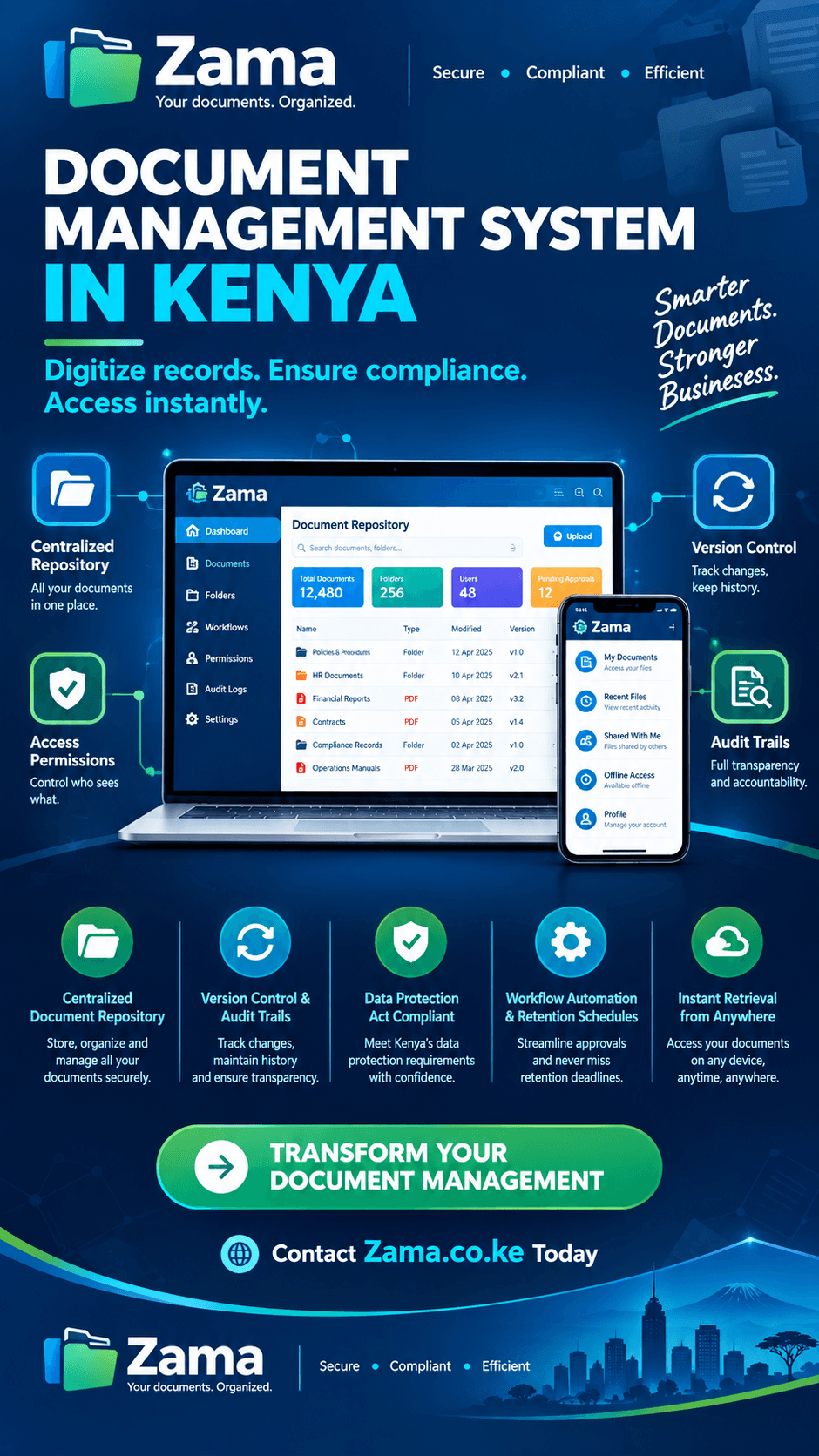
Document management system in Kenya is a question that every records manager, operations director, and compliance officer must answer in 2026. With the Kenyan government actively rolling out paperless systems across ministries, KRA implementing an enterprise-wide DMS, and organizations across banking, healthcare, and legal sectors recognizing that paper-based records are a liability, the shift to digital document management has become essential. At zama.co.ke, we’ve helped numerous organizations across Kenya implement document management systems that eliminate paper chaos, ensure regulatory compliance, and provide instant access to critical records. This comprehensive guide explores document management system in Kenya, from understanding core features to selecting the right solution for your organization.
What a Document Management System Actually Does
Before diving into document management system in Kenya, it’s essential to understand what this technology actually does. A document management system (DMS)—sometimes called an Electronic Document Management System (EDMS) or Electronic Document and Records Management System (EDRMS)—is a digital platform that captures, stores, organizes, retrieves, and manages documents throughout their lifecycle. It replaces filing cabinets, scattered folders, email attachments, and shared drives with a centralized, secure, and searchable repository.
A proper document management system in Kenya does far more than scan papers into digital format. It captures documents from multiple sources, indexes them for instant retrieval, enforces version control, applies access permissions, automates workflows, maintains audit trails, enforces retention schedules, and ensures compliance with Kenya’s Data Protection Act. The Kenya Revenue Authority describes its own DMS as a platform that will “transform documents into actionable data streams” through intelligent classification, automated metadata extraction, and workflow optimization. For Kenyan organizations, the practical definition of document management system in Kenya is this: the system that tells you exactly what documents exist, exactly where they are stored, exactly who has accessed them, exactly how long they must be retained, and exactly when they can be disposed of—all from a single dashboard accessible on any device.
Why Kenyan Organizations Are Adopting Document Management Systems
When evaluating document management system in Kenya, consider the compelling reasons for adoption:
The Cost of Paper-Based Records
Manual, paper-based records are expensive, insecure, and inefficient. The Rural Electrification and Renewable Energy Corporation (REREC), a key public sector institution under Kenya’s Ministry of Energy, faced significant challenges with paper-based records. Records were scattered across departments and locations, retrieving files was time-consuming and affected turnaround times, compliance audits were paper-based and error-prone, and sensitive documents lacked proper version control and secure storage. Inconsistent employee records, an inability to maintain version control, and the creation of audit trails placed REREC at risk with Kenya’s Data Protection Act and labour laws.
A modern document management system in Kenya addresses these challenges through digitization and automation. Metrofile, in partnership with digital transformation specialist DISI Group, digitized some half a million documents at REREC and implemented a centralized EDMS. The digitization of documents and EDMS delivered real-time access, version control, cross-department collaboration, and built-in compliance and security controls. Tasks that previously took days were completed in minutes, with digital trails ensuring traceability and compliance.
Government Digitization Mandate
The most urgent driver for document management system in Kenya is the government’s paperless initiative. The Information, Communication, and Digital Economy Cabinet Secretary announced that the government is set to roll out a new digital system that will see all government departments transition to a paperless system. The F2 system stands as an on-premises Electronic Document and Records Management System (EDRMS) engineered for the management of electronic documents within an organisation or department. The system plays a fundamental role in reducing manual effort in the creation, storage, and access of information, in addition to reducing errors while dealing with documents.
The Cabinet Secretary emphasized that the system will be fundamental in reinforcing transparency and accountability in the public service, stating that “the government requires clear processes and decision-making that can be traced, transparent, accountable, and timely.” More than 22,000 services are now onboarded on the e-Citizen platform, with a pilot phase of the EDRMS underway. This government-led push toward digital records management is driving demand for document management system in Kenya across both public and private sectors.
Data Protection Act Compliance
One of the most critical drivers for document management system in Kenya is compliance with Kenya’s Data Protection Act (2019). Importantly, the Act applies not only to digital records but also to physical files—making document management a central compliance issue. Under the Act, files must be securely stored with access limited to authorised personnel, retention policies must be clear and documented, and disposal must prevent reconstruction of data.
A compliant document management system in Kenya ensures that personal data is processed lawfully, stored securely, retained only as long as necessary, and disposed of appropriately. FileOrbis, a secure file governance platform deployed in Kenya, supports this pattern by keeping personal data in Kenya with customer-managed keys and immutable audit trails aligned with the Kenya Data Protection Act, 2019. For organizations in regulated industries like banking, healthcare, and legal services, a proper DMS is not optional—it is a regulatory requirement.
Audit Readiness and Operational Efficiency
Manual records make audits painful. When auditors request documents, staff spend days searching through filing cabinets and shared drives. A proper document management system in Kenya ensures that documents are instantly retrievable, version-controlled, and audit-ready. Sybrin implemented a comprehensive EDRMS for a Pan-African financial services group in Kenya that supports document versioning, audit trails, classification management, workflow automation, collaboration, scanning, indexing, and retention management. The organization gained greater control over its information assets, improving compliance, operational efficiency, and collaboration.
Essential Features of a Document Management System in Kenya
When evaluating document management system in Kenya, focus on these core features:
1. Centralized Document Repository
The foundation of any DMS is a centralized repository where all documents are stored, organized, and accessible. A proper document management system in Kenya should provide a single source of truth for all organizational documents, eliminating scattered files across departments, email inboxes, and personal devices. The repository should support folder structures, metadata tagging, and powerful search capabilities.
2. Document Capture and Digitization
Paper documents must be brought into the digital system. A comprehensive document management system in Kenya should support bulk scanning and document capture, automatic feeder scanners for high-volume digitization, OCR (Optical Character Recognition) for making scanned documents searchable, and integration with existing scanners and multifunction printers. Organizations like DTB have reduced document retrieval time from days to hours after digitizing their records.
3. Version Control and Document History
Multiple versions of the same document create confusion and risk. A quality document management system in Kenya should automatically track document versions, maintain complete version histories, allow comparison between versions, prevent unauthorized editing, and ensure that staff always access the latest approved version.
4. Access Control and Permissions
Not every employee should see every document. A robust document management system in Kenya should provide role-based access controls so that only authorized personnel can view, edit, or delete sensitive documents. Access should be configurable by department, role, document type, or individual. FileOrbis supports zero-trust access, persistent rights management that survives downloads, and granular external sharing controls.
5. Workflow Automation
Documents often require approvals, reviews, and routing. A modern document management system in Kenya should automate document workflows including approval chains, review cycles, distribution lists, and task assignments. Automated workflows eliminate bottlenecks, reduce turnaround times, and ensure that documents move efficiently through the organization.
6. Audit Trails and Compliance Reporting
Compliance requires evidence. A proper document management system in Kenya should maintain immutable audit trails that record every action—who accessed what document, when, and what they did. Audit logs should be exportable for regulators and auditors, and reporting should align with Kenya’s Data Protection Act requirements.
7. Retention and Disposal Management
Documents cannot be kept forever—nor can they be deleted prematurely. A comprehensive document management system in Kenya should enforce retention schedules that comply with statutory requirements, automate disposal when retention periods expire, prevent reconstruction of disposed data, and maintain certificates of destruction for audit purposes.
8. Integration with Existing Systems
A DMS should not operate in isolation. A proper document management system in Kenya should integrate with existing ERP systems, HR systems, accounting software, email platforms, and Microsoft 365. The National Social Security Fund (NSSF) integrated its EDMS with its existing Enterprise Resource Planning (ERP) system to enable real-time data synchronization.
What Makes a Kenyan Document Management System Different
A document management system in Kenya has unique characteristics that global solutions often lack:
Data Residency and Sovereignty
For regulated organizations in Kenya, data residency is decisive. The best platforms pin content, metadata, audit logs, and encryption keys to the required jurisdiction. FileOrbis supports on-premises deployment, single-tenant private cloud, and region-pinned options with customer-managed keys, ensuring that regulated data stays where the law requires.
Data Protection Act Alignment
A compliant document management system in Kenya must align with the Data Protection Act, 2019, overseen by the Office of the Data Protection Commissioner (ODPC). This includes lawful processing, data-subject rights, security of personal data, and localization and transfer rules. Reporting must be mapped to these requirements.
KRA Integration
For organizations dealing with tax documents, integration with Kenya Revenue Authority systems is essential. The KRA’s own DMS initiative aims to transform documents into actionable data streams that directly support revenue assurance. A modern document management system in Kenya should support integration with KRA systems where applicable.
Local Support and Implementation
The best document management system in Kenya providers offer local support, training, and implementation services. Whether you’re in Nairobi, Mombasa, or Kisumu, you need a partner who understands the Kenyan regulatory environment and can respond quickly when issues arise.
M-Pesa-Enabled Authentication
For law firms and organizations handling sensitive client documents, M-Pesa-linked authentication ensures only authorized staff view sensitive files. This is an emerging feature in Kenyan legal technology platforms.
Document Management System Use Cases in Kenya
Government and Public Sector
The government’s F2 system rollout across ministries and departments is the most visible DMS implementation in Kenya. The system will eliminate the physical movement of paper from one office to another, reinforcing transparency and accountability. The Ethics and Anti-Corruption Commission (EACC) has an ongoing EDMS implementation project expected to automate the Commission’s entire document lifecycle, including digital capture, indexing, workflow management, and retrieval.
Banking and Financial Services
Diamond Trust Bank (DTB) implemented a document management solution that reduced document retrieval time from days to hours. Staff now retrieve documents faster and spend less time on admin. Stronger compliance controls and a clear retention policy support safer, smarter records management. A Pan-African financial services group in Kenya worked with Sybrin to implement an EDRMS that transformed how records were captured, managed, and accessed throughout the business.
Energy and Utilities
REREC digitized half a million documents and implemented a centralized EDMS alongside automation of core HR processes. Records are now instantly accessible from a secure, centralized repository, and automated workflows have accelerated key HR and business processes.
Legal Services
Kenyan law firms are rapidly adopting document management systems. Digital case management slashes admin time by up to 40%, with centralized document repositories where all pleadings, evidence, and correspondence live in the cloud. Beveron Smart Legal Counsel offers law firms a complete digital solution to manage cases, documents, billing, and compliance. JibuDocs provides AI tools for legal research, document digitization, knowledge management, and document search.
Insurance
Mayfair Insurance implemented DocuWare Cloud to transform its document management. The company rolled out the digital document management system first in its claims department, improving efficiency and reducing paperwork.
Implementation Considerations for Kenyan Organizations
When implementing a document management system in Kenya, consider these factors:
Assess Your Document Landscape
Before selecting a system, conduct a comprehensive audit of your documents. Identify document types, volumes, locations, retention requirements, access patterns, and compliance obligations. This assessment forms the foundation for system design and migration.
Choose the Right Solution
The best document management system for your organization depends on your industry, document volume, compliance requirements, and budget. For government entities, the F2 system provides a standardized platform. For private organizations, solutions from providers like Metrofile, Cadtech, FileOrbis, and Savannah offer comprehensive capabilities.
Plan for Data Migration
Migrating existing documents—whether physical or digital—requires careful planning. Digitization of paper records, indexing, and metadata creation are essential steps. REREC’s digitization of half a million documents demonstrates the scale of this undertaking.
Train Your Team
Staff at all levels need training on the new system. Records management officers and ICT professionals need to reengineer existing processes and embrace digital transformation.
Ensure Compliance
Configure the system for Data Protection Act compliance from day one. Ensure secure storage, access controls, retention schedules, and audit trails are properly configured.
The ROI of a Document Management System in Kenya
When evaluating a document management system in Kenya, the ROI is compelling:
Reduced Retrieval Time: Organizations report document retrieval times dropping from days to hours, or even minutes, after implementing a DMS.
Lower Storage Costs: Reducing paper usage and physical storage requirements delivers significant cost savings.
Improved Compliance: Automated retention schedules and audit trails ensure regulatory compliance and reduce audit risks.
Enhanced Security: Access controls, encryption, and audit trails protect sensitive documents from unauthorized access.
Faster Decision-Making: Real-time access to documents and information accelerates business processes.
Business Continuity: Digital documents are protected from fire, flood, and loss, ensuring business continuity.
Operational Efficiency: Automated workflows eliminate bottlenecks and accelerate document-centric processes.
The Zama.co.ke Approach
When considering a document management system in Kenya, zama.co.ke follows a structured approach:
Document Assessment
We evaluate your organization’s document landscape: document types, volumes, locations, retention requirements, access patterns, and compliance obligations.
System Design
We design a document management solution tailored to your specific needs—whether it’s a centralized EDMS for a public entity, a case management system for a law firm, or a secure file governance platform for a financial institution.
Implementation and Configuration
We handle system configuration, document digitization, metadata creation, workflow automation, and integration with existing systems.
Training and Support
We provide role-specific training for records managers, administrators, and end users, including document capture, retrieval, and compliance.
Post-Implementation Support
We remain available for maintenance, troubleshooting, and system upgrades as your document management needs evolve.
Document management system in Kenya is essential for any organization seeking to eliminate paper chaos, ensure Data Protection Act compliance, and provide instant access to critical records. From REREC’s digitization of half a million documents and the government’s F2 system rollout to KRA’s enterprise DMS, the shift to digital records management is accelerating across Kenya.
At zama.co.ke, we’ve helped organizations across Kenya implement document management systems that deliver measurable results. Our approach ensures you get exactly what your organization needs—nothing more, nothing less.
Don’t let the complexity of document management system in Kenya hold you back. Whether you’re a government entity, financial institution, law firm, or private business, we have the expertise to guide you through every step.
Contact zama.co.ke today and let us help you build a document management system that transforms your records management.