
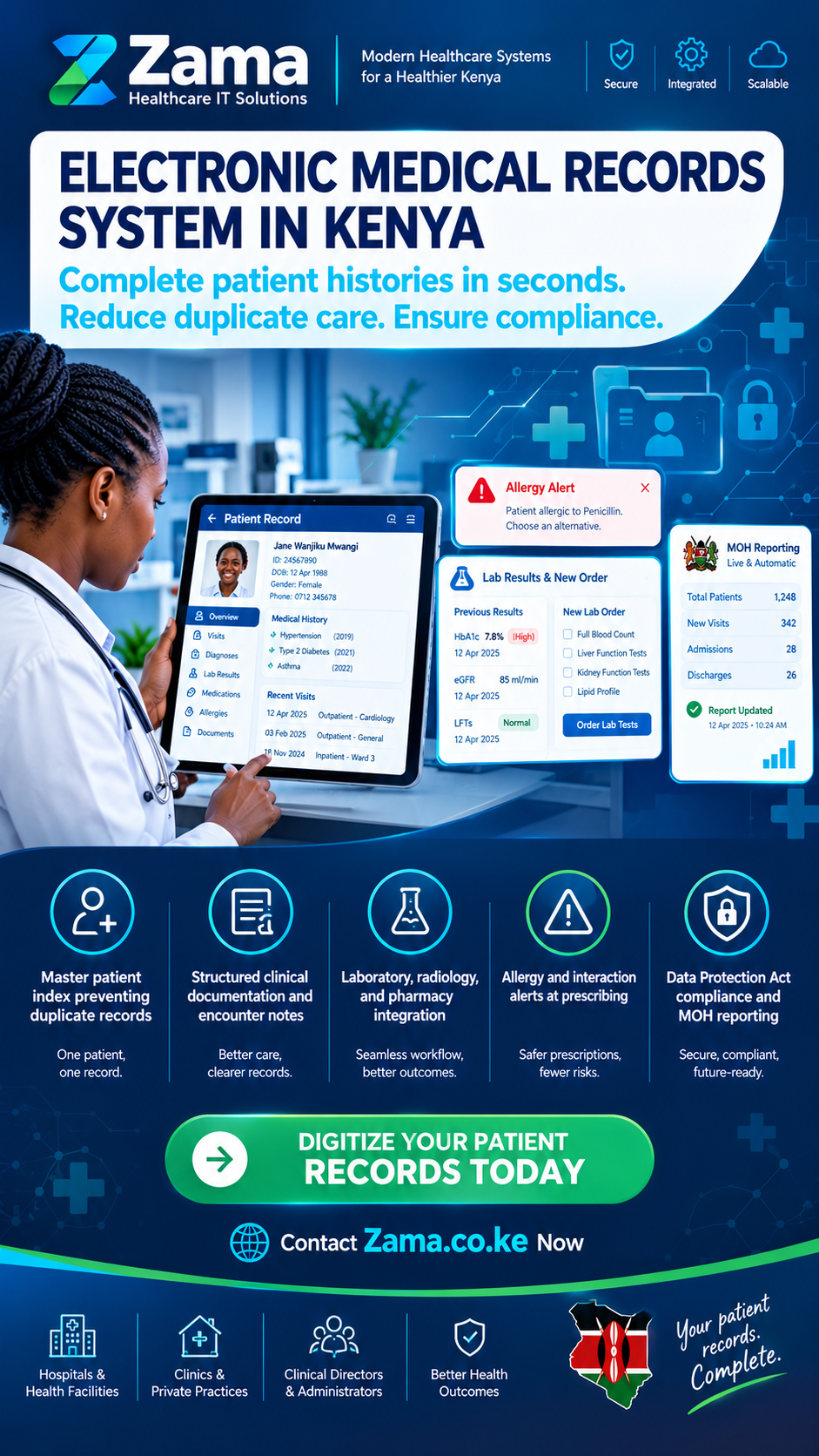
Electronic medical records system in Kenya is a question that every hospital administrator, clinic owner, and clinical director must answer in 2026. With Kenyan healthcare facilities drowning in paper files, patients receiving care across multiple facilities that cannot share records, the Social Health Authority requiring digital claims evidence, and the Data Protection Act imposing strict controls on health data, the move to electronic records has become a clinical safety issue and a compliance necessity. At zama.co.ke, we’ve helped numerous healthcare facilities across Kenya implement electronic medical records systems that make patient histories instantly available, eliminate duplicate investigations, and ensure that every clinical decision is informed by complete information. This comprehensive guide explores the electronic medical records system in Kenya, from understanding what an EMR delivers to selecting the right implementation approach for your facility.
What an Electronic Medical Records System Actually Delivers
Before diving into the electronic medical records system in Kenya, it’s essential to understand what this technology actually does. An electronic medical records system is a digital platform that captures, stores, retrieves, and manages patient clinical information across every encounter—registration, triage, consultation, laboratory, radiology, pharmacy, admission, and discharge. It replaces the paper file that follows a patient around the hospital with a digital record that is available wherever the patient is seen.
A proper electronic medical records system in Kenya does far more than scan documents into folders. It captures structured clinical data—vitals, symptoms, diagnoses, prescriptions, allergies, results—so that information can be searched, trended, and used to support clinical decisions. It makes the full patient history available to any authorised clinician within seconds. It connects orders for laboratory, radiology, and pharmacy to the encounter that generated them. It alerts clinicians to allergies and interactions at the point of prescribing.
For a Kenyan healthcare facility, the practical definition of an electronic medical records system in Kenya is this: the platform that tells any authorised clinician exactly what this patient’s history is, exactly what has been prescribed, exactly what results exist, and exactly what allergies or risks apply—at the moment of care, wherever the patient is being seen.
Why Kenyan Healthcare Facilities Need Electronic Medical Records
When evaluating the electronic medical records system in Kenya, consider the compelling reasons for adoption:
The Paper File Problem
In most Kenyan hospitals, the patient file is a physical folder. It is created at registration, carried from department to department, and filed at the end of the visit. If the patient returns, staff must find the file in the records room. If the file is misplaced—which happens constantly—the clinician must proceed without history.
A modern electronic medical records system in Kenya eliminates the paper file problem entirely. The record exists digitally and is available instantly. It cannot be misplaced. Multiple clinicians can view it simultaneously. It follows the patient across departments, facilities, and visits.
Clinical Safety and Duplicate Care
Paper records create clinical risk. A patient’s allergy to penicillin may be noted in a file that is not available at the prescribing point. A patient may undergo the same laboratory test twice because the earlier result cannot be found. A patient may receive conflicting medications because the prescribing clinician cannot see what another clinician prescribed yesterday.
A proper electronic medical records system in Kenya addresses these risks directly. Allergy and interaction alerts fire at prescribing. Previous results are visible before new tests are ordered. Medication history is complete and current. Duplicate investigations are prevented because the previous result is one click away.
The SHA and Claims Evidence Problem
The Social Health Authority requires evidence to support claims. Facilities must demonstrate that services billed were actually delivered, with clinical justification. Paper records make assembling this evidence slow and error-prone, which contributes to rejected claims and delayed reimbursements.
A comprehensive electronic medical records system in Kenya generates clinical evidence automatically. Every service billed is linked to the clinical encounter that justified it. Claims submission includes the supporting documentation. Rejections fall, and reimbursements accelerate.
Continuity Across Facilities and Referrals
Kenyan patients often receive care at multiple facilities—a local clinic, a county hospital, and a specialist referral centre. Without shared records, each facility starts from zero. Tests are repeated. Histories are retaken. Medication errors occur because the receiving clinician does not know what the referring clinician prescribed.
A quality electronic medical records system in Kenya supports continuity through structured referral documentation, shared patient identifiers, and, where appropriate, interoperability between facilities. The receiving clinician sees the referring clinician’s notes, results, and treatment—not just a handwritten referral slip.
Data Protection Act Compliance
Health data is the most sensitive category of personal data under Kenya’s Data Protection Act. The Office of the Data Protection Commissioner has been actively enforcing compliance and has issued guidance specific to health data, including requirements for consent, access controls, retention, and secure disposal. A paper records room cannot satisfy these requirements—anyone with a key can read any file.
A compliant electronic medical records system in Kenya implements role-based access so that clinicians see only the patients they are treating, encryption at rest and in transit, comprehensive audit trails showing who accessed what and when, and retention policies aligned with medical records regulations.
Ministry of Health Reporting
Kenyan facilities must submit regular reports to the Ministry of Health—MOH 705A and 705B, MOH 711, MOH 710, MOH 717, MOH 505, MOH 706, and MOH 643. Compiling these manually from paper registers consumes days each month and introduces errors. A quality electronic medical records system in Kenya generates these reports automatically from the data captured during routine care.
Efficiency and Cost Reduction
Paper records consume physical space, staff time, and administrative effort. Records clerks retrieve and re-file thousands of files each month. Paper, printing, and storage costs accumulate. Clinicians wait for files to arrive.
A proper electronic medical records system in Kenya eliminates most of these costs. Records are retrieved instantly. Printing and storage costs fall dramatically. Clinicians spend their time on care rather than waiting.
Key Modules of an Electronic Medical Records System in Kenya
When evaluating the electronic medical records system in Kenya, focus on these core modules:
1. Patient Registration and Master Patient Index
The foundation is a master patient index that prevents duplicate records and provides a unique identifier used across all modules. A proper system captures demographics, next of kin, insurance or SHA details, and consent for data processing—and links every subsequent encounter to the same patient record.
2. Clinical Documentation and Encounter Notes
Clinical documentation must capture what happened during each encounter in a structured, searchable format. A comprehensive electronic medical records system in Kenya provides structured templates for different encounter types—outpatient consultation, inpatient admission, emergency, antenatal—with free-text notes where needed, diagnosis coding, and linkage to the patient’s longitudinal record.
3. Vitals and Clinical Measurements
Vitals must be captured and trended. A quality electronic medical records system in Kenya records temperature, blood pressure, pulse, respiratory rate, oxygen saturation, weight, and height, displays trends over time, and flags abnormal values for clinical attention.
4. Problem List and Allergy Register
A patient’s active problems and allergies must be immediately visible. A proper electronic medical records system in Kenya maintains an active problem list and an allergy register that alert at prescribing and display prominently on the patient summary screen.
5. Medication Management and e-Prescribing
Medication management is central to clinical care. A comprehensive electronic medical records system in Kenya supports electronic prescribing with allergy and interaction checks, links prescriptions to pharmacy dispensing, maintains a complete medication history, and supports medication reconciliation on admission and discharge.
6. Laboratory Ordering and Results
Laboratory workflows must be integrated. A quality electronic medical records system in Kenya allows clinicians to order tests directly from the encounter, tracks sample status, receives results electronically, flags abnormal values, and stores results permanently in the patient record.
7. Radiology and Imaging
Imaging workflows must connect to clinical encounters. A proper electronic medical records system in Kenya supports imaging orders, scheduling, reporting, and delivery of reports to the ordering clinician and the patient record.
8. Inpatient and Ward Management
For facilities with inpatient services, ward management is essential. A comprehensive electronic medical records system in Kenya manages admissions, bed allocation, ward rounds, nursing notes, medication administration records, and discharge summaries.
9. Immunization and Preventive Care
Preventive care records must be maintained. A quality electronic medical records system in Kenya tracks immunizations, generates reminders for due vaccinations, and supports reporting to the Ministry of Health.
10. Audit Trails and Access Control
Every access to a patient record must be logged. A proper electronic medical records system in Kenya maintains immutable audit trails showing who accessed which record, when, and from which device—supporting both Data Protection Act compliance and clinical accountability.
What Makes an Electronic Medical Records System Different in Kenya
The electronic medical records system in Kenya has unique characteristics that global solutions often lack:
SHA Integration
Kenyan healthcare financing now runs through the Social Health Authority. A system built for Kenya links clinical encounters to SHA eligibility and claims, ensuring that documented care supports reimbursement.
Ministry of Health Reporting
Kenyan facilities must submit specific MOH reports. A system built for Kenya generates MOH 705A and 705B, MOH 711, MOH 710, MOH 717, MOH 505, MOH 706, and MOH 643 automatically from routine clinical data.
Low-Bandwidth and Offline Operation
Connectivity across Kenya varies widely. A system built for Kenya operates offline for critical clinical functions and syncs when connectivity returns, so that patient care does not stop during outages.
Multi-Language and Low-Literacy Support
Kenyan clinical environments involve staff and patients with varying literacy and language backgrounds. A system built for Kenya supports English and Swahili interfaces and uses clear, unambiguous clinical terminology.
Data Protection Act Alignment
Health data is sensitive personal data under Kenya’s Data Protection Act. A compliant system implements consent, role-based access, encryption, audit trails, and retention aligned with the Act and medical records regulations.
PPB and Clinical Standards Alignment
Kenyan prescribing, dispensing, and documentation follow Pharmacy and Poisons Board requirements. A system built for Kenya aligns with these requirements rather than imposing foreign conventions.
Integration with Local Pharmacy and Laboratory Systems
Many Kenyan facilities use specific laboratory and pharmacy systems. A system built for Kenya is designed to integrate with these local platforms.
Local Support
Kenyan facilities need support in their timezone and language. Local support is a practical requirement.
Key Factors That Determine Cost
When analysing cost, several factors directly influence pricing:
1. Facility Size and Complexity
A small outpatient clinic needs a fraction of the functionality of a referral hospital with inpatient wards, theatre, ICU, and multiple specialties.
2. Number of Modules
Registration, clinical documentation, laboratory, radiology, pharmacy, inpatient, immunization—each module adds development and configuration effort.
3. Clinical Specialty Requirements
Specialty-specific templates, workflows, and reporting add to the build.
4. Integration Depth
Integration with laboratory systems, pharmacy systems, PACS, SHA, and eTIMS determines complexity.
5. Number of Locations
Multiple facilities or branches add configuration and interoperability complexity.
6. Data Migration Scope
Migrating existing paper records or legacy digital records requires significant effort and validation.
7. Security and Compliance Requirements
Role-based access, encryption, audit trails, and Data Protection Act compliance add to development effort.
8. Deployment Model
Cloud, on-premise, or hybrid deployment affects cost and ongoing support.
9. Training and Ongoing Support
Training clinicians, nurses, and administrative staff, plus ongoing support, contributes to total cost.
For a transparent quote based on your facility’s specific requirements, contact zama.co.ke today.
Use Cases
Private Hospitals
Private hospitals use EMR systems to digitize the full patient journey, integrate billing and claims, and differentiate their clinical offering.
County and Referral Hospitals
Large public facilities use EMR systems to manage high patient volumes, generate MOH reports automatically, and maintain continuity across departments.
Small and Medium Clinics
Clinics use lightweight EMR systems to maintain complete patient histories without paper filing, and to support chronic care follow-up.
Specialised Clinics
Dermatology, ophthalmology, mental health, and fertility clinics use specialty-configured EMR systems tailored to their clinical workflows.
HIV and Chronic Disease Programs
Programs managing HIV, TB, diabetes, and hypertension use EMR systems for longitudinal tracking, adherence monitoring, and reporting to donors and the Ministry of Health.
Maternal and Child Health Facilities
Facilities providing antenatal, delivery, and child welfare services use EMR systems for maternal records, birth documentation, and immunization tracking.
The Zama.co.ke Approach to Electronic Medical Records System Development
When considering the electronic medical records system in Kenya, zama.co.ke follows a structured approach:
Clinical and Operational Discovery
We map patient pathways, clinical documentation requirements, departmental workflows, and reporting obligations.
System Design
We design the data model, clinical templates, role-based access, and integration points.
Development and Integration
We build the system, integrate laboratory, pharmacy, SHA, and eTIMS where applicable, and configure clinical alerts and reports.
Testing and Data Migration
We test clinical scenarios, alerting behaviour, and integration reliability, then migrate existing patient data where appropriate.
Training and Support
We train clinicians, nurses, pharmacists, and records staff, and provide go-live support.
Post-Launch Optimization
We monitor system usage, gather clinical feedback, and refine templates and workflows.
The ROI
When evaluating the electronic medical records system in Kenya, the ROI is compelling:
Improved Clinical Safety: Allergy alerts and complete histories reduce adverse events.
Reduced Duplicate Investigations: Previous results are visible before new tests are ordered.
Faster Claims Reimbursement: Clinical evidence supports every billed service.
Eliminated File Retrieval Delays: Records are available instantly.
Reduced Storage Costs: Paper files, cabinets, and records rooms shrink or disappear.
Automated MOH Reporting: Reports generate from routine clinical data.
Compliance Protection: Data Protection Act controls are built in from day one.
Implementation Considerations
Assess Your Clinical Requirements
Document which specialties you serve, what documentation standards apply, and what reporting obligations you face.
Choose the Right Solution
Match complexity to your facility. A clinic needs less than a referral hospital.
Plan for Data Migration
Decide which historical records must be migrated and validate accuracy carefully.
Train Your Team
Clinicians, nurses, pharmacists, and records staff all interact with the EMR and need role-specific training.
Ensure Compliance
Build Data Protection Act, MOH reporting, and PPB alignment in from day one.
Test Thoroughly
Test clinical documentation, alerting, ordering, results, and offline behaviour.
Consider a Phased Rollout
Start with registration and clinical documentation, then add laboratory, pharmacy, and inpatient modules.
The Cost of Delaying
While facilities evaluate the electronic medical records system in Kenya, the cost of inaction compounds daily. Every day of paper records is clinical risk. Every day of missing history is duplicate investigations. Every day of manual reporting is wasted staff time. Every day of uncontrolled access is a Data Protection Act exposure.
Why Contact Zama.co.ke
When researching the electronic medical records system in Kenya, facilities should contact zama.co.ke because:
Healthcare Expertise: We understand clinical workflows, documentation standards, and Kenyan regulation.
MOH Reporting: We automate the reports your facility must submit.
SHA Integration: We connect clinical documentation to eligibility and claims.
Security Focus: We implement role-based access, encryption, and audit trails aligned with the Data Protection Act.
Custom Development: We build systems matched to your clinical pathways and specialties.
Transparent Pricing: No hidden fees and full source-code ownership.
Ongoing Support: We stay available as your facility grows.
For a custom quote based on your facility’s specific requirements, contact zama.co.ke today.
The electronic medical records system in Kenya is essential for any healthcare facility seeking to improve clinical safety, reduce duplicate care, accelerate claims, and meet regulatory obligations. From patient registration and clinical documentation to laboratory, pharmacy, and MOH reporting, the right EMR changes how your facility delivers care.
At zama.co.ke, we’ve helped healthcare facilities across Kenya implement electronic medical records systems that deliver measurable results. Our approach ensures you get exactly what your facility needs—nothing more, nothing less.
Don’t let the complexity of an electronic medical records system in Kenya hold you back. Whether you run a small clinic, a specialised centre, or a referral hospital, we have the expertise to guide you through every step.
Contact zama.co.ke today for a custom quote based on your facility’s specific requirements.