
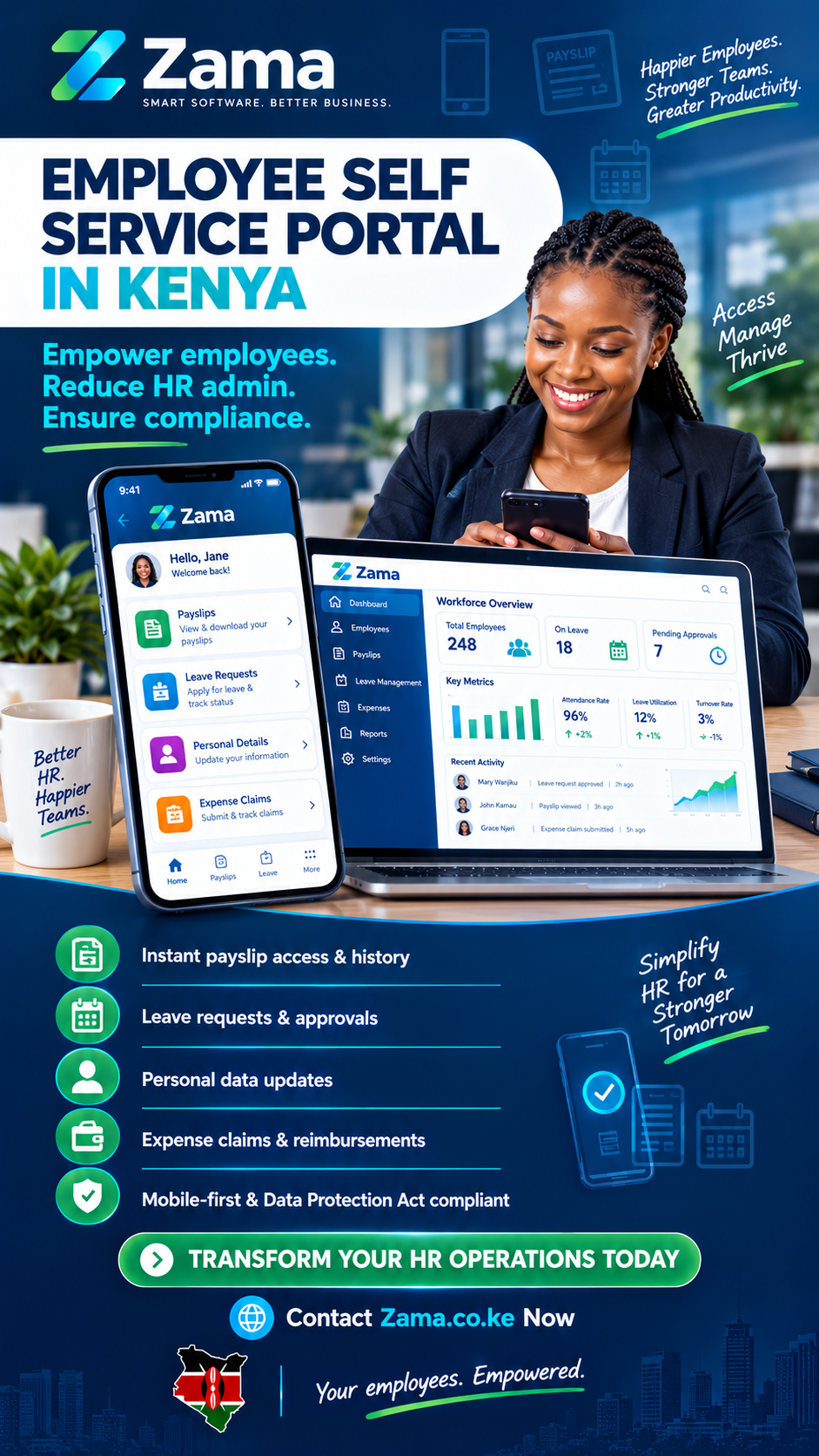
Employee self service portal in Kenya is a question that every HR director, operations manager, and business owner must answer in 2026. With Kenyan organizations managing increasingly distributed workforces, employees expecting digital experiences similar to the M-Pesa and mobile banking apps they use daily, and HR teams drowning in manual requests for payslips, leave approvals, and personal data updates, the shift to self-service portals has become essential for operational efficiency. At zama.co.ke, we’ve helped numerous organizations across Kenya implement custom employee self service portals that eliminate paperwork, accelerate HR workflows, and improve employee satisfaction. This comprehensive guide explores employee self service portal in Kenya, from understanding what these portals deliver to selecting the right solution for your organization.
What an Employee Self Service Portal Actually Delivers
Before diving into employee self service portal in Kenya, it’s essential to understand what this technology actually does. An employee self service portal is a secure, browser-based platform where employees can access and manage their own HR information without needing to contact HR staff. It replaces paper forms, email requests, WhatsApp messages, and visits to the HR office with digital workflows that employees can complete from any device.
A proper employee self service portal in Kenya does far more than display payslips. It enables employees to request leave, update personal details, download payslips and tax documents, view attendance records, access company policies, submit expense claims, complete performance reviews, and manage benefits enrollment. It connects to payroll, attendance, and HR systems so that data flows automatically and HR staff are freed from routine administrative tasks.
For a Kenyan organization, the practical definition of employee self service portal in Kenya is this: the platform that gives every employee secure access to their own HR information and workflows—from payslips and leave requests to personal data updates and performance reviews—while reducing the administrative burden on HR teams and ensuring compliance with Kenyan labour laws and the Data Protection Act.
Why Kenyan Organizations Need Employee Self Service Portals
When evaluating employee self service portal in Kenya, consider the compelling reasons for adoption:
The Administrative Burden on HR Teams
Most Kenyan HR teams spend a disproportionate amount of time on routine administrative tasks. An employee needs a payslip—they call HR. An employee wants to request leave—they fill a paper form. An employee changes their phone number—they email HR. An employee wants to check their leave balance—they visit the HR office. These individual requests add up to thousands of hours annually for a mid-sized organization.
A modern employee self service portal in Kenya eliminates these routine requests. Employees access their own information and complete their own workflows. HR teams focus on strategic initiatives—recruitment, talent development, culture, and compliance—rather than administrative paperwork.
Employee Expectations Have Changed
Kenyan employees now expect digital experiences. They use M-Pesa to pay for everything. They order food, hail rides, and shop online. They bank from their phones. They expect the same convenience from their employer. A company that requires employees to queue for payslips, fill paper forms for leave, and visit HR for basic information feels outdated and unprofessional.
A proper employee self service portal in Kenya meets these expectations. Employees access their HR information from their phones, at any time, from anywhere. This improves employee satisfaction and strengthens your employer brand.
Distributed and Remote Workforces
Kenyan organizations increasingly have distributed workforces—field staff in remote locations, employees in multiple branch offices, and remote workers at home. Managing HR workflows across a distributed workforce requires digital tools. Paper forms and physical presence do not scale.
A comprehensive employee self service portal in Kenya supports a distributed workforce. Employees in Kisumu, Mombasa, or Nairobi access the same portal. Approvers review requests from their phones. HR teams manage the entire workforce from a single dashboard.
Data Protection Act Compliance
Kenya’s Data Protection Act imposes strict requirements on how organizations handle employee data. Employees have the right to access their own data, request corrections, and understand how their data is used. A compliant employee self service portal in Kenya supports these rights. Employees can view their data, request corrections, and exercise their rights—all through a secure, audited portal.
Cost Reduction
Employee self service portals reduce costs. Less paper. Less printing. Less physical storage. Less administrative time. Less data entry. These savings add up quickly. For a mid-sized organization, the ROI from reduced administrative costs alone often justifies the investment.
Key Features of Employee Self Service Portals in Kenya
When evaluating employee self service portal in Kenya, focus on these core features:
1. Payslip Access and History
The most common self-service function is payslip access. A proper employee self service portal in Kenya should provide employees with instant access to their current payslip and historical payslips. Payslips should be downloadable as PDFs and viewable on mobile devices. They should show earnings, deductions, and net pay, with breakdowns for PAYE, NSSF, SHIF, AHL, and other deductions.
2. Leave Request and Approval
Leave management is another core self-service function. Employees should be able to view their leave balance, request leave, and track approval status. The portal should automatically check leave balances, route requests to the appropriate approver, and update records upon approval. Manager approvals should be possible from mobile devices, ensuring that leave requests are processed promptly.
A comprehensive employee self service portal in Kenya supports all leave types—annual leave, sick leave, maternity leave, paternity leave, compassionate leave—with balances configurable according to Employment Act requirements and organizational policy.
3. Personal Data Updates
Employees should be able to update their own personal data—phone number, email address, physical address, emergency contact, bank details, and next of kin. The portal should validate updates, log changes for audit purposes, and notify HR when sensitive details change.
A quality employee self service portal in Kenya ensures that employee data remains current without HR staff having to chase updates manually. When employees change their phone number or bank account, they update it themselves—securely and immediately.
4. Attendance and Time Records
For organizations using attendance tracking, the portal should provide employees with visibility into their own attendance records. Employees can view clock-in and clock-out times, hours worked, overtime accrued, and absence records. This transparency reduces disputes and improves accountability.
5. Expense Claims and Reimbursements
Employees often incur expenses on behalf of the organization—travel, client entertainment, supplies. The portal should allow employees to submit expense claims with receipt attachments, route claims to approvers, and track reimbursement status. Integration with M-Pesa enables instant reimbursement to employee accounts.
6. Performance Management
Performance management can be integrated into the self-service portal. Employees can view their performance goals, submit self-assessments, complete 360-degree feedback, and access performance review outcomes. Managers can conduct reviews, provide feedback, and set goals for their teams.
7. Document Access
Company policies, employee handbooks, HR forms, and other documents should be accessible through the portal. Employees can download, review, and acknowledge policies. HR can track acknowledgment for compliance purposes.
8. Training and Development
The portal can include training resources, course registrations, and certification tracking. Employees can register for training, access e-learning materials, and track their development progress.
9. Benefits Administration
For organizations offering benefits—health insurance, retirement plans, wellness programs—the portal can manage enrollments, provide information about benefits, and track claims or contributions.
10. Announcements and Communication
The portal can serve as a communication channel for HR announcements, company news, and important updates. Notifications can be configured for different employee groups.
What Makes Employee Self Service Portals in Kenya Different
employee self service portal in Kenya has unique characteristics that global solutions often lack:
Kenyan Payroll Integration
Employee self service portals in Kenya must integrate with Kenyan payroll systems that calculate PAYE, NSSF, SHIF, AHL, and other statutory deductions. Global portals may not support these calculations natively. A proper Kenyan portal integrates with the payroll system to ensure that payslips and deductions are accurate.
M-Pesa Integration
For expense reimbursements, salary advances, and other payments, M-Pesa integration is essential. A proper employee self service portal in Kenya supports M-Pesa B2C payments to employee accounts, with automated reconciliation.
Mobile-First Design
Kenyan employees predominantly access the internet via mobile phones. A proper employee self service portal in Kenya is designed mobile-first. The interface works beautifully on small screens, even with limited bandwidth. The portal loads quickly, works reliably on low-bandwidth connections, and supports offline access for critical functions.
Data Protection Act Compliance
Kenyan employee self service portals must comply with the Data Protection Act. This means implementing consent management, access controls, audit trails, and data subject rights. The portal must be registered as a data processor or controller with the Office of the Data Protection Commissioner.
Offline and Low-Bandwidth Capability
Internet in Kenya is not always reliable, especially outside major urban centres. Good employee self service portals should work with minimal data usage and function offline when needed, syncing when connection returns.
Local Support and Training
The best employee self service portal in Kenya providers offer local support, training, and implementation services. Organizations need a partner who can respond quickly when issues arise and who understands the Kenyan regulatory environment.
Key Factors That Determine Employee Self Service Portal Cost in Kenya
When analysing employee self service portal costs in Kenya, several factors directly influence pricing:
1. Number of Employees
The number of employees who need access to the portal is a primary cost driver. A small organization with 50 employees has simpler requirements than a large enterprise with 5,000 employees. Licensing models vary—some charge per employee, others offer tiered pricing based on employee bands.
2. Modules Required
The features included in the portal affect cost. Basic portals provide payslip access and leave requests. Advanced portals add expense claims, performance management, training, and benefits administration. Each module adds development and licensing cost.
3. Integration Requirements
Integration with payroll, attendance, accounting, and M-Pesa adds to development cost. Each integration requires development effort and ongoing maintenance.
4. Security and Compliance Requirements
Security requirements—encryption, multi-factor authentication, access controls, audit trails—add to development cost. Data Protection Act compliance requires additional effort.
5. Mobile App Requirements
If a native mobile app is required—rather than a mobile-responsive web portal—this adds to development cost. Native apps provide better performance and offline capability but require separate development for iOS and Android.
6. Deployment Model
The deployment model affects cost. On-premise deployment requires server hardware and IT infrastructure. Cloud-based deployment shifts infrastructure responsibility to the vendor. Hybrid deployment combines both approaches.
7. Customization Requirements
Customization—custom workflows, custom branding, custom reports—adds to development cost.
8. Training and Change Management
Training employees and HR staff on the new portal adds to the overall investment.
9. Ongoing Support and Maintenance
Ongoing support, security patches, and upgrades contribute to the total cost of ownership.
For a transparent quote based on your organization’s specific requirements, contact zama.co.ke today.
Employee Self Service Portal Use Cases in Kenya
Corporate Enterprises
Corporate organizations use employee self service portals to manage HR workflows for thousands of employees. Employees access payslips, request leave, update personal data, and complete performance reviews through the portal.
Manufacturing and Industrial
Manufacturers use employee self service portals to manage shift workers, track attendance, and process leave requests. Integration with biometric attendance systems ensures accurate time tracking.
Retail Chains
Retail chains use employee self service portals to manage staff across multiple branches. Employees access payslips, request leave, and view their schedules.
Hospitals and Healthcare
Healthcare facilities use employee self service portals to manage clinical and non-clinical staff, track certifications, and process leave requests.
Educational Institutions
Schools and universities use employee self service portals to manage teaching and non-teaching staff, track qualifications, and process leave.
NGOs and Development Organizations
NGOs use employee self service portals to manage staff across programs and locations, track donor-funded positions, and process claims.
Government and Public Sector
Government ministries, departments, and agencies use employee self service portals to manage large workforces and process HR workflows at scale.
The Zama.co.ke Approach to Employee Self Service Portal Development in Kenya
When considering employee self service portal in Kenya, zama.co.ke follows a structured approach:
Requirements Discovery
We evaluate your organization’s HR operations, workforce size, leave policies, payroll requirements, and compliance obligations. This includes understanding your current challenges and defining success metrics.
Portal Design
We design the portal architecture—user interfaces, integration points, security controls, and reporting. The design supports your specific HR workflows and organizational structure.
Development and Integration
We develop the portal, build integrations with payroll, attendance, accounting, and M-Pesa, and configure workflows, approvals, and reports. The portal is configured to support your specific HR processes.
Data Migration
We migrate existing employee records, leave balances, and historical data into the new portal. We validate data accuracy before migration and ensure that historical records are preserved.
Security and Compliance
We implement encryption, access controls, audit trails, and Data Protection Act compliance. The portal is registered as a data processor or controller where required.
Training and Support
We provide role-specific training for HR staff, managers, and employees. We remain available for ongoing support, maintenance, and portal upgrades.
Post-Launch Optimization
After go-live, we monitor performance, gather user feedback, and refine the portal to improve user experience and HR efficiency.
The ROI of Employee Self Service Portals in Kenya
When evaluating employee self service portal in Kenya, the ROI is compelling:
Reduced Administrative Costs: HR teams spend less time on routine requests. For a mid-sized organization, this can save thousands of hours annually.
Improved Employee Satisfaction: Employees access information instantly, from anywhere. This improves satisfaction and retention.
Faster HR Workflows: Leave requests, expense claims, and approvals move faster through digital workflows.
Reduced Errors: Automated calculations and validations reduce errors in payroll, leave balances, and personal data.
Compliance Protection: Audit trails and access controls support Data Protection Act compliance.
Paperless Operations: Reduced paper usage and printing delivers cost savings and environmental benefits.
Scalability: The portal scales with your organization, adding employees and features without rebuilding.
Implementation Considerations for Kenyan Organizations
When implementing an employee self service portal, consider these factors:
Assess Your HR Processes
Before selecting a portal, map your current HR processes. How do employees request leave? How do they access payslips? How do they update personal data? What are the pain points? This assessment forms the foundation for portal design.
Choose the Right Solution
The best portal for your organization depends on your size, industry, and requirements. A small organization may need basic payslip and leave functionality. A large enterprise may need a comprehensive HR suite.
Plan for Data Migration
Migrating employee records and leave balances requires careful validation. Ensure employee details and leave balances are accurate before migration.
Train Your Team
HR staff, managers, and employees need training on the new portal. Role-specific training produces higher adoption.
Ensure Compliance
Configure the portal for Data Protection Act compliance from day one. Ensure encryption, access controls, and audit trails are properly configured.
Test Thoroughly
Test all scenarios: payslip access, leave requests, personal data updates, and approvals. Ensure the portal works correctly on mobile devices and low-bandwidth connections.
Consider a Phased Rollout
For large organizations, consider a phased rollout. Start with payslip access and leave requests, prove the portal works, refine based on feedback, then expand to other modules.
The Cost of Delaying Employee Self Service Portal Implementation
While organizations evaluate employee self service portal in Kenya, the cost of inaction compounds daily. Every month of manual HR processes represents wasted staff time and missed opportunities. Every month of employee frustration represents retention risk. Every month of paper-based processes represents compliance risk.
Meanwhile, organizations with employee self service portals are achieving administrative efficiency, improved employee satisfaction, and compliance. The competitive gap widens with every passing month.
Why Contact Zama.co.ke for Employee Self Service Portal Development in Kenya
When researching employee self service portal in Kenya, organizations should contact zama.co.ke because:
Local Expertise: We understand Kenyan HR requirements, including payroll, leave, and Data Protection Act compliance.
Custom Development: We build portals tailored to your specific HR workflows, organizational structure, and compliance requirements, not generic solutions.
Integration Capabilities: We connect portals to payroll, attendance, accounting, and M-Pesa systems.
Mobile-First Design: We build mobile-responsive portals that work beautifully on any device.
Transparent Pricing: No hidden fees, clear milestone timelines, and full source-code ownership.
Ongoing Support: We remain available for maintenance, statutory updates, and portal upgrades as your organization evolves.
For a custom quote based on your organization’s specific requirements, contact zama.co.ke today.
Employee self service portal in Kenya is essential for any organization seeking to reduce administrative burden, improve employee satisfaction, and ensure compliance. From payslip access and leave requests to personal data updates and performance management, the right portal transforms how organizations manage their workforce.
At zama.co.ke, we’ve helped organizations across Kenya implement employee self service portals that deliver measurable results. Our approach ensures you get exactly what your organization needs—nothing more, nothing less.
Don’t let the complexity of employee self service portal in Kenya hold you back. Whether you’re a small business or a large enterprise, we have the expertise to guide you through every step.
Contact zama.co.ke today for a custom quote based on your organization’s specific requirements.