
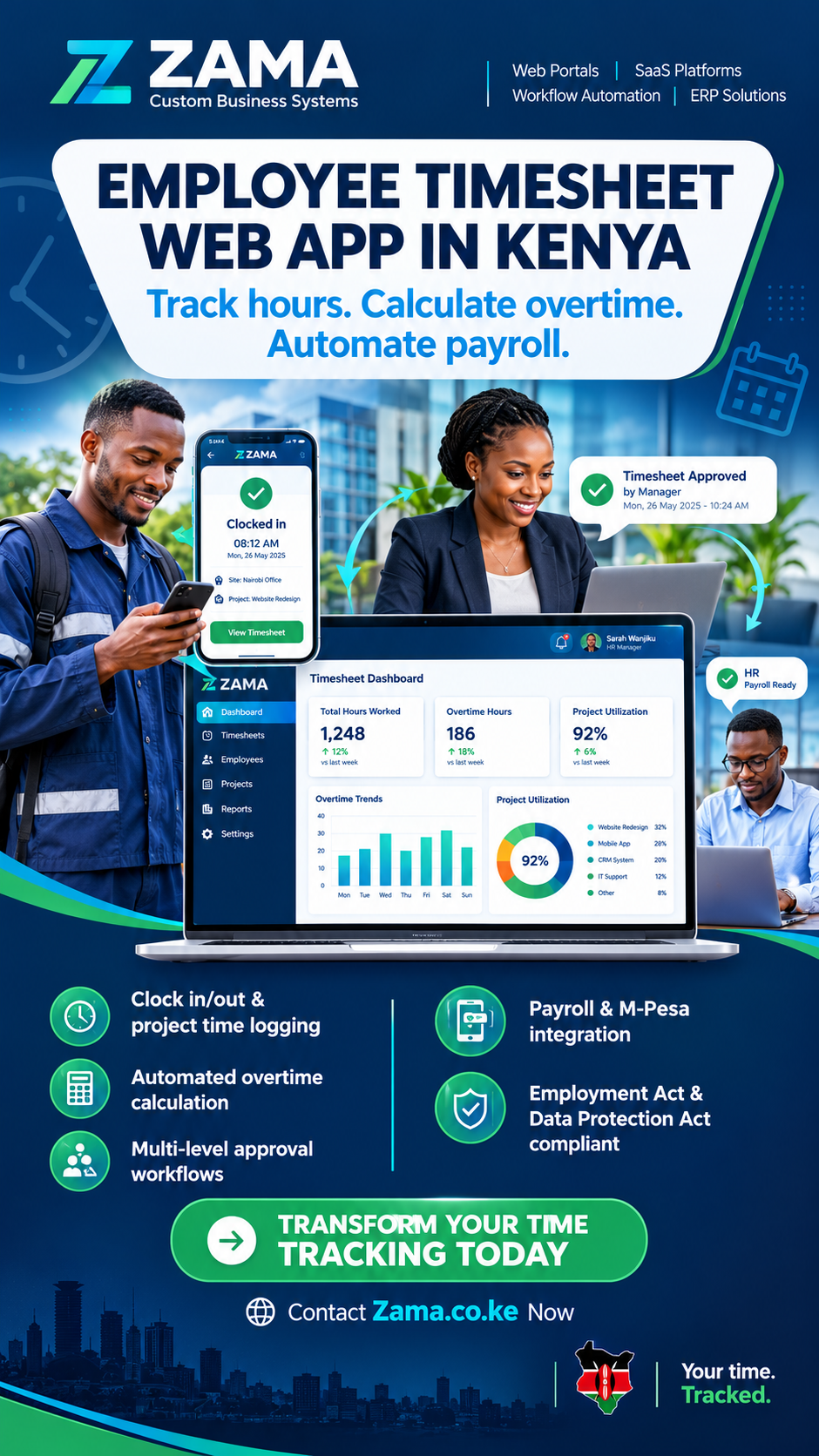
Employee timesheet web app in Kenya is a question that every HR director, operations manager, and business owner must answer in 2026. With Kenyan organizations managing increasingly distributed workforces, project-based teams, and hourly employees across multiple locations, the need for accurate time tracking has never been greater. At zama.co.ke, we’ve helped numerous organizations across Kenya implement custom timesheet web apps that eliminate manual time tracking, automate payroll calculations, and provide real-time visibility into workforce productivity. This comprehensive guide explores employee timesheet web app in Kenya, from understanding what these apps deliver to selecting the right solution for your organization.
What an Employee Timesheet Web App Actually Delivers
Before diving into employee timesheet web app in Kenya, it’s essential to understand what this technology actually does. An employee timesheet web app is a browser-based platform where employees record their working hours—whether clocking in and out, logging time against projects, or submitting weekly timesheets. It replaces paper timesheets, spreadsheet logs, and manual time tracking with digital records that flow automatically into payroll and project accounting.
A proper employee timesheet web app in Kenya does far more than record hours. It captures clock-in and clock-out times, calculates hours worked, applies overtime rules, tracks time against projects or clients, routes timesheets for approval, integrates with payroll for salary calculations, and provides dashboards showing workforce utilization and productivity.
For a Kenyan organization, the practical definition of employee timesheet web app in Kenya is this: the platform that tells you exactly how many hours every employee worked, exactly what projects they worked on, exactly how much overtime they accrued, exactly what they should be paid, and exactly how your workforce is being utilized—all in real time, from any device.
Why Kenyan Organizations Need Employee Timesheet Web Apps
When evaluating employee timesheet web app in Kenya, consider the compelling reasons for adoption:
The Cost of Manual Time Tracking
Manual time tracking is expensive and inaccurate. Paper timesheets get lost. Spreadsheet logs contain errors. Employees forget to record hours. Managers approve timesheets without verification. Payroll is calculated from inaccurate data, resulting in overpayments, underpayments, and disputes.
A modern employee timesheet web app in Kenya eliminates these problems. Employees record hours digitally. The app calculates totals automatically. Approvals are tracked. Data flows into payroll without manual entry. Errors are eliminated.
Project-Based and Client Billing
Many Kenyan organizations bill clients based on hours worked—consultancies, law firms, accounting practices, creative agencies, and IT service providers. Accurate time tracking is essential for accurate billing. Under-recording hours means lost revenue. Over-recording hours means client disputes.
A proper employee timesheet web app in Kenya tracks time against projects or clients. Employees record hours against specific engagements. The app generates billing reports showing exactly how much time was spent on each client. Revenue is maximized. Disputes are minimized.
Overtime Calculation and Compliance
Kenyan employment law specifies overtime rates—weekday overtime, weekend overtime, and public holiday overtime. Calculating overtime accurately requires knowing exactly when employees worked. Manual systems struggle with this complexity.
A comprehensive employee timesheet web app in Kenya calculates overtime automatically based on recorded hours. It applies the correct rates for weekdays, weekends, and public holidays. It generates overtime reports for payroll.
Distributed and Remote Workforces
Kenyan organizations increasingly have distributed workforces—field staff, remote workers, and employees across multiple offices. Tracking hours across a distributed workforce requires digital tools. Paper timesheets and physical presence do not scale.
A quality employee timesheet web app in Kenya supports a distributed workforce. Employees in Kisumu, Mombasa, or Nairobi record hours through the same app. Managers approve timesheets from their phones. HR sees the entire workforce from a single dashboard.
Real-Time Visibility
Management needs visibility into workforce utilization. Who is working on what? Which projects are consuming more time than budgeted? Which employees are overworked? Which are underutilized?
A proper employee timesheet web app in Kenya provides real-time dashboards showing utilization, project hours, and overtime trends. Management can make informed decisions about resource allocation.
Data Protection Act Compliance
Kenya’s Data Protection Act imposes strict requirements on how organizations handle personal data. Timesheet data includes employee work records, project assignments, and productivity data. A compliant employee timesheet web app in Kenya ensures that this data is collected lawfully, stored securely, retained only as long as necessary, and disposed of appropriately.
Key Features of an Employee Timesheet Web App in Kenya
When evaluating employee timesheet web app in Kenya, focus on these core features:
1. Multiple Time Entry Methods
Different organizations need different time entry methods. A comprehensive employee timesheet web app in Kenya should support:
Clock In/Clock Out: Employees clock in when they start work and clock out when they finish. The app calculates hours worked automatically.
Weekly Timesheets: Employees submit timesheets weekly, recording hours against days or projects.
Project-Based Time Logging: Employees log time against specific projects or clients throughout the day.
Mobile Check-In: Field staff check in from mobile devices, with GPS verification where required.
2. Project and Client Tracking
For organizations that bill clients, project tracking is essential. A proper employee timesheet web app in Kenya should allow employees to record time against specific projects or clients, generate billing reports, and track project budgets versus actual hours.
3. Overtime Calculation
Overtime calculation is complex. A comprehensive employee timesheet web app in Kenya should calculate overtime automatically based on recorded hours, apply the correct rates for weekdays, weekends, and public holidays, and generate overtime reports for payroll.
4. Approval Workflows
Timesheets require approval. A quality employee timesheet web app in Kenya should route timesheets to the appropriate approvers, allow managers to review and approve or reject, and track approval status.
5. Payroll Integration
Timesheet data must flow into payroll. A proper employee timesheet web app in Kenya should integrate with payroll systems so that hours worked, overtime, and project hours flow automatically into salary calculations.
6. Real-Time Dashboards
Management needs visibility. A comprehensive employee timesheet web app in Kenya should provide dashboards showing hours worked, overtime trends, project utilization, and workforce productivity.
7. Mobile Access
Field staff and remote workers need mobile access. A quality employee timesheet web app in Kenya should work beautifully on smartphones, allowing employees to record hours from anywhere.
8. Offline Capability
Internet in Kenya is not always reliable. A proper employee timesheet web app in Kenya should support offline time entry, storing data locally and syncing when connection returns.
9. Reporting and Analytics
HR and management need reports. A comprehensive employee timesheet web app in Kenya should generate reports on hours worked by employee, department, or project; overtime analysis; and utilization trends.
10. Compliance and Audit Trails
Timesheet records must be retained for compliance purposes. A quality employee timesheet web app in Kenya should maintain complete audit trails showing who recorded what hours, when, and who approved them.
What Makes Employee Timesheet Web Apps in Kenya Different
employee timesheet web app in Kenya has unique characteristics that global solutions often lack:
Kenyan Overtime Rules
Kenyan overtime rules are specific—weekday overtime, weekend overtime, and public holiday rates. A proper timesheet app built for Kenya applies these rules automatically.
M-Pesa Integration
For organizations that pay wages or advances via M-Pesa, integration is essential. A proper timesheet app connects to M-Pesa for disbursements based on approved hours.
Mobile-First Design
Kenyan employees predominantly access the internet via mobile phones. A proper employee timesheet web app in Kenya is designed mobile-first.
Offline and Low-Bandwidth Capability
Internet in Kenya is not always reliable. Good timesheet apps should work offline and sync when connection returns.
Local Support and Training
The best employee timesheet web app in Kenya providers offer local support, training, and implementation services.
Key Factors That Determine Employee Timesheet Web App Cost in Kenya
When analysing employee timesheet web app costs in Kenya, several factors directly influence pricing:
1. Number of Employees
The number of employees who need access to the app is a primary cost driver. A small organization with 20 employees has simpler requirements than a large enterprise with 2,000.
2. Time Entry Complexity
The complexity of time entry affects cost. Simple clock-in/clock-out is easier to implement than project-based time logging with client billing.
3. Integration Requirements
Integration with payroll, project management, accounting, and M-Pesa systems adds to development cost.
4. Approval Workflow Complexity
Multi-level approval workflows add to development complexity.
5. Mobile App Requirements
If a native mobile app is required—rather than a mobile-responsive web app—this adds to development cost.
6. Deployment Model
The deployment model affects cost. On-premise deployment requires server hardware and IT infrastructure. Cloud-based deployment shifts infrastructure responsibility to the development partner.
7. Customization Requirements
Customization—custom reports, custom workflows, custom branding—adds to development cost.
8. Training and Change Management
Training employees, managers, and HR staff on the new app adds to the overall investment.
9. Ongoing Support and Maintenance
Ongoing support, statutory updates, and system upgrades contribute to the total cost of ownership.
For a transparent quote based on your organization’s specific requirements, contact zama.co.ke today.
Employee Timesheet Web App Use Cases in Kenya
Professional Services Firms
Law firms, accounting practices, consultancies, and creative agencies use timesheet apps to track billable hours against client projects.
IT and Software Companies
IT companies use timesheet apps to track developer hours against projects, calculate project costs, and bill clients accurately.
Manufacturing and Industrial
Manufacturers use timesheet apps to track shift workers, calculate overtime, and process payroll accurately.
Retail Chains
Retail chains use timesheet apps to track staff hours across multiple branches and process payroll.
Hospitals and Healthcare
Healthcare facilities use timesheet apps to track clinical and non-clinical staff hours, including shift work and overtime.
Construction and Engineering
Construction companies use timesheet apps to track labour hours against projects, calculate project costs, and process payroll.
NGOs and Development Organizations
NGOs use timesheet apps to track staff hours against donor-funded projects and ensure compliance with donor requirements.
The Zama.co.ke Approach to Employee Timesheet Web App Development in Kenya
When considering employee timesheet web app in Kenya, zama.co.ke follows a structured approach:
Requirements Discovery
We evaluate your time tracking requirements, approval workflows, integration needs, and compliance obligations.
App Design
We design the app architecture—time entry methods, approval workflows, integrations, and dashboards.
Development and Integration
We develop the app, build integrations with payroll, project management, and M-Pesa, and configure workflows and reports.
Testing and Data Migration
We test all scenarios and migrate existing timesheet data where required.
Training and Support
We provide role-specific training for employees, managers, and HR staff.
Post-Launch Optimization
After go-live, we monitor performance and refine the app based on user feedback.
The ROI of Employee Timesheet Web Apps in Kenya
When evaluating employee timesheet web app in Kenya, the ROI is compelling:
Accurate Payroll: Digital timesheets eliminate payroll errors caused by manual time tracking.
Maximized Billable Hours: Project-based time tracking ensures all billable hours are captured.
Reduced Administrative Costs: HR teams spend less time processing timesheets and calculating payroll.
Overtime Control: Real-time overtime visibility enables managers to control labour costs.
Improved Productivity: Utilization dashboards identify over- and under-utilized staff.
Compliance Protection: Audit trails and accurate records support Employment Act and Data Protection Act compliance.
Implementation Considerations for Kenyan Organizations
When implementing an employee timesheet web app, consider these factors:
Assess Your Time Tracking Needs
Before selecting an app, map your time tracking requirements. Do employees clock in/out, submit weekly timesheets, or log project time?
Choose the Right Solution
The best app for your organization depends on your size, time tracking complexity, and integration requirements.
Plan for Data Migration
If migrating from paper or spreadsheet timesheets, plan for digitizing existing records.
Train Your Team
Employees, managers, and HR staff need training on the new app.
Ensure Compliance
Configure the app for Employment Act and Data Protection Act compliance from day one.
Test Thoroughly
Test all scenarios: time entry, overtime calculation, approvals, and payroll integration.
Consider a Phased Rollout
For large organizations, consider a phased rollout starting with one department.
The Cost of Delaying Timesheet App Implementation
While organizations evaluate employee timesheet web app in Kenya, the cost of inaction compounds daily. Every month of manual time tracking represents payroll errors and missed billable hours. Every month of poor visibility represents missed opportunities to optimize workforce utilization.
Meanwhile, organizations with timesheet apps are achieving accurate payroll, maximized billing, and improved productivity. The competitive gap widens with every passing month.
Why Contact Zama.co.ke for Employee Timesheet Web App Development in Kenya
When researching employee timesheet web app in Kenya, organizations should contact zama.co.ke because:
Local Expertise: We understand Kenyan overtime rules and Employment Act requirements.
Custom Development: We build apps tailored to your specific time tracking, approval, and integration needs.
Integration Capabilities: We connect timesheet apps to payroll, project management, accounting, and M-Pesa.
Mobile-First Design: We build mobile-responsive apps that work beautifully on any device.
Transparent Pricing: No hidden fees, clear milestone timelines, and full source-code ownership.
Ongoing Support: We remain available for maintenance, statutory updates, and app upgrades.
For a custom quote based on your organization’s specific requirements, contact zama.co.ke today.
Employee timesheet web app in Kenya is essential for any organization seeking to eliminate manual time tracking, ensure accurate payroll, and maximize billable hours. From clock-in/clock-out and project-based time logging to overtime calculation and payroll integration, the right app transforms how organizations manage time.
At zama.co.ke, we’ve helped organizations across Kenya implement employee timesheet web apps that deliver measurable results. Our approach ensures you get exactly what your organization needs—nothing more, nothing less.
Don’t let the complexity of employee timesheet web app in Kenya hold you back. Whether you’re a small business or a large enterprise, we have the expertise to guide you through every step.
Contact zama.co.ke today for a custom quote based on your organization’s specific requirements.