
Financial Software Development Kenya: Transforming the Future of Digital Finance in 2026
Introduction
The financial sector is experiencing unprecedented digital transformation across the globe, and Kenya remains one of Africa’s leading innovators in financial technology. From mobile money platforms and digital banking systems to lending applications and investment management tools, technology continues to reshape how financial services are delivered and consumed.
As businesses, banks, SACCOs, microfinance institutions, insurance companies, and fintech startups seek competitive advantages, the demand for Financial Software Development Kenya has grown significantly. Organizations are increasingly investing in custom financial solutions that improve efficiency, enhance security, automate operations, and deliver exceptional customer experiences.
The rapid adoption of digital financial services has created opportunities for businesses to streamline operations, reduce costs, improve compliance, and expand access to financial products. Custom-built financial software allows organizations to address specific operational challenges while meeting the unique needs of Kenyan consumers and businesses.
This comprehensive guide explores the importance of Financial Software Development Kenya, emerging trends, key technologies, benefits, implementation strategies, and how organizations can leverage software innovation to drive growth in 2026 and beyond.
Understanding Financial Software Development
Financial software development refers to the design, creation, deployment, and maintenance of software applications used to manage financial operations, transactions, reporting, compliance, and customer services.
Unlike generic business software, financial applications must meet strict requirements related to security, accuracy, scalability, regulatory compliance, and transaction processing.
Modern financial software solutions include:
- Digital banking systems
- Mobile banking applications
- Loan management systems
- Accounting software
- Investment management platforms
- Insurance management systems
- SACCO management software
- Payment processing platforms
- Financial reporting systems
- Wealth management applications
The primary goal of Financial Software Development Kenya is to create reliable, secure, and efficient systems that support financial institutions and businesses.
Why Financial Software Development Matters in Kenya
Kenya has become a global leader in financial innovation.
The success of mobile money and digital payment systems has demonstrated how technology can transform financial inclusion and economic growth.
Today, organizations require sophisticated software solutions to meet increasing customer expectations and evolving market demands.
Growing Digital Adoption
Consumers increasingly prefer digital financial services because they offer:
- Convenience
- Accessibility
- Speed
- Transparency
- Reduced operational costs
Financial institutions must continuously innovate to remain competitive.
Rising Customer Expectations
Customers expect seamless digital experiences.
They want to:
- Access accounts instantly
- Transfer funds quickly
- Apply for loans online
- Track investments in real time
- Receive instant notifications
Custom software helps organizations meet these expectations.
Increased Competition
The financial industry has become highly competitive.
Banks now compete with:
- Fintech startups
- Mobile money providers
- Digital lenders
- Investment platforms
Organizations must invest in technology to maintain market relevance.
Key Areas of Financial Software Development Kenya
Digital Banking Platforms
Digital banking solutions have become essential for modern financial institutions.
Features typically include:
- Account management
- Fund transfers
- Bill payments
- Transaction history
- Mobile access
- Customer support integration
These platforms enable customers to manage finances without visiting physical branches.
Loan Management Systems
Loan processing involves multiple stages, including:
- Application submission
- Credit assessment
- Approval workflows
- Disbursement
- Repayment tracking
Custom loan management software automates these processes while improving efficiency and accuracy.
SACCO Management Software
Savings and Credit Cooperative Organizations play a critical role in Kenya’s economy.
Modern SACCO systems support:
- Member management
- Loan administration
- Contribution tracking
- Dividend calculations
- Financial reporting
Tailored solutions improve operational efficiency and member satisfaction.
Insurance Management Systems
Insurance providers require software capable of managing:
- Policy administration
- Claims processing
- Premium collection
- Customer communication
- Compliance reporting
Automation reduces processing times while enhancing customer experiences.
Investment Management Platforms
Investment firms increasingly use software to:
- Monitor portfolios
- Analyze market data
- Manage client accounts
- Generate reports
- Track performance
Technology enables more informed investment decisions.
The Role of Fintech in Kenya’s Digital Economy
Financial technology continues to revolutionize financial services.
Fintech companies leverage Financial Software Development Kenya to create innovative products that solve real-world challenges.
Examples include:
- Digital lending applications
- Savings platforms
- Investment apps
- Crowdfunding systems
- Peer-to-peer payment platforms
These innovations increase access to financial services while promoting economic growth.
Benefits of Financial Software Development Kenya
Enhanced Operational Efficiency
Manual financial processes consume significant resources.
Automation helps organizations:
- Reduce paperwork
- Minimize repetitive tasks
- Improve processing speed
- Increase productivity
Employees can focus on strategic activities rather than administrative work.
Improved Accuracy
Financial transactions require precision.
Software reduces human errors associated with:
- Data entry
- Calculations
- Reporting
- Reconciliation
This improves financial reliability.
Better Customer Experiences
Customers increasingly value convenience and speed.
Modern financial applications provide:
- Faster services
- Self-service options
- Real-time information
- Personalized experiences
These capabilities improve customer satisfaction and retention.
Increased Scalability
As organizations grow, transaction volumes increase.
Custom financial software scales efficiently without requiring major infrastructure changes.
Stronger Security
Security is a top priority in financial services.
Modern solutions include:
- Encryption
- Multi-factor authentication
- Fraud detection
- Access controls
- Secure APIs
These measures protect sensitive financial information.
Technologies Driving Financial Software Development Kenya
Artificial Intelligence
Artificial intelligence is transforming financial services.
Applications include:
- Fraud detection
- Credit scoring
- Customer support chatbots
- Predictive analytics
- Risk assessment
AI enables smarter decision-making and improved efficiency.
Cloud Computing
Cloud technology offers:
- Flexibility
- Cost savings
- Scalability
- Remote access
- Automatic updates
Many financial institutions are migrating to cloud-based infrastructure.
Blockchain Technology
Blockchain enhances transparency and security.
Potential applications include:
- Digital identity verification
- Cross-border payments
- Smart contracts
- Asset tokenization
Financial organizations are exploring blockchain to improve transaction integrity.
Big Data Analytics
Financial institutions generate enormous amounts of data.
Analytics platforms help organizations:
- Understand customer behavior
- Predict trends
- Manage risks
- Improve products
Data-driven decision-making has become a competitive advantage.
API Integrations
Application Programming Interfaces enable seamless connectivity between systems.
Common integrations include:
- Payment gateways
- Mobile money services
- Credit bureaus
- Banking systems
- Government platforms
APIs improve efficiency and expand functionality.
Financial Software Development Kenya for Banks
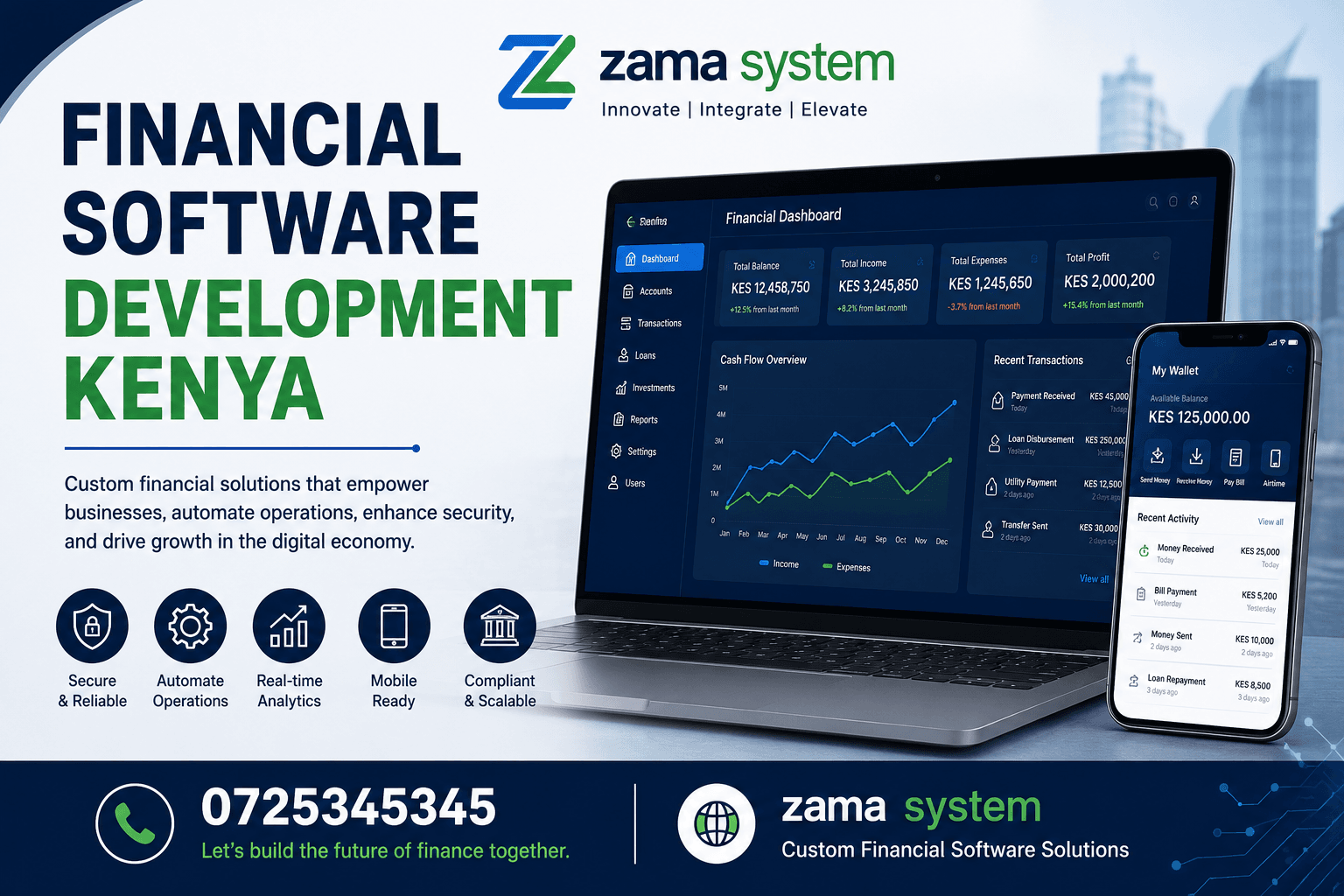
Banks face growing pressure to modernize operations and improve customer experiences.
Custom software supports initiatives such as:
Digital Account Opening
Customers can open accounts online without visiting branches.
Mobile Banking Applications
Users access financial services anytime and anywhere.
Automated Compliance Monitoring
Software helps banks comply with regulatory requirements.
Customer Relationship Management
Banks gain deeper insights into customer needs and behaviors.
Technology improves both operational efficiency and customer satisfaction.
Financial Software Development Kenya for Microfinance Institutions
Microfinance organizations often serve underserved populations.
Custom software enables them to:
- Process loans efficiently
- Track repayments
- Assess borrower risk
- Generate reports
- Improve transparency
These capabilities support sustainable growth.
Compliance and Regulatory Requirements
Financial institutions operate within highly regulated environments.
Software solutions must support compliance with applicable regulations.
Key compliance considerations include:
Data Protection
Organizations must safeguard customer information.
Anti-Money Laundering Measures
Systems should detect suspicious activities and generate alerts.
Audit Trails
Financial applications should maintain comprehensive activity logs.
Reporting Requirements
Regulators often require periodic financial reports.
Compliance-focused software simplifies regulatory obligations.
Challenges in Financial Software Development Kenya
While the opportunities are significant, organizations face several challenges.
Cybersecurity Threats
Financial institutions are attractive targets for cybercriminals.
Strong security measures are essential.
Integration Complexity
Legacy systems may be difficult to integrate with modern applications.
Regulatory Changes
Compliance requirements evolve continuously.
Software must remain adaptable.
User Adoption
Successful implementation requires employee training and change management.
Organizations that address these challenges effectively gain substantial competitive advantages.
Mobile Money Integration and Financial Innovation
No discussion about Financial Software Development Kenya is complete without examining the impact of mobile money. Kenya has become a global benchmark for mobile financial services, creating a unique environment where businesses and consumers rely heavily on digital transactions.
Financial software developers are increasingly building platforms that integrate directly with mobile payment ecosystems. These integrations enable businesses to automate transaction processing, monitor payments in real time, and improve customer convenience.
Benefits of Mobile Money Integration
Organizations that integrate mobile money into their financial systems enjoy several advantages:
- Faster payment processing
- Improved transaction visibility
- Reduced manual reconciliation
- Enhanced customer convenience
- Lower operational costs
- Better financial reporting
For businesses operating in retail, education, healthcare, transportation, and professional services, seamless payment integration has become essential.
Real-Time Transaction Processing
Traditional payment systems often involve delays in transaction confirmation. Modern financial platforms process transactions instantly, allowing businesses to update records immediately and provide faster services to customers.
This real-time capability improves efficiency while reducing administrative workloads.
Payment Gateway Development
Digital commerce continues to expand across Kenya, creating demand for secure and scalable payment processing systems.
Payment gateways serve as the foundation for online financial transactions by enabling businesses to accept and process payments securely.
Core Functions of Payment Gateways
A payment gateway typically handles:
- Transaction authorization
- Payment verification
- Fraud prevention
- Currency processing
- Settlement management
- Transaction reporting
Custom gateway solutions developed through Financial Software Development Kenya provide businesses with greater flexibility and control over payment operations.
E-Commerce Growth and Payment Innovation
As more consumers embrace online shopping, businesses require reliable payment infrastructure capable of handling increasing transaction volumes.
Advanced payment gateways support:
- Mobile payments
- Bank transfers
- Credit card payments
- Subscription billing
- Recurring transactions
These capabilities contribute to improved customer experiences and higher conversion rates.
Accounting Software Development
Accounting remains one of the most critical components of financial management.
Organizations require software that simplifies bookkeeping, improves financial accuracy, and supports strategic decision-making.
Features of Modern Accounting Systems
Today’s accounting platforms include:
- General ledger management
- Accounts payable tracking
- Accounts receivable management
- Expense monitoring
- Tax calculations
- Financial reporting
These tools provide businesses with greater visibility into their financial performance.
Automation in Accounting
Manual bookkeeping often leads to delays and inaccuracies.
Automation enables organizations to:
- Record transactions automatically
- Generate reports instantly
- Reconcile accounts efficiently
- Reduce administrative costs
Businesses can devote more attention to growth initiatives rather than routine accounting tasks.
Wealth Management Software
As personal and institutional wealth continues to grow, demand for sophisticated investment management solutions is increasing.
Wealth management software helps financial advisors, investment firms, and portfolio managers deliver superior services.
Portfolio Management
Investment professionals require tools that enable them to:
- Track asset performance
- Monitor portfolio allocations
- Evaluate investment risks
- Generate client reports
These capabilities improve investment decision-making and client communication.
Financial Planning Tools
Modern platforms assist advisors in developing comprehensive financial plans tailored to individual client objectives.
Areas commonly addressed include:
- Retirement planning
- Education funding
- Asset growth
- Risk management
- Estate planning
Technology enables more personalized and effective financial guidance.
Digital Lending Platforms
Digital lending has emerged as one of the fastest-growing sectors within financial technology.
Consumers increasingly prefer online loan applications due to convenience and speed.
Components of Digital Lending Systems
Comprehensive lending platforms typically include:
- Online applications
- Credit assessments
- Approval workflows
- Loan disbursement
- Repayment tracking
- Customer communication
These systems reduce processing times while improving borrower experiences.
Credit Scoring Innovations
Traditional credit assessment methods often exclude individuals with limited financial histories.
Advanced analytics and alternative data sources enable lenders to evaluate creditworthiness more effectively.
This expands access to financial services while improving risk management.
Treasury Management Systems
Large organizations require sophisticated tools to manage cash flow, liquidity, and financial risk.
Treasury management software helps finance teams maintain control over financial resources.
Cash Management
Treasury systems provide visibility into:
- Cash balances
- Incoming payments
- Outgoing obligations
- Short-term liquidity needs
Improved visibility supports better financial planning.
Risk Mitigation
Organizations face various financial risks, including:
- Currency fluctuations
- Interest rate changes
- Market volatility
Treasury software helps identify and manage these risks proactively.
Financial Analytics and Business Intelligence
Data has become one of the most valuable assets within financial organizations.
Financial analytics platforms transform raw data into actionable insights.
Performance Monitoring
Executives use analytics tools to evaluate:
- Revenue growth
- Profitability
- Customer acquisition
- Operational efficiency
These insights support strategic planning and decision-making.
Predictive Analytics
Predictive models help organizations anticipate future outcomes.
Examples include:
- Revenue forecasts
- Customer behavior predictions
- Loan default probabilities
- Market trend analysis
Forecasting improves preparedness and reduces uncertainty.
Interactive Dashboards
Visual dashboards enable decision-makers to access key information quickly.
Important metrics can be monitored in real time, allowing organizations to respond rapidly to changing conditions.
Open Banking and API Ecosystems
Open banking is transforming how financial institutions collaborate and deliver services.
By allowing secure data sharing through APIs, organizations can create innovative customer experiences and expand service offerings.
Benefits of Open Banking
Open banking supports:
- Enhanced competition
- Increased innovation
- Improved customer experiences
- Faster service delivery
Customers gain greater control over their financial information while benefiting from more personalized services.
API-Driven Financial Services
Modern financial software increasingly relies on API ecosystems that connect multiple systems and providers.
Examples include integrations with:
- Payment processors
- Credit bureaus
- Identity verification services
- Accounting platforms
- Investment tools
These connections create highly flexible financial ecosystems.
Financial Software for Insurance Companies
Insurance providers face complex operational requirements involving policy administration, underwriting, claims management, and customer service.
Custom software simplifies these processes while improving efficiency.
Claims Processing Automation
Manual claims handling can be slow and resource-intensive.
Automated systems enable insurers to:
- Receive claims digitally
- Verify supporting documents
- Assess eligibility
- Approve payments faster
This improves customer satisfaction while reducing operational costs.
Policy Management
Modern platforms help insurers manage:
- Policy issuance
- Renewals
- Premium collections
- Customer communications
Automation improves consistency and accuracy.
Financial Software for Investment Firms
Investment firms require technology capable of managing increasingly complex portfolios and client relationships.
Asset Management Solutions
Asset managers use software to:
- Monitor investments
- Analyze performance
- Generate compliance reports
- Manage risk exposures
Technology enables more effective portfolio oversight.
Client Reporting
Investors expect transparency regarding portfolio performance.
Advanced reporting systems provide detailed insights into:
- Asset allocation
- Investment returns
- Risk metrics
- Transaction history
These reports strengthen client trust and engagement.
Cybersecurity in Financial Software Development Kenya
Security remains one of the most critical considerations in financial software development.
Financial institutions handle sensitive information that must be protected from unauthorized access and cyber threats.
Threat Landscape
Organizations face numerous cybersecurity risks, including:
- Phishing attacks
- Malware infections
- Data breaches
- Account takeovers
- Insider threats
Strong security frameworks are essential for protecting customers and maintaining trust.
Security Best Practices
Effective financial software incorporates:
- End-to-end encryption
- Multi-factor authentication
- Intrusion detection systems
- Continuous monitoring
- Secure coding standards
These measures reduce vulnerabilities and strengthen resilience.
Security Audits and Testing
Regular security assessments help identify weaknesses before they can be exploited.
Testing activities often include:
- Penetration testing
- Vulnerability assessments
- Compliance reviews
- Code audits
Proactive security management protects organizational assets and reputation.
Enterprise Resource Planning Integration
Many organizations operate multiple business systems that must work together seamlessly.
ERP integration enables financial software to connect with:
- Human resources systems
- Procurement platforms
- Inventory management solutions
- Customer relationship management systems
This integration creates a unified operational environment.
Improved Data Consistency
When systems are connected, data flows automatically between departments.
This eliminates duplicate entries and reduces errors.
Enhanced Operational Visibility
Management gains access to comprehensive information across the organization, supporting more informed decision-making.
Emerging Opportunities for Financial Software Development Kenya
The financial technology sector continues to evolve rapidly.
Several emerging opportunities are shaping the future of Financial Software Development Kenya.
These include:
- Embedded finance
- Digital asset management
- Personalized banking experiences
- AI-powered financial advisors
- Automated compliance systems
- Real-time financial ecosystems
Organizations that embrace these innovations will be well positioned for future growth and competitiveness.
How Financial Software Development Kenya Supports Digital Transformation
Digital transformation is no longer a future objective for financial institutions and businesses—it is a present necessity. Organizations across multiple sectors are investing heavily in technology to improve efficiency, enhance customer experiences, and remain competitive in an increasingly digital marketplace.
One of the primary drivers of this transformation is Financial Software Development Kenya. Custom-built financial platforms help organizations modernize legacy processes while creating new opportunities for growth and innovation.
Through Financial Software Development Kenya, businesses can replace fragmented systems with integrated digital platforms that streamline financial operations and improve decision-making.
Organizations embracing Financial Software Development Kenya often experience faster service delivery, better customer engagement, and stronger financial performance.
Custom Financial Solutions Versus Off-the-Shelf Software
Many organizations struggle to determine whether they should purchase ready-made software or invest in custom development.
While off-the-shelf applications may provide basic functionality, they often fail to address specific business requirements.
Advantages of Custom Solutions
Businesses choosing Financial Software Development Kenya gain access to solutions specifically designed around their operational needs.
Benefits include:
- Customized workflows
- Industry-specific functionality
- Flexible integrations
- Improved scalability
- Greater control over features
Unlike generic software, Financial Software Development Kenya allows organizations to build systems that align perfectly with existing processes.
Long-Term Cost Benefits
Although custom development may require a higher initial investment, it often delivers better long-term value.
Organizations avoid:
- Expensive licensing fees
- Unnecessary features
- Vendor limitations
- Frequent software replacement costs
As businesses grow, systems created through Financial Software Development Kenya can evolve alongside organizational requirements.
Customer Experience and Financial Technology
Modern customers expect financial services to be accessible, fast, and convenient.
Businesses that fail to meet these expectations risk losing customers to more technologically advanced competitors.
Personalization Capabilities
One major advantage of Financial Software Development Kenya is the ability to create personalized customer experiences.
Financial applications can analyze user behavior and provide:
- Customized recommendations
- Personalized financial insights
- Relevant product suggestions
- Tailored communication
These capabilities improve customer satisfaction and loyalty.
Omnichannel Service Delivery
Customers interact with businesses through multiple channels, including:
- Mobile applications
- Websites
- Social media platforms
- Customer portals
Solutions developed through Financial Software Development Kenya ensure consistent experiences across all touchpoints.
Financial Inclusion Through Technology
Kenya has become a leader in financial inclusion, largely due to technology-driven innovation.
Millions of individuals who previously lacked access to traditional banking services can now participate in the formal financial system.
Expanding Access to Financial Services
Through Financial Software Development Kenya, organizations can develop platforms that reach underserved populations.
Examples include:
- Mobile banking applications
- Micro-lending platforms
- Digital savings solutions
- Community financing systems
These innovations create economic opportunities for individuals and businesses alike.
Supporting Rural Communities
Technology reduces geographical barriers by bringing financial services directly to users regardless of location.
Organizations leveraging Financial Software Development Kenya can serve customers in remote areas without investing in extensive physical infrastructure.
Artificial Intelligence and Machine Learning Applications
Artificial intelligence is rapidly transforming financial services.
Modern platforms increasingly use AI to improve efficiency and decision-making.
Intelligent Customer Support
Financial institutions can deploy AI-powered chatbots that:
- Answer customer questions
- Process service requests
- Provide account information
- Offer financial guidance
These tools improve service availability while reducing operational costs.
Risk Assessment Automation
Organizations utilizing Financial Software Development Kenya can integrate machine learning models that evaluate financial risks with greater accuracy.
These systems analyze large datasets to identify patterns that may indicate:
- Credit risk
- Fraudulent activity
- Customer churn
- Market volatility
This enhances decision-making while reducing exposure to losses.
Financial Software for Government and Public Institutions
Government agencies increasingly require digital solutions for financial management and accountability.
Revenue Collection Systems
Modern revenue collection platforms help public institutions manage:
- Tax collection
- Licensing fees
- Service payments
- Compliance monitoring
Through Financial Software Development Kenya, government agencies can improve transparency and operational efficiency.
Budget Management Solutions
Public sector organizations often manage large budgets involving multiple departments and projects.
Financial software simplifies:
- Budget allocation
- Expense tracking
- Procurement monitoring
- Financial reporting
These capabilities improve accountability and resource management.
The Role of Financial Software in Corporate Governance
Strong corporate governance depends on accurate financial information and effective oversight mechanisms.
Organizations investing in Financial Software Development Kenya gain tools that support transparency and accountability.
Audit Management
Financial software helps organizations maintain comprehensive records of financial activities.
Audit trails capture:
- User actions
- Transaction histories
- System changes
- Approval workflows
These records simplify auditing processes and strengthen compliance efforts.
Decision Support Systems
Executives require accurate information to guide strategic decisions.
Financial platforms developed through Financial Software Development Kenya provide real-time insights into organizational performance.
This enables leaders to make informed decisions based on reliable data.
Subscription-Based Financial Platforms
Subscription business models continue to gain popularity across industries.
Organizations offering recurring services require software capable of managing complex billing arrangements.
Subscription Management Features
Modern platforms support:
- Automated invoicing
- Recurring payments
- Customer account management
- Revenue forecasting
- Subscription analytics
Through Financial Software Development Kenya, businesses can automate these processes and improve operational efficiency.
Revenue Optimization
Subscription analytics help organizations understand:
- Customer retention rates
- Revenue trends
- Churn risks
- Growth opportunities
This information supports long-term profitability.
Financial Software for Startups
Startups operate in highly competitive environments where efficiency and agility are essential.
Building Scalable Foundations
Startups investing in Financial Software Development Kenya can establish scalable systems from the beginning.
This reduces the need for costly system replacements as the business grows.
Investor Reporting
Many startups must regularly provide financial updates to investors.
Financial software simplifies:
- Performance reporting
- Cash flow analysis
- Budget tracking
- Financial forecasting
Accurate reporting improves investor confidence and supports fundraising efforts.
Sustainability and Green Finance Technology
Environmental sustainability is becoming increasingly important within the financial sector.
Organizations are exploring ways to align financial operations with sustainability goals.
ESG Reporting Solutions
Environmental, Social, and Governance (ESG) reporting requirements are growing worldwide.
Through Financial Software Development Kenya, businesses can build systems that track sustainability metrics and generate compliance reports.
Sustainable Investment Platforms
Investment firms are increasingly offering environmentally focused investment products.
Specialized software supports:
- ESG assessments
- Portfolio analysis
- Impact measurement
- Sustainability reporting
These capabilities help investors make responsible financial decisions.
Financial Software Development Kenya and Future Innovation
The next decade will bring significant advancements in financial technology.
Organizations that invest in Financial Software Development Kenya today will be better prepared to capitalize on future opportunities.
Emerging innovations include:
- Autonomous financial systems
- Hyper-personalized banking
- Embedded finance ecosystems
- Real-time compliance monitoring
- AI-driven wealth management
- Intelligent financial forecasting
Businesses that embrace these developments will gain substantial competitive advantages.
Best Practices for Successful Financial Software Projects
Developing high-quality financial systems requires careful planning and execution.
Define Clear Objectives
Organizations should establish specific goals before beginning development.
Examples include:
- Improving customer experiences
- Reducing operational costs
- Enhancing compliance
- Increasing automation
Clear objectives improve project outcomes.
Prioritize Security
Every Financial Software Development Kenya project should incorporate security from the earliest stages of development.
Security-by-design principles reduce vulnerabilities and strengthen protection.
Focus on User Experience
Even the most advanced system will struggle if users find it difficult to navigate.
Successful solutions prioritize:
- Simplicity
- Accessibility
- Performance
- Reliability
Plan for Scalability
Organizations should ensure that systems can support future growth.
Scalable architectures allow businesses to expand without major disruptions.
Conclusion
The future of finance is being shaped by innovation, automation, analytics, and digital connectivity. Across banking, insurance, investment management, lending, government services, and fintech, organizations are increasingly relying on Financial Software Development Kenya to modernize operations and improve service delivery.
As technology continues to evolve, the demand for Financial Software Development Kenya will only increase. Businesses seeking greater efficiency, stronger security, enhanced customer experiences, and sustainable growth must embrace digital transformation initiatives supported by modern software solutions.
By investing in Financial Software Development Kenya, organizations can streamline financial processes, improve transparency, strengthen compliance, and unlock new opportunities for innovation. Whether serving consumers, enterprises, investors, or public institutions, custom financial software has become an essential tool for success in Kenya’s rapidly evolving digital economy.
The organizations that lead the future will be those that recognize the strategic importance of Financial Software Development Kenya and leverage technology to create smarter, faster, and more resilient financial ecosystems..