
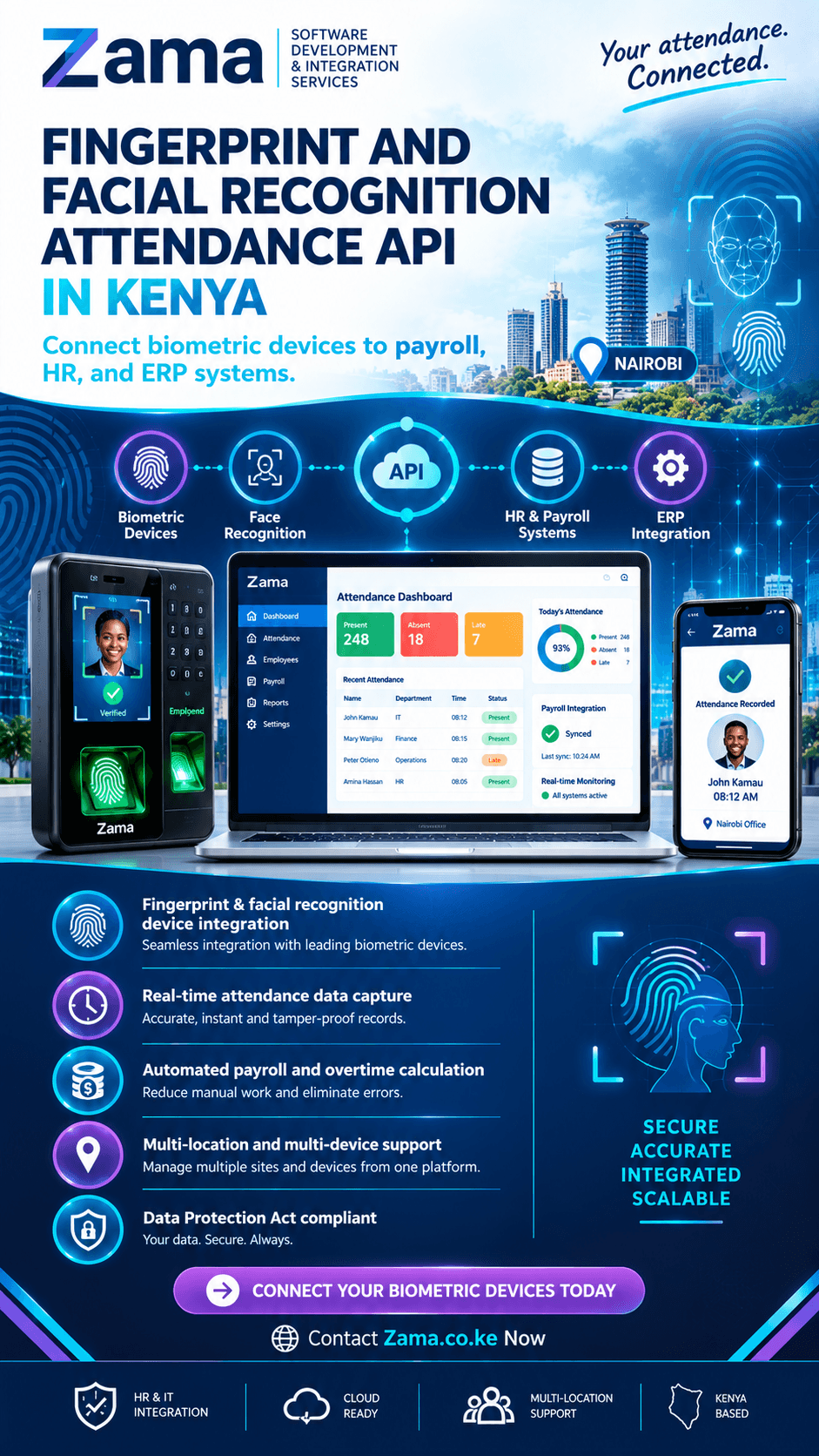
Fingerprint and facial recognition attendance API in Kenya is a question that every HR director, IT manager, and operations leader must answer in 2026. With Kenyan organizations increasingly deploying biometric terminals across offices, factories, hospitals, and schools, the ability to connect these devices to payroll, HR, and ERP systems through APIs has become essential for operational efficiency. At zama.co.ke, we’ve helped numerous organizations across Kenya implement API-driven biometric attendance solutions that eliminate manual data entry, automate payroll processing, and ensure regulatory compliance. This comprehensive guide explores fingerprint and facial recognition attendance API in Kenya, from understanding what these APIs do to selecting the right integration approach for your organization.
What Fingerprint and Facial Recognition Attendance API Actually Does
Before diving into fingerprint and facial recognition attendance API in Kenya, it’s essential to understand what this technology actually does. An attendance API (Application Programming Interface) is a set of protocols and tools that allow biometric devices—fingerprint readers, facial recognition terminals, and multi-modal devices—to communicate with your business software. It enables the flow of attendance data from the device to payroll systems, HR platforms, ERP software, and custom applications without manual intervention.
A proper fingerprint and facial recognition attendance API in Kenya does far more than simply record a punch. It authenticates employees using their fingerprint or face, timestamps the event, maps the biometric ID to the correct employee record, applies shift and overtime rules, and pushes the processed data into payroll. According to industry research, organizations using biometric API integration reduce payroll processing time by 60 to 70 percent while improving accuracy compared to manual methods. For a Kenyan business, the practical definition of fingerprint and facial recognition attendance API in Kenya is this: the system that connects your biometric devices to every other business system that needs attendance data—eliminating manual data entry, reducing errors, and creating a unified workforce management platform.
Why Kenyan Businesses Need Biometric Attendance API Integration
When evaluating fingerprint and facial recognition attendance API in Kenya, consider the compelling reasons for adoption. Kenyan workplaces face persistent challenges with manual attendance management. Employees clock in for each other (buddy punching), overtime disputes consume HR time, payroll calculations contain errors, and management lacks visibility across multiple branches.
A modern fingerprint and facial recognition attendance API in Kenya eliminates these issues through automation. The numbers tell a compelling story. Kenyan SMEs lose millions annually to time theft and payroll errors. One employee clocking in for an absent colleague for just 30 minutes daily adds up to 10 hours monthly—costing a business significantly per month per employee. Multiply that across a workforce of 50, and the losses are staggering. This is where a fingerprint and facial recognition attendance API in Kenya becomes a smart investment rather than an optional expense.
Types of Biometric Attendance Devices in Kenya
When evaluating fingerprint and facial recognition attendance API in Kenya, it’s important to understand the device landscape:
Fingerprint Attendance Terminals
Fingerprint-based systems are the most common and affordable biometric attendance solution in Kenya. Employees simply scan their fingerprints to clock in and out, ensuring quick and accurate timekeeping. These terminals are reliable, cost-effective, and easy to use. Modern fingerprint terminals use advanced algorithms for reliability, precision, and excellent matching speed. They store thousands of fingerprint templates and hundreds of thousands of transaction records, making them suitable for organizations of all sizes.
Facial Recognition Attendance Terminals
Face recognition terminals have become significantly more affordable and are now a popular choice for Kenyan businesses. They are contactless, ideal for hygiene-sensitive environments, and offer fast verification. Modern facial recognition terminals can identify employees wearing masks and work accurately under varied lighting conditions. They are widely deployed in hospitals, schools, corporate offices, and government institutions across Kenya.
Multi-Modal Biometric Terminals
For organizations requiring the highest accuracy and flexibility, multi-modal terminals combine fingerprint, facial recognition, card, and password authentication in a single device. These terminals support multiple verification methods, ensuring that every employee can clock in using their preferred method. Multi-modal devices are ideal for factories, large enterprises, and high-security facilities where different employee groups have different needs.
How Attendance API Integration Works
When learning fingerprint and facial recognition attendance API in Kenya, understanding the integration architecture is essential. Attendance API integration connects biometric devices to business systems through several methods:
Push Protocol (ADMS/iClock)
Modern biometric devices support push protocols where the device initiates communication with your server. The device dials out to your application at regular intervals, pushing attendance records in real time. This method works without requiring the server to know the device’s IP address, making it ideal for devices deployed behind dynamic IP addresses or across multiple locations. The server receives attendance data, maps device PINs to employee records, and creates check-in records automatically.
Pull Protocol (TCP/IP Socket Communication)
With pull protocols, your server connects to the biometric device using its IP address and communication key. The server fetches attendance logs, user data, and device status at configurable intervals. This method gives you full control over synchronization schedules and works well for devices on stable networks.
REST API Integration
Modern attendance software exposes REST APIs that allow third-party applications to retrieve attendance data, manage employees, and configure devices. These APIs use standard HTTP methods and JSON payloads, making integration straightforward for developers. REST APIs support authentication, pagination, and filtering, enabling efficient data retrieval even from large deployments.
Database-Level Integration
For on-premise deployments, integration can occur at the database level. The attendance software writes data to a database, and other systems read from that database. While simpler to implement, database-level integration requires careful management of data consistency and access controls.
Essential Features of Attendance API Integration in Kenya
When evaluating fingerprint and facial recognition attendance API in Kenya, focus on these core features:
1. Automated Employee Synchronization
A proper attendance API should synchronize employee data automatically. When HR adds a new employee, the system creates a matching record on the biometric device. When an employee leaves, their access is revoked instantly. The API maps device PINs to employee IDs, ensuring accurate attendance attribution without manual intervention.
2. Real-Time Attendance Capture
The API should capture attendance events in real time. When an employee scans their fingerprint or face, the event is transmitted to the server immediately, creating a check-in record that is visible on dashboards within seconds. Real-time capture enables live attendance monitoring and immediate alerts for late arrivals or absences.
3. Shift and Roster Management
A comprehensive fingerprint and facial recognition attendance API in Kenya should support shift management. The API applies shift rules to raw attendance data, determining whether employees arrived on time, worked overtime, or were absent. It supports multiple shift patterns including day shifts, night shifts, rotating shifts, split shifts, and flexible working hours.
4. Overtime Calculation and Approval
Overtime rules in Kenya are specific and can be complex. A proper API should calculate overtime automatically based on configurable rules—weekday overtime, weekend overtime, public holiday rates—and route overtime requests through approval workflows. Managers can approve or reject overtime through the HR portal, with all decisions logged for audit purposes.
5. Payroll Integration
One of the most valuable features of attendance API integration is payroll synchronization. Attendance data flows directly into payroll systems, eliminating manual entry and reducing errors. The API generates payroll-ready data with all deductions calculated according to Kenyan statutory rates—PAYE, NSSF, SHIF, and AHL.
6. Multi-Location and Multi-Device Support
Kenyan organizations often operate across multiple branches. A proper attendance API should support multiple devices across multiple locations, centralizing attendance data from all sites. The API manages device connectivity, synchronizes data, and provides a unified view of attendance across the organization.
7. Real-Time Monitoring and Alerts
The API should provide real-time monitoring capabilities. Dashboards show current attendance status, device connectivity, and pending requests. Automated alerts notify managers of late arrivals, early departures, absences, and device connectivity issues.
8. Audit Trails and Compliance Reporting
A comprehensive fingerprint and facial recognition attendance API in Kenya should maintain complete audit trails. Every attendance event, correction, and approval is logged with timestamps and user IDs. Audit trails support compliance reporting and dispute resolution.
The Data Protection Act and Biometric Attendance in Kenya
When implementing fingerprint and facial recognition attendance API in Kenya, compliance with Kenya’s Data Protection Act (2019) is non-negotiable. The Act establishes strict requirements for processing biometric data, which is classified as sensitive personal data.
The Kenyan courts have ruled decisively on this issue. In Kenya Union of Journalists v Kenya Broadcasting Corporation (JR No. E366 of 2025), the High Court declared that the introduction and rollout of a mandatory biometric attendance system without obtaining consent from data subjects, without providing pertinent information about data processing, ignoring data subjects’ objections, and failing to carry out a Data Protection Impact Assessment violated Article 31 of the Constitution and Sections 25, 26, 29, 30, 31, 32 and 36 of the Data Protection Act, 2019.
The court found that KBC failed to obtain informed consent, did not conduct the required impact assessment, ignored requests for consultation, and withheld key information about the system and its vendor. These failures amounted to both procedural and substantive violations of the law. As a result, the court declared KBC’s biometric system unconstitutional and unlawful, prohibited its implementation until all legal requirements are met, cancelled the rollout, and ordered the deletion of all collected biometric data under official supervision.
To avoid similar legal challenges, a responsible fingerprint and facial recognition attendance API in Kenya implementation must follow these principles:
Obtain Explicit Consent: Inform employees about the use of biometric data, how it will be processed, stored, and used solely for attendance monitoring purposes. Employees must provide informed consent without coercion.
Conduct a Data Protection Impact Assessment: Before deploying any biometric system, conduct a DPIA to assess privacy risks and implement mitigation measures.
Data Minimization: Collect only the biometric data necessary for attendance tracking. Do not store raw fingerprint images or facial photographs—store encrypted templates.
Secure Storage: Store biometric templates using encryption. Ensure data is protected against unauthorized access, loss, or misuse.
Data Retention Policies: Define how long biometric data is retained and when it will be deleted. Biometric data should not be retained longer than necessary for the stated purpose.
Access Control: Restrict administrator access to a limited number of authorised personnel. Implement role-based access controls for the attendance API.
Data Subject Rights: Employees have the right to access, correct, or request deletion of their biometric data. The API should support these rights.
Transparency: Provide clear information about the biometric system, including the identity of the service provider and how data will be used.
API Integration Use Cases in Kenya
Corporate Offices in Nairobi
Corporate offices require attendance systems that integrate with HR platforms, payroll software, and access control systems. A custom fingerprint and facial recognition attendance API in Kenya connects these systems, ensuring that employee data flows seamlessly between attendance, payroll, and security. When an employee clocks in, the system records attendance, unlocks the door, and updates payroll automatically.
Manufacturing Plants
Manufacturing plants operate complex shift patterns with large workforces. API integration handles rotating shifts, overtime calculations, and production-floor reporting. It connects biometric terminals on the shop floor to payroll systems, ensuring that every hour worked is accurately recorded and compensated.
Hospitals and Healthcare Facilities
Healthcare facilities require attendance systems that support 24/7 operations, shift handovers, and department-specific reporting. API integration tracks attendance by ward, department, and medical specialty, ensuring accurate payroll and compliance with health sector regulations.
Schools and Universities
Educational institutions use biometric attendance APIs for both staff and student attendance. Staff attendance integrates with payroll, while student attendance feeds into academic records and parent notification systems. API integration enables automatic SMS alerts to parents when students are absent.
Security Firms with Multiple Sites
Security companies deploy guards across multiple client sites. API integration tracks attendance by site, client, and guard deployment, ensuring accurate billing and payroll. Mobile biometric verification allows guards to clock in at remote locations using smartphones.
The Zama.co.ke Approach
When considering fingerprint and facial recognition attendance API in Kenya, zama.co.ke follows a structured approach:
Workforce and Device Assessment
We evaluate your organization’s size, shift patterns, branch locations, existing biometric devices, and integration requirements. This includes understanding your current attendance challenges, payroll processes, and reporting needs.
API Integration Design
We design the API integration architecture, selecting the right protocols (push, pull, REST, or hybrid) based on your device types, network conditions, and business requirements. We ensure the integration supports real-time data flow, error handling, and offline capability.
Development and Configuration
We develop the API connectors, configure biometric devices, and integrate with payroll, HR, and ERP systems. We build custom workflows for shift management, overtime calculation, and approval routing designed specifically for your organization.
Data Protection Compliance
We advise on best practices for Data Protection Act compliance, including consent management, DPIA support, encrypted data storage, and access controls. We ensure the system is built for compliance from day one.
Employee Enrolment and Training
We register employees, configure shift schedules, and provide role-specific training for HR teams and employees. This includes report generation training and payroll integration setup.
Post-Implementation Support
We remain available for maintenance, troubleshooting, and system upgrades as your organization evolves and your workforce grows.
The ROI of Biometric Attendance API Integration in Kenya
When evaluating fingerprint and facial recognition attendance API in Kenya, the ROI is compelling:
Payroll Processing Time Reduction: Organizations typically reduce payroll processing time by 60 to 70 percent while improving accuracy compared to manual methods.
Eliminate Buddy Punching: A fingerprint or face cannot be shared. This single feature prevents countless hours of time theft across your workforce.
Accurate Overtime Calculation: Automated overtime calculation eliminates disputes and overpayments. Managers approve overtime through the portal, and payroll processes it automatically.
Reduce HR Workload: Automatic reports—late arrivals, overtime, and absences at a glance. HR no longer spends hours compiling attendance reports.
Multi-Location Visibility: Centralized attendance data from all branches provides management with complete workforce visibility.
Compliance Protection: Data Protection Act compliance built into the system from day one, reducing legal risk.
Scalability: API-driven integration allows new devices and locations to be added without replacing existing infrastructure.
Implementation Considerations for Kenyan Organizations
When implementing fingerprint and facial recognition attendance API in Kenya, consider these factors:
Assess Your Current Infrastructure
Before selecting an integration solution, document your existing biometric devices, software, and the systems you need to connect. Identify which devices support API integration and which require replacement or upgrade.
Choose the Right Protocols
Select integration protocols based on your network conditions and device capabilities. Push protocols work well for devices behind dynamic IPs, while pull protocols give you more control over synchronization. REST APIs are ideal for cloud-based deployments.
Plan for Data Migration
Migrating employee records, biometric templates, and attendance history from legacy systems requires careful planning. Ensure data is validated before migration and that audit trails are preserved.
Train Your Team
HR staff, IT administrators, and managers need training on the integrated system. Role-specific training ensures everyone understands their responsibilities and capabilities.
Test Thoroughly
Test all integration scenarios, including normal operations, edge cases, and failure modes. Ensure the system works correctly when devices go offline or connectivity is lost.
Ensure Compliance
Configure the integration to comply with the Data Protection Act from day one. Implement consent management, DPIA documentation, access controls, and audit logging.
Fingerprint and facial recognition attendance API in Kenya is essential for any organization seeking to eliminate manual processes, automate payroll, ensure compliance, and create unified workforce management platforms. From automated employee synchronization and real-time attendance capture to payroll integration and Data Protection Act compliance, the benefits are proven and substantial.
At zama.co.ke, we’ve helped organizations across Kenya implement biometric attendance API integrations that deliver measurable results. Our approach ensures you get exactly what your organization needs—nothing more, nothing less.
Don’t let the complexity of fingerprint and facial recognition attendance API in Kenya hold you back. Whether you’re a small office or a large enterprise with multiple branches, we have the expertise to guide you through every step.
Contact zama.co.ke today and let us help you build a biometric attendance API integration that transforms your workforce management.