
Fintech Integration Services Kenya: The Complete 2026 Guide to Digital Payments, APIs, and Business Automation
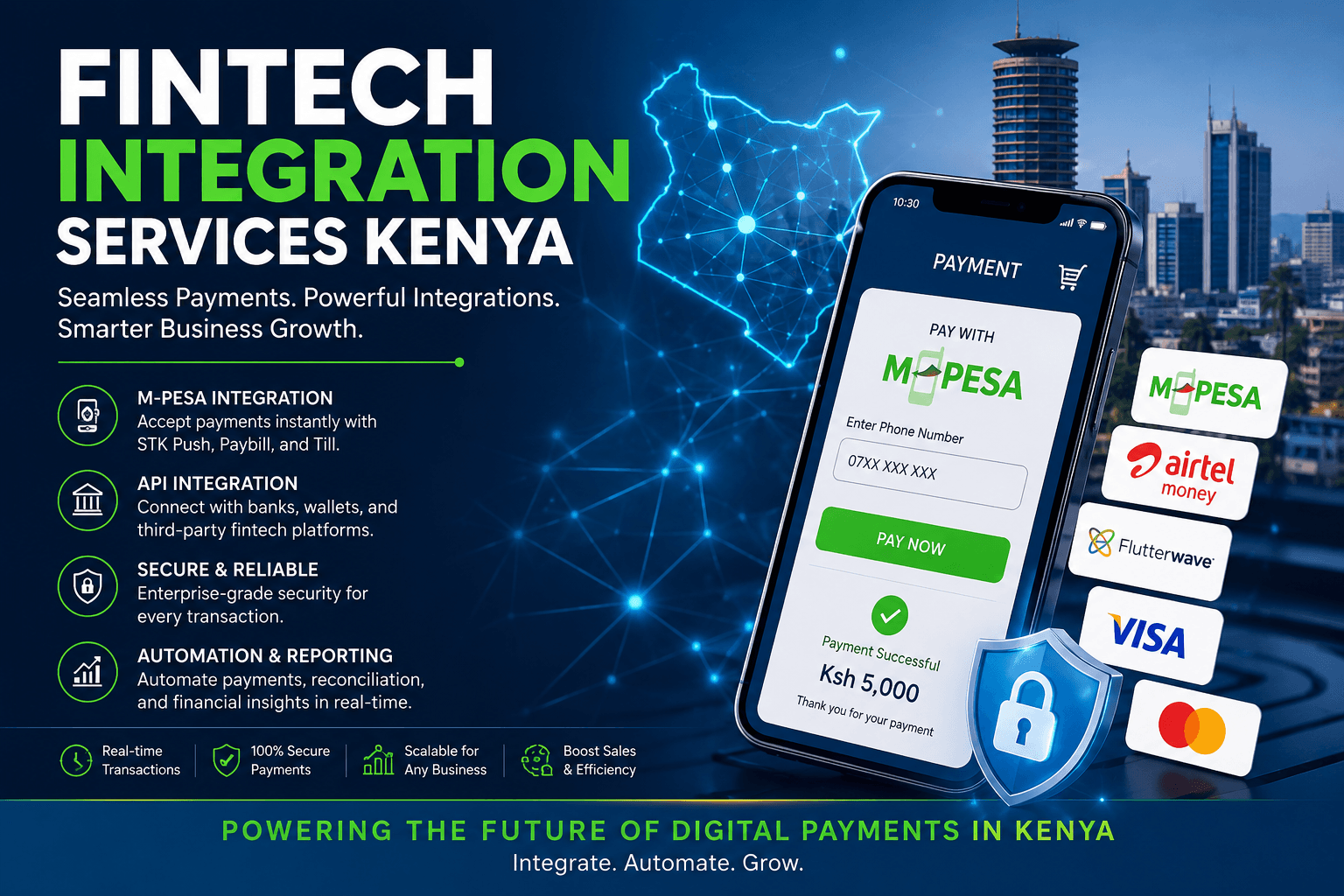
In Kenya’s fast-evolving digital economy, fintech integration services Kenya have become one of the most critical pillars of modern business growth. From small online shops to large enterprise systems, every serious business is now expected to accept digital payments, automate transactions, and connect financial systems seamlessly.
At the center of this transformation is Kenya’s powerful fintech ecosystem—driven by mobile money, APIs, banking infrastructure, and digital-first consumer behavior.
This guide explores everything you need to know about fintech integration services Kenya, including how they work, why they matter, the technologies behind them, real-world applications, industry use cases, and the future of financial technology in the country.
1. What Are Fintech Integration Services Kenya?
Fintech integration services Kenya refer to the process of connecting financial technologies (fintech systems) into business platforms such as:
- Websites
- Mobile applications
- E-commerce stores
- ERP systems
- CRM platforms
- SaaS applications
- Accounting systems
These integrations allow businesses to:
- Accept payments (M-Pesa, cards, bank transfers)
- Automate invoicing and billing
- Reconcile transactions in real time
- Improve financial reporting accuracy
- Reduce manual payment processes
In simple terms, fintech integration services Kenya help businesses digitize money flow end-to-end.
2. Why Fintech Integration Services Kenya Are Critical in 2026
Kenya is one of the most advanced mobile money economies in the world. Without fintech integration, businesses lose competitiveness.
2.1 Dominance of Mobile Money (M-Pesa)
Mobile money is not optional in Kenya—it is the default payment method.
With platforms like M-Pesa:
- Customers pay instantly via mobile phones
- Businesses receive real-time confirmations
- Transactions are trackable and secure
Without integration, businesses rely on manual processes that are slow and error-prone.
2.2 Shift to Cashless Economy
Kenya is rapidly moving toward a cashless society.
Drivers include:
- Government digitization policies
- Increased smartphone penetration
- Growth of e-commerce
- Rise of online services
Businesses without fintech integration services Kenya risk being left behind.
2.3 Demand for Automation
Modern businesses want to:
- Reduce human error
- Speed up operations
- Automate billing and reconciliation
Fintech integrations make this possible.
3. Core Components of Fintech Integration Services Kenya
A complete fintech integration system includes multiple layers:
3.1 Payment Gateway Integration
This allows businesses to accept payments through:
- M-Pesa STK Push
- Paybill and Till numbers
- Credit and debit cards
- Bank transfers
- International payments (Stripe, PayPal, etc.)
3.2 API Integration Layer
APIs (Application Programming Interfaces) connect systems.
Example:
- Website → Payment Gateway → M-Pesa → Confirmation → Database update
APIs are the backbone of fintech integration services Kenya.
3.3 Transaction Processing Systems
These systems:
- Validate payments
- Confirm transactions
- Log financial data
- Send receipts automatically
3.4 Financial Reconciliation Systems
Reconciliation ensures:
- Payments match records
- No missing transactions
- Accurate financial reporting
3.5 Security and Compliance Layer
Includes:
- Encryption protocols
- Secure authentication
- Fraud detection systems
- PCI-DSS compliance (for card payments)
4. Key Fintech Platforms in Kenya
Kenya’s fintech ecosystem is diverse and rapidly expanding.
4.1 M-Pesa (Safaricom)
The backbone of fintech integration in Kenya.
Used for:
- Mobile payments
- Business transactions
- Subscription services
- E-commerce checkout
4.2 Airtel Money
An alternative mobile money platform with growing adoption.
4.3 Bank APIs
Major banks now provide APIs for:
- Account verification
- Transfers
- Payment processing
4.4 Global Payment Gateways
Used by businesses targeting international clients:
- Stripe
- PayPal
- Flutterwave
- Paystack
5. How Fintech Integration Services Kenya Work (Step-by-Step)
Let’s break down a typical transaction flow.
Step 1: Customer Initiates Payment
A user selects:
- “Pay with M-Pesa”
- “Pay with card”
Step 2: API Sends Request
The system sends a request to the payment gateway:
- Amount
- Customer phone number
- Transaction reference
Step 3: Payment Authorization
Customer receives:
- STK push prompt
- Or redirects to payment page
They approve payment.
Step 4: Confirmation
Payment gateway:
- Confirms transaction
- Sends callback response to system
Step 5: Database Update
Business system:
- Marks invoice as paid
- Generates receipt
- Updates user account
This entire process happens in seconds.
6. Industries Using Fintech Integration Services Kenya
6.1 E-Commerce
Online stores rely heavily on fintech integration for:
- Checkout systems
- Cart payments
- Order confirmation
6.2 Real Estate
Used for:
- Rent collection
- Deposit payments
- Tenant billing systems
6.3 Education Sector
Schools use fintech integration for:
- Fee payments
- Admission payments
- Online registrations
6.4 SaaS Platforms
Software companies use it for:
- Subscription billing
- Automated renewals
- Usage-based payments
6.5 Healthcare
Hospitals use fintech systems for:
- Patient billing
- Appointment payments
- Insurance claims processing
7. Benefits of Fintech Integration Services Kenya
7.1 Faster Payments
Transactions happen instantly, improving cash flow.
7.2 Reduced Human Error
Automation eliminates:
- Manual entry mistakes
- Miscalculations
- Missing receipts
7.3 Improved Customer Experience
Customers enjoy:
- Seamless checkout
- Multiple payment options
- Instant confirmation
7.4 Better Financial Reporting
Businesses get:
- Real-time dashboards
- Transaction history
- Revenue analytics
7.5 Scalability
Systems can handle:
- Thousands of transactions per minute
- Growing customer base
8. Technologies Behind Fintech Integration Services Kenya
8.1 Backend Technologies
- Node.js
- Laravel
- Django
- Spring Boot
8.2 Frontend Technologies
- React.js
- Vue.js
- Next.js
8.3 Databases
- MySQL
- PostgreSQL
- MongoDB
8.4 APIs & Protocols
- REST APIs
- GraphQL
- Webhooks
- JSON messaging
8.5 Cloud Infrastructure
- AWS
- Google Cloud
- Azure
9. Security in Fintech Integration Services Kenya
Security is non-negotiable.
9.1 Encryption
Protects data during transmission.
9.2 Tokenization
Replaces sensitive data with secure tokens.
9.3 Fraud Detection Systems
Detect:
- Suspicious transactions
- Duplicate payments
- Unauthorized access
9.4 Two-Factor Authentication (2FA)
Adds extra security layer for users.
10. Challenges in Fintech Integration in Kenya
10.1 API Downtime
Payment systems can occasionally fail or slow down.
10.2 Regulatory Compliance
Businesses must follow:
- Central Bank regulations
- Data protection laws
10.3 Integration Complexity
Connecting multiple systems requires:
- Skilled developers
- Proper architecture
10.4 Security Risks
Cyberattacks remain a major concern.
11. Future of Fintech Integration Services Kenya
The future is highly automated and intelligent.
11.1 AI-Powered Finance Systems
- Fraud prediction
- Smart transaction routing
- Automated financial insights
11.2 Embedded Finance
Financial services will be built directly into apps:
- Buy-now-pay-later
- In-app wallets
- Micro-lending
11.3 Blockchain Integration
Future systems may include:
- Transparent transactions
- Smart contracts
- Decentralized finance
11.4 Full Cashless Ecosystem
Kenya is moving toward:
- 100% digital payments
- Real-time tax integration
- Automated business compliance
12. Why Businesses Need Professional Fintech Integration Services Kenya
DIY integrations often fail due to:
- Security gaps
- Poor API handling
- Lack of scalability
- Maintenance issues
A professional provider ensures:
- Secure architecture
- Seamless user experience
- Reliable payment processing
- Long-term system stability
13. Fintech Integration Architecture in Kenya (How Systems Are Built)
Understanding fintech integration services Kenya at a deeper level requires looking at system architecture. This is what separates a simple “payment button” from a fully scalable financial ecosystem.
A modern fintech system is typically built in layers:
13.1 Presentation Layer (User Interface)
This is what users interact with:
- Website checkout pages
- Mobile app payment screens
- Admin dashboards
- Customer portals
At this level, the focus is:
- Simplicity
- Speed
- Trust indicators (logos, SSL, payment badges)
- Clear payment instructions
A poor UI leads to abandoned payments—even if the backend is strong.
13.2 Application Layer (Business Logic)
This layer controls:
- Payment initiation
- Invoice creation
- Subscription logic
- Transaction validation
- Discount and coupon logic
Example:
If a customer is paying rent:
- System checks due amount
- Applies penalties if overdue
- Generates invoice
- Sends payment request
This is the “brain” of fintech integration services Kenya.
13.3 Integration Layer (API Gateway)
This is where external fintech systems connect.
It handles:
- M-Pesa Daraja API calls
- Bank API requests
- Card payment gateways
- Webhooks and callbacks
It ensures communication between:
- Business system ↔ Payment provider ↔ Customer
Without this layer, systems cannot talk to each other.
13.4 Data Layer (Database Systems)
This layer stores:
- Transactions
- User accounts
- Payment history
- Audit logs
- Financial records
Common databases:
- PostgreSQL (structured financial data)
- MySQL (business applications)
- MongoDB (flexible transaction logs)
Financial data must be:
- Accurate
- Immutable
- Auditable
13.5 Security Layer
This layer protects everything.
Includes:
- Encryption (TLS/SSL)
- Token-based authentication
- Role-based access control (RBAC)
- API keys and secrets management
- Fraud monitoring systems
In fintech, security is not optional—it is survival.
14. M-Pesa Daraja API: The Heart of Fintech Integration Services Kenya
The most important component in Kenya’s fintech ecosystem is the M-Pesa Daraja API.
It enables businesses to:
- Initiate STK Push payments
- Receive real-time callbacks
- Query transaction status
- Manage Paybill/Till operations
14.1 How STK Push Works Technically
- Business sends API request with:
- Phone number
- Amount
- Account reference
- Safaricom triggers STK prompt on customer phone
- Customer enters PIN
- Safaricom processes transaction
- Callback is sent to business server
- System updates payment status
This entire process takes seconds.
14.2 Importance for Kenyan Businesses
STK Push is critical because:
- It eliminates cash handling
- It increases conversion rates
- It builds trust through familiar M-Pesa flow
- It reduces fraud risks
No serious fintech integration services Kenya solution can ignore M-Pesa.
15. Advanced Use Cases of Fintech Integration in Kenya
15.1 Rental and Property Management Systems
Used by landlords and agencies for:
- Automated rent collection
- Late fee calculations
- Tenant payment tracking
- Digital receipts
Example flow:
Tenant → receives SMS invoice → pays via M-Pesa → system auto-updates ledger
15.2 Subscription-Based Businesses
Used by:
- SaaS companies
- Gyms
- Online learning platforms
Features:
- Recurring billing logic
- Auto-renewal reminders
- Failed payment retries
- User account suspension rules
15.3 E-Commerce Automation
Advanced integrations include:
- Cart checkout APIs
- Inventory synchronization
- Order fulfillment triggers
- Refund automation
This creates a fully automated online store.
15.4 Logistics and Transport Systems
Fintech integration powers:
- Delivery payments
- Cash-on-delivery reconciliation
- Driver payout systems
- Fuel advance tracking
15.5 Healthcare Billing Systems
Hospitals use fintech integration for:
- Patient billing automation
- Insurance claim submission
- Appointment prepayments
- Pharmacy transactions
16. API Design Principles in Fintech Integration Services Kenya
Good fintech systems follow strict API design rules.
16.1 RESTful Architecture
APIs must be:
- Stateless
- Scalable
- Predictable
Example endpoints:
- /initiate-payment
- /check-status
- /transaction-history
16.2 Webhooks for Real-Time Updates
Webhooks allow systems to receive instant updates.
Example:
- Payment completed → webhook triggers → database updates automatically
Without webhooks, systems must constantly “ask” for updates (inefficient).
16.3 Idempotency (Preventing Duplicate Payments)
If a user retries payment:
- System must ensure only one transaction is processed
This prevents:
- Double charging
- Financial inconsistencies
16.4 Rate Limiting
Protects APIs from overload and abuse.
17. Business Models Enabled by Fintech Integration Services Kenya
Fintech integration unlocks new digital business models.
17.1 Pay-as-You-Go Models
Customers pay based on usage:
- Water consumption
- Electricity units
- Software usage
17.2 Micro-Payments Economy
Kenya’s mobile money enables:
- Low-value transactions
- Daily subscriptions
- Small digital purchases
17.3 Digital Lending Platforms
Fintech systems enable:
- Loan disbursement APIs
- Automated repayment collection
- Credit scoring systems
17.4 Marketplace Platforms
Platforms like:
- Uber-style apps
- Freelancer marketplaces
- Delivery aggregators
Require:
- Split payments
- Commission tracking
- Multi-wallet systems
18. Common Integration Patterns Used in Kenya
18.1 Direct Integration
Business connects directly to:
- M-Pesa API
- Bank APIs
Pros:
- Faster
- Lower cost
Cons:
- More maintenance responsibility
18.2 Aggregator Integration
Using platforms like:
- Flutterwave
- Paystack
Pros:
- Multiple payment methods in one system
- Easier setup
Cons:
- Slightly higher transaction fees
18.3 Hybrid Systems
Combination of:
- Direct M-Pesa integration
- Third-party gateways
- Internal billing systems
This is the most scalable model for large businesses.
19. Performance Optimization in Fintech Systems
A slow payment system kills conversions.
19.1 API Response Time Optimization
- Use caching where possible
- Optimize database queries
- Reduce unnecessary API calls
19.2 Asynchronous Processing
Instead of blocking users:
- Payments are processed in background queues
- Users receive instant confirmation
19.3 Load Balancing
Distributes traffic across servers:
- Prevents downtime
- Ensures reliability during peak usage
20. Regulatory Environment for Fintech Integration in Kenya
Fintech systems must comply with:
- Central Bank of Kenya (CBK) regulations
- Data Protection Act (2019)
- Anti-money laundering (AML) rules
- Know Your Customer (KYC) requirements
Failure to comply can lead to:
- Fines
- Account suspension
- Legal action
21. Challenges Facing Fintech Integration Services Kenya
21.1 API Downtime and Instability
Even major providers occasionally experience:
- Delays
- Service outages
21.2 Fraud and Cybersecurity Threats
Common risks include:
- Phishing attacks
- API key theft
- Transaction manipulation
21.3 Integration Complexity
Challenges include:
- Multiple payment systems
- Legacy systems in older businesses
- Lack of skilled developers
21.4 Cost of Maintenance
Fintech systems require:
- Continuous updates
- Security patches
- Monitoring infrastructure
22. Future Evolution of Fintech Integration Services Kenya
22.1 Real-Time National Payment Systems
Kenya is moving toward:
- Instant interbank settlement
- Unified payment rails
22.2 AI-Powered Financial Automation
Future systems will:
- Detect fraud automatically
- Predict cash flow issues
- Optimize payment routing
22.3 Embedded Finance Everywhere
Every app will become a financial platform:
- Social media payments
- In-app lending
- Instant insurance purchase
22.4 Blockchain and Smart Contracts
Potential use cases:
- Automated rental agreements
- Transparent supply chain payments
- Cross-border settlements
Conclusion
The evolution of fintech integration services Kenya represents one of the most transformative shifts in the country’s digital and economic landscape. What began as simple mobile money transactions has now matured into a highly sophisticated ecosystem where businesses, banks, and software platforms are deeply interconnected through APIs, automation layers, and real-time payment infrastructure.
Today, fintech integration is no longer just a technical feature added to websites or mobile apps—it has become the core operational backbone of modern businesses in Kenya. Every transaction, subscription, invoice, and customer payment is increasingly expected to happen instantly, securely, and without friction. Businesses that fail to adopt these systems risk operating inefficiently in an economy that is rapidly becoming fully digital.
At the heart of this transformation is Kenya’s globally recognized mobile money ecosystem, led by M-Pesa. Through advanced APIs and integration frameworks, businesses can now initiate payments, receive confirmations in real time, automate reconciliation, and manage financial reporting without manual intervention. This has drastically reduced operational costs while improving accuracy and speed across industries.
Beyond payments, fintech integration services Kenya are enabling entirely new business models. Companies are no longer limited to traditional one-time sales; they can now implement subscriptions, pay-as-you-go systems, digital wallets, automated billing cycles, and embedded finance solutions directly within their platforms. This shift is powering the growth of SaaS platforms, e-commerce ecosystems, real estate management systems, education portals, logistics platforms, and healthcare billing systems across the country.
Another major impact is the rise of financial automation and intelligence. Businesses can now track transactions in real time, detect anomalies, automate revenue reporting, and gain deep insights into customer behavior. This level of financial visibility was previously only available to large enterprises, but fintech integration has democratized it for SMEs and startups as well.
However, the true value of fintech integration lies not only in convenience but in scalability and resilience. As businesses grow, manual payment systems quickly become bottlenecks. Integrated fintech systems ensure that whether a company processes 10 transactions or 10,000 per day, the financial infrastructure remains stable, secure, and efficient.
Looking ahead, the future of fintech integration services Kenya is set to become even more advanced. Artificial intelligence will enhance fraud detection and financial forecasting. Embedded finance will allow every digital platform to function as a financial service provider. Blockchain technologies may introduce greater transparency and automation through smart contracts. Meanwhile, real-time national payment systems will further reduce friction in money movement across banks and mobile networks.
In conclusion, fintech integration is not just shaping the future of business in Kenya—it is defining it. Organizations that embrace these systems early are positioning themselves for long-term success in a fully digital, cashless, and highly automated economy. Those that delay risk being left behind in a market where speed, convenience, and automation are no longer competitive advantages, but basic expectations.
Fintech integration services in Kenya are therefore not just a technological upgrade—they are a strategic foundation for survival, growth, and dominance in the digital economy of 2026 and beyond.