
Managing company vehicles using spreadsheets, paper files, phone calls and separate GPS tracking platforms can quickly become difficult as a business grows.
Fleet Management Software Kenya gives transport companies, logistics businesses, distributors, construction companies and organizations with company vehicles one central platform for managing vehicles, drivers, trips, fuel, maintenance, expenses, tyres, insurance, GPS tracking and fleet performance.
Instead of simply knowing where a vehicle is located, modern fleet management software helps management understand where the vehicle went, who drove it, how many kilometres it travelled, how much fuel it consumed, what the trip cost, when it requires servicing and whether the vehicle is being used efficiently.
For Kenyan businesses operating trucks, vans, buses, pickups, motorcycles or company cars, this level of visibility can transform fleet operations.
 What Is Fleet Management Software?
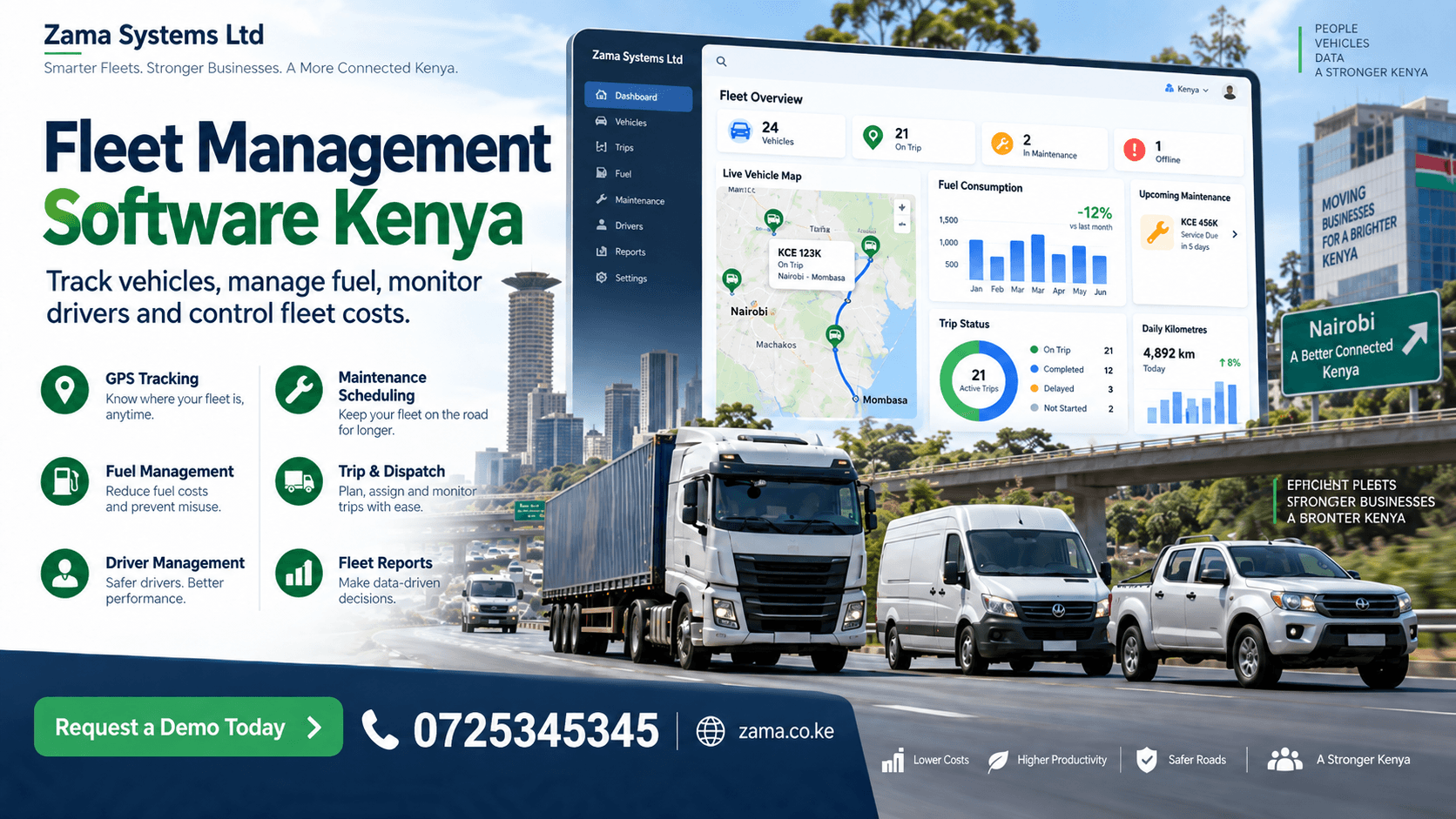
Fleet management software is a digital platform used to manage vehicles, drivers and the operational costs associated with running a fleet.
It brings fleet information together into one system where authorized users can monitor and manage:
- Vehicles
- Drivers
- GPS locations
- Daily kilometres
- Trips
- Dispatch
- Fuel
- Maintenance
- Repairs
- Tyres
- Insurance
- Licences
- Expenses
- Accidents
- Inspections
- Driver behaviour
- Vehicle documents
- Fleet utilization
- Reports and analytics
A Fleet Management System goes beyond basic vehicle tracking.
A GPS tracker may tell you where a vehicle is.
A complete Fleet Management System should help you understand what that vehicle is doing and whether it is making operational and financial sense for your organization.
Why Kenyan Businesses Need Fleet Management Software
Managing a growing fleet creates many operational questions.
A fleet manager may need to know:
- Where is each vehicle?
- Which driver has the vehicle?
- Which trucks are currently on trips?
- Which vehicles are available?
- How many kilometres did every truck travel today?
- Which vehicle consumes the most fuel?
- Which vehicles are due for service?
- How much has each vehicle cost this month?
- Which driver frequently speeds?
- Which vehicle has been idle for too long?
- Which tyres are due for replacement?
- Which insurance policies are expiring?
- Which trips are profitable?
- How much are we spending per kilometre?
Without a centralized system, answering these questions may require checking different spreadsheets, GPS portals, receipts, notebooks and WhatsApp conversations.
A Fleet Management Software Kenya solution centralizes this information and makes it easier for managers to understand fleet performance.
Key Features of Fleet Management Software Kenya
A complete fleet platform should cover much more than vehicle location.
1. Real-Time GPS Vehicle Tracking
GPS tracking provides live visibility into vehicle movement.
Fleet managers can monitor:
- Current vehicle location
- Current speed
- Direction of travel
- Ignition status
- Previous routes
- Stops
- Parking locations
- Distance travelled
- Trip history
This can help businesses manage vehicles operating across Nairobi, Mombasa, Kisumu, Nakuru, Eldoret, Thika and other areas.
For long-distance transport businesses, vehicles can also be monitored across major routes such as the Nairobi–Mombasa corridor.
2. Vehicle Tracking System in Kenya
A Vehicle Tracking System in Kenya is one of the core components of a Fleet Management System.
The tracking platform receives location information from a GPS device installed in the vehicle.
Management can then see vehicles from a web dashboard or mobile application.
Common tracking capabilities include:
- Live vehicle location
- Route history
- Speed monitoring
- Ignition alerts
- Geofencing
- Stop detection
- Unauthorized movement alerts
- Trip playback
- Mileage information
However, tracking should ideally connect with the wider fleet platform.
Location data becomes much more useful when combined with driver, trip, fuel and maintenance information.
3. Daily Kilometres per Vehicle
One of the most important fleet reports is the daily kilometres report.
Management should be able to see:
| Vehicle | Driver | Opening KM | Closing KM | Distance Travelled |
|---|---|---|---|---|
| Truck 01 | Driver A | 124,500 | 124,820 | 320 KM |
| Truck 02 | Driver B | 210,400 | 210,610 | 210 KM |
| Van 03 | Driver C | 89,100 | 89,245 | 145 KM |
This report provides quick visibility into vehicle utilization.
Management can identify:
- Vehicles travelling unusually high kilometres
- Underutilized vehicles
- Vehicles with no movement
- Differences between assigned routes and actual travel
- Daily fleet productivity
Monthly reports can then summarize total kilometres travelled by each vehicle.
4. Fleet Fuel Management
Fuel is one of the most important fleet operating expenses.
A Fleet Management System should allow businesses to record and analyze:
- Fuel date
- Vehicle
- Driver
- Fuel station
- Number of litres
- Fuel amount
- Odometer
- Cost per litre
- Fuel type
- Receipt/reference
- Supplier
The system can calculate metrics such as:
Fuel Efficiency = Kilometres Travelled ÷ Litres Consumed
For example:
If a truck travels 600 kilometres using 100 litres:
600 ÷ 100 = 6 KM/L
Managers can compare fuel efficiency between vehicles.
A sudden change may indicate a mechanical problem, operational issue or incorrect fuel records that require investigation.
5. Fuel Consumption Reports
The system should provide reports such as:
- Fuel consumed per vehicle
- Fuel consumed per driver
- Fuel cost per month
- Fuel efficiency
- Cost per kilometre
- Fuel by route
- Fuel by branch
- Fuel supplier report
- Fuel variance report
These reports help management see where fleet money is being spent.
6. Vehicle Maintenance Management
Fleet vehicles require regular maintenance.
Missing scheduled servicing can lead to avoidable breakdowns and operational disruption.
A fleet maintenance module can manage:
- Routine servicing
- Oil changes
- Brake inspections
- Engine repairs
- Suspension work
- Battery replacement
- Tyre replacement
- Electrical repairs
- Body repairs
- Gearbox repairs
- Inspection schedules
Each maintenance record can contain:
- Vehicle
- Date
- Odometer
- Garage
- Technician
- Work performed
- Parts used
- Labour cost
- Parts cost
- Total cost
- Next service date
- Next service mileage
7. Preventive Maintenance Scheduling
The system can automatically remind fleet managers when a vehicle approaches its next service.
Maintenance may be scheduled according to:
- Kilometres travelled
- Date
- Engine hours
- Manufacturer recommendation
For example:
Current Odometer: 95,300 KM
Next Service: 100,000 KM
Remaining: 4,700 KM
The dashboard can highlight vehicles approaching the service threshold.
8. Vehicle Repair History
Every vehicle should maintain a complete maintenance history.
Management can open a vehicle profile and see:
- Service dates
- Repairs
- Parts replaced
- Garage used
- Maintenance expenses
- Breakdown history
This becomes valuable when deciding whether to continue repairing an older vehicle or consider replacement.
9. Fleet Driver Management
Vehicles and drivers should not be managed separately.
The system can maintain driver records including:
- Full name
- Employee number
- Phone number
- National ID
- Driving licence
- Licence category
- Licence expiry
- Assigned vehicle
- Employment status
- Branch
- Emergency contact
Managers can quickly identify which driver is responsible for a particular vehicle or trip.
10. Driver Behaviour Monitoring
When GPS and telematics are connected, businesses can monitor driving behaviour.
Possible events include:
- Overspeeding
- Harsh braking
- Harsh acceleration
- Excessive idling
- Unauthorized routes
- Long stops
- Night driving
- Geofence violations
The objective should be to give fleet managers useful information they can use when reviewing safety, vehicle use and driver performance.
11. Driver Performance Scorecards
Fleet managers can create driver performance reports based on relevant operational metrics.
For example:
- Distance travelled
- Trips completed
- Fuel efficiency
- Overspeeding events
- Harsh braking events
- Idling
- On-time deliveries
- Vehicle inspection compliance
Managers can use this information when conducting driver reviews and training.
Fleet Trip Management
Every commercial vehicle movement should ideally be linked to a trip.
A trip can include:
- Trip number
- Vehicle
- Driver
- Origin
- Destination
- Customer
- Cargo
- Departure date
- Expected arrival
- Actual arrival
- Opening odometer
- Closing odometer
- Fuel allocated
- Trip expenses
- Trip revenue
- Status
Trip statuses may include:
- Planned
- Assigned
- Dispatched
- In Transit
- Arrived
- Completed
- Cancelled
This allows operations teams to see fleet activity from one dashboard.
Trip Expense Management
Fleet operations involve many expenses beyond fuel.
These can include:
- Parking
- Tolls
- Loading
- Offloading
- Accommodation
- Driver allowance
- Repairs
- Washing
- Road expenses
- Other approved costs
Employees can attach receipts or supporting documents where required.
Trip Profitability
For transport businesses, management should understand whether individual trips are profitable.
A simple calculation is:
Trip Profit = Trip Revenue – Trip Expenses
Expenses can include:
- Fuel
- Driver allowance
- Toll charges
- Maintenance allocation
- Loading/offloading
- Other trip costs
This allows management to compare routes, vehicles and customers.
Fleet Dispatch Management
Dispatch software helps operations teams assign vehicles and drivers to work.
A dispatcher can see:
- Available vehicles
- Vehicles already assigned
- Drivers available
- Vehicles under maintenance
- Trips awaiting dispatch
- Active trips
- Completed trips
This can reduce dependence on phone calls and manual dispatch books.
Route Management and Optimization
Poor route planning can increase:
- Fuel consumption
- Distance travelled
- Delivery times
- Vehicle wear
- Driver hours
Fleet management software can help organizations plan and analyze routes.
Where mapping services are integrated, dispatch teams can monitor planned routes against actual vehicle movement.
Geofencing
A geofence is a virtual boundary around a location.
For example, a business can create geofences around:
- Warehouse
- Customer premises
- Office
- Fuel station
- Construction site
- Port
- Depot
The system may generate notifications when a vehicle enters or leaves the location.
This can improve visibility without requiring staff to repeatedly call drivers.
Fleet Management Software KenyaWork Orders
A maintenance issue should be traceable from reporting through completion.
For example:
Driver reports brake problem → Supervisor reviews → Work order created → Vehicle sent to garage → Parts recorded → Repair completed → Vehicle returned to service.
A work order can include:
- Work order number
- Vehicle
- Reported problem
- Priority
- Assigned garage
- Parts required
- Estimated cost
- Actual cost
- Status
- Completion date
This creates accountability around maintenance spending.
Vehicle Inspection Management
Drivers can perform inspections before or after trips.
A checklist may cover:
- Tyres
- Lights
- Brakes
- Mirrors
- Windscreen
- Oil level
- Coolant
- Battery
- Fire extinguisher
- First aid kit
- Body condition
Problems can automatically create maintenance tasks.
Tyre Management Software
Tyres are an important fleet cost and should be tracked as individual assets where detailed control is required.
A tyre module can record:
- Tyre number
- Brand
- Size
- Purchase date
- Purchase price
- Supplier
- Vehicle fitted
- Wheel position
- Kilometres covered
- Removal date
- Removal reason
Fleet managers can calculate cost per kilometre for individual tyres.
This helps compare tyre brands and purchasing decisions.
Vehicle Expense Management
Management should be able to determine the total cost of owning and operating every vehicle.
Vehicle costs may include:
- Fuel
- Maintenance
- Repairs
- Insurance
- Licences
- Tyres
- Tracking
- Parking
- Cleaning
- Driver expenses
- Other costs
This allows fleet managers to calculate:
Total Vehicle Cost
and
Operating Cost per KM
A vehicle that looks productive from its trip numbers may actually be expensive to operate.
Vehicle Document Management
Important vehicle documents have expiry dates.
The system can manage records such as:
- Insurance
- Inspection
- Licences
- Ownership documents
- Service contracts
- Vehicle certificates
Alerts can be configured before documents expire.
Fleet Insurance Management
Fleet insurance records can include:
- Vehicle
- Insurance provider
- Policy number
- Cover type
- Start date
- Expiry date
- Premium
- Supporting documents
The system can display upcoming expiries on the fleet dashboard.
Fleet Accident and Incident Management
Organizations should maintain a structured record of vehicle accidents and incidents.
Information can include:
- Vehicle
- Driver
- Date
- Location
- Incident description
- Damage
- Photos
- Police reference
- Insurance claim
- Repair cost
- Outcome
This creates an auditable history.
Fleet Management Software Kenya Dashboard
Fleet managers should not have to open ten reports to understand what is happening.
The dashboard can show:
- Total vehicles
- Active vehicles
- Vehicles on trip
- Vehicles under maintenance
- Available vehicles
- Drivers on duty
- Distance travelled today
- Fuel consumed
- Maintenance due
- Expiring documents
- Active incidents
- Fleet expenses
This provides a quick operational overview.
Fleet Reports and Analytics
Data becomes valuable when it can be transformed into useful reports.
Important fleet reports include:
Vehicle Mileage Report
Shows kilometres travelled by each vehicle.
Daily Truck Performance Report
Shows daily distance, trips, fuel and utilization.
Fuel Consumption Report
Shows fuel usage and efficiency.
Vehicle Expense Report
Shows total operating costs.
Maintenance Cost Report
Shows maintenance spending per vehicle.
Driver Performance Report
Shows driver activity and selected performance indicators.
Trip Report
Shows completed and active trips.
Vehicle Utilization Report
Shows how frequently vehicles are being used.
Cost per Kilometre Report
Calculates operational cost against kilometres travelled.
Breakdown Report
Tracks breakdown frequency and related expenses.
Branch Fleet Report
Compares fleet performance between locations.
Fleet Management Software for Trucks in Kenya
Truck operators have requirements that go beyond basic car tracking.
A truck fleet system may need to manage:
- Prime movers
- Trailers
- Drivers
- Long-distance trips
- Fuel allocation
- Route compliance
- Driver allowances
- Maintenance
- Tyres
- Cargo
- Delivery documents
- Trip expenses
A truck may also switch trailers, drivers or routes.
The system therefore needs a flexible assignment structure.
Fleet Management Software for Logistics Companies
Logistics businesses depend on fleet availability.
Their platform can connect:
Customer Order → Dispatch → Vehicle → Driver → Trip → Delivery → Expenses → Invoice → Report.
This gives operations teams visibility from order assignment to final delivery.
Fleet Management Software for Distribution Companies
Businesses distributing FMCG products, beverages, dairy products, pharmaceutical products and other goods can use fleet management alongside delivery management.
The system can manage:
- Delivery routes
- Driver assignment
- Vehicle allocation
- Customer stops
- Delivery status
- Proof of delivery
- Returns
- Damaged goods
- Delivery expenses
Integrating delivery and fleet data provides much stronger operational visibility.
Fleet Management Software for Construction Companies
Construction fleets often include:
- Trucks
- Excavators
- Loaders
- Pickups
- Cranes
- Generators
- Equipment
A fleet platform can help track the location, utilization, fuel, service schedules and maintenance history of these assets.
Fleet Management Software for Schools and Institutions
Schools, universities and organizations operating staff or student transport can manage:
- Buses
- Drivers
- Routes
- Service schedules
- Insurance
- Fuel
- Vehicle inspections
- Expenses
The same platform can provide management reports across the entire fleet.
Fleet Management Software for Small Businesses
Fleet technology is not limited to companies operating hundreds of vehicles.
The best fleet management software for a small business should allow the company to start with its current fleet and scale as operations grow.
A business operating five vehicles may initially require:
- Vehicle register
- Driver assignment
- GPS tracking
- Fuel records
- Maintenance reminders
- Expenses
It can later add:
- Dispatch
- Trip management
- Driver scorecards
- Route management
- Customer deliveries
- API integrations
- Advanced analytics
GPS Tracking vs Fleet Management Software
These two terms are often confused.
GPS Tracking Software
Primarily answers:
Where is my vehicle?
It typically provides:
- Live location
- Speed
- Route history
- Geofences
- Movement alerts
Fleet Management Software
Answers broader questions:
Where is the vehicle?
Who is driving it?
Why is it there?
Which trip is it handling?
How much fuel has it consumed?
How many kilometres has it travelled?
When does it need servicing?
How much does it cost to operate?
Is the vehicle productive?
This distinction is important when choosing a system.
Cloud Fleet Management Software
A web-based fleet system allows authorized users to manage operations from different locations.
Managers can access information from:
- Office desktop
- Laptop
- Tablet
- Smartphone
A cloud platform is particularly useful for organizations with several branches.
Multi-Branch Fleet Management Software Kenya
Businesses operating from multiple locations need centralized fleet visibility.
Head office can monitor fleets operating from different branches while allowing branch managers to view only vehicles under their responsibility.
The system can provide:
- Branch vehicle lists
- Branch drivers
- Branch expenses
- Branch fuel
- Branch maintenance
- Branch performance comparisons
Mobile Fleet Management
Fleet managers are not always at their desks.
A mobile-friendly platform can allow authorized staff to:
- View vehicle locations
- Review trips
- Approve requests
- Record expenses
- Upload receipts
- Perform inspections
- Check maintenance status
This keeps operations moving even when managers are outside the office.
Fleet Management Software Integration
A fleet platform becomes more powerful when integrated with other business systems.
Possible integrations include:
- ERP systems
- Accounting software
- GPS tracking platforms
- Fuel systems
- HR systems
- Payroll
- Customer portals
- Warehouse systems
- Delivery management platforms
- Mobile money
- Banking platforms
- APIs
Integration reduces duplicate data entry and gives management a more complete view of business operations.
Fleet and Accounting Integration
Fleet transactions eventually affect company finances.
Examples include:
Fuel purchase → Expense
Vehicle repair → Maintenance Expense
Transport trip → Revenue
Driver allowance → Trip Expense
Tyre purchase → Fleet Expense or Inventory
Integrating fleet and accounting information can make reconciliation and management reporting easier.
Fleet Management Software Cost in Kenya
The fleet management software cost in Kenya depends on the organization’s requirements.
Factors that affect pricing include:
- Number of vehicles
- Number of users
- GPS devices
- Number of branches
- Modules required
- Mobile applications
- Integrations
- Custom reports
- Training
- Installation
- Support
- Cloud or on-premise deployment
A business requiring vehicle records and maintenance management will have different requirements from a transport company managing hundreds of trucks with real-time GPS integrations.
For this reason, organizations should request a demonstration and requirements assessment before comparing quotations.
How to Choose Fleet Management Software in Kenya
Before choosing a Fleet Management System, ask the following questions.
Does it manage more than GPS tracking?
Tracking is important, but complete fleet management should also address drivers, trips, fuel, maintenance and costs.
Can it track daily kilometres?
Mileage should be available by day, vehicle, driver and period.
Does it manage fuel?
Fuel reporting should allow management to analyze consumption and cost.
Can it schedule vehicle maintenance?
The system should provide service reminders based on dates or mileage.
Can it manage drivers?
Driver records and vehicle assignments should be easy to access.
Does it have useful reports?
A good system should convert operational information into management reports.
Can it integrate with existing trackers?
Businesses that already have GPS devices should ask whether available APIs can be integrated rather than automatically replacing everything.
Can it support multiple branches?
This becomes important as an organization grows.
Can it integrate with existing business software?
Fleet operations should ideally connect with the wider business environment.
Is local implementation and support available?
Organizations should understand who will configure the system, train users and provide technical support.
Benefits of Fleet Management Software
A properly implemented fleet platform can provide several operational benefits.
Greater Fleet Visibility
Management can see vehicle, driver and trip information centrally.
Better Fuel Accountability
Fuel records can be linked to vehicles, drivers and mileage.
Better Maintenance Planning
Service schedules and reminders reduce reliance on memory and paperwork.
Better Driver Accountability
Vehicles and trips can be associated with responsible drivers.
Better Cost Control
Management can analyze operating expenses per vehicle.
Better Dispatching
Operations teams can see which vehicles and drivers are available.
Better Reporting
Management receives measurable information about fleet performance.
Centralized Fleet Records
Vehicle documents, maintenance histories and expenses remain in one system.
Who Needs Fleet Management Software in Kenya?
The software can be useful for:
- Transport companies
- Logistics companies
- Courier companies
- Distribution businesses
- FMCG companies
- Dairy distributors
- Construction companies
- Manufacturing companies
- Schools
- Universities
- NGOs
- Government institutions
- County governments
- Security companies
- Car rental companies
- Delivery companies
- Field service businesses
- Companies with sales vehicles
- Companies operating staff transport
Any organization managing several vehicles can benefit from greater fleet visibility.
Smart Fleet Management Software Kenya
The future of fleet management is not simply showing vehicles on a map.
A modern Fleet Management Software Kenya platform should connect:
Vehicles + Drivers + GPS + Trips + Fuel + Maintenance + Tyres + Expenses + Documents + Dispatch + Reports
into one operational environment.
Management should be able to move from a high-level dashboard to the detailed history of one individual vehicle.
For example:
Truck KXX 123A
- Driver: John
- Current location: Nairobi
- Today’s distance: 327 KM
- Fuel efficiency: 5.8 KM/L
- Active trip: TRP-1054
- Next service: 4,200 KM
- Insurance expiry: 45 days
- Current status: In Transit
That is significantly more useful than simply seeing a truck icon on a map.
Fleet Management Software Kenya – Request a Demo
If your business operates trucks, vans, pickups, motorcycles, buses or company vehicles, managing everything from separate spreadsheets and systems can make fleet control unnecessarily difficult.
Zama Systems Ltd provides customizable fleet management solutions for organizations that need greater visibility into their vehicles, drivers and operating costs.
Your solution can include:
- Fleet vehicle management
- GPS tracking integration
- Driver management
- Daily kilometre reports
- Fuel management
- Trip management
- Dispatch
- Maintenance scheduling
- Work orders
- Tyre management
- Vehicle expenses
- Insurance tracking
- Document expiry alerts
- Vehicle inspections
- Incident management
- Multi-branch fleet management
- Fleet dashboards
- Custom reports
- API integrations
Request a Fleet Management Software demo today.
Call or WhatsApp: 0725345345
Visit zama.co.ke to learn more about business and fleet management solutions.
Frequently Asked Questions About Fleet Management Software Kenya
What is Fleet Management Software?
Fleet Management Software is a digital platform for managing company vehicles, drivers, GPS tracking, fuel, maintenance, trips, expenses and fleet reports from one central system.
What is the best Fleet Management Software in Kenya?
The best platform depends on the size and operations of the fleet. Businesses should evaluate GPS tracking, fuel management, maintenance, driver management, trip management, reporting, integrations and local support before selecting a system.
How much does Fleet Management Software cost in Kenya?
Pricing depends on fleet size, modules, GPS devices, users, integrations, implementation and support requirements. A requirements assessment is normally necessary before providing an accurate quotation.
Does Fleet Management Software include GPS tracking?
It can. Modern fleet systems can integrate GPS tracking to provide vehicle location, speed, trip history, routes and geofence information.
Can Fleet Management Software monitor fuel?
Yes. Fuel management can record refueling transactions, litres, mileage, fuel cost and fuel efficiency for each vehicle.
Can it calculate daily kilometres travelled?
Yes. Mileage information can be used to produce daily, weekly and monthly kilometre reports by vehicle.
Can it manage vehicle maintenance?
Yes. Fleet software can schedule servicing based on mileage or date and maintain repair histories for every vehicle.
Can it manage trucks and trailers?
Yes. A system can manage trucks, trailers, drivers and trip assignments depending on the organization’s workflow.
Can Fleet Management Software manage multiple branches?
Yes. Multi-branch functionality allows head office to monitor fleet performance across different operational locations.
Can existing GPS trackers be integrated?
Potentially. Integration depends on whether the existing tracking platform provides a supported API or compatible device connection.
Can fleet software integrate with ERP?
Yes. APIs can be used to connect fleet operations with ERP, accounting, HR, inventory, delivery and other systems where supported.
What reports should Fleet Management Software provide?
Important reports include mileage, fuel consumption, maintenance costs, vehicle expenses, trip performance, driver performance, utilization and cost-per-kilometre reports.
Conclusion
Choosing the right Fleet Management Software Kenya is about much more than locating vehicles.
Kenyan businesses need a platform capable of showing what every vehicle is doing, who is responsible for it, what it costs to operate, how much fuel it consumes, how many kilometres it travels, when it needs maintenance and whether it is being used productively.
Bringing GPS tracking, vehicle management, drivers, trips, dispatch, fuel, maintenance, tyres, expenses and reporting together gives management a clearer operational picture.
Whether your organization operates five vehicles or a much larger fleet, digitizing fleet operations can make information easier to access, improve accountability and give management the reports required to make better operational decisions.
For a customized Fleet Management Software Kenya demonstration and requirements assessment, contact Zama Systems Ltd on 0725345345.