
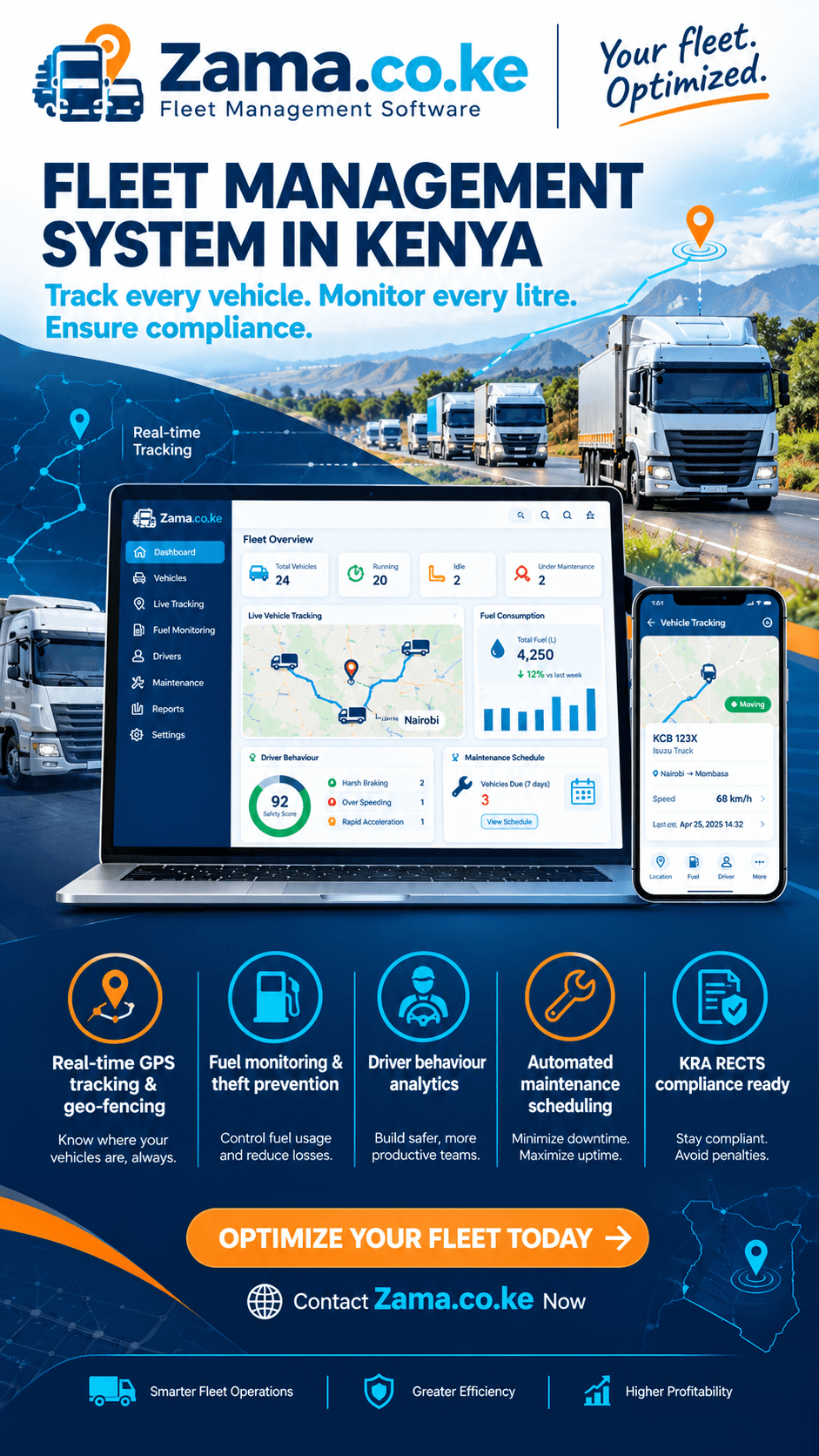
Fleet management system in Kenya is a question that every transport manager, logistics director, and fleet owner must answer in 2026. With Kenya’s transport sector facing rising fuel costs, regulatory pressures, and operational inefficiencies, the ability to track vehicles, monitor fuel consumption, and manage drivers has become essential for survival. At zama.co.ke, we’ve helped numerous transport and logistics businesses across Kenya build custom fleet management solutions that address their unique operational challenges. This comprehensive guide explores fleet management system in Kenya, from understanding core requirements to selecting the right solution for your fleet operations.
The Rising Cost of Fleet Operations in Kenya
Before diving into fleet management system in Kenya, it’s essential to understand the current challenges facing fleet owners. Fuel costs have skyrocketed, with the Treasury reporting that government transport costs rose to Sh14.3 billion in 2023 from Sh8.6 billion in 2021 [4†L22-L23]. The current transport system has been widely abused, and the pressure to cut costs has never been greater [4†L21-L22].
The challenges facing fleet managers are severe:
Fuel Theft and Fraud: Fuel theft remains a major headache for fleet operators [4†L41]. From siphoning to odometer tampering, the losses add up quickly. A Mombasa-based technology firm has introduced AI-powered systems that monitor driver behaviour and curb fuel theft [0†L12-L14]. Transporters are increasingly adopting digital fuel monitoring systems to reduce fuel theft and improve accountability [3†L20-L21]. In the haulage sector, digital fuel monitoring systems are now being deployed to track every litre of fuel consumed and compare consumption with distance travelled and vehicle load [3†L21-L22]. Pesapal has also rolled out ‘Drive’, a digital fleet fuel management platform aimed at transforming how businesses handle fuel-related operations [1†L48-L50]. The platform integrates with Pesapal’s Forecourt Management Solution, which powers digital fueling and payments at over 200 stations across Kenya, Uganda, and beyond [1†L36-L37][1†L51-L52].
Unaccounted Vehicle Usage: The misuse of government registration plates, gaps in fuel and mileage records, and the failure to account for donor-funded vehicles after project completion have undermined accountability and efficient service delivery [4†L7-L10]. Without a proper fleet management system in Kenya, vehicles can be used for unauthorized trips, and fuel consumption goes unmonitored.
Maintenance Neglect: Vehicles deteriorate without proper maintenance schedules. A fleet management system in Kenya provides automated service reminders, reducing breakdowns and extending vehicle life. MMUST’s comprehensive fleet management system includes automated document management that tracks vehicle and driver licenses and sends alerts before expiration [3†L12-L14].
Regulatory Fines: KRA requires all cargo to be tracked under the Regional Electronic Cargo Tracking System (RECTS), monitored from the Times Tower [7†L47-L50]. Before a truck can be fitted with a tracking device, transporters must first be onboarded onto the Integrated Customs Management System (iCMS) and registered as compliant transit operators [7†L32-L33]. Non-compliance can result in fines and operational disruptions. Additionally, the Communications Authority of Kenya has directed all entities to engage only licensed Application Service Providers for fleet management and asset tracking services [7†L6-L10]. Organizations must verify the Annual Compliance Certificate of any tracking service provider before engagement [7†L21-L22].
What a Fleet Management System Actually Does
A fleet management system in Kenya is software that controls and tracks the physical operations of a vehicle fleet. It answers the operational questions that manual logs or basic tracking cannot: where exactly is each vehicle right now, how much fuel is each vehicle consuming, which driver is behind the wheel, when is the next service due, and what is the maintenance history of every vehicle at this moment.
For a Kenyan business, the practical definition of fleet management system in Kenya is this: the system that tells you exactly where every vehicle is, exactly how much fuel it is using, exactly who is driving it, and exactly what maintenance it needs, across every depot, branch, and region, in real time, from a single dashboard accessible on any device.
The Kenya Fleet Management Software Market is experiencing steady growth driven by the increasing adoption of technology in the transportation and logistics sectors, characterized by a rising demand for solutions that can optimize fleet operations, improve efficiency, and enhance driver safety [1†L8-L11]. Market forecasts by technology type include GPS tracking, telematics, and other solutions [1†L17-L18].
Essential Features of a Fleet Management System in Kenya
When evaluating fleet management system in Kenya, focus on these core features:
1. Real-Time GPS Tracking
Real-time GPS tracking is the foundation of any fleet management system in Kenya. Modern IoT trackers cost as little as KSh 3,500 per unit and can be fitted to any vehicle, feeding location data every 10 seconds and giving you a live map of every truck [2†L26-L28]. GPS trackers can be installed for as little as KSh 3,000 per unit, allowing you to view every truck on a map from a laptop or smartphone and set geo-fences around Mombasa port, Jomo Kenyatta Airport, or key warehouses [2†L47-L50].
A proper fleet management system in Kenya should provide:
Live Vehicle Locations: See every vehicle on a map in real time.
Historical Routes: Replay any trip to verify driver claims.
Geofencing: Set virtual boundaries and receive alerts when vehicles enter or leave designated areas.
2. Fuel Monitoring and Theft Prevention
Fuel is the single largest operating cost for most fleets. A comprehensive fleet management system in Kenya should integrate industrial-grade fuel sensors with GPS trackers [2†L13]. Transporters are increasingly adopting digital fuel monitoring systems to reduce fuel theft and improve accountability [3†L20-L21].
Key fuel management features include:
Fuel Level Sensors: Track fuel levels in real time and detect sudden drops indicating siphoning.
Fuel Consumption Reports: Compare fuel consumption with distance travelled and vehicle load [3†L21-L22].
Driver Performance Scores: Monitor driver behaviour, including harsh braking, overspeeding, and sharp turns, generating a driver performance score [3†L24-L25].
Instant Alerts: Receive real-time alerts for limit violations or unauthorized transactions [3†L27-L28].
3. Driver Behavior Monitoring
Driver behavior directly impacts fuel consumption, safety, and vehicle wear. A modern fleet management system in Kenya uses AI-powered systems to monitor driver behaviour [0†L12-L14]. The system monitors driver behaviour, including harsh braking, overspeeding, and sharp turns, generating a driver performance score for fleet managers [3†L24-L25].
4. Maintenance Scheduling and Asset Management
Preventive maintenance reduces breakdowns and extends vehicle life. A proper fleet management system in Kenya should:
Schedule Maintenance: Set service intervals and receive automated reminders.
Track Service History: Record every repair, service, and part replacement.
Manage Tyres: Integrate tyre management with wear tracking [3†L14].
Manage Licenses: Track vehicle and driver licenses with expiration alerts [3†L12-L14].
5. Driver Management
A comprehensive fleet management system in Kenya should manage drivers as effectively as vehicles:
Driver Profiles: Store driver licenses, certifications, and contact details.
Trip Assignment: Assign trips to drivers and track completion.
Working Hours Tracking: Drivers can track their working hours and submit leave requests through a web interface or mobile app [3†L7-L8].
Pre-Trip Inspections: Electronic checklists for pre-trip inspections to enhance vehicle safety [3†L6-L7].
6. Reporting and Analytics
A fleet management system in Kenya should provide comprehensive reports:
Fuel Reports: Consumption, cost, and efficiency by vehicle and driver.
Maintenance Reports: Service history, costs, and upcoming maintenance.
Driver Performance Reports: Scores, incidents, and improvement areas.
Cost Analysis: Total cost of ownership per vehicle.
Trip Reports: Distance, time, and route efficiency.
7. KRA and Regulatory Compliance
Compliance is non-negotiable for Kenyan fleet operators. A fleet management system in Kenya should:
Support RECTS Compliance: Integrate with the Regional Electronic Cargo Tracking System for cargo tracking [7†L47-L50].
Support Licensed Providers: Ensure the system is provided by a licensed Application Service Provider [7†L6-L10].
Generate Audit Reports: Produce reports for KRA and other regulatory bodies.
Track Driver Licenses: Ensure all drivers have valid licenses with automated alerts.
What Makes a Kenyan Fleet Management System Different
A fleet management system in Kenya has unique characteristics that global solutions often lack:
Local Road and Traffic Realities
Generic software assumes roads work like they do in Europe or North America. In Kenya, fleet operators face Nairobi traffic, potholes, weighbridge delays, and fluctuating road conditions. A proper fleet management system in Kenya accounts for these realities—navigating delivery delays, unexpected route changes, and the unique challenges of operating across multiple counties.
M-Pesa Integration
M-Pesa integration is essential for Kenyan fleet operations. Fuel payments, driver advances, and customer collections all flow through mobile money. A fleet management system in Kenya should integrate natively with M-Pesa for payments and reconciliation. Safaricom Telematics, for example, is an end-to-end fleet management solution that offers real-time asset tracking, driver behavior management, and fuel monitoring [0†L8-L10][3†L33-L35].
Multi-Location Operations
Kenyan fleets operate across Nairobi, Mombasa, Kisumu, Nakuru, Eldoret, and beyond. A fleet management system in Kenya should support multi-depot operations, inter-depot vehicle transfers, and region-specific reporting. The Government Vehicle Management System (GVMS) being rolled out by the government will provide real-time monitoring of every government vehicle, its authorized driver, and its location [0†L24-L25][0†L32-L33]. Nairobi County has also launched a new Fleet Management System to track, monitor, and manage all its vehicles in real time across county departments [0†L37-L40].
Low-Bandwidth Optimization
Internet in Kenya is not always reliable, especially outside major cities. Good fleet management system in Kenya should work with minimal data usage and function offline when needed.
Local Language and Context
The best systems are built for Kenyan realities—navigating Nairobi traffic, fluctuating 3G/4G networks, and multi-tier supply chains. Generic software assumes Kenya operates like Europe or North America.
Implementation Considerations for Kenyan Fleets
When implementing a fleet management system in Kenya, consider these factors:
Start with a Pilot
Implement the system on a small fleet first, gather feedback, and refine before rolling out to the entire fleet. This approach catches issues early and builds confidence.
Training is Critical
Fleet managers and drivers need proper training. Role-specific training delivered using real scenarios consistently produces higher adoption rates.
Hardware Selection Matters
Choose GPS trackers and sensors that are durable and suitable for Kenyan road conditions. Devices should be weather-resistant, tamper-proof, and easy to install. Modern IoT trackers can be glued to any vehicle and are cost-effective [2†L26-L27].
Regulatory Compliance
Ensure your system is provided by a licensed Application Service Provider with a valid compliance certificate [7†L6-L10][7†L21-L22]. This is not optional—the Communications Authority of Kenya is cracking down on unlicensed providers [7†L25-L26].
The ROI of a Fleet Management System in Kenya
When evaluating a fleet management system in Kenya, the ROI is compelling:
Fuel Savings: Companies report average fuel savings of 12-47% after implementing fleet management systems [5†L12-L13]. For a fleet spending KSh 1 million monthly on fuel, a 20% reduction saves KSh 2.4 million annually.
Maintenance Cost Reduction: Studies show an overall reduction of 23% in maintenance costs, from KSh 23.9 to KSh 18.5 per km [5†L28-L29]. For a fleet covering 100,000 km annually, this saves over KSh 500,000 per year.
Reduced Fuel Theft: Digital fuel monitoring systems significantly reduce fuel theft, saving thousands of shillings monthly [4†L13-L14][5†L36-L41].
Operational Efficiency: The overall cost savings and increased revenue income due to operational efficiency can amount to millions of shillings annually [5†L6-L7].
Compliance Protection: Audit-ready GPS logs and RECTS compliance prevent KRA fines and operational disruptions.
Scalability: Automation enables fleets to handle more vehicles without proportional increases in management staff.
The Zama.co.ke Approach
When considering a fleet management system in Kenya, zama.co.ke follows a structured approach:
Operational Discovery
We define your fleet operations: vehicle types, routes, driver management, fuel monitoring, maintenance schedules, and the reports leadership needs. This includes mapping current workflows, identifying pain points, and defining success metrics.
System Design
Modules, data structure, permissions, user journeys, and reporting layers are planned so the platform supports your fleet operations coherently. zama.co.ke offers fleet and trip oversight where vehicle, driver, and trip history can be monitored where the logistics business needs stronger operational control [6†L5-L6]. This includes trip and fleet control software for trip assignment, vehicle oversight, driver coordination, delay tracking, and route-level performance reporting [6†L7-L9].
Build and Integrate
Core modules, dashboards, automation logic, and external connections are developed in stages with review checkpoints against agreed requirements. Important integrations include GPS tracking, M-Pesa, and regulatory reporting systems.
Validation and Rollout Readiness
We test critical workflows, user roles, integrations, calculations, and reporting behavior so the system can be adopted with confidence.
Post-Launch Support
After go-live, we support stabilization, user feedback, ongoing maintenance, and the next round of improvements informed by real usage.
Fleet management system in Kenya is essential for any transport and logistics business operating in 2026. From real-time GPS tracking and fuel monitoring to driver behaviour analytics and KRA compliance, the right software transforms how fleets operate.
At zama.co.ke, we’ve helped transport businesses across Kenya build custom fleet management solutions that streamline operations and improve performance. Our approach ensures you get exactly what your fleet needs—nothing more, nothing less.
Don’t let the complexity of fleet management system in Kenya hold you back. Whether you’re a small delivery fleet or a large logistics company, we have the expertise to guide you through every step.
Contact zama.co.ke today and let us help you build a fleet management system that transforms your operations.