

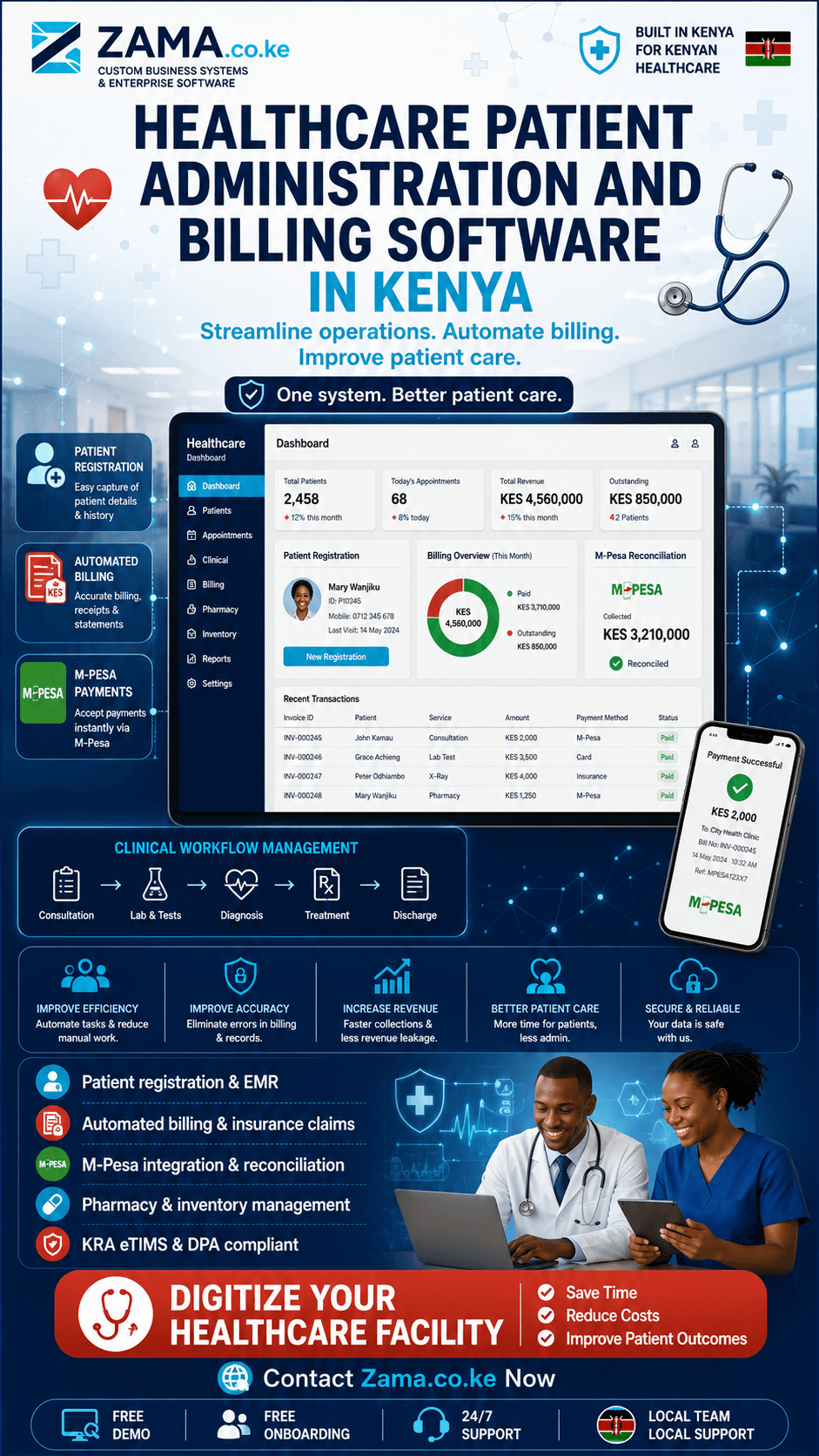
Healthcare patient administration and billing software in Kenya is a question that every hospital administrator, clinic manager, and healthcare entrepreneur must answer in 2026. With Kenya’s healthcare sector undergoing rapid digital transformation, the need for integrated systems that handle patient registration, clinical workflows, and billing processes has never been more urgent. At zama.co.ke, we’ve helped numerous healthcare facilities across Kenya build custom patient administration and billing solutions that streamline operations, improve patient experience, and ensure regulatory compliance. This comprehensive guide explores healthcare patient administration and billing software in Kenya, from understanding core requirements to selecting the right solution for your facility.
The Digital Transformation of Kenyan Healthcare
Before diving into healthcare patient administration and billing software in Kenya, it’s important to understand the current landscape. Kenya’s healthcare sector is undergoing significant digital transformation, with major institutions leading the way. Kenyatta National Hospital (KNH), the country’s largest referral and teaching hospital, has begun a full transition from manual paper-based systems to a fully integrated digital platform known as the Afya Apex/ERP System . This initiative replaces processes that have been in place for over 125 years, covering clinical, administrative, billing, pharmacy, and patient management services .
The KNH digitization program is expected to significantly improve efficiency, transparency, accountability, and coordination across the hospital. Clinicians will have faster access to patient information, administrative processes will be streamlined, and patients will experience more timely and organized services . If successful, the Afya Apex/ERP model is expected to be adopted by other Level 5 and 6 hospitals nationwide .
This trend toward digitization reflects the growing demand for healthcare patient administration and billing software in Kenya across the entire healthcare sector. Healthcare today depends on speed, coordination, accuracy, and real-time access to information . In a busy hospital setup, delays in retrieving records, fragmented communication between departments, and manual billing processes can directly affect patient experience and operational efficiency .
Understanding Healthcare Patient Administration and Billing Software
A comprehensive healthcare patient administration and billing software in Kenya integrates clinical, administrative, and financial processes into one coordinated digital ecosystem . According to experts, the system provides a platform that enables end-to-end digital management of clinical workflows while seamlessly integrating with enterprise resource planning systems . It connects patient care, administrative functions, and financial processes into one coordinated digital ecosystem .
The KenyaEMR 3.x billing module, for example, integrates billing with patient records and clinical workflows, allowing healthcare providers to generate accurate invoices, submit claims to payers, and track payments efficiently . The system ensures compliance with billing regulations and facilitates revenue cycle management .
When considering healthcare patient administration and billing software in Kenya, the problem is usually not lack of data entry tools—it is lack of one system that models the clinical and financial workflow of the facility properly. A modern and tailored HMIS platform can address these issues and significantly improve the overall quality of healthcare services .
Essential Features of Healthcare Patient Administration and Billing Software
When evaluating healthcare patient administration and billing software in Kenya, focus on these core features:
1. Patient Registration and Administration
Patient administration is the foundation of any healthcare system. A proper healthcare patient administration and billing software in Kenya should:
Register and Search Patients: Simplify the patient registration process by allowing patients to provide their information electronically . Capture and maintain patient demographic information, medical history, insurance details, and next of kin .
Check-in and Queue Management: Support check-in with visit type, payment details, payment methods (Cash, Mobile, Insurance), and billable service selection . Streamline appointment scheduling for both healthcare providers and patients, ensuring minimal wait times and optimizing doctor availability .
Manage Patient Records: Securely store all patient information, including demographic data, medical history, current diagnosis, and treatment plans . Authorized healthcare professionals can access patient records anytime, from any department .
2. Clinical Workflow Management
A comprehensive healthcare patient administration and billing software in Kenya should support clinical workflows:
Outpatient Management: Manage consultation services, record vitals and triage, order laboratory services, and create pharmacy prescriptions . Facilitate appointments with general practitioners and specialists, and seamlessly integrate with EHR systems to access and update patient medical records .
Inpatient Management: Handle admissions, bed and ward management, nursing care, and discharge . Streamline the admission process with electronic forms and checklists, and manage bed availability, allocation, and room assignments .
Electronic Medical Records (EMR): Implement a user-friendly EHR system that allows healthcare providers to easily record and access patient medical histories, test results, prescriptions, and treatment plans . Support multidisciplinary care planning and facilitate safe medication administration with electronic medication orders .
3. Billing and Financial Management
Billing automation is the heart of any healthcare patient administration and billing software in Kenya. A proper system should:
Automate Billing: Generate accurate invoices for services rendered, from outpatient consultations to complex surgeries . The system automates billing for consultation services, laboratory services, pharmacy prescriptions, and inpatient charges .
Handle Multiple Payment Methods: Support cash, mobile money (M-Pesa), insurance, and bank transfers . Process payments via mobile money (STK Push), print receipts, and update ledgers in real-time .
Insurance and Claims Management: Integrate with local and international insurance providers, automating claim submissions and tracking the status of payments . Support NHIF/SHA electronic claims submission and processing .
KRA eTIMS Compliance: Generate KRA-compliant tax invoices automatically . Automatic tax invoice generation ensures compliance with Kenya Revenue Authority requirements .
Reconciliation and Reporting: Track hospital expenses, generate invoices, and provide detailed financial reports that help in budgeting and resource allocation . The finance dashboard allows administrators to track facility-wide collections in real-time .
4. Pharmacy and Inventory Management
Managing pharmacy stocks and hospital inventory becomes hassle-free with a healthcare patient administration and billing software in Kenya . The system should:
Track Medication Usage: Automate reordering of low-stock items and ensure expired drugs are removed from inventory . Support FEFO expiry tracking and PPB-compliant controlled substance logs .
Integrate with Prescriptions: Prescriptions written by doctors are directly transmitted to the hospital pharmacy, reducing errors and improving service delivery .
Manage Ward Dispensing: Support pharmacy POS, ward dispensing, and stock management .
5. Laboratory and Diagnostic Integration
A comprehensive healthcare patient administration and billing software in Kenya should integrate laboratory and diagnostic services:
Manage Lab Orders: Manage lab orders, track samples, and deliver results seamlessly to healthcare providers .
View Results: Results can be quickly viewed by doctors through the patient’s record, eliminating the need for physical reports .
Support Imaging: Support radiology and imaging with sample tracking, results, and reports .
6. Reporting and Analytics
Make data-driven decisions with robust reporting and analytics tools . A healthcare patient administration and billing software in Kenya should:
Generate Comprehensive Reports: Generate detailed reports on various hospital operations, including patient inflow, bed occupancy, revenue, doctor performance, and more .
Provide Real-Time Analytics: Real-time data tracking and analytics provide insights that enable informed decision-making, leading to improved resource allocation and cost-effectiveness .
Support Regulatory Reporting: Automate the generation of regulatory reports required by Kenyan healthcare authorities .
7. Patient Portal and Communication
Modern patients expect visibility into their healthcare. A healthcare patient administration and billing software in Kenya should:
Provide Patient Access: Patients can access their medical records, appointment schedules, and billing information through a secure portal .
Send Automated Reminders: Send SMS or email notifications to remind patients of upcoming appointments, follow-up care instructions, and other relevant information .
Telehealth Integration: Offer virtual consultations through telehealth features, allowing patients to consult with healthcare professionals remotely .
8. Security and Compliance
Data security is critical for any healthcare patient administration and billing software in Kenya. The system should:
Protect Patient Data: Implement robust security measures to protect patient data and ensure compliance with healthcare data privacy regulations . Use secure data encryption, access control, and audit trails .
Ensure DPA Compliance: Ensure compliance with Kenya’s Data Protection Act requirements.
Maintain Audit Trails: Track who accessed what, when, and from which device .
What Makes Kenyan Healthcare Software Different
Healthcare patient administration and billing software in Kenya has unique characteristics that global solutions often lack:
M-Pesa Integration
Kenyan healthcare systems must integrate with M-Pesa as the primary payment channel. Native Safaricom M-Pesa integration with instant confirmation is essential .
NHIF/SHA Integration
Systems must support National Hospital Insurance Fund and Social Health Authority electronic claims submission and processing . The transition from NHIF to SHA with new digital requirements demands systems that adapt quickly.
KRA eTIMS Compliance
Automatic tax invoice generation and compliance with Kenya Revenue Authority electronic tax requirements is non-negotiable .
Offline Capability
Many Kenyan healthcare facilities face power and internet outages. Systems must support critical functions during connectivity issues .
Local Language Support
English and Swahili interface options ensure all staff can use the system effectively .
Mobile-First Design
With the dominance of mobile devices, healthcare systems must be accessible from any device, anywhere in Kenya.
The Zama.co.ke Approach
When considering healthcare patient administration and billing software in Kenya, zama.co.ke follows a structured approach:
Operational Discovery
We define the facility’s workflows: patient registration, clinical care, billing, pharmacy, laboratory, and the reports leadership needs to trust. This includes mapping current workflows, identifying pain points, and defining integration requirements.
System Design
Modules, data structure, permissions, user journeys, and reporting layers are planned so the platform supports the clinical and financial workflow coherently. The system should be developed with direct input from staff to ensure it reflects real workflows and operational needs .
Build and Integrate
Core modules, dashboards, automation logic, and external connections are developed in stages with review checkpoints against agreed requirements. Important integrations include M-Pesa, KRA eTIMS, and insurance claims .
Validation and Rollout Readiness
We test critical workflows, user roles, integrations, calculations, and reporting behavior so the system can be adopted with confidence.
Post-Launch Support
After go-live, we support stabilization, user feedback, ongoing maintenance, and the next round of improvements informed by real usage.
Why Healthcare Facilities Choose Custom Solutions
When evaluating healthcare patient administration and billing software in Kenya, facilities often choose custom solutions because:
Business-Process Understanding
We design systems around how the organization actually works, not treating the project as a feature list .
Architecture That Supports Change
A good software foundation makes it easier to add modules, integrations, and new workflows without rebuilding everything later.
Integration-Ready
We can connect payments, insurance claims, diagnostic centers, pharmacies, and legacy tools .
Reliable Support
Software projects create value over time, so we stay available to maintain, refine, and extend the platform after launch.
Local Expertise
We understand the Kenyan healthcare landscape, regulatory requirements, and operational realities.
Common Implementation Challenges and Solutions
Challenge 1: Staff Resistance to Change
Solution: Training workshops with hands-on sessions, identifying tech-savvy champions who can mentor peers, and celebrating wins publicly. Systems developed with staff input see stronger adoption .
Challenge 2: Operational Disruptions
Solution: Phased rollout with contingency measures to maintain service continuity during transition .
Challenge 3: Data Migration from Paper Records
Solution: Phased migration with data validation checkpoints.
Challenge 4: Inconsistent Internet Connectivity
Solution: Systems optimized for low-bandwidth networks with offline capability for critical functions .
Healthcare patient administration and billing software in Kenya is essential for any healthcare facility operating in 2026. From patient registration and clinical workflows to automated billing and M-Pesa integration, the right system transforms how healthcare facilities operate and serve patients .
At zama.co.ke, we’ve helped healthcare facilities across Kenya build custom patient administration and billing solutions that streamline operations and improve patient care. Our approach ensures you get exactly what your facility needs—nothing more, nothing less.
Don’t let the complexity of healthcare patient administration and billing software in Kenya hold you back. Whether you’re a small clinic or a large hospital, we have the expertise to guide you through every step.
Contact zama.co.ke today and let us help you build a healthcare patient administration and billing software solution that transforms your facility’s operations.