
Healthcare institutions across Kenya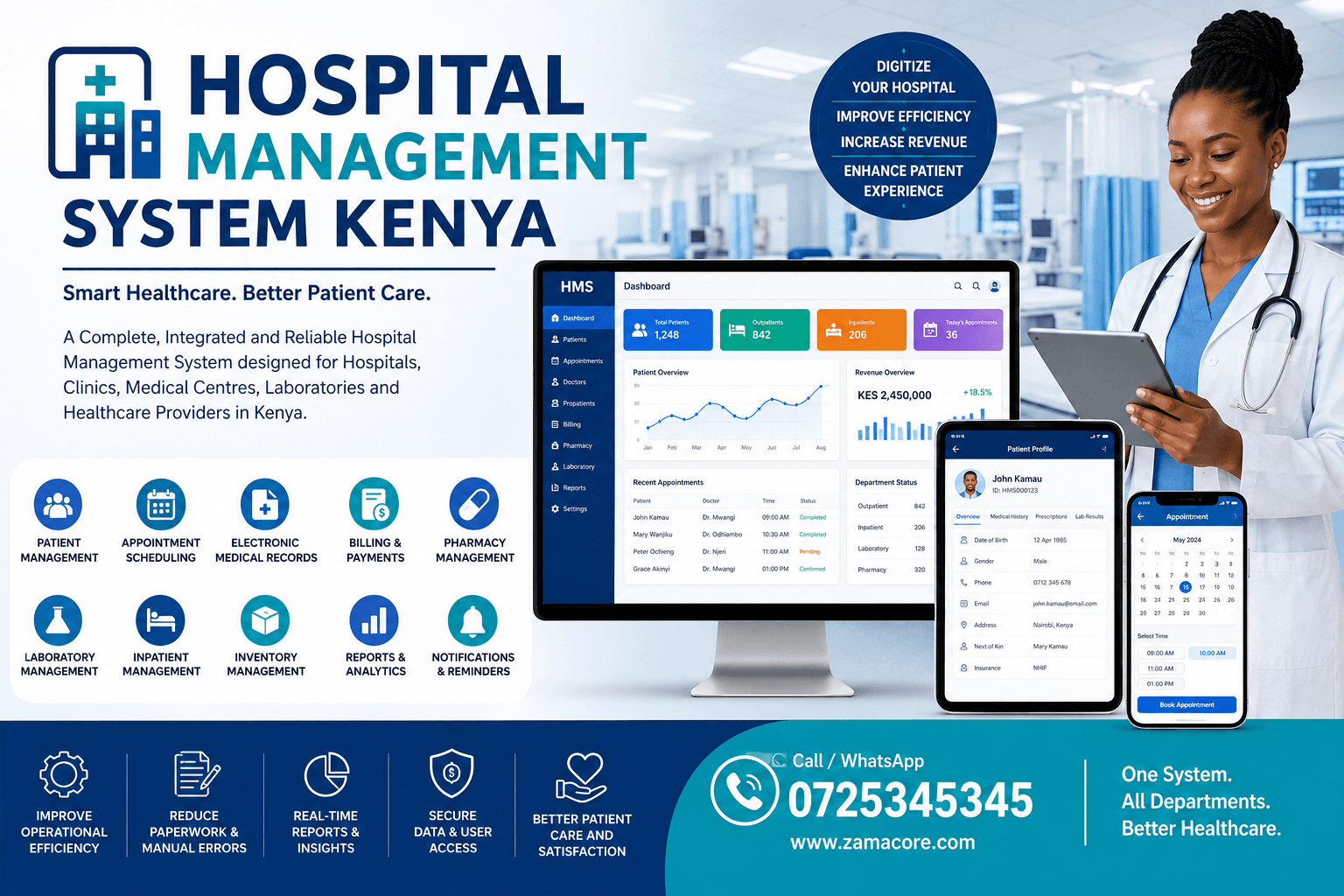 are embracing digital transformation to improve patient care, streamline operations, and increase efficiency. Managing patient records, appointments, billing, pharmacy inventory, laboratory results, inpatient services, and financial reporting manually is no longer practical in today’s fast-paced healthcare environment.
A modern Hospital Management System Kenya enables hospitals, clinics, medical centres, dispensaries, diagnostic laboratories, and specialty healthcare providers to automate daily operations while delivering exceptional patient experiences.
Whether you operate a private hospital, county hospital, maternity hospital, specialist clinic, dental practice, or outpatient medical centre, implementing a reliable Hospital Management System helps reduce paperwork, eliminate errors, improve productivity, and provide better healthcare outcomes.
Table of Contents
- What is a Hospital Management System?
- Why Hospitals in Kenya Need Digital Healthcare Solutions
- Key Features of Hospital Management Software
- Modules of a Complete Hospital Management System
- Benefits of Hospital Management Software
- Hospital Departments Supported
- Cloud vs On-Premise Hospital Systems
- Patient Journey Using HMS
- Security and Compliance
- Why Choose Our Hospital Management System
- Frequently Asked Questions
- Get Started Today
What is a Hospital Management System?
A Hospital Management System Kenya is a centralized software platform designed to manage all administrative, financial, and clinical activities within a healthcare facility.
Instead of relying on paper records or disconnected software, an integrated Hospital Management System connects every department into a single platform, ensuring accurate information sharing and improved operational efficiency.
A comprehensive Hospital Management System can manage:
- Patient registration
- Electronic Medical Records (EMR)
- Appointment scheduling
- Consultation notes
- Laboratory services
- Radiology
- Pharmacy
- Billing
- Insurance claims
- Inpatient management
- Theatre management
- Inventory
- Financial reports
- Human resources
- Payroll
- Asset management
By centralizing these operations, hospitals can provide faster, safer, and more reliable healthcare services.
Why Hospitals in Kenya Need Hospital Management Software
Healthcare providers face increasing pressure to improve efficiency while maintaining high standards of patient care.
Common challenges include:
- Lost patient files
- Long waiting times
- Manual billing errors
- Poor appointment coordination
- Medicine stock shortages
- Insurance claim delays
- Limited reporting
- Duplicate patient records
- Difficult financial reconciliation
- Poor communication between departments
A Hospital Management System addresses these challenges through automation and real-time data access, helping medical facilities operate more efficiently.
Key Features of a Hospital Management System Kenya
Patient Registration
Quickly register new patients while maintaining a unique medical record number for each individual.
Features include:
- Patient demographics
- Medical history
- Emergency contacts
- Insurance details
- National ID integration
- Photo capture
Electronic Medical Records (EMR)
Digital patient records improve continuity of care by allowing authorized healthcare professionals to access medical histories, diagnoses, prescriptions, allergies, laboratory results, and treatment plans from a secure system.
Benefits include:
- Reduced paperwork
- Faster diagnosis
- Better patient safety
- Improved collaboration
- Easy retrieval of records
Appointment Scheduling
Healthcare providers can efficiently manage appointments by:
- Booking consultations
- Sending reminders
- Tracking doctor availability
- Managing queues
- Reducing patient waiting time
Doctor Management
Manage doctor schedules, specialties, consultations, availability, and workload while improving coordination across departments.
Pharmacy Management
A built-in pharmacy module helps manage:
- Medicine inventory
- Prescription dispensing
- Expiry dates
- Batch tracking
- Supplier management
- Low-stock alerts
- Purchase orders
Laboratory Management
Laboratory workflows become faster and more accurate through:
- Test requests
- Sample tracking
- Digital results
- Report generation
- Doctor notifications
Billing and Payments
Generate accurate invoices for:
- Consultations
- Laboratory services
- Pharmacy purchases
- Admissions
- Procedures
- Theatre services
- Radiology
The system can also integrate with popular digital payment methods and insurance workflows where applicable.
Inpatient Management
Manage admitted patients with:
- Bed allocation
- Ward transfers
- Nursing notes
- Medication administration
- Daily monitoring
- Discharge summaries
Inventory Management
Track medical supplies, equipment, and consumables with:
- Stock levels
- Purchase requests
- Supplier management
- Reorder alerts
- Expiry monitoring
Financial Reporting
Generate reports such as:
- Revenue analysis
- Daily collections
- Outstanding balances
- Department performance
- Profit and loss
- Cash flow
- Insurance claims
Benefits of Hospital Management System Kenya
A Hospital Management System delivers measurable improvements across clinical, operational, and financial areas.
Key benefits include:
- Faster patient registration
- Reduced paperwork
- Improved accuracy
- Better coordination between departments
- Enhanced patient experience
- Stronger financial control
- Real-time reporting
- Reduced operational costs
- Secure data storage
- Scalable growth for healthcare facilities
Departments Supported
A modern Hospital Management System can support:
- Outpatient Department (OPD)
- Inpatient Department (IPD)
- Emergency Unit
- Pharmacy
- Laboratory
- Radiology
- Theatre
- Maternity
- Dental
- Physiotherapy
- Dialysis
- ICU
- Oncology
- Cardiology
- Administration
- Finance
- Human Resources
Cloud vs On-Premise Hospital Management Systems
Cloud-based Hospital Management Systems offer:
- Access from multiple locations
- Automatic backups
- Lower infrastructure costs
- Easier updates
- Improved scalability
- Better disaster recovery
On-premise systems may suit organizations with strict internal hosting requirements but typically involve higher hardware and maintenance costs.
Why Choose Our Hospital Management System?
We design healthcare software that is:
- Secure
- User-friendly
- Scalable
- Cloud-enabled
- Mobile responsive
- Customizable
- Reliable
- Easy to integrate with existing systems
- Supported by ongoing technical assistance
Our solutions are tailored for hospitals, clinics, specialist practices, and healthcare providers across Kenya.
Frequently Asked Questions
How much does a Hospital Management System cost in Kenya?
Pricing depends on the number of users, required modules, customization needs, and deployment model.
Can the system manage multiple branches?
Yes. Multi-branch healthcare organizations can manage all facilities from a centralized platform.
Is patient information secure?
Yes. The system uses role-based access, authentication, encryption, and audit trails to help protect patient data.
Can it integrate with laboratory and pharmacy modules?
Yes. The platform supports integrated workflows between clinical, pharmacy, laboratory, billing, and administration modules.
Is training provided?
Yes. User training, implementation support, and ongoing maintenance are typically included as part of the deployment process.
Conclusion
The healthcare sector in Kenya continues to evolve, and digital systems have become essential for delivering efficient, high-quality patient care. A Hospital Management System Kenya helps healthcare providers automate operations, improve collaboration, reduce errors, enhance financial management, and deliver a better patient experience.
Whether you manage a hospital, clinic, medical centre, or specialized healthcare practice, implementing the right Hospital Management System provides a strong foundation for sustainable growth and operational excellence.