
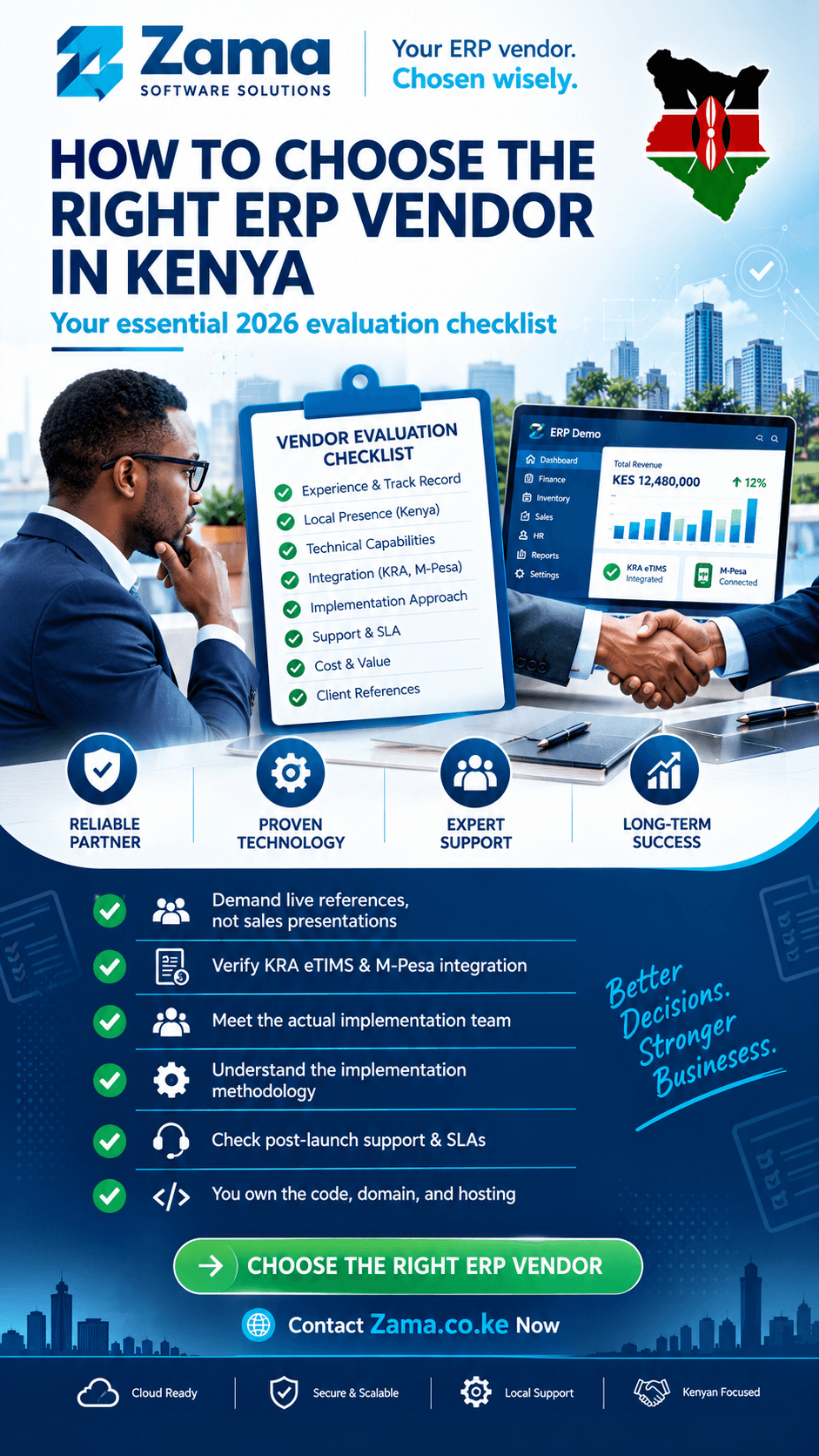
How to choose the right ERP vendor in Kenya is a question that every business owner, operations director, and finance manager must answer in 2026. With the Kenya ERP software market experiencing steady growth, the Middle East and Africa ERP market projected to reach USD 10.20 billion by 2032, and over 56 ERP services startups operating in Kenya, the choices have never been more numerous—or more confusing. At zama.co.ke, we’ve helped numerous organizations across Kenya navigate this complex landscape and select ERP partners that deliver real value. This comprehensive guide explores how to choose the right ERP vendor in Kenya, providing a practical framework to help you separate capable partners from costly mistakes.
The True Cost of Choosing the Wrong ERP Vendor
Before diving into how to choose the right ERP vendor in Kenya, it’s essential to understand the stakes. Kenyan SMEs lose an estimated KSh 4.7 billion annually to software failures, system crashes, and poorly integrated digital tools. But the cost of a failed ERP project goes far beyond lost revenue.
The numbers are sobering. 78% of Kenyan SMEs that adopted global software solutions abandoned them within 18 months. Millions of shillings spent on systems that were supposed to transform operations—only to gather dust because they were built for a business environment that doesn’t exist in Kenya. One manufacturing company in Industrial Area spent KSh 4.2 million implementing a popular ERP system. Six months later, they were still manually reconciling M-Pesa payments because the software couldn’t handle local payment flows. A Nairobi-based distributor spent KSh 850,000 on a popular ERP system—the same one his competitor used, the one every consultant recommended—only to discover it couldn’t support his multi-branch inventory requirements.
These failures are not isolated incidents. They are the predictable result of how to choose the right ERP vendor in Kenya being treated as a technology decision rather than a business decision.
Understanding the Kenyan ERP Landscape
Before evaluating how to choose the right ERP vendor in Kenya, it’s important to understand the market you’re navigating. The Kenyan ERP market includes:
Global Platforms: SAP, Oracle, Microsoft Dynamics, Sage, and others with local presence.
Regional Specialists: Odoo partners, Zoho partners, and ERPNext specialists operating across East Africa.
Homegrown Solutions: Cloud-native platforms built in Kenya, designed specifically for African manufacturers, distributors, and SMEs.
Each category has strengths and weaknesses. Global platforms offer comprehensive functionality but often require expensive customization for Kenyan requirements. Regional specialists understand local markets but vary widely in capability. Homegrown solutions are built for local realities but may lack the depth of established platforms.
Understanding this landscape is the first step in how to choose the right ERP vendor in Kenya effectively.
The Kenya-Specific Factors That Matter Most
When learning how to choose the right ERP vendor in Kenya, you must prioritize vendors who understand the unique requirements of operating in Kenya:
KRA eTIMS Compliance
The most important Kenya-specific requirement for any ERP vendor is KRA eTIMS compliance. The Kenya Revenue Authority mandates that all VAT-registered businesses transmit invoices electronically through eTIMS. From 1 January 2024, business expenses must be supported by an electronic tax invoice. Non-compliance carries penalties of up to KES 1 million or imprisonment.
A vendor who does not have eTIMS integration built natively into their solution—or who requires expensive custom development to achieve it—is not a vendor who understands the Kenyan market. The best how to choose the right ERP vendor in Kenya advice is to ask for a live demonstration of eTIMS integration before signing anything.
M-Pesa Integration
M-Pesa integration must be native, not an afterthought. If an ERP vendor does not have deep experience integrating with Safaricom’s Daraja API for STK Push, C2B, B2C, and B2B transactions, they cannot deliver a truly local solution. Global software assumes payments work like they do in New York or London—Stripe, PayPal, bank transfers that clear in seconds. In Kenya, your customers pay via M-Pesa, Airtel Money, and bank transfers that take time to clear.
A retail chain that implemented a global point-of-sale system across 12 branches found that three months later, they still had staff maintaining separate Excel sheets for M-Pesa transactions because the system couldn’t integrate with local payment providers. They were essentially running two businesses—one in the software, one in reality. The best how to choose the right ERP vendor in Kenya approach is to demand proof of M-Pesa integration in live systems.
Payroll and Statutory Compliance
Kenyan payroll is complex. PAYE, NSSF, SHIF, and AHL deductions must be calculated accurately and remitted on time. An ERP vendor who does not understand Kenyan payroll requirements will create compliance headaches from day one. The best how to choose the right ERP vendor in Kenya checklist includes verifying that payroll modules support current statutory rates and can generate the required returns.
Data Protection Act Compliance
Kenya’s Data Protection Act imposes strict requirements on how businesses handle personal data. An ERP system stores employee records, customer data, and financial information. The vendor you choose must understand data protection requirements and build compliance into their solution—not treat it as an afterthought.
The Vendor Evaluation Framework
When considering how to choose the right ERP vendor in Kenya, use this structured framework:
1. Demand Live References, Not Sales Presentations
Anyone can prepare a polished sales presentation. Before you discuss pricing, ask the vendor for at least three live customer references in Kenya. Not case studies. Not testimonials. Actual customers you can call.
The best how to choose the right ERP vendor in Kenya approach is to ask specific questions of references:
How long did implementation actually take versus what was promised?
How responsive is support when you have a critical issue?
Did the vendor understand Kenyan compliance requirements from day one?
What would you do differently if you were selecting a vendor again?
A confident vendor hands over references immediately. A vendor who hesitates is telling you something.
2. Verify Local Compliance Expertise
A vendor who does not understand KRA eTIMS, M-Pesa integration, and Kenyan payroll requirements will create problems that cost far more than any upfront savings. The best how to choose the right ERP vendor in Kenya advice is to ask for a live demonstration of compliance features before signing anything.
Ask to see:
A live eTIMS integration transmitting an invoice
A live M-Pesa STK Push transaction
A sample payroll run with current statutory deductions
A Data Protection Act compliance checklist
If the vendor cannot demonstrate these capabilities, they are not ready for the Kenyan market.
3. Meet the Actual Implementation Team
Companies often say “our team of experienced engineers.” That is not enough. Demand to know who will actually implement your ERP.
The best how to choose the right ERP vendor in Kenya approach is to ask for names, backgrounds, and specific roles. For ERP systems handling sensitive financial data, knowing who is accountable is not just good practice—it is a governance requirement. A strong implementation consultant can explain a past project clearly—what went wrong, how they caught it, how they fixed it.
4. Understand the Implementation Methodology
A serious ERP vendor should understand the difference between configuration, customization, migration, integration, reporting, and adoption. Each of these areas affects cost, timeline, user acceptance, and long-term support.
The best how to choose the right ERP vendor in Kenya methodology follows a structured approach:
Discovery Workshop: Map the current process, pain points, users, reports, and system gaps.
Solution Blueprint: Define modules, workflows, data fields, roles, automations, and integrations.
Configuration and Controlled Customization: Build only what the business can own after go-live.
Migration and Validation: Clean data, migrate the approved scope, and reconcile important records.
User Acceptance Testing: Test real operating scenarios with business users.
Training and Go-Live: Prepare users with role-based training and a practical cutover plan.
Stabilization: Fix adoption issues, dashboard gaps, and workflow exceptions after launch.
If a vendor cannot clearly explain their process, proceed with caution.
5. Check Data Migration Expertise
Data migration is almost always the longest single thread in an ERP implementation, and it is almost always underestimated. Specific challenges include item master records created inconsistently across years, customer and supplier records with incorrect tax IDs, historical transactions with incomplete costing data, and opening balances that do not reconcile.
The best how to choose the right ERP vendor in Kenya vendors begin data cleansing during the project’s planning phase—not at migration. By the time cutover is approaching, the window for remediation is too small. Ask the vendor: “How do you handle data migration, and what is your track record of on-time, reconciled go-lives?”
6. Evaluate Post-Launch Support
The first four to six weeks after go-live are the most operationally vulnerable period of any ERP project. Kenyan businesses lose an average of KSh 340,000 per incident in downtime. Having a hypercare plan with dedicated support, quick escalation paths, and rapid response times is essential for stabilization.
The best how to choose the right ERP vendor in Kenya support includes:
Clear Service Level Agreements (SLAs) with defined response times
Local support teams in your timezone
Escalation paths for critical issues
Ongoing maintenance and upgrade planning
7. Understand the True Total Cost of Ownership
ERP costs extend far beyond the initial license or subscription fee. When evaluating how to choose the right ERP vendor in Kenya, consider:
Implementation costs
Customization costs
Data migration costs
Training costs
Ongoing support and maintenance
Upgrade costs
Integration costs
A vendor who quotes dramatically below market rates is either cutting corners or will recover costs through expensive change requests later.
8. Check for Red Flags
When learning how to choose the right ERP vendor in Kenya, watch for these warning signs:
No Local References: If a vendor cannot provide Kenyan references, they do not understand the market.
No Live Demonstrations: If they cannot show you a working system, they are selling promises, not software.
Vague Processes: If they cannot explain their implementation methodology, they do not have one.
Over-Customization: If they promise to build everything you ask for without pushback, they are setting you up for a system that cannot be upgraded.
Price Too Good to Be True: If the quote is dramatically below competitors, there is a reason.
No Compliance Knowledge: If they cannot discuss KRA eTIMS, M-Pesa integration, and Kenyan payroll, they are not ready for your business.
The Vendor Selection Scorecard
When evaluating how to choose the right ERP vendor in Kenya, use this scorecard to compare vendors objectively:
| Criteria | Weight | Vendor A | Vendor B | Vendor C |
|---|---|---|---|---|
| KRA eTIMS compliance | 20% | |||
| M-Pesa integration | 15% | |||
| Kenyan payroll expertise | 10% | |||
| Live references | 15% | |||
| Implementation methodology | 15% | |||
| Post-launch support | 10% | |||
| Total cost of ownership | 10% | |||
| Cultural fit and communication | 5% |
This structured approach ensures you evaluate vendors on what actually matters, not on sales presentations.
The Zama.co.ke Approach
When considering how to choose the right ERP vendor in Kenya, zama.co.ke follows a structured approach:
Business-Process Understanding
We design systems around how the organization actually works instead of treating the project as a feature list with no operational structure. Our first step is always understanding your business—not selling software.
Compliance-First Design
We build ERP solutions with Kenya-specific compliance built in from day one—KRA eTIMS integration, M-Pesa Daraja API, payroll (PAYE, NSSF, SHIF, AHL), and Data Protection Act requirements. We don’t retrofit compliance; we design it in.
Architecture That Supports Change
A good software foundation makes it easier to add modules, integrations, reports, and new user groups without rebuilding everything later. We build for the long term, not just go-live.
Local Integration Patterns
We build for what Kenyan businesses actually use—M-Pesa, KRA eTIMS, local banks, and messaging platforms. Our practice is built for the local rails that matter, not Stripe and QuickBooks.
Transparent Partnership
No hidden fees, no “black box” development. We provide clear milestone timelines, upfront pricing, and full source-code ownership.
Reliable Support
We remain available to maintain, refine, and extend your ERP solution as your business evolves. Our commitment extends beyond go-live.
Common Mistakes to Avoid
When learning how to choose the right ERP vendor in Kenya, avoid these common mistakes:
Mistake #1: Choosing Software Before Understanding Your Processes
Many ERP projects fail because configuration completes on time but key business decisions remain unresolved. Decisions that stall most often include tax treatment for intercompany transactions, approval hierarchy, item master structure, and inter-branch stock movement rules. The resolution is to build a business validation buffer into the project timeline.
Mistake #2: Underestimating Data Migration
Data migration is almost always the longest single thread in an ERP implementation. Kenyan records are often incomplete, inconsistent, or stored in formats that cannot be directly migrated. Beginning data cleansing during the project’s planning phase—not at migration—is essential.
Mistake #3: Treating Training as an Event
Training conducted once before go-live covering all roles in a single session is a reliable predictor of poor user adoption. Role-specific training delivered closer to go-live using the organization’s own data and actual business scenarios consistently produces higher adoption rates.
Mistake #4: Skipping the Hypercare Phase
The first four to six weeks after go-live are the most operationally vulnerable period. Having a hypercare plan with dedicated support, quick escalation paths, and rapid response times is essential for stabilization.
Mistake #5: Forgetting That ERP Is a Business Project, Not an IT Project
ERP implementations succeed or fail based on business process alignment, user adoption, and data quality—not on technology alone. Ensure business leaders are actively involved, not just IT teams.
The ROI of Choosing Wisely
When you understand how to choose the right ERP vendor in Kenya, the business case becomes clear:
Operational Efficiency: ERP systems streamline operations, eliminate manual work, and reduce errors.
Compliance Confidence: Automated compliance with statutory requirements eliminates manual errors and reduces compliance risk.
Data-Driven Decisions: Real-time dashboards and reporting provide visibility that supports strategic decisions.
Scalability: The right ERP grows with your business, from a single location to multiple branches and regions.
Competitive Advantage: Businesses with properly implemented ERP systems can respond faster to market changes and customer needs.
Cost Reduction: Reducing manual work, eliminating errors, and optimizing inventory delivers measurable savings.
The Zama.co.ke Difference
When you choose zama.co.ke to help you navigate how to choose the right ERP vendor in Kenya, you gain:
Local Context Mastery: We understand the Kenyan business landscape, regulatory environment, and user behavior patterns.
Compliance-First Design: KRA eTIMS, M-Pesa, payroll, and DPA built in from day one.
Transparent Partnership: No hidden fees, clear milestone timelines, and full source-code ownership.
Proven Results: We’ve helped businesses across Kenya implement ERP solutions that deliver measurable results.
Long-Term Commitment: We stay with you beyond launch, supporting, refining, and extending your solution as your business evolves.
How to choose the right ERP vendor in Kenya is not a decision to be taken lightly. The wrong choice costs millions in wasted investment, lost productivity, and compliance penalties. The right choice transforms your operations, ensures compliance, and positions your business for growth.
At zama.co.ke, we’ve helped organizations across Kenya navigate this decision and select ERP partners that deliver real value. Our approach ensures you get exactly what your business needs—nothing more, nothing less.
Don’t let the complexity of how to choose the right ERP vendor in Kenya hold you back. Whether you’re a growing SME or a large enterprise, we have the expertise to guide you through every step.
Contact zama.co.ke today and let us help you find the right ERP vendor for your business.