
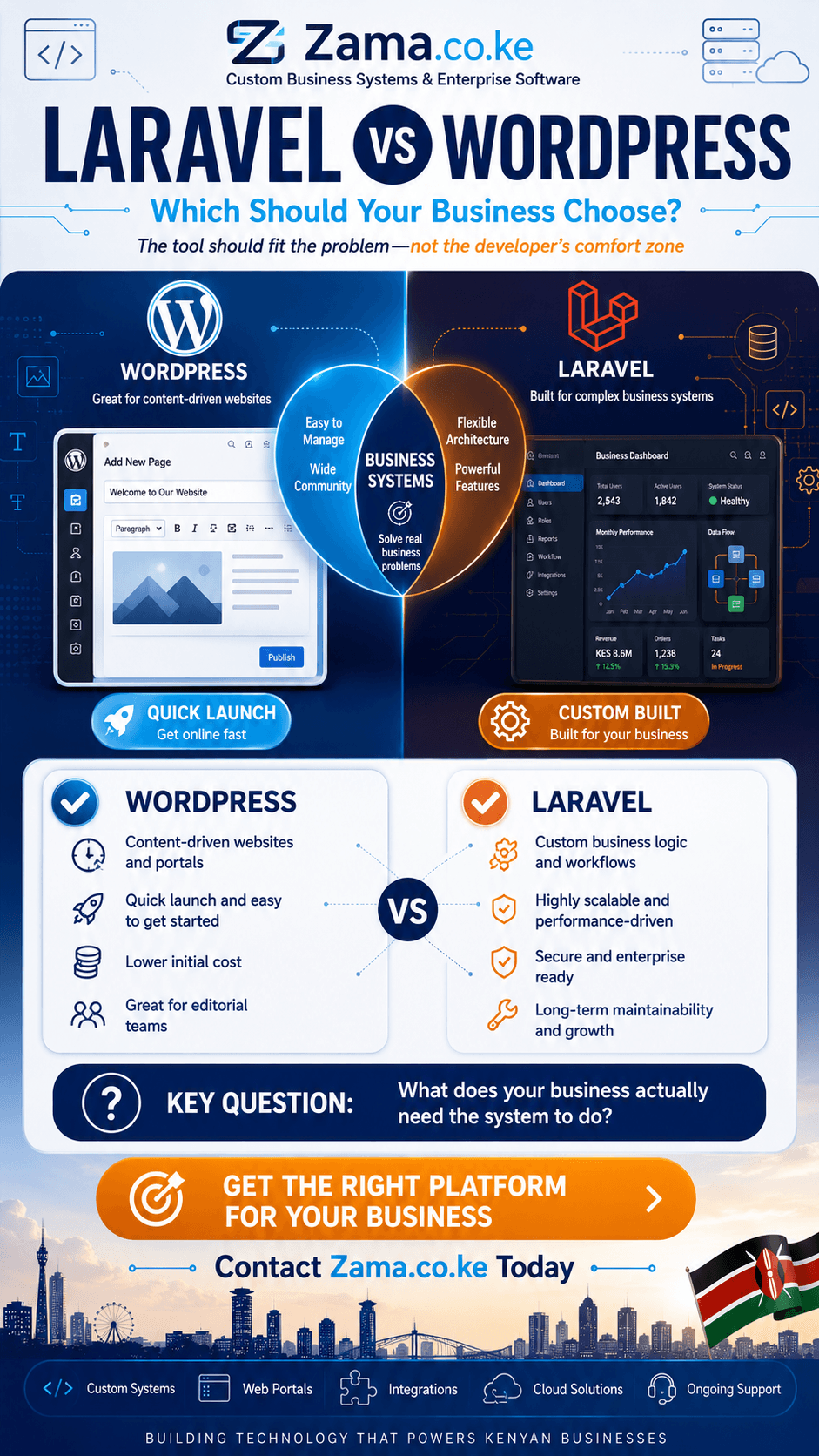
Laravel vs WordPress for business systems: which should you choose is a question that every business owner, operations manager, and entrepreneur in Kenya must answer in 2026. With WordPress powering roughly 40% of all websites globally and Laravel emerging as the framework of choice for custom business applications, the decision has significant long-term implications. At zama.co.ke, we’ve helped numerous organizations across Kenya build both WordPress sites and Laravel applications, and we understand the trade-offs involved. This guide explores Laravel vs WordPress for business systems: which should you choose, providing a practical framework for making the right decision for your specific needs.
Understanding the Core Difference
Before diving into Laravel vs WordPress for business systems: which should you choose, it’s essential to understand what each platform actually is. Laravel is a modern PHP framework—a toolkit for developers to build custom web applications from the ground up. It gives developers full control over structure, logic, and features. WordPress, on the other hand, is a content management system (CMS) designed for quick website launches with minimal technical expertise.
The distinction is fundamental. WordPress is a ready-made product. Laravel is a tool for building custom products. When considering Laravel vs WordPress for business systems: which should you choose, you’re really asking whether you need a ready-made solution or a custom-built one.
What WordPress Does Well
WordPress has become the world’s most popular CMS, and for good reasons. When evaluating Laravel vs WordPress for business systems: which should you choose, consider these WordPress strengths:
Rapid Launch
A basic WordPress site can be launched in days, not months. The platform comes with thousands of pre-built themes and plugins that allow non-technical users to create functional websites quickly. This speed-to-market is valuable for businesses that need an online presence fast.
Content Management
WordPress shines when content management is the core requirement. Non-technical team members can create pages, write blog posts, and update content without involving developers. The Gutenberg editor and page builders make content management accessible.
Low Initial Cost
WordPress itself is free, and many themes and plugins are available at low cost. A basic WordPress site can be built for relatively little upfront investment, making it accessible for small businesses and startups.
Editorial SEO
WordPress benefits from a rich ecosystem of SEO plugins like Yoast and RankMath that simplify sitemap and metadata management. For straightforward content publishing, this is excellent.
Large Community
With over 57,000 plugins and thousands of themes, WordPress has an enormous ecosystem. Finding solutions to common problems is usually easy, and developers are widely available.
What WordPress Doesn’t Do Well
When considering Laravel vs WordPress for business systems: which should you choose, WordPress has significant limitations:
Performance Degradation
A typical WordPress site loads 15-30 plugins, each adding JavaScript and CSS files that the browser must download. A premium theme adds another layer of code, much of it for features you’ll never use. The result? Page load times of 4-8 seconds are common on WordPress sites, even with good hosting.
Security Vulnerabilities
WordPress is the most targeted CMS in the world. WordPress accounts for over 90% of all hacked CMS platforms. Every plugin is a potential vulnerability, and many WordPress sites run outdated plugins with known security flaws.
Scalability Limits
WordPress struggles with scale. Database queries slow down as content grows, plugin conflicts become more common, and the platform’s architecture makes it difficult to optimize specific bottlenecks. Once you add business logic (booking, calculations, dashboards), you accumulate plugins and technical debt soars.
Limited Business Logic
WordPress is excellent for content, but once your website needs to actually do something—handle custom calculations, client portals, automated workflows, or integrations with systems that don’t have WordPress plugins—you hit limits.
What Laravel Does Well
When considering Laravel vs WordPress for business systems: which should you choose, Laravel offers distinct advantages:
Full Control
Laravel gives developers complete control over every aspect of the application—architecture, logic, interfaces, and functionality. There are no platform-imposed limitations.
Performance
Laravel uses Eloquent ORM, which efficiently gets data from databases, resulting in faster websites. Custom websites routinely achieve load times under 2 seconds, often under 1 second.
Security
Laravel includes built-in security features like CSRF protection, password encryption, role-based access control, and centralized HTTP request validation. External dependencies are limited and vetted via Composer, reducing the attack surface.
Scalability
Laravel is designed to scale cleanly as requirements evolve. You can add modules, workflows, and integrations without bending a CMS into shapes it wasn’t designed for. The MVC architecture handles growing features efficiently.
Business Logic
Laravel excels when your system needs custom business logic: onboarding flows, role-based dashboards, workflow automation, complex integrations, and data orchestration.
What Laravel Doesn’t Do Well
When evaluating Laravel vs WordPress for business systems: which should you choose, understand Laravel’s limitations:
Higher Initial Cost
Laravel requires custom development. Development costs can range from $3,000 to over $250,000 depending on complexity. In the Kenyan context, a Laravel setup typically costs KSh 40,000-70,000 compared to KSh 15,000-25,000 for WordPress.
Longer Time-to-Market
Building a Laravel application takes longer than launching a WordPress site. The upfront investment in time and money is higher, but future enhancements integrate naturally without accumulating technical debt.
Requires Development Expertise
Laravel requires skilled developers. Non-technical teams cannot easily build or maintain Laravel applications without developer support.
Admin Interface Must Be Built
WordPress comes with a built-in admin panel. With Laravel, you must either build a custom admin interface or use tools like Filament or Laravel Nova.
Making the Right Choice for Your Business
When considering Laravel vs WordPress for business systems: which should you choose, use this framework:
Choose WordPress When:
Content is your core requirement: Blogs, portfolios, news sites, marketing websites
Your team needs to update content without developers: Marketing teams want to publish independently
Time-to-market matters more than custom architecture: You need a website quickly
A proven plugin ecosystem covers 70%+ of your requirements: Simple business sites with minimal custom logic
Budget is limited: You need a functional site with minimal upfront cost
You’re building a brochure website: Information-heavy marketing sites that don’t require custom business logic
Choose Laravel When:
The application has complex business logic: Custom workflows, calculations, or processes
You need custom APIs, authentication systems, or background jobs: Modern web applications require these capabilities
The team will maintain it long-term and needs a clean codebase: Long-term maintainability matters
You’re building something that will grow and scale: Future-proofing is essential
Performance and security are non-negotiable: Your business depends on speed and security
Your roadmap will add features over time: You need extensibility without rebuilding
Your website needs to work like software: Custom portals, dashboards, or applications
The Performance and Cost Trade-Off
When analyzing Laravel vs WordPress for business systems: which should you choose, consider the long-term economics:
WordPress offers a low initial cost, but premium plugin licenses, extension conflicts, and frequent updates can inflate maintenance expenses. Hidden costs emerge as you add plugins to simulate application behavior—increasing risk and slowing performance.
Laravel has a higher upfront budget, but technical debt remains minimal and future enhancements integrate naturally without domino effects. You invest earlier to avoid expensive rebuilds later.
The Kenyan Context
For Kenyan businesses, several local factors should influence your decision when evaluating Laravel vs WordPress for business systems: which should you choose:
Mobile-First Requirements
Over 80% of internet users in Kenya access the web via mobile phones. The slower load times typical of WordPress sites can be devastating in this context—53% of mobile users abandon a site that takes more than 3 seconds to load. Custom Laravel sites routinely achieve load times under 2 seconds.
M-Pesa Integration
If your business system needs to integrate with M-Pesa for payments, Laravel provides cleaner, more secure integration pathways than WordPress plugins.
Local SEO
Custom development allows full control over technical SEO: URL structure, schema, sitemaps, and performance budgets—all of which matter for Google rankings in Kenya.
The Zama.co.ke Approach
When clients ask Laravel vs WordPress for business systems: which should you choose, zama.co.ke follows a structured evaluation:
Operational Discovery
We define what the business actually needs: content management, custom calculations, client portals, integrations, and the reports leadership needs.
Platform Recommendation
Based on the discovery, we recommend either WordPress for content-driven sites or Laravel for custom business applications. We’re not locked into one approach—we choose what fits the problem.
Implementation
For WordPress projects, we build clean, lightweight sites with minimal plugins for performance and security. For Laravel projects, we architect scalable applications with proper testing, security, and maintenance planning.
Post-Launch Support
Regardless of the platform, we remain available to maintain, refine, and extend the solution after launch.
The Bottom Line
Laravel vs WordPress for business systems: which should you choose depends entirely on what you’re building. WordPress is the right choice for content-driven websites—blogs, brochures, portfolios, and simple business sites. It’s faster to build and easier for non-technical teams to manage.
Laravel is the right choice when your website needs to work like software—custom calculations, automated workflows, complex integrations, and scalable applications. The upfront investment is higher, but the long-term returns are significantly greater for businesses whose operations depend on their digital systems.
The tool should fit the problem—not the developer’s comfort zone. At zama.co.ke, we help Kenyan businesses make this decision based on their specific needs, not generic recommendations.
Don’t let the complexity of Laravel vs WordPress for business systems: which should you choose hold you back. Whether you need a content-driven WordPress site or a custom Laravel application, we have the expertise to guide you through every step.
When evaluating Laravel vs WordPress for business systems: which should you choose, remember that the right choice depends on your specific business requirements, not on what works for someone else. The platform you choose will impact your business for years to come, so take the time to evaluate carefully.
The question of Laravel vs WordPress for business systems: which should you choose is ultimately about understanding your business needs. If content is king, WordPress may be your answer. If custom functionality and scalability are paramount, Laravel is likely the better choice.
Laravel vs WordPress for business systems: which should you choose is a decision that requires careful consideration of your long-term goals, budget, and technical requirements. Both platforms have their place, and the right choice depends on what you’re building.
Contact zama.co.ke today and let us help you build the right solution for your business.