
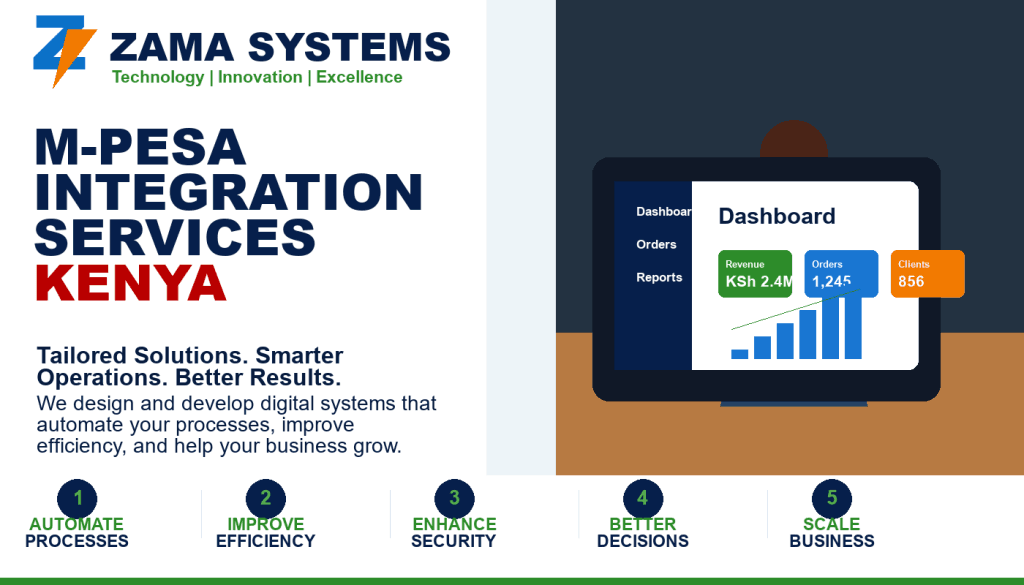
M-Pesa Integration Services Kenya: 8 Ways to Automate Payments and Records
M-Pesa Integration Services Kenya is useful for businesses that receive mobile payments and need cleaner confirmations, receipts, reconciliations, and customer records that need better systems, faster workflows, cleaner records, connected payments, and clearer management reports. Connect M-Pesa STK Push, payment confirmation, invoices, receipts, dashboards, and business systems. Zama builds practical software and automation systems that support daily business operations. Related M-Pesa Integration Services Kenya links: M-Pesa Integration Services Kenya – Zama.co.ke | M-Pesa Integration Services Kenya – Prim.co.ke | M-Pesa Integration Services Kenya – RentalDesk.co.ke | M-Pesa Integration Services Kenya – Saseni.com | M-Pesa Integration Services Kenya – Awasam.co.ke | M-Pesa Integration Services Kenya – Spacekits.co.ke.
Table of Contents
- What this solution means
- Important features
- Implementation checklist
- Useful links
- Frequently asked questions
What Is
M-Pesa Integration Services Kenya is a digital solution for organizations that need stronger software, automation, ERP tools, integrations, dashboards, payment workflows, and operational visibility. It helps teams replace scattered records with structured systems that are easier to manage.
The best systems are built around the way a business actually works. They connect people, departments, tasks, approvals, customer records, stock records, payments, and reports so owners can see what is happening without chasing manual updates.
Important Features of M-Pesa Integration Services Kenya
- STK Push
- payment callbacks
- invoice matching
- receipt automation
- customer records
- dashboards
- reconciliation
- API integration
1. Map the current workflow: M-Pesa Integration Services Kenya
M-Pesa Integration Services Kenya helps businesses that receive mobile payments and need cleaner confirmations, receipts, reconciliations, and customer records replace scattered manual work with structured digital workflows, cleaner records, and better reporting. Many Kenyan organizations already use websites, WhatsApp, spreadsheets, accounting tools, payment channels, and staff chats, but these tools often remain disconnected. A strong system brings the process together so teams can work with fewer errors and clearer accountability.
Zama designs software around real operations. The goal is not to add technology for its own sake; the goal is to reduce manual repetition, improve response times, protect data, simplify reporting, and help staff complete daily work with fewer bottlenecks.
Important capabilities include STK Push, payment callbacks, invoice matching, receipt automation, customer records, dashboards, reconciliation, API integration. These capabilities can support customers, sales, inventory, finance, HR, approvals, mobile payments, reporting dashboards, support teams, and management visibility.
Before rollout, the business should define users, data sources, approval rules, payment flows, reporting needs, security requirements, and success metrics. Clear planning makes the system easier to build, test, train, and maintain.
2. Automate repeated tasks: M-Pesa Integration Services Kenya
M-Pesa Integration Services Kenya helps businesses that receive mobile payments and need cleaner confirmations, receipts, reconciliations, and customer records replace scattered manual work with structured digital workflows, cleaner records, and better reporting. Many Kenyan organizations already use websites, WhatsApp, spreadsheets, accounting tools, payment channels, and staff chats, but these tools often remain disconnected. A strong system brings the process together so teams can work with fewer errors and clearer accountability.
Zama designs software around real operations. The goal is not to add technology for its own sake; the goal is to reduce manual repetition, improve response times, protect data, simplify reporting, and help staff complete daily work with fewer bottlenecks.
Important capabilities include STK Push, payment callbacks, invoice matching, receipt automation, customer records, dashboards, reconciliation, API integration. These capabilities can support customers, sales, inventory, finance, HR, approvals, mobile payments, reporting dashboards, support teams, and management visibility.
Before rollout, the business should define users, data sources, approval rules, payment flows, reporting needs, security requirements, and success metrics. Clear planning makes the system easier to build, test, train, and maintain.
3. Connect customer and staff records: M-Pesa Integration Services Kenya
M-Pesa Integration Services Kenya helps businesses that receive mobile payments and need cleaner confirmations, receipts, reconciliations, and customer records replace scattered manual work with structured digital workflows, cleaner records, and better reporting. Many Kenyan organizations already use websites, WhatsApp, spreadsheets, accounting tools, payment channels, and staff chats, but these tools often remain disconnected. A strong system brings the process together so teams can work with fewer errors and clearer accountability.
Zama designs software around real operations. The goal is not to add technology for its own sake; the goal is to reduce manual repetition, improve response times, protect data, simplify reporting, and help staff complete daily work with fewer bottlenecks.
Important capabilities include STK Push, payment callbacks, invoice matching, receipt automation, customer records, dashboards, reconciliation, API integration. These capabilities can support customers, sales, inventory, finance, HR, approvals, mobile payments, reporting dashboards, support teams, and management visibility.
Before rollout, the business should define users, data sources, approval rules, payment flows, reporting needs, security requirements, and success metrics. Clear planning makes the system easier to build, test, train, and maintain.
4. Improve reporting dashboards: M-Pesa Integration Services Kenya
M-Pesa Integration Services Kenya helps businesses that receive mobile payments and need cleaner confirmations, receipts, reconciliations, and customer records replace scattered manual work with structured digital workflows, cleaner records, and better reporting. Many Kenyan organizations already use websites, WhatsApp, spreadsheets, accounting tools, payment channels, and staff chats, but these tools often remain disconnected. A strong system brings the process together so teams can work with fewer errors and clearer accountability.
Zama designs software around real operations. The goal is not to add technology for its own sake; the goal is to reduce manual repetition, improve response times, protect data, simplify reporting, and help staff complete daily work with fewer bottlenecks.
Important capabilities include STK Push, payment callbacks, invoice matching, receipt automation, customer records, dashboards, reconciliation, API integration. These capabilities can support customers, sales, inventory, finance, HR, approvals, mobile payments, reporting dashboards, support teams, and management visibility.
Before rollout, the business should define users, data sources, approval rules, payment flows, reporting needs, security requirements, and success metrics. Clear planning makes the system easier to build, test, train, and maintain.
5. Integrate payments and APIs: M-Pesa Integration Services Kenya
M-Pesa Integration Services Kenya helps businesses that receive mobile payments and need cleaner confirmations, receipts, reconciliations, and customer records replace scattered manual work with structured digital workflows, cleaner records, and better reporting. Many Kenyan organizations already use websites, WhatsApp, spreadsheets, accounting tools, payment channels, and staff chats, but these tools often remain disconnected. A strong system brings the process together so teams can work with fewer errors and clearer accountability.
Zama designs software around real operations. The goal is not to add technology for its own sake; the goal is to reduce manual repetition, improve response times, protect data, simplify reporting, and help staff complete daily work with fewer bottlenecks.
Important capabilities include STK Push, payment callbacks, invoice matching, receipt automation, customer records, dashboards, reconciliation, API integration. These capabilities can support customers, sales, inventory, finance, HR, approvals, mobile payments, reporting dashboards, support teams, and management visibility.
Before rollout, the business should define users, data sources, approval rules, payment flows, reporting needs, security requirements, and success metrics. Clear planning makes the system easier to build, test, train, and maintain.
6. Control roles and permissions: M-Pesa Integration Services Kenya
M-Pesa Integration Services Kenya helps businesses that receive mobile payments and need cleaner confirmations, receipts, reconciliations, and customer records replace scattered manual work with structured digital workflows, cleaner records, and better reporting. Many Kenyan organizations already use websites, WhatsApp, spreadsheets, accounting tools, payment channels, and staff chats, but these tools often remain disconnected. A strong system brings the process together so teams can work with fewer errors and clearer accountability.
Zama designs software around real operations. The goal is not to add technology for its own sake; the goal is to reduce manual repetition, improve response times, protect data, simplify reporting, and help staff complete daily work with fewer bottlenecks.
Important capabilities include STK Push, payment callbacks, invoice matching, receipt automation, customer records, dashboards, reconciliation, API integration. These capabilities can support customers, sales, inventory, finance, HR, approvals, mobile payments, reporting dashboards, support teams, and management visibility.
Before rollout, the business should define users, data sources, approval rules, payment flows, reporting needs, security requirements, and success metrics. Clear planning makes the system easier to build, test, train, and maintain.
7. Plan security and data protection: M-Pesa Integration Services Kenya
M-Pesa Integration Services Kenya helps businesses that receive mobile payments and need cleaner confirmations, receipts, reconciliations, and customer records replace scattered manual work with structured digital workflows, cleaner records, and better reporting. Many Kenyan organizations already use websites, WhatsApp, spreadsheets, accounting tools, payment channels, and staff chats, but these tools often remain disconnected. A strong system brings the process together so teams can work with fewer errors and clearer accountability.
Zama designs software around real operations. The goal is not to add technology for its own sake; the goal is to reduce manual repetition, improve response times, protect data, simplify reporting, and help staff complete daily work with fewer bottlenecks.
Important capabilities include STK Push, payment callbacks, invoice matching, receipt automation, customer records, dashboards, reconciliation, API integration. These capabilities can support customers, sales, inventory, finance, HR, approvals, mobile payments, reporting dashboards, support teams, and management visibility.
Before rollout, the business should define users, data sources, approval rules, payment flows, reporting needs, security requirements, and success metrics. Clear planning makes the system easier to build, test, train, and maintain.
8. Train staff for adoption: M-Pesa Integration Services Kenya
M-Pesa Integration Services Kenya helps businesses that receive mobile payments and need cleaner confirmations, receipts, reconciliations, and customer records replace scattered manual work with structured digital workflows, cleaner records, and better reporting. Many Kenyan organizations already use websites, WhatsApp, spreadsheets, accounting tools, payment channels, and staff chats, but these tools often remain disconnected. A strong system brings the process together so teams can work with fewer errors and clearer accountability.
Zama designs software around real operations. The goal is not to add technology for its own sake; the goal is to reduce manual repetition, improve response times, protect data, simplify reporting, and help staff complete daily work with fewer bottlenecks.
Important capabilities include STK Push, payment callbacks, invoice matching, receipt automation, customer records, dashboards, reconciliation, API integration. These capabilities can support customers, sales, inventory, finance, HR, approvals, mobile payments, reporting dashboards, support teams, and management visibility.
Before rollout, the business should define users, data sources, approval rules, payment flows, reporting needs, security requirements, and success metrics. Clear planning makes the system easier to build, test, train, and maintain.
9. Measure return on investment: M-Pesa Integration Services Kenya
M-Pesa Integration Services Kenya helps businesses that receive mobile payments and need cleaner confirmations, receipts, reconciliations, and customer records replace scattered manual work with structured digital workflows, cleaner records, and better reporting. Many Kenyan organizations already use websites, WhatsApp, spreadsheets, accounting tools, payment channels, and staff chats, but these tools often remain disconnected. A strong system brings the process together so teams can work with fewer errors and clearer accountability.
Zama designs software around real operations. The goal is not to add technology for its own sake; the goal is to reduce manual repetition, improve response times, protect data, simplify reporting, and help staff complete daily work with fewer bottlenecks.
Important capabilities include STK Push, payment callbacks, invoice matching, receipt automation, customer records, dashboards, reconciliation, API integration. These capabilities can support customers, sales, inventory, finance, HR, approvals, mobile payments, reporting dashboards, support teams, and management visibility.
Before rollout, the business should define users, data sources, approval rules, payment flows, reporting needs, security requirements, and success metrics. Clear planning makes the system easier to build, test, train, and maintain.
10. Avoid common implementation mistakes: M-Pesa Integration Services Kenya
M-Pesa Integration Services Kenya helps businesses that receive mobile payments and need cleaner confirmations, receipts, reconciliations, and customer records replace scattered manual work with structured digital workflows, cleaner records, and better reporting. Many Kenyan organizations already use websites, WhatsApp, spreadsheets, accounting tools, payment channels, and staff chats, but these tools often remain disconnected. A strong system brings the process together so teams can work with fewer errors and clearer accountability.
Zama designs software around real operations. The goal is not to add technology for its own sake; the goal is to reduce manual repetition, improve response times, protect data, simplify reporting, and help staff complete daily work with fewer bottlenecks.
Important capabilities include STK Push, payment callbacks, invoice matching, receipt automation, customer records, dashboards, reconciliation, API integration. These capabilities can support customers, sales, inventory, finance, HR, approvals, mobile payments, reporting dashboards, support teams, and management visibility.
Before rollout, the business should define users, data sources, approval rules, payment flows, reporting needs, security requirements, and success metrics. Clear planning makes the system easier to build, test, train, and maintain.
11. Why Zama is a practical partner
This implementation step helps businesses reduce repeated work, connect departments, and make management decisions from reliable data. Many Kenyan organizations already use websites, WhatsApp, spreadsheets, accounting tools, payment channels, and staff chats, but these tools often remain disconnected. A strong system brings the process together so teams can work with fewer errors and clearer accountability.
Zama designs software around real operations. The goal is not to add technology for its own sake; the goal is to reduce manual repetition, improve response times, protect data, simplify reporting, and help staff complete daily work with fewer bottlenecks.
Important capabilities include STK Push, payment callbacks, invoice matching, receipt automation, customer records, dashboards, reconciliation, API integration. These capabilities can support customers, sales, inventory, finance, HR, approvals, mobile payments, reporting dashboards, support teams, and management visibility.
Before rollout, the business should define users, data sources, approval rules, payment flows, reporting needs, security requirements, and success metrics. Clear planning makes the system easier to build, test, train, and maintain.
12. Final rollout checklist
This implementation step helps businesses reduce repeated work, connect departments, and make management decisions from reliable data. Many Kenyan organizations already use websites, WhatsApp, spreadsheets, accounting tools, payment channels, and staff chats, but these tools often remain disconnected. A strong system brings the process together so teams can work with fewer errors and clearer accountability.
Zama designs software around real operations. The goal is not to add technology for its own sake; the goal is to reduce manual repetition, improve response times, protect data, simplify reporting, and help staff complete daily work with fewer bottlenecks.
Important capabilities include STK Push, payment callbacks, invoice matching, receipt automation, customer records, dashboards, reconciliation, API integration. These capabilities can support customers, sales, inventory, finance, HR, approvals, mobile payments, reporting dashboards, support teams, and management visibility.
Before rollout, the business should define users, data sources, approval rules, payment flows, reporting needs, security requirements, and success metrics. Clear planning makes the system easier to build, test, train, and maintain.
Implementation Checklist for M-Pesa Integration Services Kenya
- Document the current manual process before development starts.
- List users, roles, permissions, and approval rules.
- Define reports that managers need every day, week, and month.
- Confirm integrations such as M-Pesa, email, SMS, APIs, websites, and accounting tools.
- Plan testing with real staff and sample business records.
- Train users before go-live and collect feedback after launch.
Useful Links
Internal Zama resources include Zama software development, Software Development Company in Kenya, Custom Software Development Kenya, and Business Software Solutions Kenya.
External references include Office of the Data Protection Commissioner Kenya, Safaricom M-Pesa, and Communications Authority of Kenya.
Frequently Asked Questions
Who needs
It is useful for organizations with repeated manual tasks, disconnected records, slow reports, payment reconciliation issues, approval delays, or workflows that depend too much on staff memory.
Can Zama build custom software and ERP modules?
Yes. Zama can design custom modules for sales, inventory, finance, HR, approvals, customer records, reports, integrations, and branch operations.
Can Zama integrate M-Pesa?
Yes. M-Pesa integration can support STK Push, payment callbacks, invoice matching, receipts, customer records, and dashboard reporting depending on the business workflow.
How do I get started?
Visit Zama and share your business process, current tools, repeated tasks, reporting needs, payment workflow, and integration goals.