
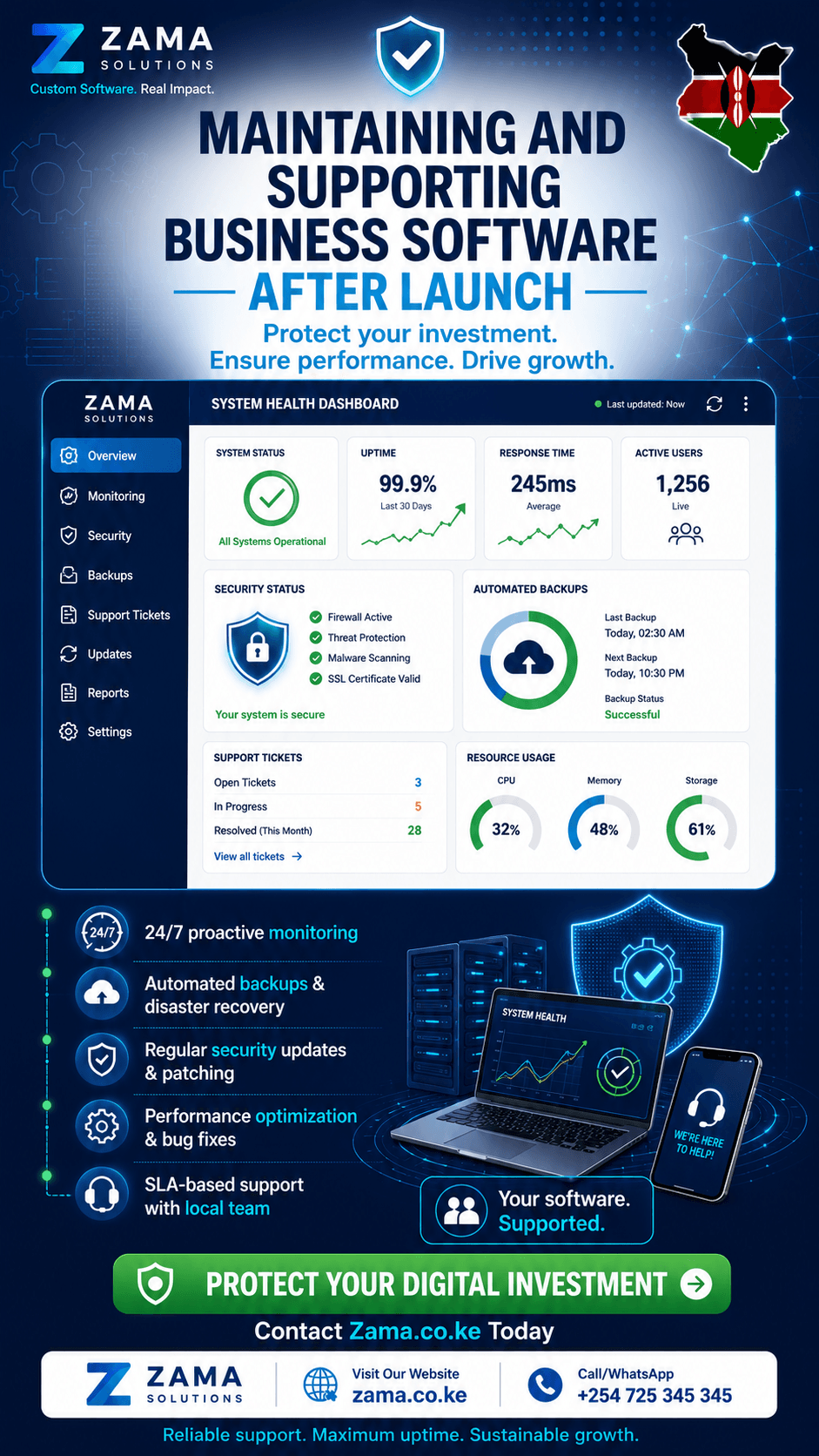
Maintaining and supporting business software after launch is a question that every business owner, operations manager, and IT decision-maker in Kenya must answer in 2026. Launch day is just the starting line—the real journey of maintaining and supporting business software after launch determines whether your investment delivers lasting value or becomes a costly liability. At zama.co.ke, we’ve helped numerous organizations across Kenya implement sustainable post-launch strategies that keep software secure, performant, and aligned with evolving business needs. This comprehensive guide explores maintaining and supporting business software after launch, from understanding the hidden costs of neglect to implementing a structured support framework.
The Hidden Cost of Neglecting Post-Launch Support
Before diving into maintaining and supporting business software after launch, it’s essential to understand the consequences of neglecting maintenance. A 2023 survey of Kenyan SMEs found that 6 in 10 lose over KSh 1 million in their first year to preventable tech failures . Most never trace the money to the real culprit: silent IT mistakes made in month one.
The reality is stark. Many Kenyan startups and SMEs treat software like a one-time buy—they launch and move on. A Kilimani café owner who bought an off-the-shelf POS without ongoing support over-ordered via guesswork, wasted KSh 120,000 monthly, and blamed slow foot traffic instead of the missing post-launch care . This is the silent tax that kills businesses before they break even.
When organizations neglect maintaining and supporting business software after launch, they face:
Data Loss Without Backup: Hard drives fail, phones are stolen, laptops drown in matatu rain floods. If data lives only on one device, a single incident can close the business . Kenyan weather and transport are not your friends .
KRA Compliance Penalties: Many startups use manual books or disconnected POS systems. The Kenya Revenue Authority’s systems flag mismatches fast, and penalties dwarf IT savings . Without proper system maintenance, compliance gaps widen.
Security Breaches: “Hackers target big firms,” said every breached startup . Kenyan SMEs are easier marks. One phishing email to your email can drain an M-Pesa-linked account in minutes .
Performance Degradation: A Kenyan founder lost KSh 1.2 million in their first eight months to IT mistakes that a KSh 80,000 engagement would have prevented . Slow websites, lagging apps, and unresponsive APIs frustrate customers, leading to churn—especially in a market where M-Pesa payments expect instant results .
Why Maintenance Is Your Most Strategic Investment
Think of your software as a high-performance vehicle. You wouldn’t buy a race car and never change the oil, check the tires, or tune the engine. Neglect leads to breakdowns. For your digital product, breakdowns are crashes, security flaws, negative reviews, and user abandonment .
Consistent maintaining and supporting business software after launch ensures your digital assets remain competitive, secure, and aligned with evolving user expectations. This is what sets apart businesses that succeed from those that simply disappear after launch .
The financial case for maintenance is compelling. A single downtime day in Nairobi can cost a retail startup KSh 40,000 in lost sales . Multiply that by the frequent failures of DIY setups and the bleed becomes catastrophic. Smart Nairobi businesses now use integrated systems with ongoing support that keep them clean and allow them to sleep .
Essential Components of Post-Launch Software Support
When evaluating maintaining and supporting business software after launch, these components are essential:
1. Proactive Monitoring and Incident Response
The foundation of effective maintenance is knowing when something goes wrong before it impacts users. A proper post-launch strategy should:
Monitor Uptime and Performance: Implement monitoring dashboards that track uptime, response time, and error rates. Set alert thresholds and schedule monthly performance reviews . WinK Dev Solutions, serving East Africa, reports achieving 99.9% application uptime through proactive monitoring .
Define Severity Levels and SLAs: Support contracts typically classify issues by severity: Critical (system down) requires initial response within 30 minutes and final resolution within 10 calendar days; Major bugs within 4 hours; Minor issues within 24 hours . This structured approach ensures clarity and accountability.
Maintain a Local Support Team: A partner with Nairobi-based teams guarantees rapid response during East African business hours with 24/7 emergency coverage for critical incidents . When a router blows, you need a technician on-site within 2 hours, not 48 .
2. Automated Backups and Disaster Recovery
Data protection is non-negotiable. Modern maintaining and supporting business software after launch requires:
Automated Cloud Backups: Choose a cloud backup provider with Kenyan data centers to keep data local, speed recovery, and adhere to KRA data protection regulations. Set up daily incremental backups and weekly full restores .
The 3-2-1 Rule: Three copies of your data, two different media, one off-site (cloud). This protects against hardware failure, ransomware, and even a Nairobi fire .
Regular Recovery Testing: Test the restore process quarterly to ensure backups are valid . A Nairobi fintech saved KSh 1.2 million annually by switching to cloud infrastructure with expert guidance .
3. Security Updates and Patch Management
Security threats evolve daily. A robust maintaining and supporting business software after launch strategy includes:
Regular Security Updates: Proactively manage compatibility with the latest OS versions, integrate critical third-party service patches, and implement security refinements . Deploy low-cost endpoint protection and staff training—the cost is less than one bad transaction .
Vulnerability Scanning: Subscribe to local threat intelligence feeds and run phishing simulations every six months .
Access Control Review: Implement role-based access with password managers and 2FA. Revoke access on exit day. Logins should be tracked via central ID .
4. Bug Fixes and Performance Optimization
Software inevitably has bugs. Effective maintaining and supporting business software after launch addresses:
Systematic Bug Resolution: Issues are inevitable in complex software. Systematic monitoring and a streamlined reporting pipeline allow identification and resolution of problems quickly .
Performance Tuning: Compress images to under 300 KB for 3G networks and test on real devices—especially older Androids common in Mombasa and Nairobi markets . Performance monitoring can achieve up to 40% performance gain according to WinK Dev Solutions .
Compatibility Management: Operating systems evolve. Proactive maintenance ensures your software remains compatible with the modern device ecosystem .
5. Strategic Feature Enhancements
Beyond fixing what’s broken, maintaining and supporting business software after launch should evolve with your business:
Continuous Improvement: Your app’s lifecycle is a commitment. Ongoing care transforms a one-time project into a continuously evolving digital asset .
User Feedback Integration: As user expectations rise, feature enhancements informed by real usage keep your software competitive.
Technical Debt Reduction: Conduct regular code audits to identify technical debt and establish baseline performance metrics .
6. Documentation and Knowledge Transfer
Without documentation, you are stranded :
Maintain System Documentation: A freelancer who built your inventory system vanished because no documentation existed. The business couldn’t modify it, train staff, or hire new developers without starting over .
Train Staff: Provide end-user and administrator training with proper documentation and knowledge transfer .
The Kenyan Support Landscape
Several organizations provide the services needed for maintaining and supporting business software after launch in Kenya:
WinK Dev Solutions
Serving all East Africa from Nairobi, WinK Dev Solutions offers maintenance plans including 24/7 monitoring, security updates, and bug fixes starting from $199/month. They guarantee 99.9% application uptime and 48-hour critical fix response. Their team of software experts can maintain applications built by other developers, conducting a comprehensive code audit first to understand the architecture .
Glow Enterprise Solutions
Based in Nairobi, Glow Enterprise Solutions is a Microsoft Dynamics Partner offering support, maintenance, and development for Dynamics GP. Their services include incident support, financial routines like reconciliations, year-ends, depreciation, and system upgrades and migrations .
Synergy Application and Services
An Odoo partner with more than a decade of experience in East Africa, Synergy provides support and maintenance including system optimization, enhancements and upgrades, and ongoing technical support. They serve retail, distribution, manufacturing, logistics, and other industries .
Tetris East Africa Ltd
As an SAP Partner, Tetris East Africa Ltd provides SAP support and maintenance, upgrades, and custom development. Their team of certified SAP experts leverages deep knowledge of the SAP ecosystem .
Logical Crest Ltd
Specializing in application maintenance and support, Logical Crest Ltd offers software strategy consultation, cloud and hybrid integration, and complex API integrations. They have been operating since 2011 in Westlands, Nairobi .
The Zama.co.ke Approach
When considering maintaining and supporting business software after launch, zama.co.ke follows a structured approach:
Post-Launch Support Planning
We design support packages before launch, defining severity levels, response times, escalation procedures, and coverage hours. Our SLAs are documented and measurable .
Proactive Monitoring Setup
We implement monitoring dashboards tracking uptime, response time, and error rates. Alerts are configured at thresholds so issues die before they cost money .
Automated Backup and Recovery
We set up automated cloud backups with local data residency, daily incremental backups, and quarterly restore testing .
Security Update Management
We manage security patches, OS compatibility, and vulnerability scanning. We deploy multi-factor authentication and role-based access control .
Continuous Improvement
We remain available to maintain, refine, and extend your solution as your business evolves. Our team stays with you beyond launch .
Common Mistakes to Avoid
When implementing maintaining and supporting business software after launch, avoid these pitfalls:
Mistake #1: Treating IT as a One-Time Buy
The Fix: Plan for 15% of IT budget as monthly upkeep. Use managed support, not break-fix panic. Cloud subscriptions beat owned hardware for cash flow .
Mistake #2: No Backup Until the Crash
The Fix: KSh 2,000/month cloud backup vs KSh 200,000 recovery. Assign one owner to verify backups .
Mistake #3: Hiring the Cheapest ‘Tech Guy’
The Fix: A certified partner documents everything. Pay for accountability, not just hours. Local firms know KSh reality and ISP quirks .
Mistake #4: Skipping Analytics Until It’s Too Late
The Fix: Install simple dashboards showing M-Pesa flows, site traffic, and stock. Nairobi retail clients spot dead campaigns in a day, not a quarter .
Mistake #5: Ignoring KRA Digital Compliance
The Fix: Cloud accounting with eTIMS integration saves penalties. Reconcile M-Pesa automatically .
The ROI of Proper Maintenance
When evaluating maintaining and supporting business software after launch, the ROI is clear:
99.9% application uptime protects revenue
40% performance gain from ongoing optimization
95% client retention through reliable support
Avoided penalties from KRA compliance failures
Saved recovery costs: KSh 2,000/month vs KSh 200,000 recovery
Maintaining and supporting business software after launch is essential for any Kenyan organization seeking long-term success. From proactive monitoring and automated backups to security updates and strategic enhancements, the right support framework protects your investment and enables growth.
At zama.co.ke, we’ve helped organizations across Kenya implement sustainable post-launch strategies that keep software secure, performant, and aligned with evolving business needs. Our approach ensures you get exactly what your organization needs—nothing more, nothing less.
Don’t let the complexity of maintaining and supporting business software after launch hold you back. Whether you’re a small SME or a large enterprise, we have the expertise to guide you through every step.
Contact zama.co.ke today and let us help you build a post-launch support strategy that protects your investment and drives your business forward.