
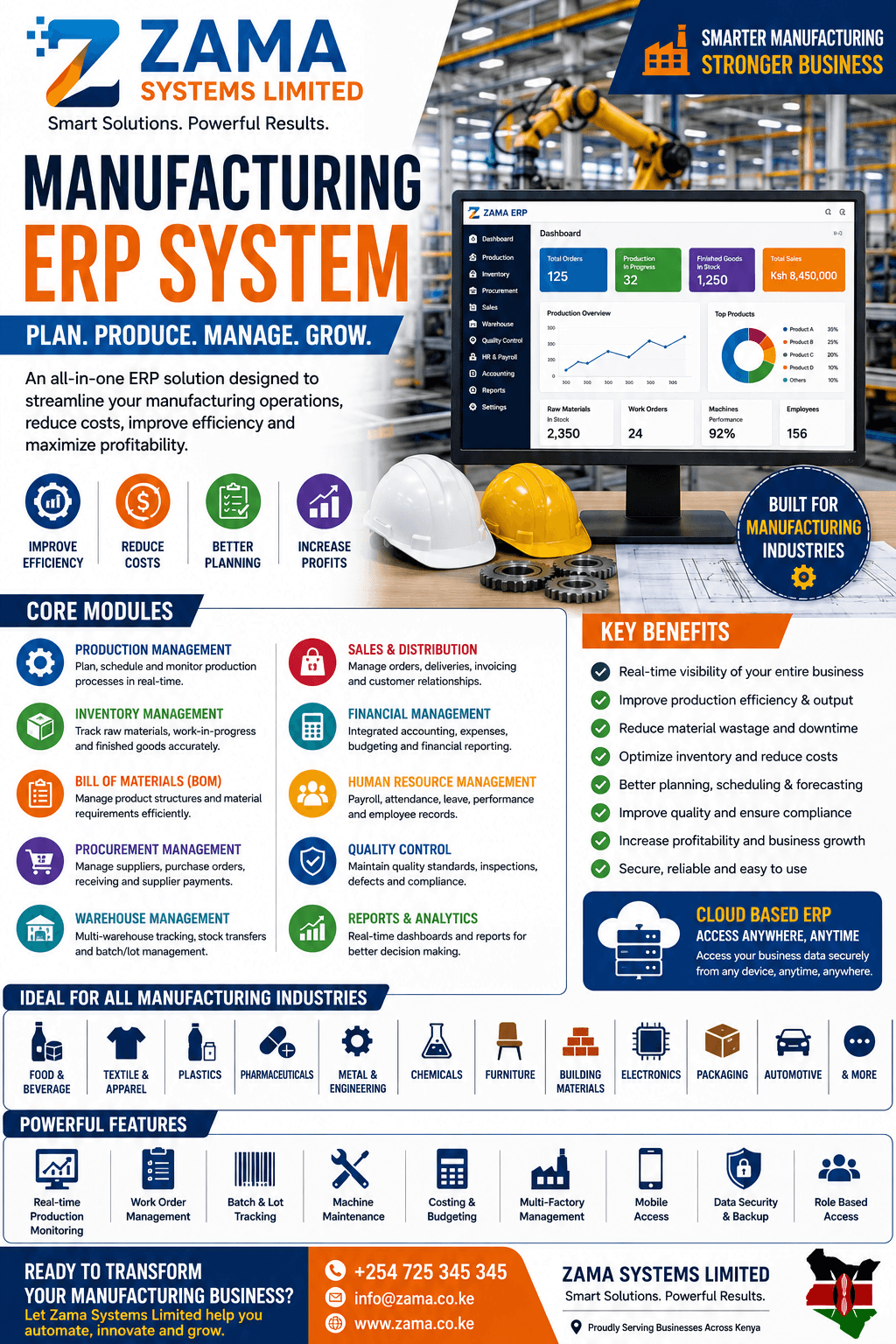
Manufacturing industries are becoming increasingly competitive and technology-driven. Businesses that still rely on manual processes often struggle with production delays, inventory losses, inaccurate reporting, poor planning, and inefficient operations. A modern Manufacturing ERP System helps businesses automate operations, improve productivity, reduce costs, and increase profitability.
Whether you operate a food processing factory, textile company, plastics manufacturing plant, construction materials factory, pharmaceutical company, or industrial production business, implementing a Manufacturing ERP System is essential for growth and operational efficiency.
At Zama Systems Limited, we provide reliable and scalable ERP solutions designed to help manufacturers streamline operations and manage their entire business from one centralized platform.
What Is a Manufacturing ERP System?
A Manufacturing ERP System is enterprise software designed to integrate and automate all manufacturing business processes into one system.
ERP stands for Enterprise Resource Planning.
The system connects departments such as:
- Production
- Inventory
- Procurement
- Accounting
- Sales
- Human resources
- Warehouse management
- Supply chain management
This allows businesses to manage operations efficiently and access real-time information.
Why Manufacturing Businesses Need an ERP System
Manufacturing operations involve many complex processes.
Without automation, businesses often face:
- Production delays
- Inventory inaccuracies
- Poor planning
- Material wastage
- Financial mismanagement
- Lack of visibility
A Manufacturing ERP System solves these challenges through centralized automation.
Core Features of a Manufacturing ERP System
Production Management
Production management helps manufacturers plan and monitor production processes.
The system tracks:
- Production schedules
- Work orders
- Production stages
- Output quantities
- Machine utilization
This improves operational efficiency.
Inventory Management
Inventory control is critical in manufacturing.
The system tracks:
- Raw materials
- Work-in-progress inventory
- Finished goods
- Stock movement
- Reorder levels
This reduces wastage and stock shortages.
Bill of Materials (BOM)
A Bill of Materials lists all components required to manufacture a product.
The ERP system helps manage:
- Raw material requirements
- Product structures
- Manufacturing formulas
- Material consumption
This improves production accuracy.
Procurement Management
Manufacturers work with many suppliers.
The ERP system manages:
- Supplier records
- Purchase orders
- Supplier quotations
- Goods receiving
- Outstanding balances
This improves procurement efficiency.
Warehouse Management
Warehouse management helps track inventory across storage locations.
The system monitors:
- Warehouse stock levels
- Product movement
- Stock transfers
- Batch tracking
This improves inventory organization.
Sales and Distribution Management
Manufacturing ERP systems help businesses manage customer orders.
Features include:
- Sales orders
- Quotations
- Invoicing
- Delivery tracking
- Customer records
This improves order fulfillment.
Financial Management
ERP systems provide integrated accounting features.
The system tracks:
- Revenue
- Expenses
- Profit and loss
- Tax records
- Supplier payments
- Customer balances
This improves financial visibility.
Human Resource Management
Manufacturing businesses manage many employees.
The ERP system helps track:
- Attendance
- Payroll
- Staff performance
- Leave management
- Shift scheduling
This improves workforce management.
Production Planning and Scheduling
Production planning ensures efficient resource utilization.
The system helps manage:
- Machine schedules
- Workforce allocation
- Production timelines
- Manufacturing priorities
This improves operational flow.
Quality Control Management
Quality assurance is critical in manufacturing.
The system tracks:
- Product inspections
- Defective products
- Quality standards
- Batch testing
This improves product quality.
Manufacturing ERP System Benefits
Improved Efficiency
Automation reduces repetitive manual tasks.
Employees work faster and more accurately.
Reduced Operational Costs
ERP systems reduce:
- Material wastage
- Inventory losses
- Production delays
- Administrative costs
This improves profitability.
Better Inventory Control
Real-time inventory tracking prevents shortages and overstocking.
Improved Production Planning
Manufacturers can forecast production needs accurately.
Real-Time Reporting
Business owners access live operational data instantly.
Better Decision Making
Accurate analytics improve strategic planning.
Improved Customer Satisfaction
Efficient operations improve order fulfillment and delivery times.
Enhanced Data Accuracy
Automation minimizes human errors.
Manufacturing ERP System for Small Businesses
Small manufacturing businesses also benefit from ERP systems.
Advantages include:
- Better organization
- Reduced wastage
- Improved reporting
- Operational efficiency
Small businesses can scale more effectively.
Manufacturing ERP System for Large Factories
Large factories require advanced ERP features such as:
- Multi-factory management
- Supply chain integration
- Enterprise analytics
- Advanced reporting
This improves scalability.
Real-Time Production Monitoring
Managers can monitor production in real time.
The system tracks:
- Current production status
- Machine performance
- Output quantities
- Delays and bottlenecks
This improves operational visibility.
Material Requirement Planning (MRP)
MRP helps manufacturers calculate production material needs.
Benefits include:
- Accurate procurement
- Reduced stock shortages
- Better production planning
This improves resource management.
Batch and Lot Tracking
Manufacturing businesses often require batch tracking.
The ERP system tracks:
- Product batches
- Manufacturing dates
- Expiry dates
- Batch movements
This improves traceability.
Manufacturing ERP System and Supply Chain Management
Supply chain coordination is essential.
The system improves:
- Supplier communication
- Procurement planning
- Delivery coordination
- Inventory synchronization
This improves operational efficiency.
Cloud-Based Manufacturing ERP System
Cloud ERP systems provide flexibility and remote access.
Benefits include:
- Automatic backups
- Access from anywhere
- Real-time synchronization
- Lower infrastructure costs
This improves business continuity.
Mobile ERP Access
Managers can access ERP systems using smartphones or tablets.
Features include:
- Viewing reports
- Monitoring production
- Approving transactions
- Tracking inventory
This improves convenience.
Manufacturing ERP System Security Features
ERP systems contain sensitive business information.
Security features include:
- User permissions
- Audit logs
- Password protection
- Secure backups
This protects business data.
Manufacturing ERP System and Accounting Integration
Integrated accounting improves financial management.
The ERP system automates:
- Invoicing
- Expense tracking
- Tax calculations
- Financial reporting
This reduces accounting errors.
Manufacturing ERP System for Food Processing Companies
Food manufacturers require additional tracking features such as:
- Expiry date management
- Batch tracking
- Quality control
- Supplier traceability
This improves compliance and safety.
ERP for Textile Manufacturing
Textile businesses require inventory and production tracking.
The ERP system helps manage:
- Fabric inventory
- Production stages
- Orders
- Supplier coordination
This improves operational efficiency.
Manufacturing ERP for Pharmaceutical Companies
Pharmaceutical companies require strict compliance and traceability.
ERP systems help manage:
- Batch records
- Quality testing
- Inventory tracking
- Regulatory compliance
This improves operational control.
Manufacturing ERP for Plastic Industries
Plastic manufacturing companies use ERP systems to monitor:
- Raw material usage
- Production output
- Machine performance
- Inventory levels
This improves productivity.
Managing Machine Maintenance
ERP systems can track equipment maintenance schedules.
Benefits include:
- Reduced downtime
- Improved machine lifespan
- Better production continuity
This improves operational reliability.
Production Cost Analysis
Manufacturers need accurate cost calculations.
The ERP system tracks:
- Material costs
- Labor costs
- Operational expenses
- Production profitability
This improves financial planning.
Manufacturing ERP Reporting and Analytics
Reports help businesses understand operational performance.
The system generates:
- Production reports
- Inventory reports
- Financial reports
- Employee reports
- Supplier reports
This supports better decisions.
Why Kenyan Manufacturers Are Adopting ERP Systems
Manufacturing businesses in Kenya are embracing automation because of:
- Increased competition
- Need for efficiency
- Rising operational costs
- Customer expectations
ERP systems improve competitiveness.
Digital Transformation in Manufacturing
Manufacturing is becoming increasingly technology-driven.
Businesses using ERP systems enjoy:
- Faster operations
- Better visibility
- Improved planning
- Increased profitability
Technology improves growth potential.
Why Choose Zama Systems Limited
Zama Systems Limited provides modern Manufacturing ERP Systems tailored for businesses in Kenya.
Our solutions include:
- Production management
- Inventory control
- Procurement management
- Accounting integration
- Warehouse management
- Real-time reporting
We help manufacturers streamline operations and grow efficiently.
Industries We Serve
Our ERP systems are suitable for:
- Food processing companies
- Textile manufacturers
- Pharmaceutical companies
- Plastic industries
- Construction material manufacturers
- Industrial production businesses
We customize solutions based on business needs.
Affordable ERP Solutions in Kenya
We provide cost-effective ERP solutions suitable for:
- Small manufacturers
- Medium enterprises
- Large factories
Our systems are scalable and future-ready.
Future of Manufacturing ERP Systems
ERP technology continues evolving rapidly.
Future innovations include:
- Artificial intelligence
- Predictive analytics
- Smart manufacturing
- IoT integration
- Automated production forecasting
Businesses adopting modern ERP systems gain a major competitive advantage.
Final Thoughts
A Manufacturing ERP System is essential for modern manufacturing businesses. From production management to inventory control and financial reporting, ERP automation improves every aspect of manufacturing operations.
Businesses using ERP systems benefit from:
- Improved efficiency
- Reduced operational costs
- Better inventory management
- Accurate reporting
- Improved planning
- Increased profitability
At Zama Systems Limited, we provide reliable and scalable Manufacturing ERP solutions designed to help businesses across Kenya modernize operations and achieve sustainable growth.
Whether you run a small factory or a large industrial operation, our ERP systems can help transform your manufacturing business with smart technology.