
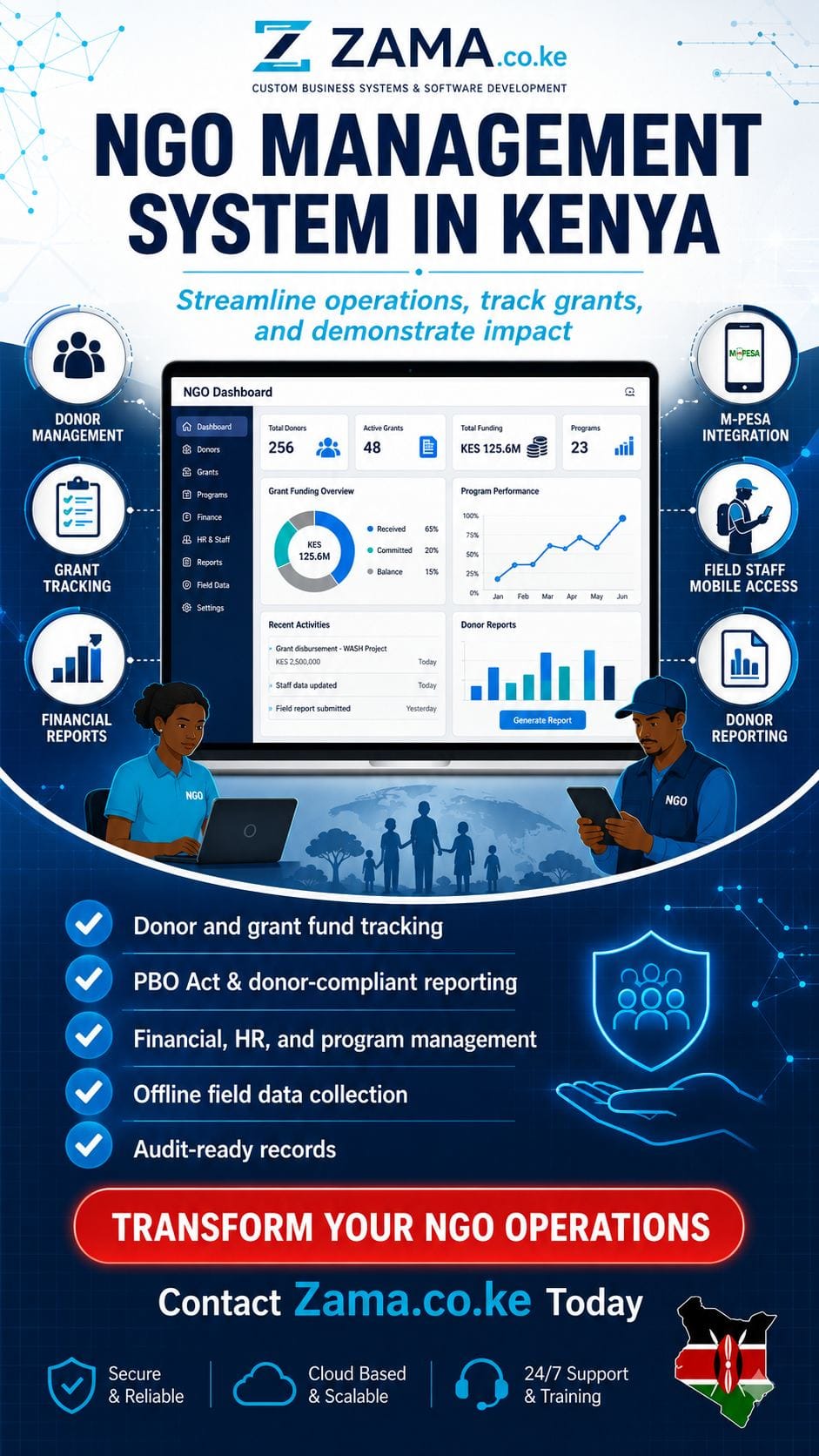
NGO management system in Kenya is a question that every nonprofit leader, program manager, and donor relations officer must answer in 2026. With the Public Benefit Organisations (PBO) Act now fully operational and the sector employing approximately 80,000 individuals while receiving Sh196 billion in project support, the need for robust management systems has never been greater . At zama.co.ke, we’ve helped numerous nonprofits across Kenya build custom management solutions that address their unique operational challenges. This comprehensive guide explores NGO management system in Kenya, from understanding core requirements to selecting the right solution for your organization.
The Regulatory Landscape for NGOs in Kenya
Before diving into NGO management system in Kenya, it’s essential to understand the current regulatory environment. The Public Benefit Organisations Act, enacted in 2013, officially came into effect on May 14, 2024, replacing the outdated Non-Governmental Organisations Coordination Act of 1990 . The Public Benefit Organisations Regulatory Authority (PBORA) now serves as an independent oversight body tasked with registration, monitoring compliance, interpreting policy, and advising the government on matters affecting the sector .
The new regulations, published on June 5, 2025, are designed to enhance transparency and accountability in NGO operations. According to PBORA’s Legal Affairs Manager, these regulations will help eliminate “briefcase NGOs” and strengthen oversight of the nonprofit sector . This regulatory shift has made NGO management system in Kenya more critical than ever for organizations seeking to demonstrate compliance and maintain donor trust.
What an NGO Management System Does
An effective NGO management system in Kenya consolidates critical operations into a single platform, eliminating the fragmentation that plagues many organizations. According to research, many NGOs struggle with inadequate and inefficient internal management systems that make administering projects overly complex and time-consuming, generate errors and compliance risks, and hinder organizational sustainability .
Common operational functions in NGOs include finance systems, human resource management systems, procurement systems, and performance management systems . A comprehensive NGO management system in Kenya brings these functions together, enabling teams to work from one unified platform.
Essential Features of an NGO Management System
When evaluating NGO management system in Kenya, focus on these core features:
1. Grant and Donor Management
Managing donor funds, restricted and unrestricted, is one of the most critical functions of any NGO. A proper NGO management system in Kenya should:
Track Funds with Clarity: Set up and monitor restricted or unrestricted funds by project, donor, or grant—no more spreadsheet confusion .
Donor-Ready Reports in Minutes: Generate tailored reports for funders and boards without chasing your accountant or fixing last-minute errors. Systems designed for Kenyan NGOs include templates for USAID, EU, Mastercard Foundation, and other common funders .
Project-Based Cost Tracking: Tag transactions to specific donors, grants, or projects, ensuring expenditures are clearly linked to funding sources .
2. Financial Management
A robust NGO management system in Kenya should provide comprehensive financial management capabilities :
General Ledger Management: Proper accounting of financial data transferred from all sub-ledgers including accounts payable, accounts receivable, cash management, fixed assets, and purchasing.
Accounts Payable Management: For both supplier and grantee management.
Accounts Receivable Management: Optimizing cash flow by streamlining accounts receivable processes and tracking donor payments.
Multi-Currency Support: Accounting for transactions in foreign currency as well as base currency.
Cash Management: Tracking cash inflows and outflows, including monthly bank reconciliations.
Budget Management: Allocation of budgets and tracking expenditures against approved budgets.
3. Procurement and Inventory
When considering NGO management system in Kenya, procurement functionality is essential:
Purchase Order Automation: Create LPOs with automated approval workflows.
Vendor Management: Track supplier performance and compliance.
Inventory Tracking: Monitor stock levels for program supplies and equipment.
4. HR and Payroll Management
Staff management is a key function of any NGO management system in Kenya:
Timesheet Management: Staff can record time directly against projects or donors, simplifying payroll allocation and strengthening audit readiness .
Leave Management: Staff can request leave and access payslips online, drastically reducing administrative burden on HR departments .
Staff Database: Centralized employee records, contracts, and performance data.
5. Case and Program Management
For NGOs working directly with beneficiaries, NGO management system in Kenya should support:
Case Management: Tracking beneficiaries through program stages—Identification, Assessment, Stabilization, Empowerment, and Graduation .
Offline Mobile Data Collection: Field staff can collect data using mobile devices even without internet connectivity, syncing when connection is restored .
Program Tracking: Monitor activities, milestones, and budget line items in real-time .
6. Donor Portal and Reporting
Transparency is essential for donor retention. A comprehensive NGO management system in Kenya should:
Donor Reporting: Generate comprehensive donor reports instantly, cutting reporting time from days to minutes .
Real-Time Project Updates: Donors can see real-time updates on projects they fund and view impact reports .
Audit-Ready Records: Maintain structured records with clear trails for income, expenses, and allocations .
7. Timesheet and Resource Management
An integrated NGO management system in Kenya should include:
Timesheet Allocation: Staff can record time directly in the system against projects or donors .
Resource Tracking: Monitor how resources are allocated across programs.
8. Security and Access Control
Data security is critical for any NGO management system in Kenya:
Role-Based Access: Multiple team members can access the system while maintaining control over permissions and edits .
Data Encryption: Data is encrypted in transit to protect sensitive information .
Audit Trails: Track who accessed what, when, and from which device.
What Makes Kenyan NGO Management Systems Different
NGO management system in Kenya has unique characteristics that global solutions often lack:
PBO Act Compliance
Systems must support reporting aligned with the Public Benefit Organisations Act requirements, including financial transparency and accountability measures .
Local Funders and Donors
Understanding local reporting requirements for organizations like the Kenya Community Development Foundation (KCDF) and other local foundations .
Offline Capability
Many NGOs operate in areas with unreliable internet connectivity. Systems must support offline data collection and sync when connection is restored .
Mobile-First Design
Field staff need to collect data on mobile devices without requiring laptops or extensive training.
Multi-Currency Support
NGOs receive funding from international donors and need to track and report in multiple currencies.
Grantee Support
Some NGOs are exploring systems that support their grantees and partners, providing training and templates to ensure accurate, audit-ready reports .
Challenges Facing NGO Management Systems
According to research on enterprise system usability in Kenyan NGOs, several challenges affect implementation :
Minimal User Involvement: Many organizations face usability issues due to minimal user involvement during system development.
Limited Digital Skills: Staff may lack the digital skills needed to fully utilize complex systems.
Rigid System Structures: Systems that cannot adapt to changing organizational needs create frustration.
Insufficient Infrastructure: Poor connectivity and hardware limitations hinder adoption.
Fragmented Systems: Many NGOs use multiple separate, overlapping, and/or concurrent project-based systems .
The Zama.co.ke Approach
When considering NGO management system in Kenya, zama.co.ke follows a structured approach:
Operational Discovery
We define your organization’s workflows: grants management, program tracking, financial reporting, HR processes, and the reports leadership needs to demonstrate impact.
System Design
Modules, data structure, permissions, user journeys, and reporting layers are planned so the platform supports your unique operational model.
Build and Integrate
Core modules, dashboards, automation logic, and external connections are developed in stages with review checkpoints against agreed requirements.
Validation and Rollout Readiness
We test critical workflows, user roles, integrations, calculations, and reporting behavior so the system can be adopted with confidence.
Post-Launch Support
After go-live, we support stabilization, user feedback, ongoing maintenance, and the next round of improvements informed by real usage.
Why NGOs Choose Custom Solutions
When evaluating NGO management system in Kenya, organizations often choose custom solutions because:
Business-Process Understanding
We design systems around how your organization actually works instead of treating the project as a feature list with no operational structure.
Architecture That Supports Change
A good software foundation makes it easier to add modules, integrations, reports, and new user groups without rebuilding everything later.
Integration-Ready
We can connect payments, messaging, CRMs, legacy tools, and data services so the software becomes part of the wider operating environment.
Reliable Support
Software projects create value over time, so we stay available to maintain, refine, and extend the platform after launch.
Local Expertise
We understand the Kenyan regulatory landscape, donor expectations, and operational realities.
The Cost of Not Automating
While NGOs evaluate NGO management system in Kenya, the cost of not automating is often higher:
Manual Reporting Time: Staff spend hours compiling donor reports instead of focusing on program impact .
Compliance Risks: Without proper systems, organizations face compliance challenges and audit issues .
Donor Friction: Funders frustrated by delayed or inaccurate reports may reconsider future funding.
Staff Inefficiency: Administrative burden reduces time available for mission-critical work.
Data Loss: Fragmented systems increase the risk of lost or corrupted data.
NGO management system in Kenya is essential for any nonprofit organization operating in 2026. From donor fund tracking and grant reporting to financial management and program tracking, the right system transforms how NGOs operate.
At zama.co.ke, we’ve helped NGOs across Kenya build custom management solutions that streamline operations, improve donor reporting, and demonstrate impact. Our approach ensures you get exactly what your organization needs—nothing more, nothing less.
Don’t let the complexity of NGO management system in Kenya hold you back. Whether you’re a small community foundation or a large international NGO, we have the expertise to guide you through every step.
Contact zama.co.ke today and let us help you build a management system that transforms your operations.