
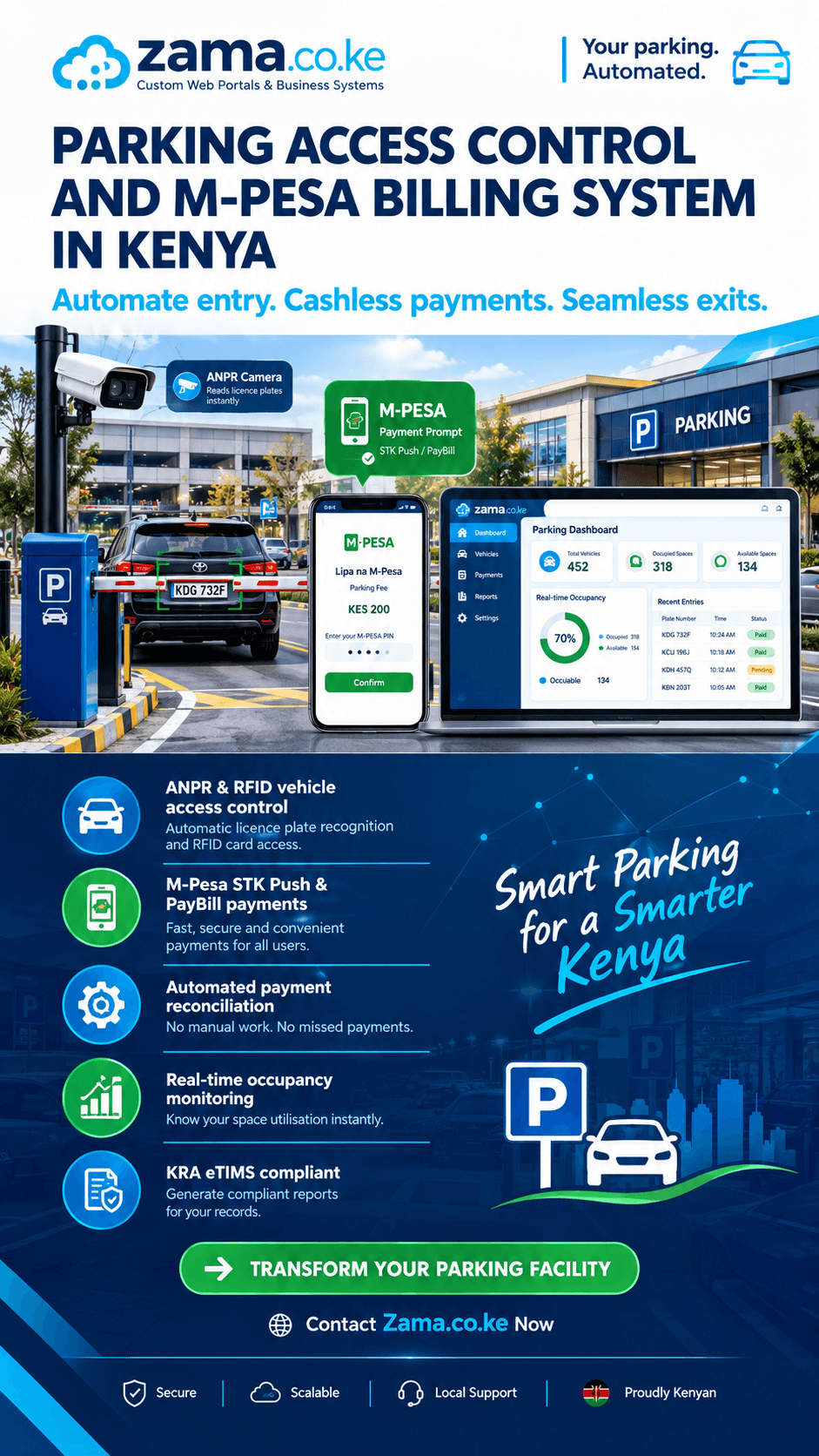
Parking access control and M-Pesa billing system in Kenya is a question that every property manager, mall operator, and facility owner must answer in 2026. With the number of registered vehicles in Kenya surpassing 2.5 million and urban parking demand intensifying across Nairobi, Mombasa, Kisumu, Nakuru, and Eldoret, the need for automated, cashless, and secure parking solutions has never been greater. At zama.co.ke, we’ve helped numerous organizations across Kenya implement integrated parking access control and M-Pesa billing solutions that eliminate revenue leakage, reduce congestion, and enhance the overall parking experience. This comprehensive guide explores parking access control and M-Pesa billing system in Kenya, from understanding how these systems work to selecting the right solution for your facility.
What Parking Access Control and M-Pesa Billing System Actually Does
Before diving into parking access control and M-Pesa billing system in Kenya, it’s essential to understand what this technology actually does. A parking access control and M-Pesa billing system combines vehicle entry and exit management with automated payment collection through Kenya’s dominant mobile money platform. It controls who enters your parking facility, tracks how long they stay, calculates charges automatically, collects payment via M-Pesa, and releases the vehicle—all without manual intervention.
A proper parking access control and M-Pesa billing system in Kenya replaces manual boom barriers, cash payments, and paper tickets with automatic number plate recognition (ANPR), RFID vehicle tags, automated barriers, and cashless M-Pesa transactions. The system verifies vehicle identity, calculates parking duration, processes payment through M-Pesa STK Push or PayBill, and opens the exit barrier automatically once payment is confirmed.
For a Kenyan facility owner, the practical definition of parking access control and M-Pesa billing system in Kenya is this: the system that tells you exactly which vehicles are in your facility, exactly how long they have been there, exactly how much has been paid, and exactly how to manage entry and exit without cashiers or manual intervention.
Why Kenyan Facilities Need Automated Parking Access Control
When evaluating parking access control and M-Pesa billing system in Kenya, consider the compelling reasons for adoption:
Revenue Leakage: Cash payments are difficult to track, prone to theft, and rarely reconciled accurately. Manual parking operations in Kenyan malls, offices, and estates lose significant revenue every month through uncollected fees, under-reported transactions, and outright theft. An integrated M-Pesa billing solution eliminates cash handling entirely, ensuring every transaction is recorded and reconciled automatically.
Congestion and Delays: Manual ticketing creates long queues at entry and exit points. During peak hours in Nairobi’s shopping malls, CBD office buildings, and event venues, these queues frustrate motorists and reduce the number of vehicles your facility can serve. Automated access control with M-Pesa billing reduces entry and exit times to seconds.
Security Concerns: Without access control, any vehicle can enter your facility. Without proper logging, investigating incidents—theft, vandalism, unauthorized parking—becomes nearly impossible. A proper parking access control and M-Pesa billing system in Kenya logs every entry and exit with vehicle plate, timestamp, and photographic evidence, creating a complete audit trail.
Operational Costs: Manual parking operations require cashiers at every entry and exit point, 24 hours a day. Automated systems reduce staffing requirements significantly, cutting operational costs while improving service quality.
Customer Expectations: Kenyan motorists now expect seamless, cashless payments. They use M-Pesa for everything from matatu fares to supermarket shopping. A parking facility that only accepts cash—or that requires motorists to queue at a payment machine—is behind the times.
How Parking Access Control and M-Pesa Billing Works
When learning parking access control and M-Pesa billing system in Kenya, understanding the workflow is essential. The system operates through an integrated sequence of technologies:
Entry Process
When a vehicle approaches the entry point, the system identifies it through one of several methods:
ANPR (Automatic Number Plate Recognition): High-resolution cameras capture the vehicle’s number plate. The system matches it against registered vehicles (residents, staff, season ticket holders) and opens the barrier automatically for authorized vehicles. For unregistered vehicles, the system logs the plate and issues a virtual ticket.
RFID Tags: Long-range RFID readers detect vehicle tags from up to 5 metres away, enabling barrier-free entry for registered users. This is ideal for residential estates, corporate parking, and staff parking where the same vehicles enter daily.
Ticket or QR Code: For visitor parking, the system issues a printed ticket or displays a QR code that the motorist scans with their phone. The ticket or QR code becomes the reference for calculating parking duration.
Ticket Dispenser with M-Pesa Prompt: For facilities serving both registered and unregistered vehicles, the system can prompt unregistered motorists to initiate M-Pesa payment at entry, or issue a ticket that links to an M-Pesa payment portal.
Parking Duration Tracking
Once inside, the system tracks each vehicle’s entry time. For ANPR and RFID vehicles, the system knows exactly which vehicle is in the facility and when it entered. For ticket-based entry, the virtual ticket or QR code links to the vehicle’s entry record.
Payment Collection via M-Pesa
When a motorist is ready to exit, the system calculates the parking charge based on the time spent and the applicable tariff. Payment is collected through M-Pesa using one of several methods:
STK Push: The system initiates a payment prompt to the motorist’s phone. The motorist enters their M-Pesa PIN, and the payment is confirmed instantly. This method is ideal for automated kiosks and mobile apps.
PayBill: The motorist pays to a designated PayBill number, entering their ticket number as the account reference. The system matches the payment to the correct parking session.
QR Code with M-Pesa Integration: The motorist scans a QR code that opens an M-Pesa payment page pre-populated with the amount due. After payment, the system receives confirmation and releases the barrier.
Exit Terminal with M-Pesa Integration: Motorists who prefer to pay before returning to their vehicle can use self-service payment terminals that accept M-Pesa and issue a validated exit ticket.
Exit Process
Once payment is confirmed, the system releases the exit barrier. For ANPR systems, the exit camera verifies the vehicle plate and opens the barrier automatically. For RFID vehicles, the tag is read and the barrier opens. For ticket-based systems, the motorist inserts the validated ticket or scans the QR code to confirm payment and open the barrier.
Essential Features of Parking Access Control and M-Pesa Billing System in Kenya
When evaluating parking access control and M-Pesa billing system in Kenya, focus on these core features:
1. Automatic Number Plate Recognition
ANPR is the foundation of modern parking access control. High-performance cameras automatically recognize vehicle number plates, allowing registered vehicles to enter and exit without tickets. The system logs every plate with timestamp, lane, and photographic evidence. For a proper parking access control and M-Pesa billing system in Kenya, ANPR accuracy in local conditions—varied plate formats, lighting conditions, and weather—is critical.
2. RFID Vehicle Access
For residents, employees, and frequent users, RFID tags enable hands-free access. Long-range readers detect tags from several metres away, opening barriers without the vehicle stopping. This is ideal for high-traffic facilities where speed and convenience are paramount.
3. Automated Boom Barrier Control
The system integrates with intelligent boom barriers that open automatically after successful vehicle verification or payment confirmation. Quality barriers open in 1.5 to 3 seconds and include loop detectors, anti-crash protection, and weatherproof housing suitable for Kenyan conditions.
4. M-Pesa STK Push Integration
M-Pesa STK Push is the fastest and most convenient payment method for Kenyan motorists. A comprehensive parking access control and M-Pesa billing system in Kenya should initiate STK Push prompts directly from the payment kiosk or mobile app, allowing motorists to pay with their PIN in seconds. The system receives payment confirmation and releases the exit barrier automatically.
5. Automated Reconciliation
The system should automatically reconcile every M-Pesa payment with the corresponding parking session. This eliminates manual reconciliation, ensures accurate revenue reporting, and provides a complete audit trail for finance teams.
6. Real-Time Occupancy Monitoring
A quality parking access control and M-Pesa billing system in Kenya should provide real-time visibility into parking occupancy. Facility managers can see how many vehicles are inside, which spaces are available, and how long vehicles have been parked. This data supports dynamic pricing, capacity planning, and customer guidance systems.
7. Multi-Lane and Multi-Entry Support
For larger facilities—shopping malls, airports, hospitals—the system must support multiple entry and exit lanes, each with its own ANPR camera, barrier, and payment terminal. Centralized management software consolidates data from all lanes into a single dashboard.
8. Reporting and Analytics
The system should generate comprehensive reports including revenue by hour, day, and month, average parking duration, peak occupancy times, payment method breakdown, and exception reports for unpaid exits or failed payments. For a proper parking access control and M-Pesa billing system in Kenya, reporting must align with KRA requirements for tax compliance.
What Makes Kenyan Parking Systems Different
Parking access control and M-Pesa billing system in Kenya has unique characteristics that global solutions often lack:
M-Pesa First Design
Kenyan parking systems must be designed around M-Pesa as the primary payment channel. Unlike international systems where credit cards dominate, Kenyan motorists overwhelmingly prefer M-Pesa. The system must integrate directly with Safaricom’s Daraja API for STK Push, C2B, and B2B transactions.
KRA eTIMS Compliance
Kenya Revenue Authority requires all VAT-registered businesses to transmit invoices electronically through eTIMS. A compliant parking system must generate eTIMS-compliant tax invoices for every parking transaction and transmit them to KRA automatically.
KES Currency and Local Tariffs
Pricing, tariffs, and reporting must be in Kenya Shillings. The system should support flexible tariff structures including hourly, daily, overnight, and season ticket pricing, all configurable by facility managers.
Local Vehicle Plate Formats
ANPR systems must recognize all Kenyan plate formats—including the new digital number plates, older formats, and diplomatic plates. Generic ANPR systems that are trained only on foreign plates fail in Kenyan conditions.
Offline Capability
Kenyan facilities face power fluctuations and internet outages. A proper parking access control and M-Pesa billing system in Kenya should continue functioning during connectivity issues, storing transactions locally and syncing when connection returns.
Multi-Tenant Support
Kenyan commercial buildings often house multiple tenants. The parking system should support different access rules and tariffs for different tenant groups, with each tenant able to manage their own parking allocations.
Parking Access Control and M-Pesa Billing Use Cases in Kenya
Shopping Malls
Shopping malls in Nairobi, Mombasa, and Kisumu use integrated parking systems to manage high volumes of visitor traffic. ANPR cameras capture plates at entry, virtual tickets are issued, and motorists pay via M-Pesa at exit terminals or directly through the mall app.
Office Buildings and Corporate Parks
Corporate offices use parking systems to manage staff and visitor parking. Staff receive RFID tags or ANPR registration for seamless access, while visitors use QR codes or ticket-based entry with M-Pesa payment.
Residential Estates and Apartments
Residential estates use access control to prevent unauthorized entry and manage visitor parking. Residents receive RFID tags, visitors are logged at the gate, and parking charges—if applicable—are collected via M-Pesa.
Hospitals and Healthcare Facilities
Hospitals use parking systems to manage patient, visitor, and staff parking. Validation codes can be issued at reception for patients, allowing free or discounted parking, while staff use RFID access.
Airports and Transport Hubs
Airports use sophisticated parking systems with ANPR, multiple entry and exit lanes, and M-Pesa payment integration. Long-term and short-term parking are managed separately, with different tariff structures.
Government Facilities
Government buildings use parking access control to manage security and revenue. Visitor parking is logged, payments are collected via M-Pesa, and audit trails support accountability requirements.
The Zama.co.ke Approach
When considering parking access control and M-Pesa billing system in Kenya, zama.co.ke follows a structured approach:
Facility Assessment
We evaluate your parking facility’s requirements: vehicle volume, entry and exit lanes, user types (staff, visitors, tenants), payment preferences, integration needs, and reporting requirements. This includes understanding current pain points and defining success metrics.
System Design
We design a parking access control and M-Pesa billing solution tailored to your specific facility—whether it’s a single-lane estate gate, a multi-lane mall, or a distributed network of parking facilities.
Hardware Selection and Installation
We recommend and supply the right hardware for your environment—ANPR cameras, RFID readers, boom barriers, payment kiosks, and exit terminals—with installation and configuration included. We ensure all hardware works seamlessly with M-Pesa and your management dashboard.
M-Pesa Integration
We integrate the system directly with Safaricom’s Daraja API for STK Push, C2B, and B2B transactions. We configure tariff structures, payment workflows, and automated reconciliation.
Management Dashboard Configuration
We configure the centralized management dashboard with real-time occupancy monitoring, revenue reporting, user management, and audit trails.
Training and Support
We provide role-specific training for facility managers, security staff, and finance teams. We remain available for ongoing support, maintenance, and system upgrades.
The ROI of Parking Access Control and M-Pesa Billing System in Kenya
When evaluating parking access control and M-Pesa billing system in Kenya, the ROI is compelling:
Eliminate Revenue Leakage: Cashless M-Pesa payments and automated reconciliation ensure every transaction is recorded. Facilities typically see revenue increases of 20 to 30 percent after switching from cash to automated billing.
Reduce Staff Costs: Automated entry and exit reduce or eliminate the need for cashiers at every lane, cutting operational costs significantly.
Increase Throughput: Faster entry and exit times mean your facility can serve more vehicles per hour, increasing revenue potential.
Improve Customer Experience: Cashless payments, quick exits, and real-time space availability improve the overall parking experience, encouraging repeat visits.
Enhance Security: ANPR and RFID access control prevents unauthorized vehicle entry. Complete audit trails support incident investigation.
Data-Driven Decisions: Real-time occupancy data and revenue reporting support dynamic pricing, capacity planning, and operational decisions.
Compliance Protection: Automated eTIMS integration ensures KRA compliance, eliminating penalties and audit risks.
Implementation Considerations for Kenyan Facilities
When implementing parking access control and M-Pesa billing system in Kenya, consider these factors:
Assess Your Facility
Before selecting a system, document your parking facility’s layout, entry and exit points, vehicle volume, user types, and payment requirements. This assessment forms the foundation for system design and hardware selection.
Choose the Right Payment Methods
M-Pesa STK Push is fastest, but some motorists prefer PayBill or QR code payment. The system should support multiple M-Pesa payment methods to accommodate different user preferences.
Plan for Connectivity
Kenyan facilities face internet outages. Ensure the system has offline capability—storing transactions locally and syncing when connectivity returns—so that parking operations continue without interruption.
Train Security and Finance Teams
Security staff need to understand how to handle exceptions—vehicles with failed payments, lost tickets, or ANPR misreads. Finance teams need to understand reconciliation reports and eTIMS compliance.
Test Thoroughly
Test all scenarios: registered and unregistered vehicles, ANPR recognition in different lighting conditions, M-Pesa payment success and failure, offline mode, and exception handling.
Ensure Compliance
Configure the system for KRA eTIMS compliance from day one. Ensure every parking transaction generates a compliant tax invoice and transmits to KRA automatically.
The Zama.co.ke Difference
When you choose zama.co.ke for your parking access control and M-Pesa billing system, you gain:
Local Expertise: We understand Kenyan parking operations, M-Pesa integration, and KRA compliance requirements.
Custom Development: We build solutions tailored to your facility’s specific workflows, not generic systems.
Hardware and Software: We supply, install, and configure ANPR cameras, RFID readers, barriers, and payment terminals alongside the management software.
M-Pesa Integration: We integrate directly with Safaricom’s Daraja API for STK Push, C2B, and B2B transactions.
Ongoing Support: We remain available for maintenance, troubleshooting, and system upgrades.
Transparent Pricing: No hidden fees, clear milestone timelines, and full source-code ownership.
Parking access control and M-Pesa billing system in Kenya is essential for any facility seeking to eliminate revenue leakage, reduce congestion, enhance security, and meet customer expectations for cashless payments. From ANPR and RFID vehicle recognition to M-Pesa STK Push payment and automated reconciliation, the right system transforms how parking facilities operate.
At zama.co.ke, we’ve helped organizations across Kenya implement parking access control and M-Pesa billing solutions that deliver measurable results. Our approach ensures you get exactly what your facility needs—nothing more, nothing less.
Don’t let the complexity of parking access control and M-Pesa billing system in Kenya hold you back. Whether you’re managing a small estate gate or a multi-lane shopping mall, we have the expertise to guide you through every step.
Contact zama.co.ke today and let us help you build a parking access control and M-Pesa billing system that transforms your facility operations.